11
RADIO NAV — CHAPTER 11 · NOTES
Radar Principles
by Ghost Aviator
Ghost Aviator
www.ghostaviator.com
Ghost Aviator
www.ghostaviator.com
Ghost Aviator
DGCA CPL / ATPL Study Notes • Radio Navigation • Ch 11
✈ Chapter 11: Radar Principles
Radio Detection And Ranging
📋 Contents
1. Introduction 2. Types of Radar 3. Radar Frequencies 4. Pulse Technique (PRI, PRF) 5. Range Measurement (Echo Principle) 6. Maximum & Minimum Range 7. Factors Affecting Range 8. Radar Resolution 9. Moving Target Indication (MTI) 10. Radar Antennae 11. Practice Questions (14 Q)1. Introduction
Radar = RAdio Detection And Ranging. Developed before WWII, used both for military and civil aviation. Today radar is essential for ATC, weather warning (AWR), surface movement (ASMI), and navigation (DME is secondary radar).
📡 Radar Applications in Aviation
| Use | System |
|---|---|
| ATC surveillance | ASR, TAR, PAR, ASMI |
| Aircraft identification + altitude | SSR (Secondary Surveillance Radar) |
| Range measurement | DME (secondary radar) |
| Weather depiction | AWR (Airborne Weather Radar) |
| Weather info to ATC | Ground weather radars |
2. Types of Radar
📡 Primary vs Secondary Radar
| Type | How it Works | Examples |
|---|---|---|
| Primary Radar | Transmits pulse, detects reflected echo from target. One frequency. Does not require target cooperation. | ATC surveillance, AWR, PAR, ASMI |
| Secondary Radar | Transmits interrogation pulse; target (transponder) transmits its own reply on different frequency. Requires transponder. | SSR, DME |
3. Radar Frequencies
📡 Why VHF and Above?
- Free from external noise/static and ionospheric scatter
- Shorter wavelengths produce narrow, efficient beams for target discrimination and bearing
- Shorter wavelengths allow shorter pulses (better range resolution)
- Efficient reflection: shorter λ reflected more efficiently from objects
4. Pulse Technique
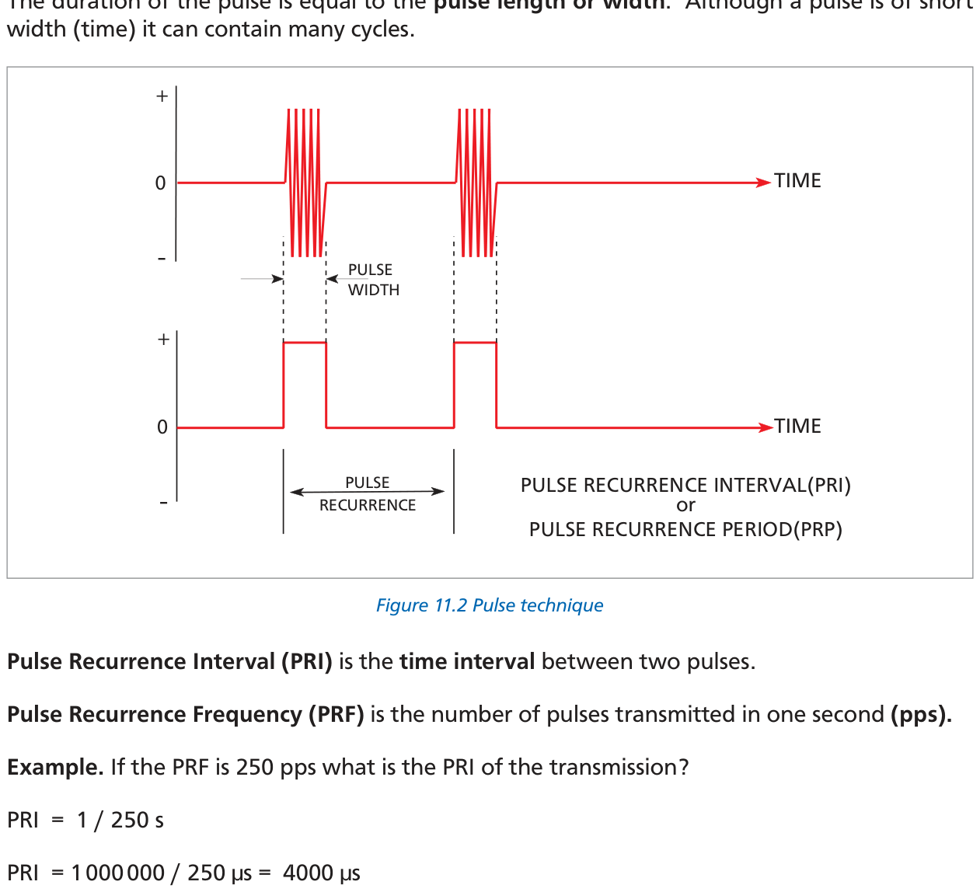
Fig 11.2: Pulse technique — pulse width, PRI, PRF illustrated
📡 Key Pulse Parameters
| Term | Definition | Formula |
|---|---|---|
| Pulse Width (PW) | Duration of each transmitted pulse | — |
| PRF / PRR | Pulse Recurrence Frequency — pulses per second (pps) | — |
| PRI / PRP | Pulse Recurrence Interval/Period — time between pulses | PRI = 1/PRF |
⚡ Example Calculation
PRF = 250 pps → PRI = 1/250 s = 1,000,000/250 µs = 4000 µs
5. Range Measurement (Echo Principle)
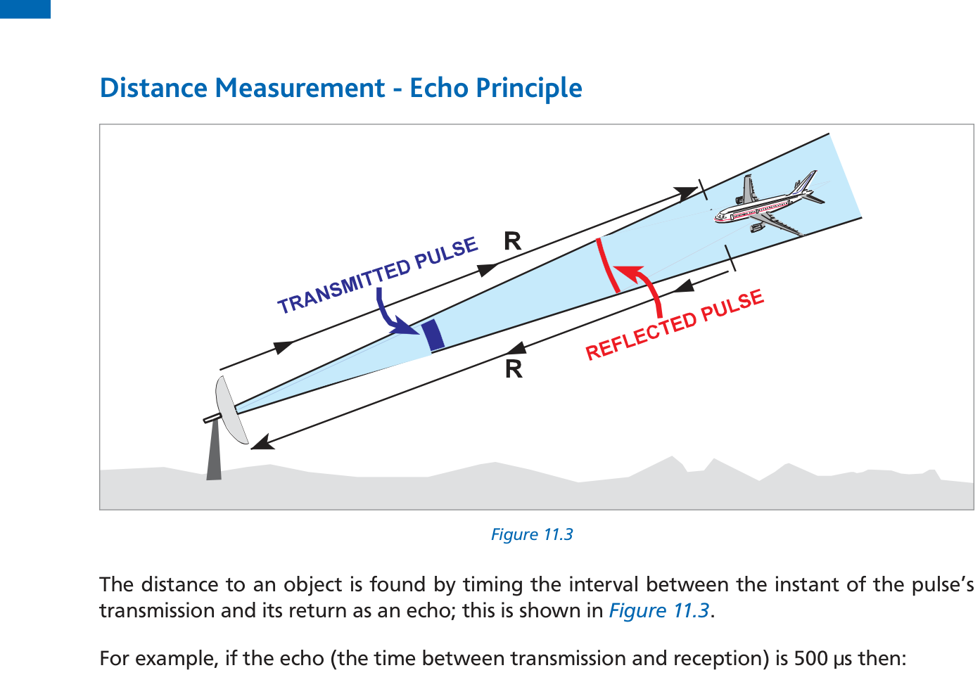
Fig 11.3: Echo principle — timing the round-trip of the pulse determines range
📡 Range Calculation
Speed of radio waves: c = 3 × 10&sup8; m/s = 162,000 NM/s
Range (NM) = Echo time (µs) / 12.36
Range (km) = Echo time (µs) × 300 / 2
One radar mile (1 NM out and back) = 12.36 µsSpeed of radio waves: c = 3 × 10&sup8; m/s = 162,000 NM/s
⚡ Worked Example
Echo time = 500 µs:
Range = 500/12.36 = 40.5 NM | Range = 500 × 300/2 = 75 km
Range = 500/12.36 = 40.5 NM | Range = 500 × 300/2 = 75 km
6. Maximum & Minimum Range
⚠ Maximum Range — Limited by PRF
Each pulse must return from the most distant target BEFORE the next pulse is transmitted.
Rule: Greater range required → lower PRF.
Max Range (NM) = 81,000 / PRF(pps) [or: PRF = 81,000 / Max_Range_NM]
Max Range (km) = 150,000 / PRF(pps)Rule: Greater range required → lower PRF.
⚠ Minimum Range — Limited by Pulse Width
Target must be far enough that its echo returns AFTER the pulse tail leaves the transmitter.
In 1 µs, radio waves travel 300 m (150 m each way).
In 1 µs, radio waves travel 300 m (150 m each way).
Min Range (m) = Pulse Width (µs) × 150
Short pulses needed for short range; long pulses for long range.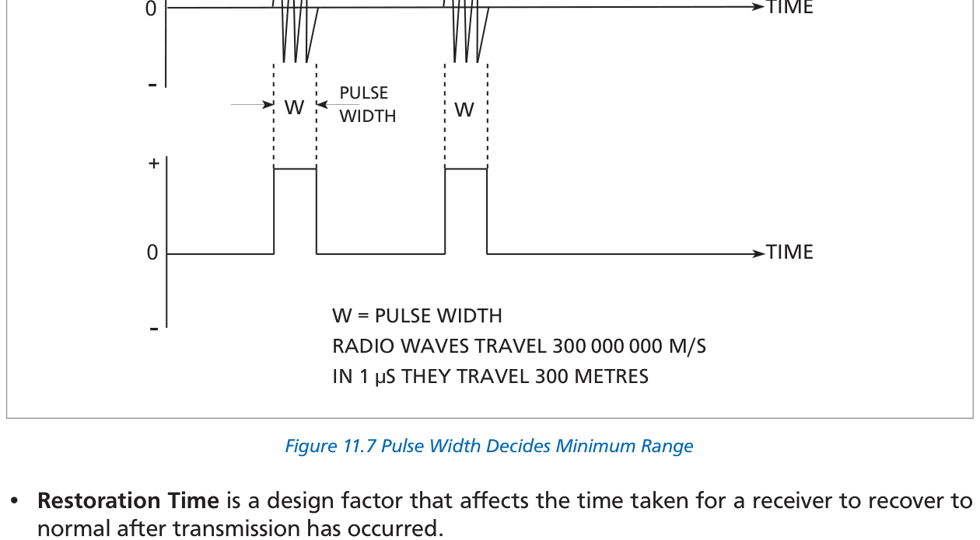
Fig 11.7: Pulse width determines minimum range — target must be beyond 150m per µs of pulse width
⚡ PRF Examples
| Requirement | Calculation | Answer |
|---|---|---|
| Max range 187 km, find PRF | PRF = 300,000,000/(2×187,000) | 802 pps |
| Max range 200 NM, find PRF | PRF = 81,000/200 | 405 pps |
| PRF = 400 pps, find max range NM | 81,000/400 | 203 NM |
| PRI = 2100 µs, find max range NM | PRF=1/2100µs=476pps; 81,000/476 | 170 NM |
7. Factors Affecting Range & Accuracy
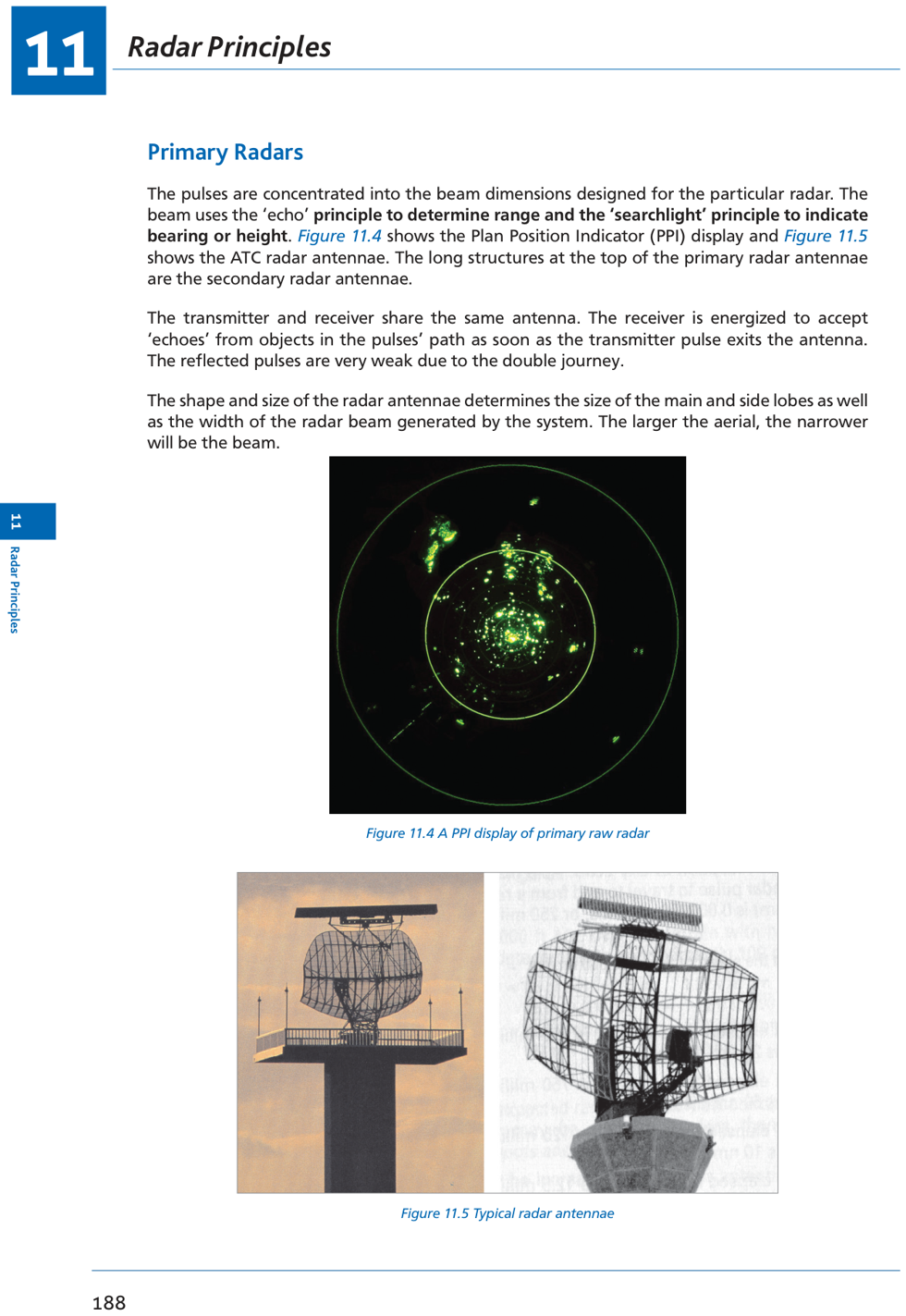
Fig 11.4: PPI display and Fig 11.5: ATC radar antennae (primary radar with SSR on top)
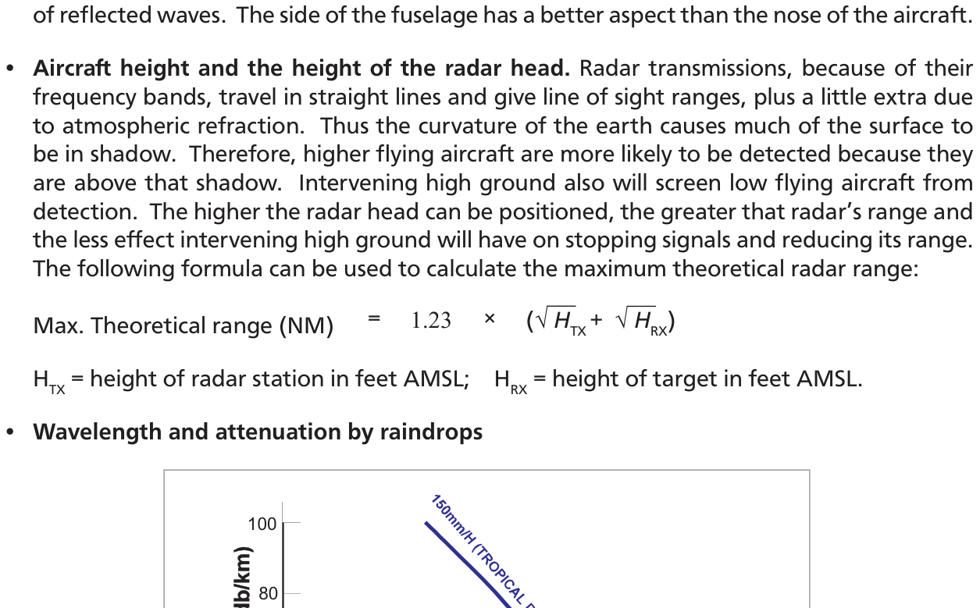
Fig 11.6: Attenuation by raindrops vs wavelength — shorter wavelengths absorbed more
📡 Factors Affecting Primary Radar Range
| Factor | Effect |
|---|---|
| Transmit power | Power ∝ range&sup4; → to double range, power must increase by factor of 16 |
| Target characteristics | Metal > wood; larger objects > smaller; aspect angle matters |
| Aircraft height | LOS system — higher aircraft detected at greater range; high ground screens low-level aircraft |
| Wavelength vs rain | λ >10 cm: negligible attenuation; λ 4–10 cm: significant in tropical rain; λ <4 cm: significant in temperate rain |
| Super-refraction | Temperature inversion + humidity decrease with height → waves refract DOWN → beyond LOS range |
| Sub-refraction | Waves refract UP → reduced range |
| Restoration time | Recovery time of receiver after transmission — design factor affecting minimum range |
| Fly-back / dead time | CRT trace return time → reduces practical range below theoretical maximum |
⚡ Wavelength Guide for Radar Systems
- ASMI (Surface Movement): 1.75–2 cm (15–17 GHz, SHF)
- AWR / PAR: 3 cm (9375 MHz, SHF)
- Aerodrome Surveillance: 3 or 10 cm
- Terminal Surveillance: 10, 23 or 50 cm
- Long range ASR: 10–50 cm
- Do not use λ < 3 cm for long range systems (too much rain attenuation)
📡 LOS Range Formula for Radar
Max Range (NM) = 1.23 × (√HTX + √HRX)
H in feet AMSL. (Note: 1.25 used for VOR/VDF; radar uses 1.23)8. Radar Resolution
📡 Resolution Rectangle
A point target appears as a rectangle on the PPI — stretched radially (by pulse width) and in azimuth (by beamwidth).
To improve resolution: shorter pulse + narrower beam (larger antenna). Narrowing beam requires larger aerial.
| Dimension | Determined by | Detail |
|---|---|---|
| Radial (range) resolution | Half pulse width | 1 µs PW → 150 m radial stretch |
| Azimuth resolution | Full beamwidth | 3° BW at 120 km → 6 km azimuth stretch (1:60) |
9. Moving Target Indication (MTI)
📡 MTI
- Eliminates returns from stationary objects (hills, buildings) — shows only moving targets (aircraft)
- Risk: second trace returns — echoes from beyond selected range appear as false moving targets
- Solution: Jitter the PRF (change PRI between consecutive pulses) → removes second trace returns
10. Radar Antennae
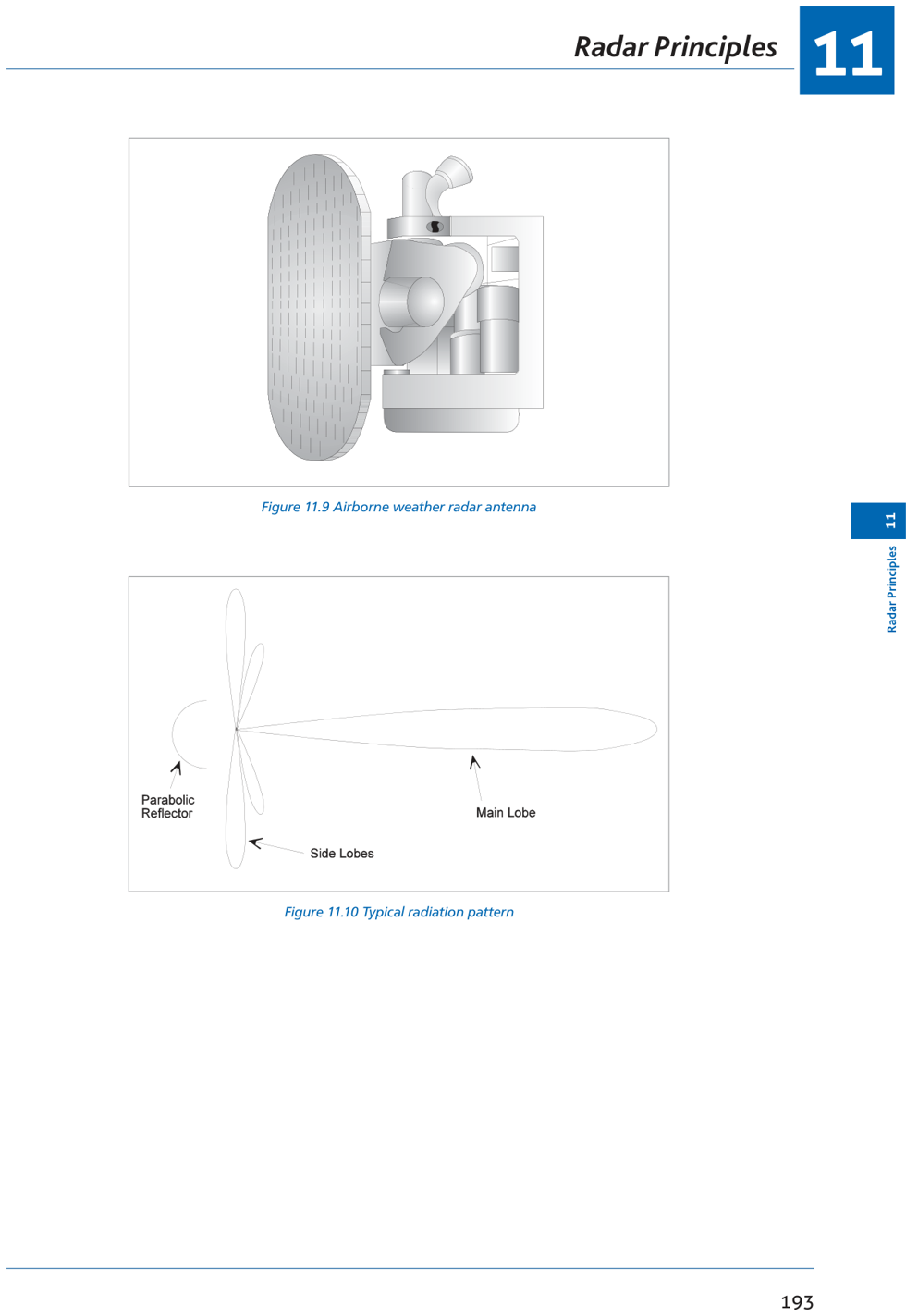
Fig 11.8: Radar antennae types | Fig 11.9: AWR flat-plate antenna | Fig 11.10: Radiation pattern with main and side lobes
📡 Antenna Types
| Type | Features | Use |
|---|---|---|
| Microwave Horn | Often used as feed for parabolic reflectors | General purpose |
| Parabolic Reflector | Dish; main lobes + side lobes; needs side-lobe suppression | ATC, AWR |
| Slotted Planar Array (Flat Plate) | Narrower beam, much smaller side lobes; less power needed; better resolution | Modern AWR, PAR |
⚡ Larger Antenna = Narrower Beam = Better Resolution
But a larger antenna in an aircraft is impractical → hence shorter wavelengths are used in aircraft (AWR: 3 cm).
11. Practice Questions
Q1. The factor which determines the MAXIMUM range of a radar is:
(a) pulse repetition rate
(b) pulse width
(c) power
(d) beamwidth
Answer: (a)
Maximum range is determined by the pulse repetition rate (PRF). The next pulse cannot be sent until the first returns from maximum range. Lower PRF = greater max range.
Maximum range is determined by the pulse repetition rate (PRF). The next pulse cannot be sent until the first returns from maximum range. Lower PRF = greater max range.
Q2. The main advantage of continuous wave (CW) radars is:
(a) no maximum range limitation
(b) better range resolution
(c) no minimum range limitation
(d) better bearing accuracy
Answer: (c)
CW radars have no minimum range limitation (the radio altimeter uses CW). Pulsed radars have a minimum range determined by pulse width.
CW radars have no minimum range limitation (the radio altimeter uses CW). Pulsed radars have a minimum range determined by pulse width.
Q3. If the PRF of a primary radar is 500 pps, the maximum range will be:
(a) 324 NM
(b) 300 NM
(c) 162 NM
(d) 600 NM
Answer: (c)
Max range = 81,000 / PRF = 81,000 / 500 = 162 NM.
Max range = 81,000 / PRF = 81,000 / 500 = 162 NM.
Q4. To double the range of a primary radar requires power to be increased by a factor of:
(a) 2
(b) 4
(c) 8
(d) 16
Answer: (d)
Power ∝ range&sup4;. To double range: power increase = 2&sup4; = 16.
Power ∝ range&sup4;. To double range: power increase = 2&sup4; = 16.
Q5. Echo time is 1720 µs. Range of target:
(a) 139 km
(b) 258 km
(c) 278 km
(d) 516 km
Answer: (b)
Range = 1720 × 300 / 2 = 258,000 m = 258 km.
Range = 1720 × 300 / 2 = 258,000 m = 258 km.
Q6. Max range required: 100 NM. Maximum PRF?
(a) 1620 pps
(b) 1234 pps
(c) 617 pps
(d) 810 pps
Answer: (d)
PRF = 81,000 / 100 = 810 pps.
PRF = 81,000 / 100 = 810 pps.
Q7. PRI = 2100 µs. Maximum radar range:
(a) 170 NM
(b) 315 NM
(c) 340 NM
(d) 630 NM
Answer: (a)
PRF = 1,000,000 / 2100 = 476 pps. Max range = 81,000 / 476 ≈ 170 NM.
PRF = 1,000,000 / 2100 = 476 pps. Max range = 81,000 / 476 ≈ 170 NM.
Q8. To improve resolution of a radar display:
(a) narrow pulse width and narrow beamwidth
(b) high frequency and large reflector
(c) wide beamwidth and wide pulse width
(d) low frequency and narrow pulse width
Answer: (a)
Better resolution = shorter pulse width (radial) + narrower beamwidth (azimuth). Answer: narrow PW + narrow BW.
Better resolution = shorter pulse width (radial) + narrower beamwidth (azimuth). Answer: narrow PW + narrow BW.
Q9. Advantage of phased array (slotted antenna):
(a) better resolution
(b) less power required
(c) reduced side lobes and clutter
(d) all of the above
Answer: (d)
Slotted planar array: narrower beam → better resolution, less power needed, reduced side lobes. All of the above.
Slotted planar array: narrower beam → better resolution, less power needed, reduced side lobes. All of the above.
Q10. Echo received 900 µs after transmission. Range to target:
(a) 73 NM
(b) 270 NM
(c) 135 NM
(d) 146 NM
Answer: (a)
Range = 900/12.36 = 72.8 ≈ 73 NM.
Range = 900/12.36 = 72.8 ≈ 73 NM.
Q11. Factor limiting MINIMUM detection range of radar:
(a) pulse repetition interval
(b) transmitter power
(c) pulse width
(d) pulse repetition frequency
Answer: (c)
Minimum range is limited by pulse width. Target must be far enough that its echo returns after the pulse has finished transmitting.
Minimum range is limited by pulse width. Target must be far enough that its echo returns after the pulse has finished transmitting.
Q12. Doppler MTI generates second trace returns. These are removed by:
(a) using different frequency for Tx/Rx
(b) jittering the PRF
(c) regular pulsewidth changes
(d) limiting power output
Answer: (b)
Second trace returns are removed by jittering the PRF (varying PRI between pulses). This prevents false targets from appearing within range.
Second trace returns are removed by jittering the PRF (varying PRI between pulses). This prevents false targets from appearing within range.
Q13. Radar max range: 12 km. Maximum PRF?
(a) 25,000 pps
(b) 6,700 pps
(c) 12,500 pps
(d) 13,400 pps
Answer: (c)
PRF = 300,000,000 / (2 × 12,000) = 300,000,000 / 24,000 = 12,500 pps.
PRF = 300,000,000 / (2 × 12,000) = 300,000,000 / 24,000 = 12,500 pps.
Q14. Bearing of primary radar measured by:
(a) phase comparison
(b) searchlight principle
(c) lobe comparison
(d) DF techniques
Answer: (b)
Primary radar bearing uses the searchlight principle — a narrow rotating beam; direction of target = direction of beam when echo is received.
Primary radar bearing uses the searchlight principle — a narrow rotating beam; direction of target = direction of beam when echo is received.
DGCA CPL/ATPL Radio Navigation Study Notes
Chapter 11 — Radar Principles
Ghost Aviator | www.ghostaviator.com
For personal study use only.
Chapter 11 — Radar Principles
Ghost Aviator | www.ghostaviator.com
For personal study use only.
Study Radio Nav with other student pilots
Join the free Radio Nav group on Telegram. Stuck on a doubt? Type /q and your question, and get an answer from Ghost Aviator's notes.
LIVE BATCH
Study Radio Navigation live with the Captain
Small batch of 10 · live doubt-clearing · 4–6 weeks · ₹12,999 ₹7,999
Reinforce Chapter 11: Radar Principles
Test your knowledge and practice actual exam questions for Radio Navigation.
Planning your Pilot Training in 2026?
Calculate exact flying hours, DGCA exam fees, and living costs with our interactive calculator.