5
METEOROLOGY — CHAPTER 5 · NOTES
Humidity
by Ghost Aviator
LECTURE PARTS
Table of Contents
- 1. Introduction — Water Vapour & Water Cycle
- 2. Three Phases of Water
- 3. Key Humidity Terms & Definitions
- 4. Relative Humidity (RH)
- 5. Temperature Parameters — Wet Bulb, Dew Point, Frost Point
- 6. Cloud Base Calculation
- 7. SVP over Water vs Ice — Sub-zero Behaviour
- 8. Temperature Relationships — Saturated vs Unsaturated Air
- 9. Quick Revision Summary
- 10. Practice Q&A (DGCA Style)
- 11. Master Reference Tables
1. Introduction — Water Vapour & The Water Cycle
📘 Core Concept
Water vapour is always present in the air to a greater or lesser extent, in the troposphere. This water vapour plays a very important role in all the atmospheric processes.
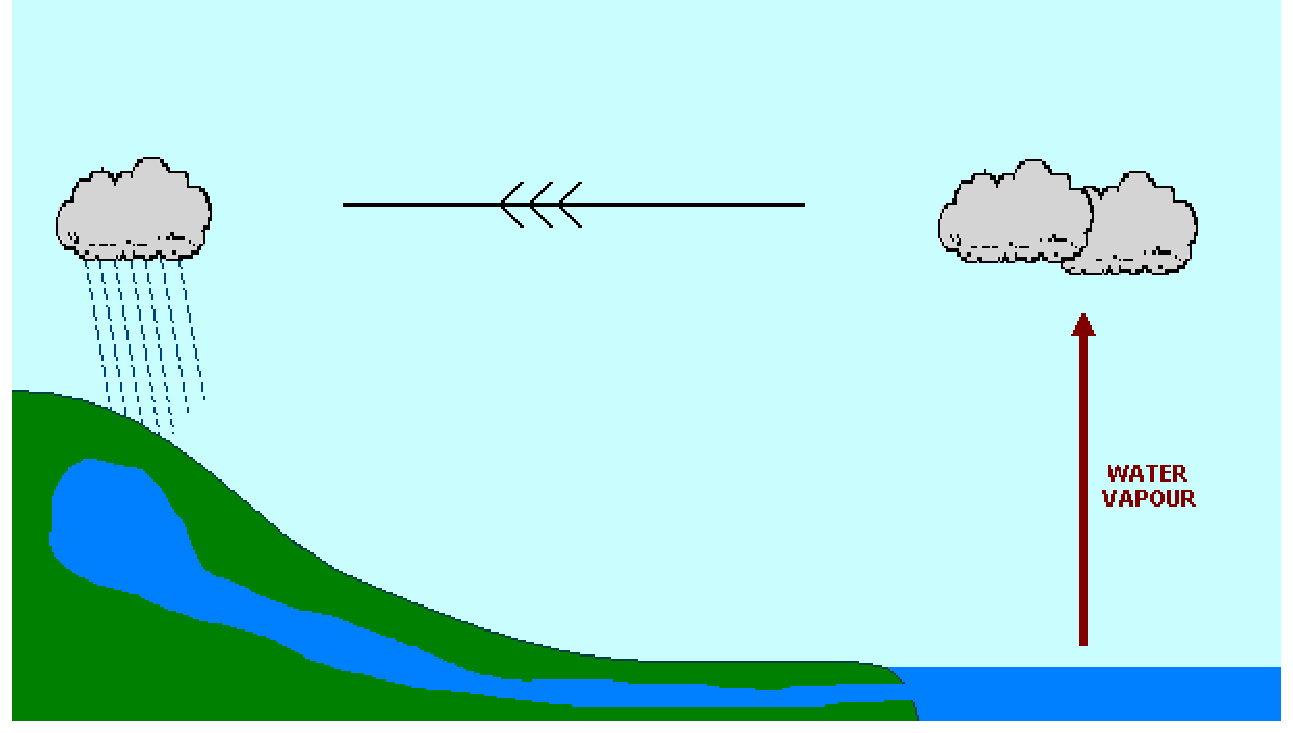
Water evaporates into the air from oceans, lakes, rivers, and vegetation. It ascends and forms clouds which cause precipitation. This is the water cycle.
flowchart LR
    A[Oceans / Lakes\nRivers / Vegetation] -->|Evaporation| B[Water Vapour\nin Atmosphere]
    B -->|Ascending air\nCooling| C[Cloud Formation\nCondensation]
    C -->|Precipitation| D[Rain / Snow / Hail]
    D -->|Runoff| A
    style A fill:#e3f2fd,stroke:#1565c0
    style B fill:#e8f5e9,stroke:#2e7d32
    style C fill:#f3e5f5,stroke:#6a1b9a
    style D fill:#fff3e0,stroke:#e65100
⚡ Key Principle
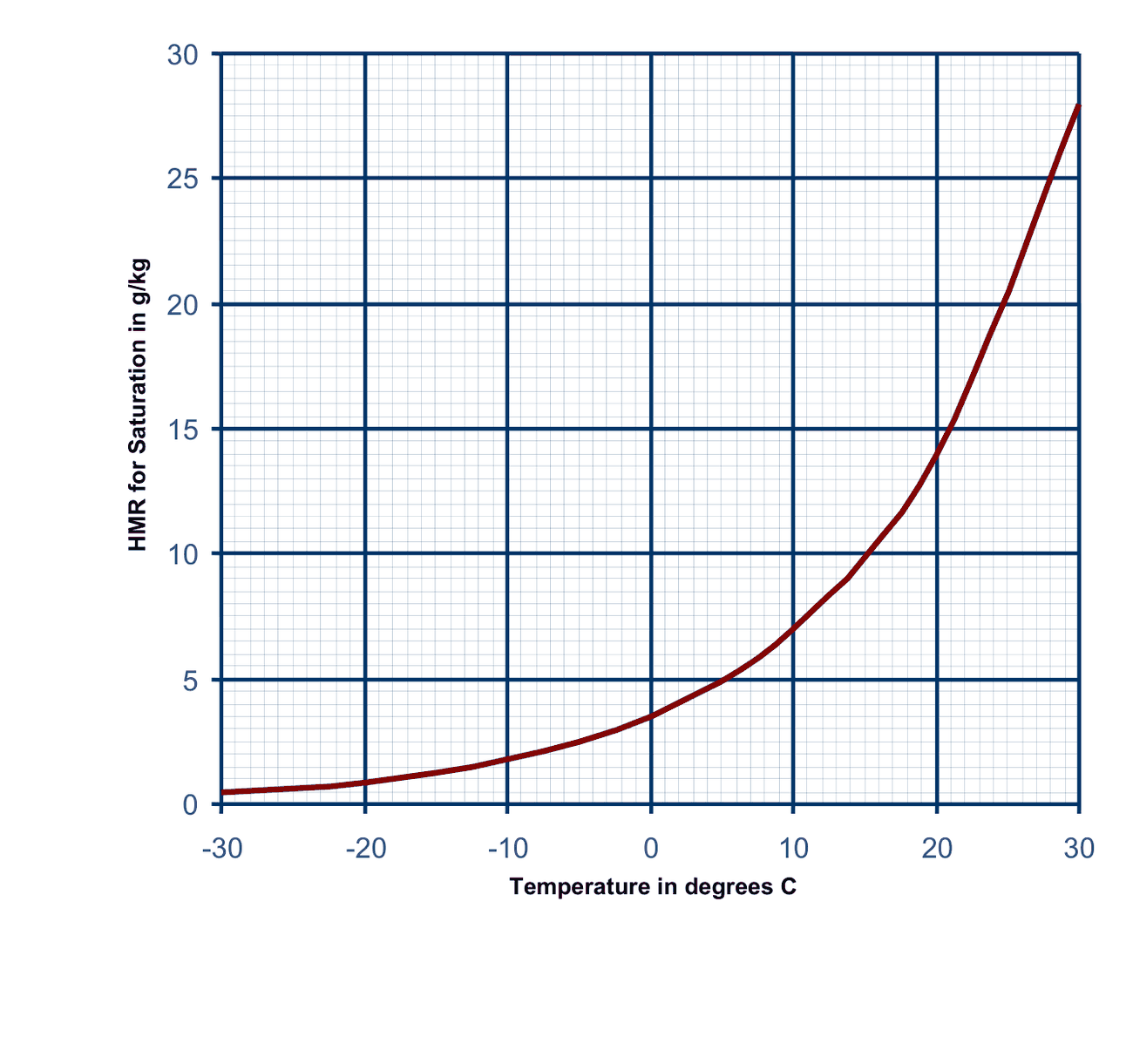
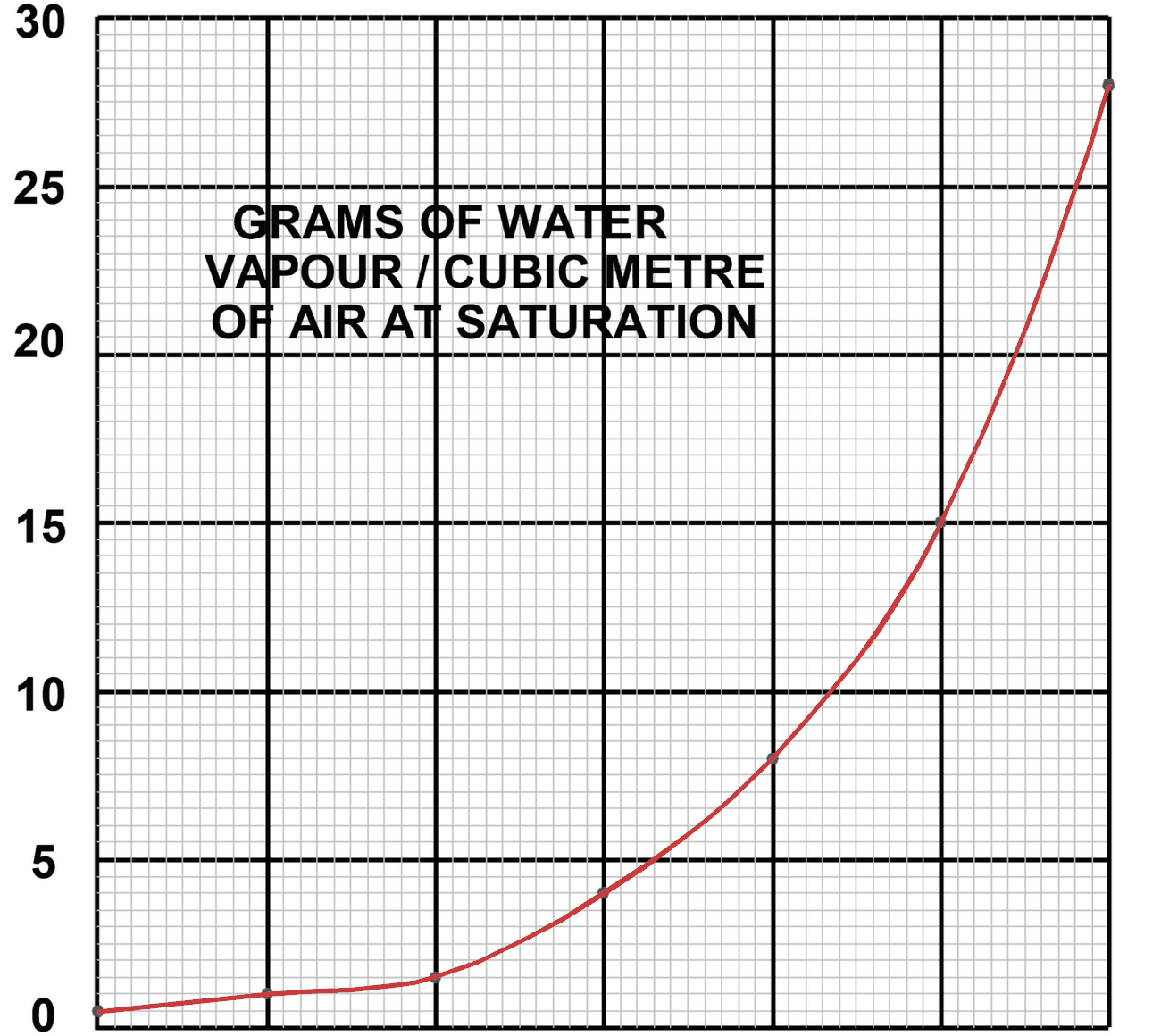
The capacity of dry air to hold water vapour depends largely on temperature (higher temperature = higher capacity) and to some extent on pressure. Higher the temperature, higher the capacity of air to hold water vapour.
2. Three Phases of Water
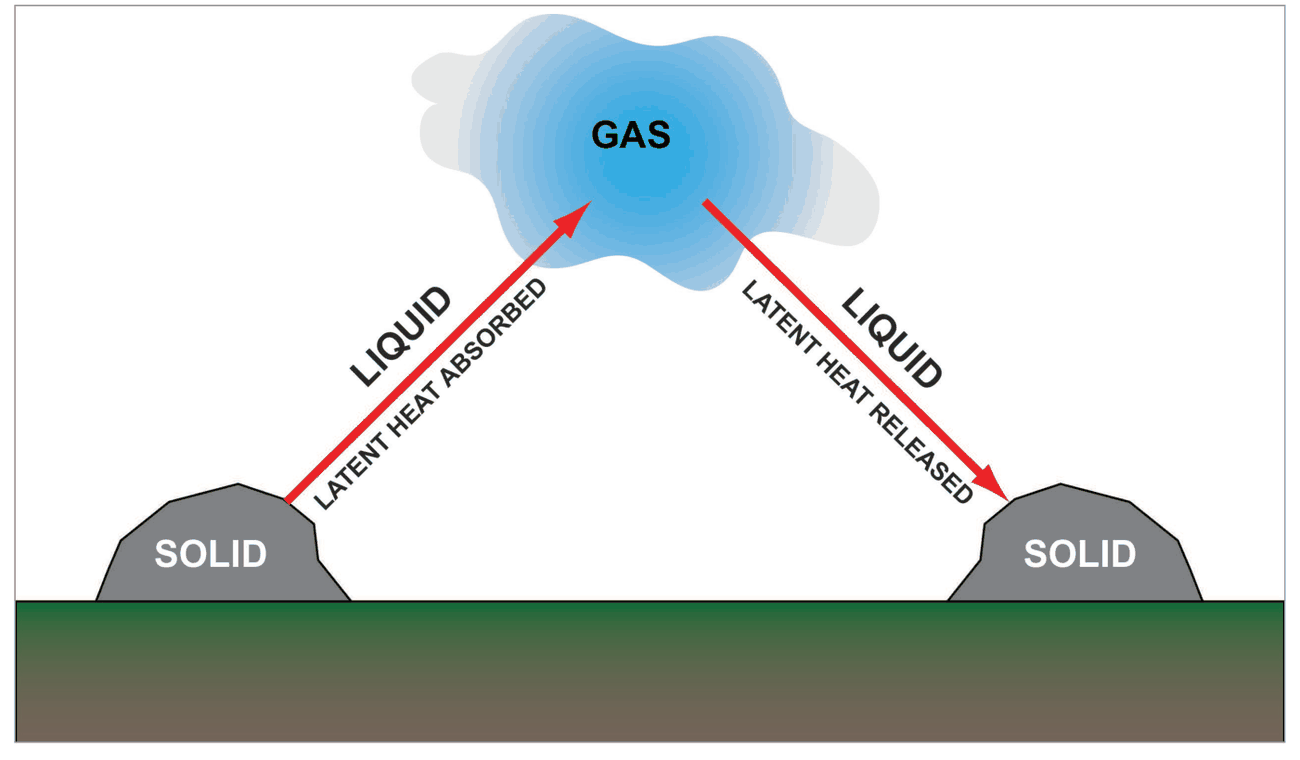
| Phase | State | Examples |
|---|---|---|
| Gas | Water Vapour | Invisible moisture in the atmosphere |
| Liquid | Water | Rain, drizzle, shower, super-cooled water droplets |
| Solid | Ice | Snow, hail, ice crystals, hoar frost |
3. Key Humidity Terms & Definitions
📘 Dry Air
Air that contains no water vapour is called dry air. Such an air may exist in the upper troposphere or stratosphere.
📘 Moist Air
Moist air is air containing water vapour. It may be saturated or unsaturated. In gas-law calculations, dry air means air without water vapour.
📘 Saturated Air
Air is like a sponge which can absorb certain amount of water and no more. When the air holds maximum water vapour, it is called saturated air.
📘 Vapour Pressure (VP)
The partial pressure exerted by the water vapour in the air is called vapour pressure. If p is the total pressure of air and e is the vapour pressure, then (p − e) is the pressure of dry air.
📘 Saturation Vapour Pressure (SVP)
It is the pressure exerted by water vapour when air is saturated.
📘 Absolute Humidity
It is defined as the actual amount of water vapour contained in a given volume of air at a given temperature. It is expressed in g/m³.
📘 Humidity Mixing Ratio (HMR)
It is the mass of water vapour divided by the mass of dry air. It is expressed as g/kg.
📘 HMR for Saturated Air
The maximum mass of water vapour that can be contained in a given mass of dry air at a particular temperature and pressure. Also expressed as g/kg of dry air. The saturation humidity mixing ratio increases with temperature.
| Term | Definition | Unit | Key Note |
|---|---|---|---|
| Absolute Humidity | Water vapour per unit VOLUME | g/m³ | Changes with T and P |
| HMR | Water vapour per unit MASS of dry air | g/kg | Constant if no moisture added/removed |
| Vapour Pressure (VP) | Partial pressure of water vapour | hPa | e in gas equations |
| SVP | VP when air is saturated | hPa | Increases with temperature |
⚠️ Critical — HMR During Adiabatic Lifting
If there is no addition or removal of water vapour, the HMR remains constant when air is lifted adiabatically. The mixing ratio is a conservative property during adiabatic processes.
4. Relative Humidity (RH)
📘 Definition
Relative Humidity is defined as the ratio, in percentage, of the actual water vapour in the air to the maximum it can contain at the same temperature and pressure.
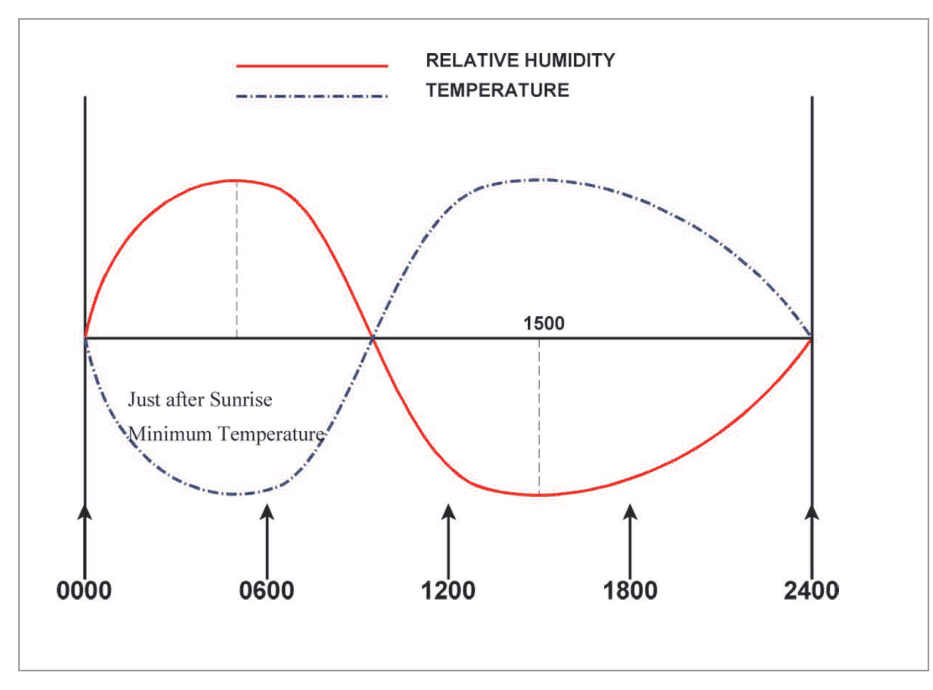
RH (%) = (HMR × 100) / (HMR for Saturated Air)
OR equivalently:
RH (%) = (VP of Air × 100) / (SVP of Air)
| HMR | Humidity Mixing Ratio of actual air |
| HMR(sat) | HMR for saturated air at same temperature |
| VP | Actual Vapour Pressure |
| SVP | Saturation Vapour Pressure at same temperature |
⚡ RH Measurement
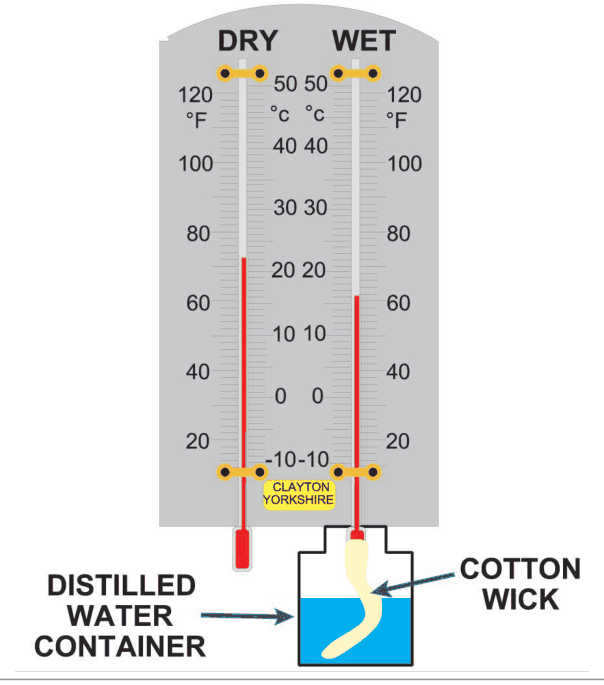
Humidity is measured by the instruments Psychrometer and Hygrometer, and is recorded by Hygrograph.
⚠️ RH vs Dew Point — Key Distinction
- RH is affected by change in both water content AND temperature
- Dew Point (DP) is only affected by change in water content
- By cooling or warming the air, RH changes but DP does not change
- DP is higher if air contains more water vapour
flowchart TD
    A[Air Sample] --> B{Change made?}
    B -->|Temperature changes\nwater content same| C[RH changes\nDP unchanged]
    B -->|Water content changes\ntemperature same| D[Both RH and DP change]
    B -->|Air lifted adiabatically\nno water added/removed| E[HMR unchanged\nRH increases as T drops]
    style C fill:#fff8e1,stroke:#f57c00
    style D fill:#fdecea,stroke:#c0392b
    style E fill:#e8f1fb,stroke:#2c5aa0
5. Temperature Parameters — Wet Bulb, Dew Point & Frost Point
📘 Wet Bulb Temperature (Tw)
It is the lowest temperature which air would attain by evaporating water into it to saturate it. Desert coolers work on this principle. The drier the air, the more effective would be the cooling.
📘 Dew Point Temperature (TdTd or Td)
It is the lowest temperature to which air should be cooled at constant pressure to saturate it with respect to water. Cooling below Dew Point (DP) causes condensation.
📘 Frost Point
It is the temperature to which air must be cooled to reach saturation with respect to ice. Cooling below the frost point causes formation of hoar frost.
| Temperature | Symbol | Definition | Below This → |
|---|---|---|---|
| Air Temperature | TT | Actual ambient air temperature (dry bulb) | N/A |
| Wet Bulb Temp | Tw | Lowest T by evaporating water to saturate the air | Not applicable (evaporative limit) |
| Dew Point | TdTd / Td | T at which air saturates with respect to water at constant pressure | Condensation (dew, fog) |
| Frost Point | — | T at which air saturates with respect to ice | Hoar frost formation |
🧠 Key Relationship — Unsaturated Air
TT > Tw > Td (Unsaturated Air)
TT = Tw = Td (Saturated Air — Fog, During Rain)
When RH = 100%, all three temperatures converge.
6. Cloud Base Calculation
📘 Empirical Cloud Base Formula
The theoretical height of the base of cloud can be determined using surface temperatures by the empirical formula:
Cloud Base Height = (TT − Td) × 400 ft
| TT | Surface Air Temperature (°C) |
| Td | Surface Dew Point Temperature (°C) |
| (TT − Td) | Dew Point Spread or Depression |
| 400 ft | Empirical constant per °C spread |
🔢 Worked Example — Cloud Base
Given: Surface temperature TT = 25°C, Dew Point Td = 15°C
DP Spread: 25 − 15 = 10°C
Cloud Base = 10 × 400 = 4,000 ft AGL
Note: Smaller the spread between TT and Td, lower the cloud base. When spread = 0, cloud is at surface (fog).
⚠️ Important
When TT = Td (spread = zero), the cloud base is at the surface — this is fog (or very low stratus). The smaller the dew point depression, the closer the air is to saturation.
🧠 Memory Aid
"4-0-0 feet per degree of spread" — if the spread is 5°C, cloud base = 2000 ft. If 10°C, cloud base = 4000 ft. The cooler and moister the air, the lower the cloud base.
7. SVP over Water vs Ice — Sub-Zero Behaviour
📘 Important Sub-Zero Principle
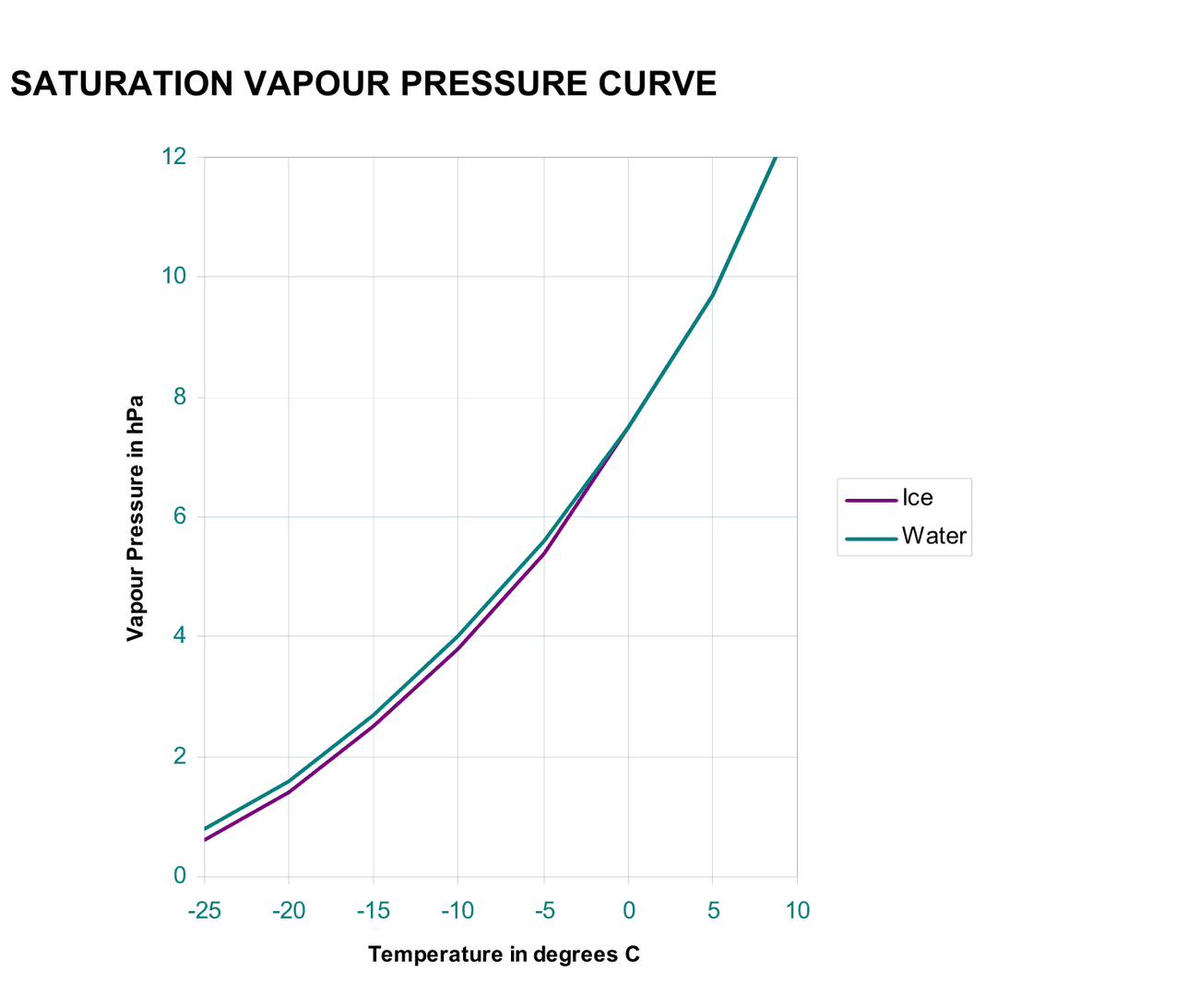
At sub-zero temperatures, water molecules have more energy and a greater degree of freedom than ice. Consequently, the saturation vapour pressure over water is more than that over ice particles.
⚠️ Bergeron-Findeisen Process — Exam Important
If water drops and ice particles co-exist in a cloud:
- SVP over water > SVP over ice at the same temperature
- Water drops evaporate and condense on the ice particles
- Ice particles grow at the expense of water droplets
- This explains rainfall from clouds which extend above 0°C level in the atmosphere — mixed-phase clouds produce rain via the Bergeron-Findeisen process
- Both super-cooled water drops and ice crystals can co-exist in this mixed zone
flowchart TD
    A["Mixed-phase Cloud\n(Water drops + Ice crystals\nat same sub-zero temperature)"] --> B{"SVP over Water\nvs SVP over Ice"}
    B -->|"SVP(water) > SVP(ice)"| C[Water drops evaporate]
    C --> D[Water vapour condenses\non ice crystals]
    D --> E[Ice crystals grow\nwater drops shrink]
    E --> F[Ice crystals become heavy\nand fall as precipitation]
    F --> G["Melts below 0°C level\n→ RAIN at surface"]
    style A fill:#e3f2fd,stroke:#1565c0
    style B fill:#fff8e1,stroke:#f57c00
    style G fill:#e8f5e9,stroke:#2e7d32
⚠️ Super-Cooled Water Droplets — Critical for Aviation Icing
Small water droplets can exist in a super-cooled (liquid below 0°C) state:
- In normal clouds: up to −40°C
- In Cumulonimbus (CB) clouds: up to −45°C
- These super-cooled droplets freeze on contact with aircraft surfaces → severe icing hazard
8. Temperature Relationships — Saturated vs Unsaturated Air
✅ Saturated Air (Fog, During Rain)
Air Temperature (TT) = Wet Bulb (Tw) = Dew Point (Td)
When RH = 100%, the air is saturated and all three temperature readings are identical.
⚡ Unsaturated Air
TT > Tw > Td
In normal (unsaturated) air, air temperature is highest, wet bulb is intermediate, and dew point is lowest.
| Condition | TT vs Tw vs Td | RH | DP Spread |
|---|---|---|---|
| Saturated air (fog, heavy rain) | TT = Tw = Td | 100% | 0°C |
| Unsaturated air (normal) | TT > Tw > Td | < 100% | > 0°C |
| Very dry air (desert) | TT >> Tw > Td | Very low | Large spread |
9. Quick Revision Summary
⚡ Chapter 5 — Quick Revision: Humidity
- Capacity to hold water vapour ∝ temperature — higher T = more capacity
- Absolute Humidity: g/m³ (per volume) | HMR: g/kg (per mass)
- RH = (VP/SVP) × 100% = (HMR/HMR-sat) × 100%
- Measured by Psychrometer/Hygrometer; recorded by Hygrograph
- HMR is constant when air lifted adiabatically (no moisture added/removed)
- Saturation HMR increases with temperature
- Dew Point: cooling at constant pressure → saturation wrt water → condensation
- Wet Bulb: evaporation cools air to saturation; TT > Tw > Td (unsaturated)
- Frost Point: cooling to saturation wrt ice → hoar frost below
- Saturated air: TT = Tw = Td (RH = 100%)
- Cooling/warming changes RH but NOT dew point
- DP higher if more water vapour is present
- Cloud Base = (TT − Td) × 400 ft
- SVP over water > SVP over ice (sub-zero) → Bergeron-Findeisen process
- Super-cooled droplets: up to −40°C in clouds, up to −45°C in CB
10. Practice Q&A — DGCA Examination Style
Q1. The ratio in % between the amount of water vapour present in the air to the amount of water vapour that it can hold at the same temperature is:
(a) Humidity (b) Relative humidity (c) Dew point
(a) Humidity (b) Relative humidity (c) Dew point
✅ Correct Answer: (b) Relative Humidity
Explanation: Relative Humidity is precisely defined as the ratio (in %) of the actual water vapour content to the maximum water vapour the air can hold at the same temperature and pressure. It is "relative" because it compares actual moisture to maximum possible moisture.
❌ Distractors: (a) Humidity — too vague; humidity is the general term for water vapour content. (c) Dew Point — a temperature, not a ratio.
📌 Instructor's Note: RH = (VP/SVP) × 100 = (HMR/HMR-sat) × 100. When RH = 100%, air is saturated. RH depends on BOTH water content AND temperature.
Q2. The temperature to which air be cooled at constant pressure to become saturated is called:
(a) Wet bulb temperature (b) Dry bulb temperature (c) Dew point (d) Humidity
(a) Wet bulb temperature (b) Dry bulb temperature (c) Dew point (d) Humidity
✅ Correct Answer: (c) Dew Point
Explanation: The Dew Point Temperature is defined as the lowest temperature to which air must be cooled at constant pressure to become saturated with respect to water. Below this temperature, condensation occurs.
❌ Distractors: (a) Wet Bulb — this is the temperature attained by evaporating water INTO the air, not by cooling it. The process is different. (b) Dry bulb — this is just the ordinary air temperature. (d) Humidity — a measure of moisture content, not a temperature.
📌 Instructor's Note: Key distinction — Dew Point is achieved by COOLING at constant pressure. Wet Bulb is achieved by EVAPORATION into the air. Both result in saturation but by different processes.
Q3. Free air temperature, Wet bulb temperature and Dew point temperature are equal when:
(a) Air temperature is 0°C
(b) Relative humidity is 100%
(c) Air temperature is not below 0°C
(a) Air temperature is 0°C
(b) Relative humidity is 100%
(c) Air temperature is not below 0°C
✅ Correct Answer: (b) Relative humidity is 100%
Explanation: When RH = 100%, the air is fully saturated. There is no difference between actual moisture content and maximum possible moisture content, so TT = Tw = Td. This condition exists in fog, during heavy rain, or in saturated cloud.
❌ Distractors: (a) 0°C is not a condition for equality — it could be 0°C with any RH. (c) Temperature above 0°C has no special significance for this relationship.
📌 Instructor's Note: "Fog = TT = Tw = Td" — when you see fog or are in cloud, assume these three temperatures are equal. This is frequently tested. RH = 100% is the ONLY condition that makes all three equal.
Q4. On a rainy day compared to sunny day the length of runway required is:
(a) More (b) Less (c) Same
(a) More (b) Less (c) Same
✅ Answer: (a) More
A wet runway gives poorer braking action, and standing water adds aquaplaning risk, so both take-off and landing distances increase. This outweighs the small gain from cooler, denser air.
❌ (b) Less and (c) Same ignore the effect of the wet surface.
💡 Wet runway = longer distances. Treat a rainy day as a performance penalty.
Q5. The spread (difference) between Free air temperature and Dew point temperature is ………… when air is saturated:
(a) Large (b) Least (c) Same
(a) Large (b) Least (c) Same
✅ Correct Answer: (b) Least (approaches zero)
Explanation: When air is saturated (RH = 100%), TT = Td. The spread between them is zero — the minimum possible. The spread (TT − Td) is also called the "dew point depression." Zero spread means the air is at saturation.
❌ Distractors: (a) Large — the spread is largest in very dry air (desert conditions). (c) Same — the spread changes constantly with temperature and moisture content.
📌 Instructor's Note: DP Spread / DP Depression = TT − Td. Spread = 0 → fog/saturation. Spread large → dry air, high cloud bases. Cloud Base = Spread × 400 ft.
Q6. The saturation vapour pressure over water is ………… than the ice:
(a) More (b) Less (c) Same
(a) More (b) Less (c) Same
✅ Correct Answer: (a) More
Explanation: At sub-zero temperatures, water molecules in the liquid state have more kinetic energy (greater degree of freedom) than in the solid (ice) state. Therefore, the saturation vapour pressure over liquid water exceeds that over ice at the same temperature. This SVP difference drives the Bergeron-Findeisen process of precipitation formation.
❌ Distractors: (b) Less — incorrect; the higher molecular energy of liquid water means higher SVP. (c) Same — there is always a difference at sub-zero temperatures; SVP over water and ice are only equal at exactly 0°C.
📌 Instructor's Note: SVP(water) > SVP(ice) at sub-zero → ice grows, water drops shrink → Bergeron process → rainfall. This is why clouds with both water drops AND ice crystals produce efficient precipitation.
Q7. As the temperature of the air increases, the amount of water vapour required to saturate it:
(a) decreases (b) increases (c) remains same
(a) decreases (b) increases (c) remains same
✅ Correct Answer: (b) increases
Explanation: Warmer air has a greater capacity to hold water vapour. The saturation humidity mixing ratio (HMR-sat) and the saturation vapour pressure (SVP) both increase with temperature. This is why warm tropical air can hold much more moisture than cold polar air.
❌ Distractors: (a) decreases — opposite is true. (c) remains same — capacity changes significantly with temperature.
📌 Instructor's Note: "Warm air = bigger sponge." The SVP curve rises steeply with temperature. This is why tropical air is so humid — warm air can hold more moisture before becoming saturated.
Q8. The actual amount of water vapour contained in a given volume of air at a given temperature is termed as:
(a) Relative Humidity (b) Specific Humidity (c) Absolute Humidity
(a) Relative Humidity (b) Specific Humidity (c) Absolute Humidity
✅ Answer: (c) Absolute Humidity
Absolute humidity is the actual mass of water vapour in a given volume of air, in g/m³.
❌ (a) Relative humidity is a ratio in per cent, not an amount. (b) Specific humidity is the mass of vapour per unit mass of moist air, in g/kg.
💡 Absolute: g per m³. Specific/mixing ratio: g per kg. Relative: per cent.
Q9. Humidity Mixing Ratio ………… when air is lifted adiabatically:
(a) Relative Humidity (b) remains constant (c) increases
(a) Relative Humidity (b) remains constant (c) increases
✅ Answer: (b) remains constant
When unsaturated air is lifted adiabatically no water is added or removed, so the humidity mixing ratio stays constant. What changes is the relative humidity, which rises as the air cools, until it reaches 100% at the condensation level.
❌ (a) Relative humidity is not what the question asks about. (c) The mixing ratio does not increase unless moisture is added.
💡 Lifting unsaturated air: mixing ratio constant, relative humidity increases.
Q10. It is the lowest temperature which air would attain by evaporating water into it to saturate it:
(a) Wet bulb temp (b) Dry bulb temp (c) Dew point
(a) Wet bulb temp (b) Dry bulb temp (c) Dew point
✅ Correct Answer: (a) Wet Bulb Temperature
Explanation: Wet Bulb Temperature (Tw) is precisely defined as the lowest temperature which air would attain by evaporating water into it until it is saturated. The evaporative cooling process lowers the temperature to the wet bulb value. Desert coolers work on this same principle — drier the air, more the cooling effect.
❌ Distractors: (b) Dry bulb — this is simply the ordinary air temperature measured by an unmodified thermometer. (c) Dew point — cooling the air without adding moisture until it saturates; different process (temperature-lowering vs. moisture-adding).
📌 Instructor's Note: Two routes to saturation: (1) ADD MOISTURE → reach Wet Bulb temperature. (2) REMOVE HEAT (cool) → reach Dew Point. Both achieve saturation but by opposite processes. Wet bulb > Dew point in unsaturated air.
11. Master Reference Tables
11.1 All Numerical Values — Chapter 5
| Parameter | Value | Context |
|---|---|---|
| Absolute Humidity unit | g/m³ | Water vapour per unit volume |
| HMR unit | g/kg | Water vapour per unit mass of air |
| Cloud base constant | 400 ft/°C | Cloud Base = (TT − Td) × 400 ft |
| Super-cooled droplets (normal clouds) | up to −40°C | Icing hazard |
| Super-cooled droplets (CB clouds) | up to −45°C | Severe icing in CB |
| RH at saturation | 100% | TT = Tw = Td condition |
| Dew point spread at saturation | 0°C | Fog / in-cloud condition |
11.2 Formula Sheet
| Formula | Variables | Application |
|---|---|---|
| RH (%) = (HMR/HMR-sat) × 100 | HMR = actual mixing ratio; HMR-sat = saturation mixing ratio | Relative Humidity calculation |
| RH (%) = (VP/SVP) × 100 | VP = actual vapour pressure; SVP = saturation vapour pressure | Alternative RH formula |
| Cloud Base = (TT − Td) × 400 ft | TT = air temp, Td = dew point (°C) | Estimating cloud base height AGL |
| Dry air pressure = p − e | p = total pressure; e = vapour pressure | Pressure partitioning |
11.3 Key Distinctions — Humidity Terms
| What Changes? | Effect on RH | Effect on DP | Effect on HMR |
|---|---|---|---|
| Temperature increases only | RH decreases | No change | No change |
| Temperature decreases only | RH increases | No change | No change |
| Water content increases | RH increases | DP increases | HMR increases |
| Air lifted adiabatically | RH increases | No change | No change (constant) |
11.5 Mnemonics Quick Reference
🧠 All Mnemonics — Chapter 5
- Absolute = Volume (g/m³) | HMR = Mass (g/kg)
- RH = VP/SVP × 100 — "Vapour over Saturation times 100"
- TT > Tw > Td — "Temperature Takes Talent" (decreasing order in unsaturated air)
- TT = Tw = Td — in FOG (Saturated Air, RH = 100%)
- Cloud Base = Spread × 400 — "(T minus DP) times 400 feet"
- Cooling → RH changes, DP doesn't — "Cool Changes RH, not DP"
- HMR constant adiabatically — "Mixing Ratio Doesn't Mix when lifted"
- SVP(water) > SVP(ice) — "Water beats Ice" → Bergeron process
- −40°C / −45°C — Super-cooled droplet limits in clouds/CB
- Desert Cooler = Wet Bulb principle
- Hoar Frost = below Frost Point (ice saturation temperature)
Ghost Aviator
Study Meteorology with other student pilots
Join the free Meteorology group on Telegram. Stuck on a doubt? Type /q and your question, and get an answer from Ghost Aviator's notes.
LIVE BATCH
Study Aviation Meteorology live with the Captain
Small batch of 10 · live doubt-clearing · 4–6 weeks · ₹12,999 ₹7,999
Reinforce Chapter 5: Humidity
Test your knowledge and practice actual exam questions for Aviation Meteorology.
Planning your Pilot Training in 2026?
Calculate exact flying hours, DGCA exam fees, and living costs with our interactive calculator.