Air Density
by Ghost Aviator
Table of Contents
- 1. Introduction & Gas Equation
- 2. Density of Dry Air
- 3. Density of Moist Air
- 4. Factors Affecting Air Density
- 5. Variations in Surface Density
- 6. Variation of Density with Height
- 7. Latitudinal Variation of Density
- 8. Density Altitude — Key Concept
- 9. Quick Revision Summary
- 10. Practice Q&A (DGCA Style)
- 11. Master Reference Tables
1. Introduction & The Gas Equation
The density of air can be derived from the fundamental gas equation:
| P | Pressure in pascals (Pa); 1 hPa = 100 Pa |
| V | Specific volume (volume per unit mass), in m³/kg |
| R | Gas constant for the particular gas |
| T | Absolute temperature (Kelvin) |
Since for a unit mass of gas, density ρ is the reciprocal of volume V, therefore:
| ρ | Air density (kg/m³) |
| P | Pressure (Pa; multiply hPa by 100) |
| R | Gas constant (specific to the gas) |
| T | Absolute temperature (Kelvin) |
2. Density of Dry Air
For dry air, the gas constant R = 287 J/(kg·K).
🔢 Worked Example — ISA Surface Density
Given:
- ISA surface pressure = 1013.25 hPa
- ISA surface temperature = 15°C = 288.15 K
- R for dry air = 287 J/(kg·K)
Calculation: ρ = P/(RT) = 101325 / (287 × 288.15) ≈ 1.225 kg/m³ = 1225 g/m³.
Result: ISA surface air density = 1225 g/m³
3. Density of Moist Air
| Component | Pressure | Density Expression |
|---|---|---|
| Water Vapour | e | 5e/8RT |
| Dry Air (partial) | (p−e) | (p−e)/RT |
| Moist Air (total) | p | (p − 3e/8) / RT |
4. Factors Affecting Air Density
| Factor | Effect on Density | Aviation Implication |
|---|---|---|
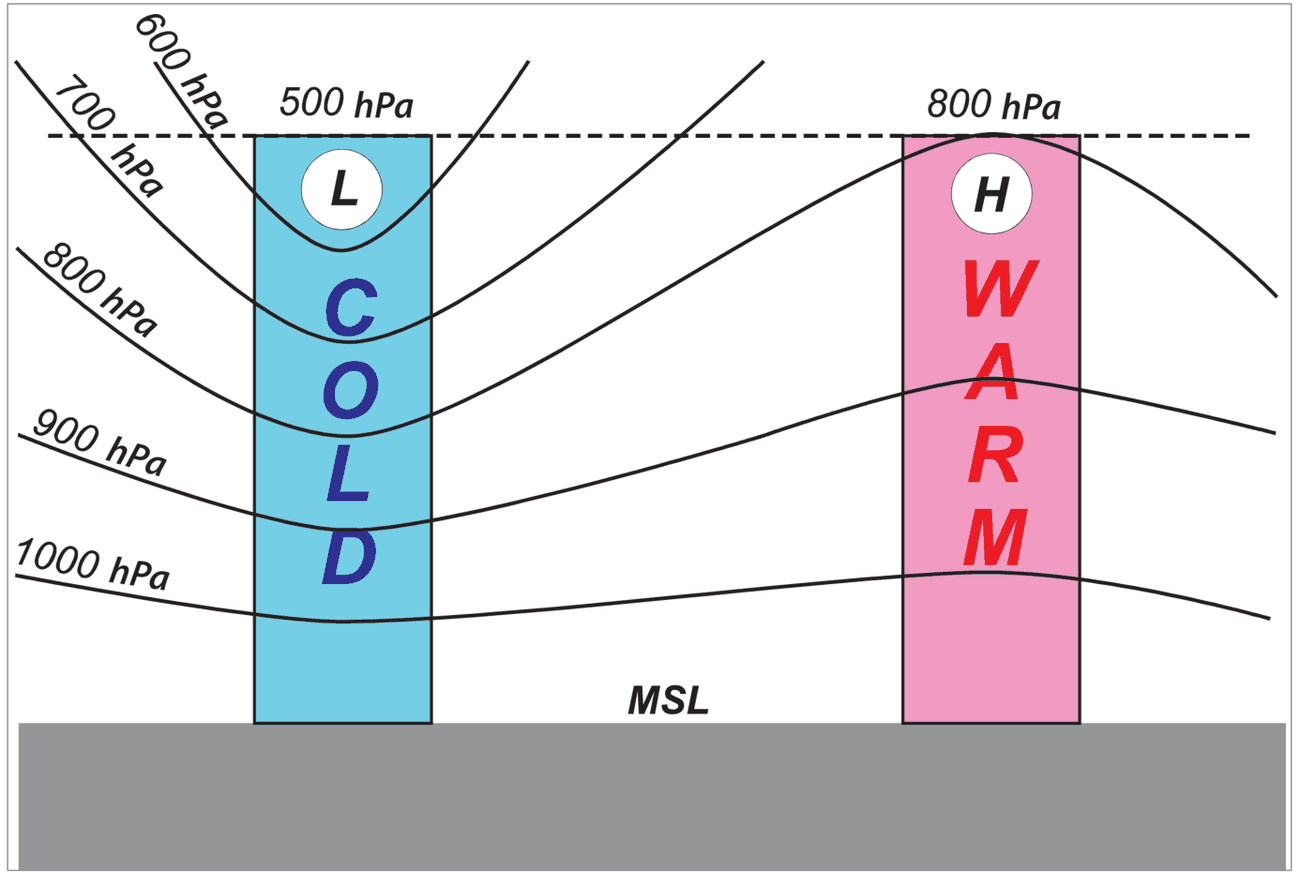
| Altitude ↑ | Density ↓ (Less dense) | Reduced engine power, longer T/O run, reduced climb rate |
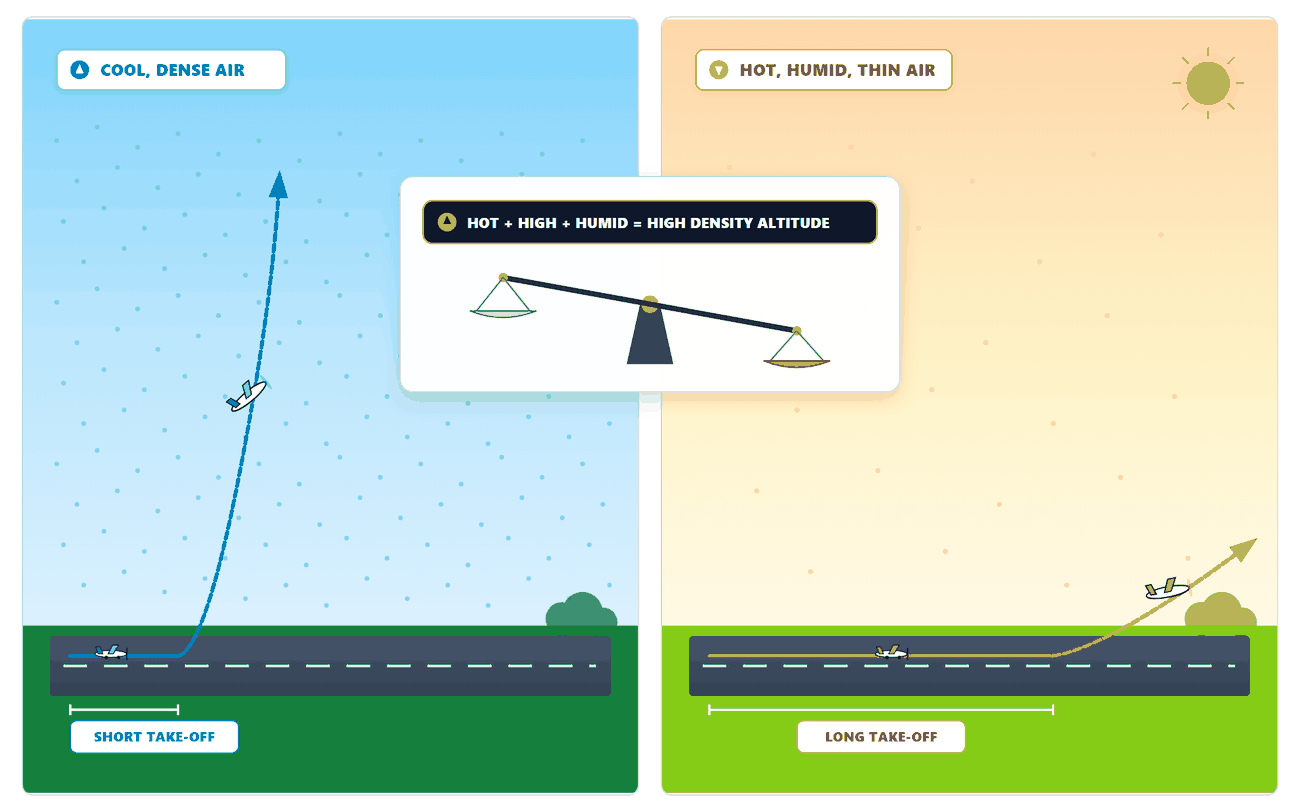
| Temperature ↑ | Density ↓ (Less dense) | Hot day = less dense air = degraded performance |
| Humidity ↑ | Density ↓ (Less dense, minor effect) | Add 10% to T/O distance in high humidity; anticipate reduced climb |
5. Variations in Surface Density
Diurnal (Daily) Variation: The lowest densities occur in the afternoon and the highest just after sunrise. This is due to the diurnal variation of temperature.
Seasonal Variation: Seasonal density changes occur due to variations in temperature and pressure.
- A fall of pressure of 10 hPa, OR
- An increase of temperature of 3°C, OR
- An increase in height of 300 feet
6. Variation of Density with Height
If the density of air were to remain uniform with height, the atmosphere would extend up to 8 km. But since density decreases with height, at every 5–6 km it reduces to its previous half value.
| Altitude | Density as Fraction of Surface Value | Key Note |
|---|---|---|
| 0 km (Surface) | 1/1 (Full density) | ISA: 1225 g/m³ |
| 6 km | 1/2 | Density halved |
| 11 km | 1/4 | Tropopause region |
| 17 km | 1/8 | Stratosphere |
| 240 km | Still offers resistance | Density sufficient for drag |
| 800 km | Atmosphere effectively ends | Upper limit |
6 km → ½ | 11 km → ¼ | 17 km → ⅛
(Think: "Six Eleven Seventeen — Density Halves Quarteres Eighths")
flowchart TD
    A["Surface — 0 km\nDensity = 1/1\n1225 g/m³"] --> B["6 km\nDensity = 1/2\nHalved"]
    B --> C["11 km — Tropopause\nDensity = 1/4\nQuartered"]
    C --> D["17 km — Stratosphere\nDensity = 1/8\nOne-eighth"]
    D --> E["240 km\nStill offers resistance"]
    E --> F["800 km\nAtmosphere ends"]
    style A fill:#e8f5e9,stroke:#2e7d32
    style B fill:#fff3e0,stroke:#f57c00
    style C fill:#fce4ec,stroke:#c0392b
    style D fill:#f3e5f5,stroke:#6a1b9a
    style E fill:#e8eaf6,stroke:#3f51b5
    style F fill:#fafafa,stroke:#9e9e9e
7. Latitudinal Variation of Density
| Altitude Band | Highest Density Location | Lowest Density Location |
|---|---|---|
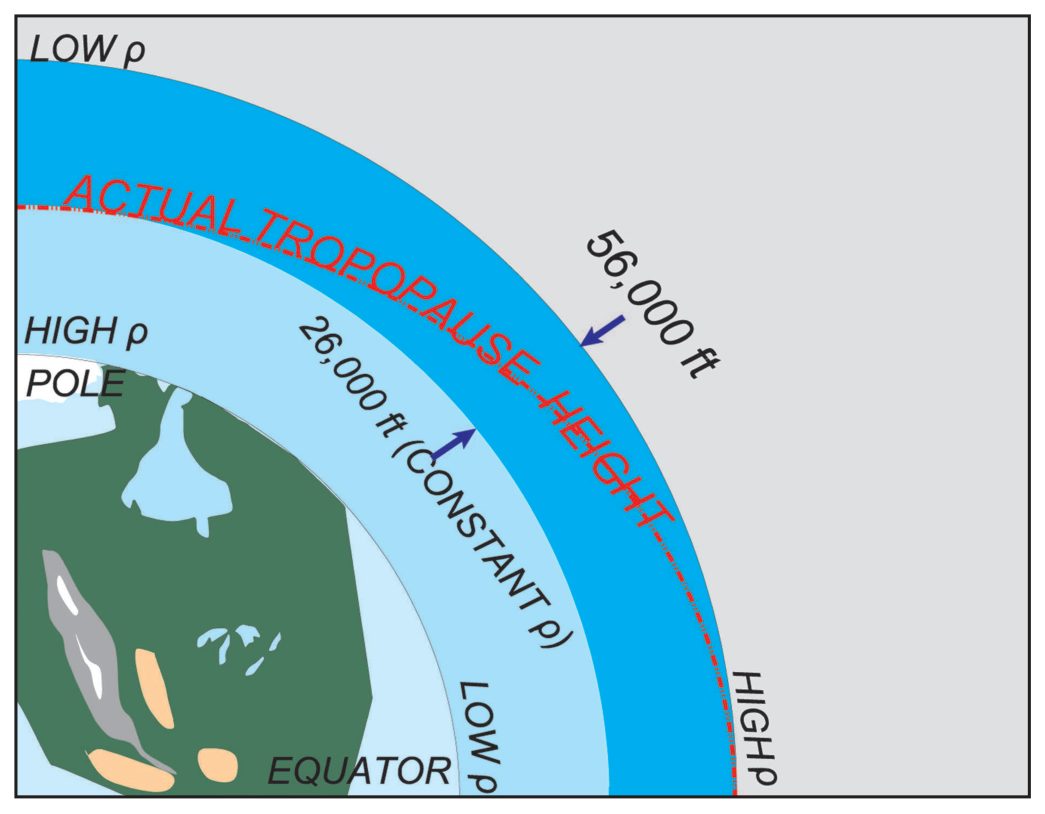
| Surface to ~8 km | Poles (cold, dense air) | Equator (warm, less dense) |
| Above ~8 km | Equator (reversal) | Poles (reversal) |
- Piston-engine aircraft (low cruise altitude): Operational efficiency greater at high latitudes (poles) — denser air below 8 km.
- Jet aircraft (high cruise altitude): Operational efficiency greater in the tropics (equator) — denser air above 8 km reversal.
flowchart LR
    subgraph Below_8km ["Below 8 km"]
        P1[Poles\nHighest Density] --> E1[Equator\nLowest Density]
    end
    subgraph Above_8km ["Above 8 km — REVERSAL"]
        E2[Equator\nHighest Density] --> P2[Poles\nLowest Density]
    end
    Below_8km -->|"Reversal at ~8 km"| Above_8km
    style P1 fill:#e3f2fd,stroke:#1565c0
    style E1 fill:#fff3e0,stroke:#e65100
    style E2 fill:#e8f5e9,stroke:#2e7d32
    style P2 fill:#fdecea,stroke:#c0392b
8. Density Altitude — Key Concept
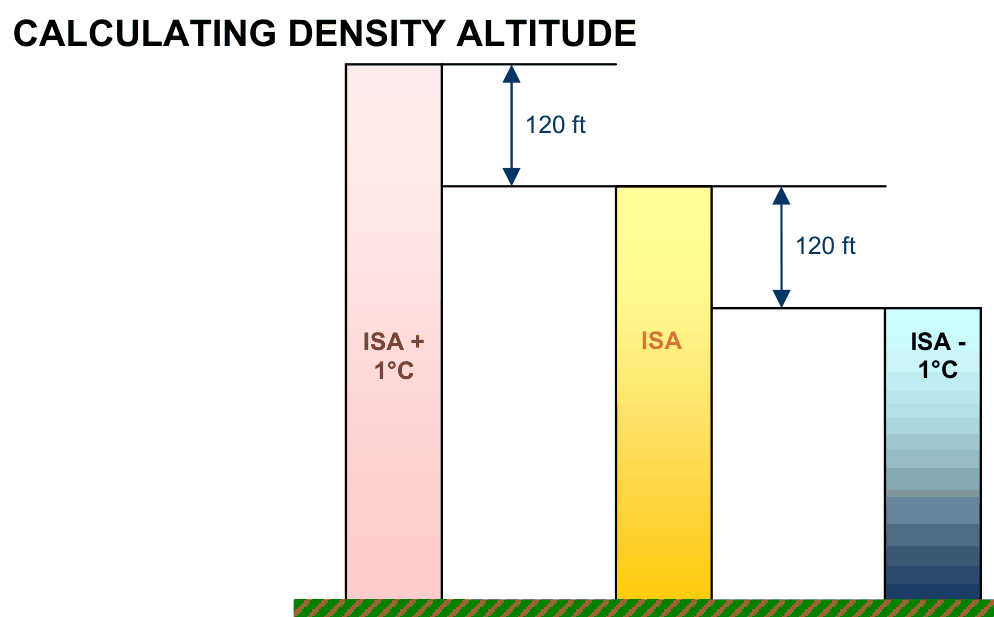
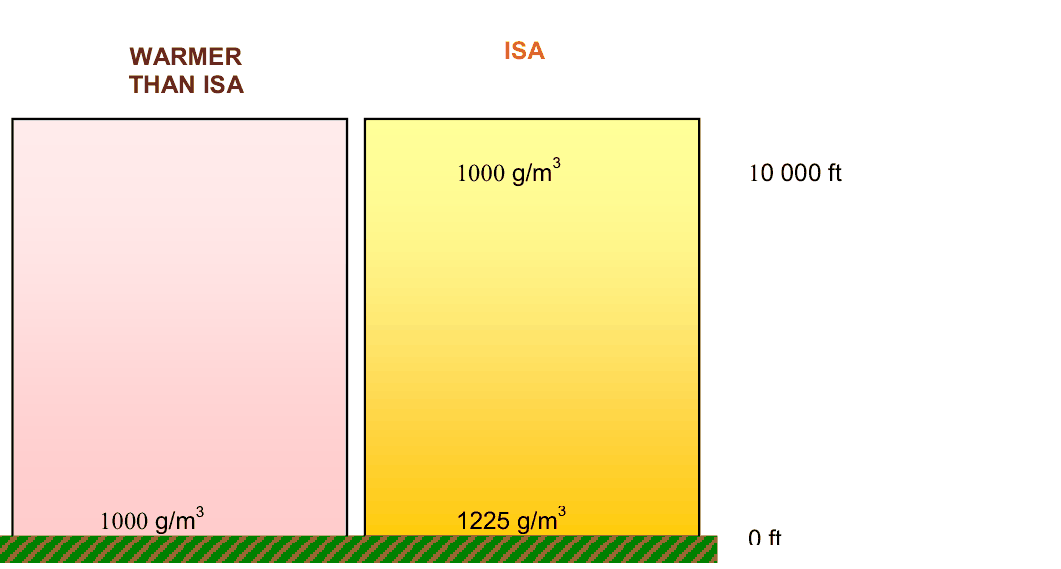
Note: Q10 in the textbook gives options of 33 ft, 100 ft, 120 ft, and 210 ft — correct answer is (c) 120 ft.
🔢 Density Altitude Example
Aerodrome elevation: 2000 ft. QNH gives pressure altitude = 2000 ft. Temperature is 10°C above ISA standard for that level.
Correction: 10°C × 120 ft/°C = 1200 ft addition
Density Altitude = 2000 + 1200 = 3200 ft
Aircraft will perform as if operating from a 3200-ft elevation aerodrome.
9. Quick Revision Summary
- Gas equation: PV = RT → Density ρ = P/RT
- ISA surface density = 1225 g/m³ at 15°C (288 K) and 1013.25 hPa
- Gas constant for dry air R = 287 J/(kg·K)
- Water vapour gas constant = 8/5 times dry air; moist air density = (p − 3e/8)/RT
- Moist air < Dry air in density (under same T and P)
- Density decreases with: ↑ Altitude, ↑ Temperature, ↑ Humidity
- 1% density drop = 10 hPa drop OR 3°C rise OR 300 ft gain
- Density halves every 5–6 km: 6 km → ½ | 11 km → ¼ | 17 km → ⅛
- Below 8 km: Poles > Equator in density | Above 8 km: Equator > Poles (reversal)
- Piston aircraft: better at poles (below 8 km) | Jet aircraft: better at tropics (above 8 km)
- Density altitude differs from pressure altitude by ~120 ft per 1°C temperature deviation
- High humidity: add 10% to T/O distance; expect reduced climb rate
10. Practice Q&A — DGCA Examination Style
(a) Higher (b) Lower (c) Same
(a) Higher (b) Lower (c) Same
(a) Density Altitude (b) ISA Density (c) Real Density
(a) Kg/sq m (b) g/cu m (c) N/sq m
(a) Higher (b) Lower (c) Same
(a) Higher (b) Lower (c) Same
(a) High Altitudes (b) Warm Air (c) High humidity (d) All these
(a) The altitude in ISA at which the prevailing pressure occurs.
(b) The altitude in ISA at which the prevailing density occurs.
(c) The altitude in the actual atmosphere at which the prevailing density occurs.
(a) increases (b) lowers (c) remains the same
(a) 33 ft (b) 100 ft (c) 120 ft (d) 210 ft
11. Master Reference Tables
11.1 All Numerical Values — Chapter 4
| Parameter | Value | Context |
|---|---|---|
| ISA Surface Density | 1225 g/m³ | At 15°C, 1013.25 hPa |
| ISA Surface Pressure | 1013.25 hPa | Standard atmosphere |
| ISA Surface Temperature | 15°C / 288 K | Standard atmosphere |
| Gas constant — Dry Air | 287 J/(kg·K) | R in gas equation |
| Water vapour R | 8/5 × R(dry) | More than dry air |
| Density decrease per 1000 ft (lower atmosphere) | ~3% | Valid to 20,000 ft |
| 1% density change rule | 10 hPa / 3°C / 300 ft | Any one causes 1% change |
| Density halving altitude intervals | 5–6 km | Halves every 5-6 km |
| Half density altitude | 6 km | ½ surface density |
| Quarter density altitude | 11 km | ¼ surface density |
| Eighth density altitude | 17 km | ⅛ surface density |
| Latitudinal reversal altitude | 8 km | Below: poles denser; above: equator denser |
| Atmosphere upper limit | ~800 km | Meaningful density ends ~240 km |
| DA vs PA per 1°C | 120 ft | Density altitude correction |
| High humidity T/O correction | +10% | Add to computed T/O distance |
11.2 Formula Sheet
| Formula | Variables | Application |
|---|---|---|
| PV = RT | P = pressure, V = volume, R = gas constant, T = absolute temp (K) | Fundamental gas equation |
| ρ = P/RT | ρ = density, P = pressure, R = gas constant, T = temp (K) | Density calculation |
| ρ(moist) = (p − 3e/8) / RT | p = total pressure, e = vapour pressure | Moist air density |
| DA = PA ± (ΔT × 120) | DA = density altitude, PA = pressure altitude, ΔT = ISA deviation (°C) | Density altitude calculation |
11.4 Mnemonics Quick Reference
- ρ = P/RT — "Pressure Raises density; Temperature Reduces it"
- 10-3-300 — 10 hPa drop / 3°C rise / 300 ft gain = 1% density decrease
- 6-11-17 — Half density altitudes in km (½, ¼, ⅛)
- 8 km Reversal — Below 8 km: Poles denser; Above 8 km: Equator denser
- 3H Rule — Hot + High + Humid = Highest Density Altitude = Worst Performance
- 120 ft/°C — Density altitude correction per degree ISA deviation
- +10% — Add to T/O distance in high humidity; expect reduced climb
- Moist < Dry — Moist air is LESS dense than dry air (water mol. wt. 18 vs O₂ 32)
Reinforce Chapter 4: Air Density
Test your knowledge and practice actual exam questions for Aviation Meteorology.