3
METEOROLOGY — CHAPTER 3 · NOTES
Temperature
by Ghost Aviator
LECTURE PARTS
Table of Contents
- Definition & Temperature Scales
- Instruments for Measurement
- Types of Temperature
- Heat and Temperature
- Specific Heat and Latent Heat
- Evaporation, Condensation and Latent Heat
- Methods of Heat Transfer
- Insolation
- Laws of Radiation
- Solar Radiation
- Terrestrial & Nocturnal Radiation
- Radiation and Heat Budget / Albedo
- Diurnal Variation of Surface Temperature
- Effect of Clouds on Surface Temperature
- Practice Q&A (39 Questions)
- Master Reference Tables
1. Definition & Temperature Scales
Temperature is a measure of heat. It is measured by a thermometer in degrees Celsius (Centigrade) or Fahrenheit.
Celsius Scale: 0°C = melting point of ice; 100°C = boiling point of pure water at normal pressure. Used internationally, in aviation and science.
Fahrenheit Scale: 32°F = melting point; 212°F = boiling point. Used in a few English-speaking countries.
Absolute Zero: The minimum temperature attainable for all substances. Value = −273.15°C = 0K.
Celsius Scale: 0°C = melting point of ice; 100°C = boiling point of pure water at normal pressure. Used internationally, in aviation and science.
Fahrenheit Scale: 32°F = melting point; 212°F = boiling point. Used in a few English-speaking countries.
Absolute Zero: The minimum temperature attainable for all substances. Value = −273.15°C = 0K.
Temperature Conversion Formulae:
F = (9C/5) + 32
C = 5/9 × (F − 32)
K = C + 273
F = (9C/5) + 32
C = 5/9 × (F − 32)
K = C + 273
Special value — same on both scales:
–40°C = –40°F
Worked Example:
Convert 100°C to Fahrenheit:
F = (9 × 100)/5 + 32 = 180 + 32 = 212°F
Convert 32°F to Celsius:
C = 5/9 × (32 − 32) = 5/9 × 0 = 0°C
Convert 15°C to Kelvin:
K = 15 + 273 = 288 K
–40°C = –40°F
Worked Example:
Convert 100°C to Fahrenheit:
F = (9 × 100)/5 + 32 = 180 + 32 = 212°F
Convert 32°F to Celsius:
C = 5/9 × (32 − 32) = 5/9 × 0 = 0°C
Convert 15°C to Kelvin:
K = 15 + 273 = 288 K
🎯 Exam Tip: Freezing point of water = 0°C = 32°F = 273 K. Boiling point = 100°C = 212°F = 373 K. The unique crossover: −40°C = −40°F.
2. Instruments for Measurement
| Instrument | Description | Special Notes |
|---|---|---|
| Dry Bulb Thermometer | Standard mercury thermometer measuring ambient air temperature. | One part of the psychrometer pair |
| Wet Bulb Thermometer | Bulb covered with muslin cloth kept moist. Evaporation cools the bulb. Used to measure humidity. | Wet bulb temp always ≤ dry bulb temp |
| Maximum Thermometer | Like a Doctor's thermometer — records maximum temperature attained. Has a constriction to prevent mercury from falling back. | Reset by shaking |
| Minimum Thermometer | Uses Alcohol instead of mercury (alcohol doesn't freeze). Has a dumbbell-shaped iron index. When temperature falls, alcohol drags index back; index stays at minimum position. | Concave meniscus drags index back to indicate minimum temperature |
| Thermograph | Gives a continuous record of temperature. Uses bimetallic strips in Upper Air measurements. | Daily or weekly recording |
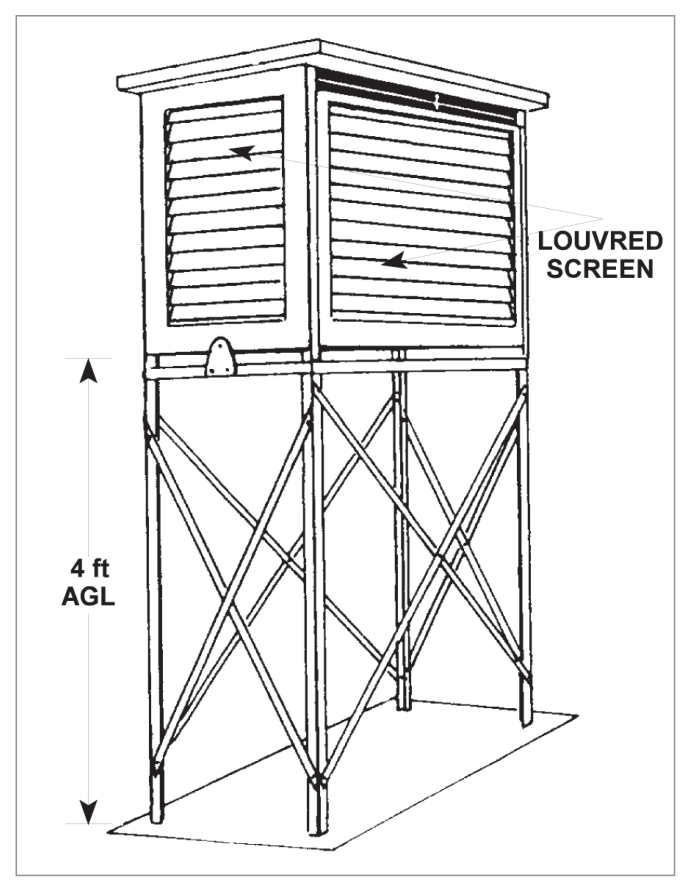
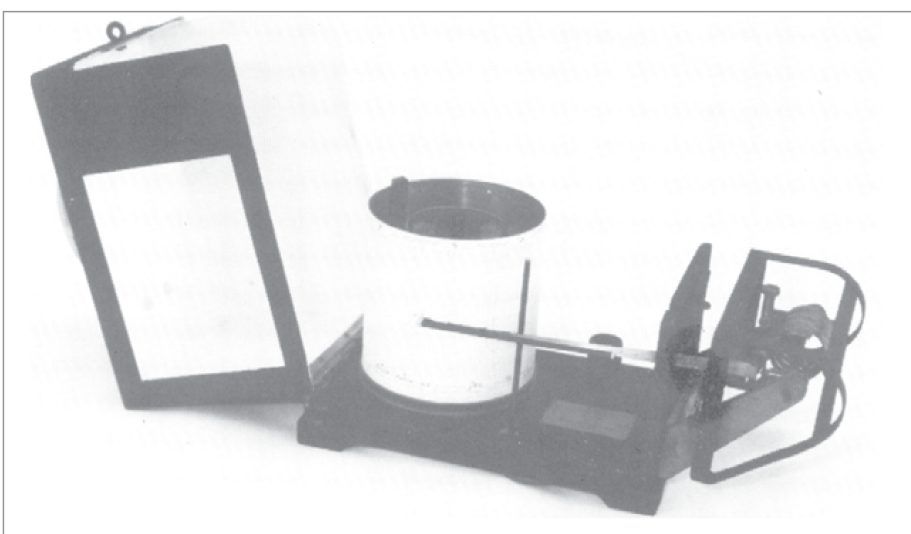
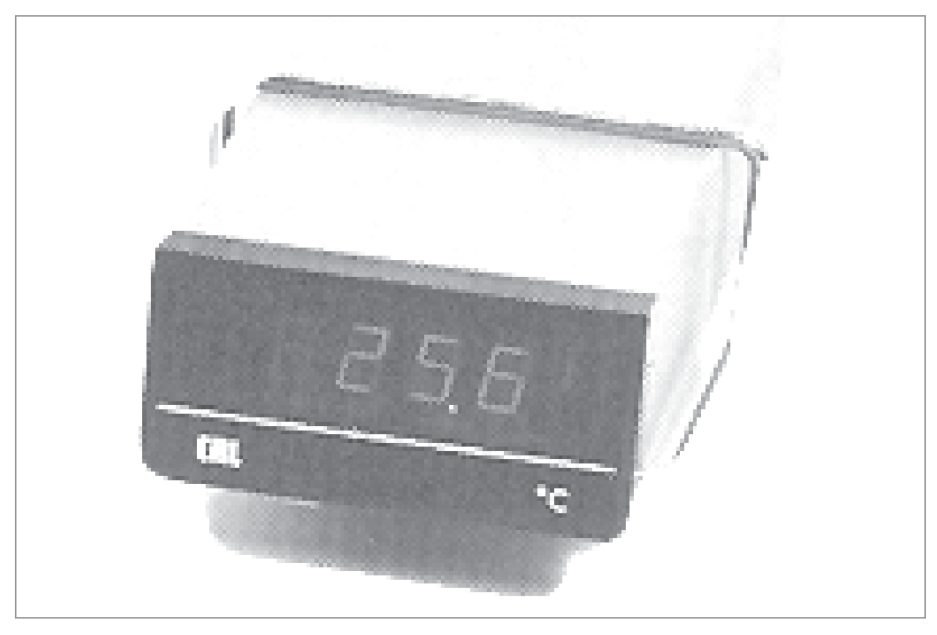
Stevenson's Screen: Surface temperature is recorded at a height of 4 ft (1.25 m) above ground in shade, inside a Stevenson's Screen — a louvred white-painted wooden box that protects instruments from direct radiation while allowing free air circulation.
3. Types of Temperature
| Type | Definition |
|---|---|
| Surface Temperature | Temperature recorded at 4 ft (1.25 m) above ground in shade (inside Stevenson's Screen). |
| Ambient Temperature | Temperature of the surroundings. |
| Virtual Temperature (VT) | In a thermodynamic process, the temperature at which dry air parcel would have the same pressure and density as a moist parcel of air. VT allows use of dry air equation of state for moist air also. VT is always higher than actual temperature. |
4. Heat and Temperature
Heat is energy transferred because of a temperature difference. Internal energy is energy stored in the substance.
Temperature is the average KE of all molecules and atoms of a substance.
Heat is energy transferred because of a temperature difference; internal energy is energy stored in a substance. Temperature alone does not tell us the total internal energy of a quantity of material. Keep these three ideas separate when explaining atmospheric heating.
Temperature is the average KE of all molecules and atoms of a substance.
Heat is energy transferred because of a temperature difference; internal energy is energy stored in a substance. Temperature alone does not tell us the total internal energy of a quantity of material. Keep these three ideas separate when explaining atmospheric heating.
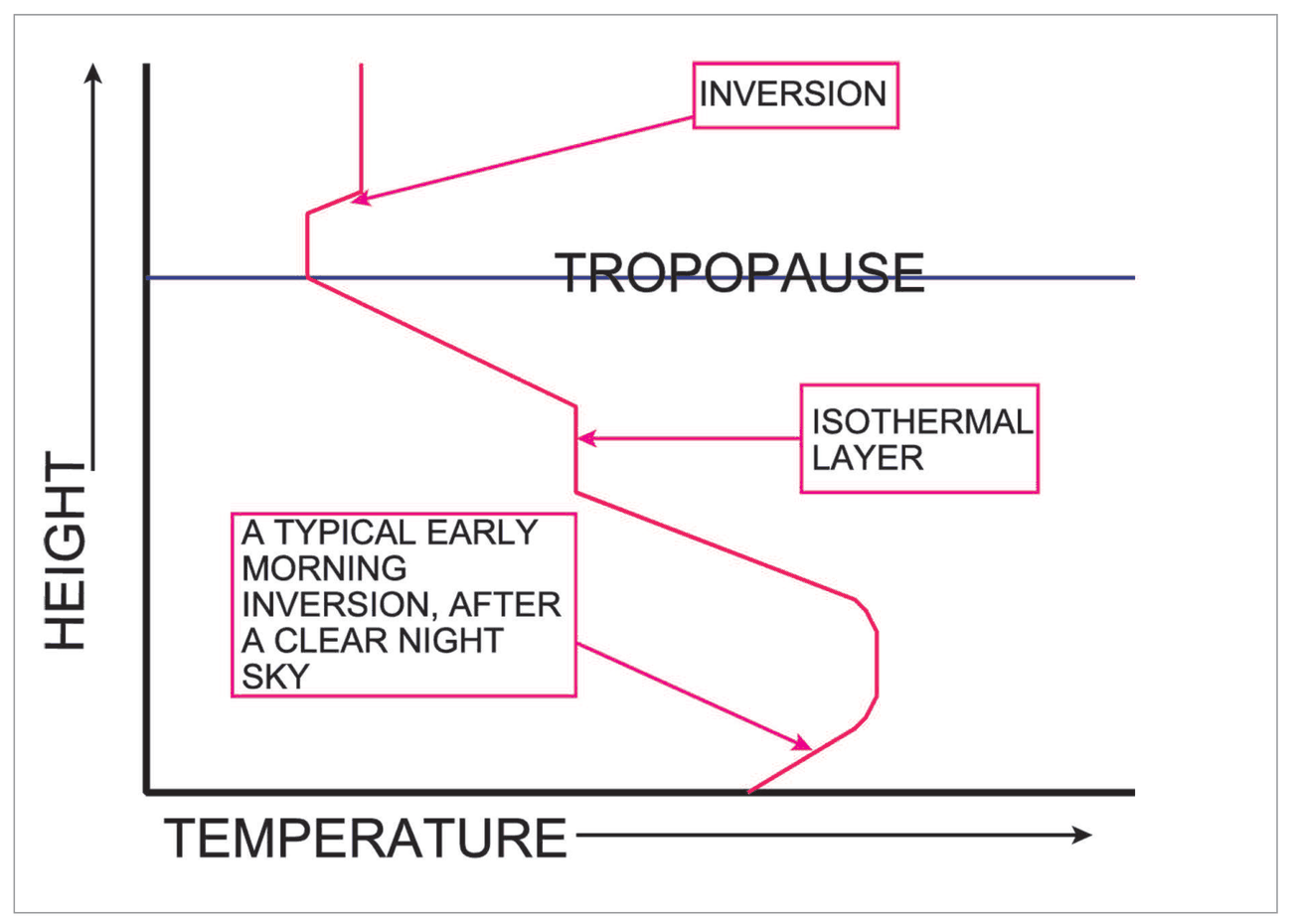
🎯 Exam Tip: Keep temperature, stored internal energy and energy transferred as heat separate. Temperature alone does not state the internal energy of a whole object.
5. Specific Heat and Latent Heat
Specific Heat
Specific Heat is the heat required to raise the temperature of unit mass of a substance by 1°C.
| Substance | Specific Heat (relative) |
|---|---|
| Water | 1 (highest — reference value) |
| Ice | 0.5 |
| Soil (Land) | 0.2 |
⚠️ Aviation Implication: Because land has a much lower specific heat than water (0.2 vs 1.0), land heats and cools much faster than the sea. This drives sea breezes, land breezes, and monsoon circulation.
Latent Heat
Latent Heat is defined as the "amount of heat absorbed or released during change of phase from/to solid/liquid/vapour".
• Absorbed during: solid → liquid, liquid → vapour
• Released during: vapour → liquid (condensation), liquid → solid (freezing)
Latent heat is "hidden" — it does not change temperature, only phase.
• Absorbed during: solid → liquid, liquid → vapour
• Released during: vapour → liquid (condensation), liquid → solid (freezing)
Latent heat is "hidden" — it does not change temperature, only phase.
6. Evaporation, Condensation and Latent Heat
When water changes to vapour, a certain quantity of heat is supplied. To change boiling water into vapour requires more than five times as much heat as needed to bring ice cold water to the boil.
Once boiling has begun, the temperature remains constant — heat supplied at this stage is latent. It is released as latent heat when vapour condenses to water.
The latent heat absorbed by melting of ice or evaporation of water at the earth's surface is subsequently released in the atmosphere by condensation or freezing.
Once boiling has begun, the temperature remains constant — heat supplied at this stage is latent. It is released as latent heat when vapour condenses to water.
The latent heat absorbed by melting of ice or evaporation of water at the earth's surface is subsequently released in the atmosphere by condensation or freezing.
🎯 Key Point: Evaporation = heat absorbed from surroundings = cooling effect. Condensation = heat released = warming effect. This is why clouds release heat (Latent Heat Release = LHR) — critical for thunderstorm development!
flowchart LR
    A[Ice / Solid] -->|Melting — absorbs Latent Heat| B[Water / Liquid]
    B -->|Evaporation — absorbs Latent Heat| C[Water Vapour]
    C -->|Condensation — releases Latent Heat| B
    B -->|Freezing — releases Latent Heat| A
    C -->|Sublimation — absorbs| A
    A -->|Deposition — releases| C
7. Methods of Heat Transfer
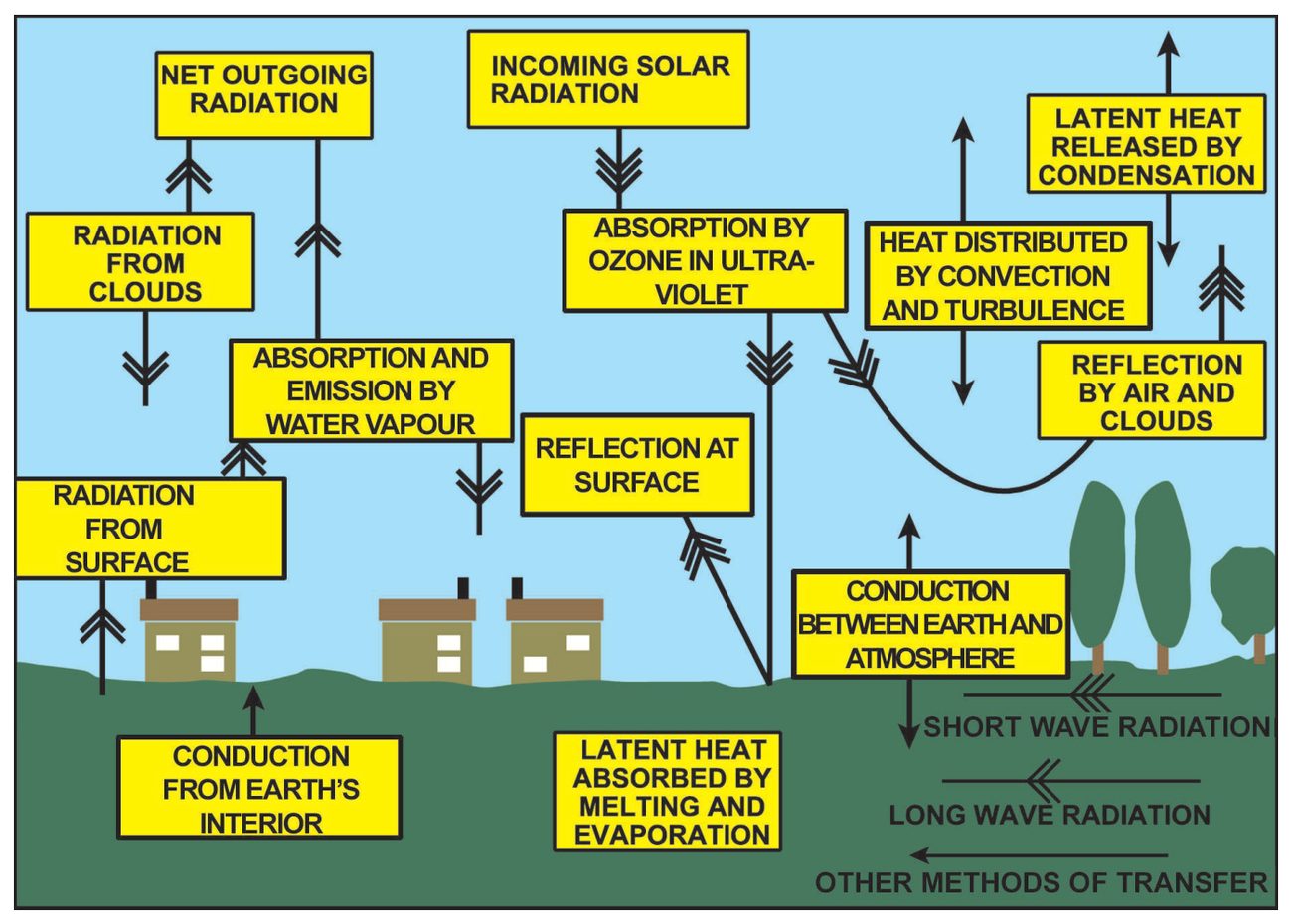
Heat is transferred by Conduction, Convection, Radiation, and other methods. In the atmosphere, Radiation plays the most significant role.
| Method | Definition | Significance in Atmosphere |
|---|---|---|
| Conduction | Physical transfer by molecular contact | Important very close to the ground. Heats lowest air layer in contact with warm surface. |
| Convection | Bodily transfer of fluid to colder part of the fluid. More than 70% of earth covered by water → convection highly important. | Free Convection = intense solar heating. Forced Convection = topography. Air lifts to higher levels and transfers heat. |
| Radiation | Every body radiates at its temperature. Medium neither affected nor required. Solar radiation heats earth directly. | Most important in the atmosphere. Long and short wave radiation. |
| Advection | Horizontal motion of the atmosphere transferring heat. | Transfers heat horizontally by winds (e.g., warm/cold advection). |
| Turbulence | Irregular eddy motion of the atmosphere causes redistribution of heat. | Important in the lowest atmospheric layers. |
| Latent Heat Release | Latent heat absorbed by evaporation is released by condensation or freezing. | Released in the atmosphere — major heat source for cloud systems and thunderstorms. |
In the Troposphere: All above processes transfer heat.
In the Stratosphere: Neither convection nor latent heat has influence. Short wave radiation heats it up due to ozone absorption.
In the Stratosphere: Neither convection nor latent heat has influence. Short wave radiation heats it up due to ozone absorption.
8. Insolation
Insolation is the total amount of solar radiation received over a particular area.
Insolation depends on the obliquity (angle) of sun's rays:
Insolation depends on the obliquity (angle) of sun's rays:
- Maximum when sun is overhead (vertical rays cover less area → more energy per unit area)
- Least at sunrise and sunset (oblique rays spread over large area)
- Maximum insolation in the Tropics (between Tropic of Cancer and Tropic of Capricorn)
- Least at the Poles
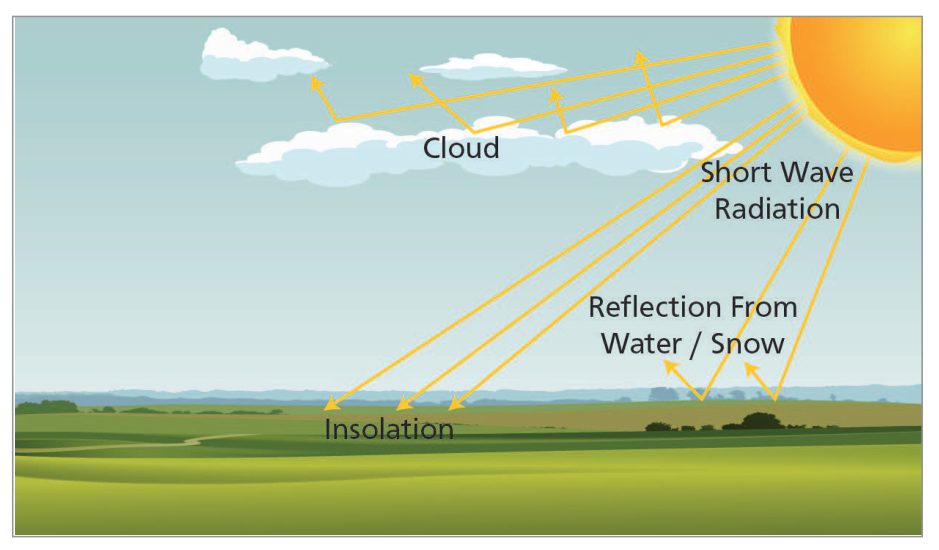
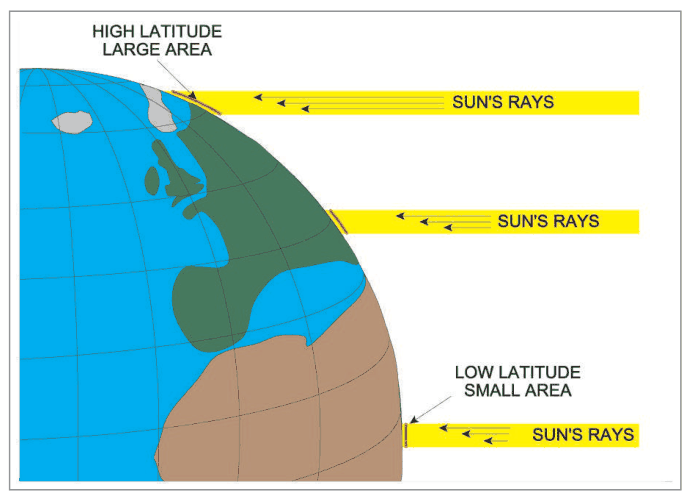
Fig 3.1: Insolation and Obliquity of Sun's Rays
9. Laws of Radiation
Black Body: Objects emit thermal radiation. An ideal blackbody absorbs all incident radiation; real objects need not behave as perfect blackbodies.
| Law | Statement | Formula / Key Point |
|---|---|---|
| Stefan Boltzmann's Law | The total amount of energy radiated by a black body is proportional to the fourth power of its absolute temperature. | E ∝ T⁴ Hence intense radiation is emitted by hot bodies like the sun. |
| Wien's Law | The wavelength of most intense radiation is inversely proportional to the absolute temperature. | Hot bodies (like sun) → Short Waves Colder bodies (like earth) → Long Waves |
| Planck's Law | Describes distribution of radiated energy with absolute temperature. | Curve is a right-skewed central distribution. |
Stefan Boltzmann's Law:
E ∝ T⁴
E ∝ T⁴
If temperature doubles: E increases by 2⁴ = 16 times
Example: Sun (T ≈ 6000K) radiates much more intensely than Earth (T ≈ 300K).
Ratio = (6000/300)⁴ = 20⁴ = 160,000 times more energy per unit area from the Sun.
Example: Sun (T ≈ 6000K) radiates much more intensely than Earth (T ≈ 300K).
Ratio = (6000/300)⁴ = 20⁴ = 160,000 times more energy per unit area from the Sun.
🎯 Memory Aid:
Stefan = T to the FOURTH (Total energy)
Wien = Wavelength INVERSELY proportional to T (hot = short wave, cold = long wave)
"Hot Sun = Short Wave; Cold Earth = Long Wave" — this is central to the greenhouse effect!
Stefan = T to the FOURTH (Total energy)
Wien = Wavelength INVERSELY proportional to T (hot = short wave, cold = long wave)
"Hot Sun = Short Wave; Cold Earth = Long Wave" — this is central to the greenhouse effect!
10. Solar Radiation
The temperature of the surface of the sun is about 6000°C. Solar radiation is therefore mainly Short Wave radiation.
The solar spectrum (visible = VIBGYOR — Violet, Indigo, Blue, Green, Yellow, Orange, Red):
The solar spectrum (visible = VIBGYOR — Violet, Indigo, Blue, Green, Yellow, Orange, Red):
| Type | Percentage of Solar Radiation | Nature |
|---|---|---|
| IR (Infra-Red) | 46% | Beyond red end of spectrum; invisible |
| Visible Light | 45% | VIBGYOR — white light |
| UV (Ultra-Violet) | 9% | Beyond violet end; absorbed by ozone |
Complete solar radiation (including visible, UV, and IR) is responsible for all the heat the earth receives from the sun as short wave radiation.
🎯 Mnemonic: "46-45-9" or "I-V-U"
IR = 46%, Visible = 45%, UV = 9%. Total = 100%.
"Infra-Red is the biggest slice of the solar pie."
IR = 46%, Visible = 45%, UV = 9%. Total = 100%.
"Infra-Red is the biggest slice of the solar pie."
11. Terrestrial Radiation & Nocturnal Radiation
Terrestrial Radiation
The earth radiates at its own temperature and loses heat. These are called Terrestrial Radiation. They are Long Wave Infra-Red (IR) radiation and are invisible.
The earth receives heat as short-wave radiation from the sun and loses heat as long-wave radiation.
The earth receives heat as short-wave radiation from the sun and loses heat as long-wave radiation.
Nocturnal Radiation
At night, the short-wave radiation from the sun is absent. Only the earth radiates and loses heat. The radiation emitted by the earth at night is called Nocturnal Radiation.
⚠️ Aviation Significance: Nocturnal radiation causes surface cooling at night → ground fog formation, radiation fog, frost → hazardous for takeoff/landing!
12. Radiation and Heat Budget / Albedo
Radiation and Heat Budget
Since the mean temperature of the earth has remained almost unchanged over a long period, the heat received from the sun as short-wave radiation is returned to space as terrestrial radiation and are equal.
| Fate of Incoming Solar Radiation | Percentage |
|---|---|
| Absorbed by Earth Surface | 51% |
| Absorbed by Water Vapour, Dust, Ozone | 16% |
| Absorbed by Clouds | 3% |
| Total Absorbed | 70% |
| Back-scattered by Air | 6% |
| Reflected back by Clouds | 20% |
| Reflected back by Earth Surface | 4% |
| Total Reflected/Back-scattered | 30% |
| Grand Total | 100% |
Albedo
Albedo = Reflected Radiation / Incident Radiation
The 30% of solar radiation reflected back to space by the earth and clouds is the reflecting power of earth, called Albedo.
In clear weather, about 5/6 of the solar radiation reaches earth surface → about 1/6 (≈17%) is reflected.
Earth surface reflects about 10% in clear conditions.
Snow surface reflects about 80% of incident energy (very high albedo).
The 30% of solar radiation reflected back to space by the earth and clouds is the reflecting power of earth, called Albedo.
In clear weather, about 5/6 of the solar radiation reaches earth surface → about 1/6 (≈17%) is reflected.
Earth surface reflects about 10% in clear conditions.
Snow surface reflects about 80% of incident energy (very high albedo).
🎯 Exam Tip:
"Albedo = Reflecting Power of Earth" — 30% of total solar radiation is reflected (not absorbed).
Snow = high albedo (80%) → reflects most sunlight → stays cold.
Ocean = low albedo (~10%) → absorbs most sunlight → stays warmer relative to snow.
"Albedo = Reflecting Power of Earth" — 30% of total solar radiation is reflected (not absorbed).
Snow = high albedo (80%) → reflects most sunlight → stays cold.
Ocean = low albedo (~10%) → absorbs most sunlight → stays warmer relative to snow.
flowchart TD
    SUN["☀️ Incoming Solar Radiation (100%)"] --> ABS["Absorbed 70%"]
    SUN --> REF["Reflected/Scattered 30%"]
    ABS --> EARTH["Earth Surface 51%"]
    ABS --> ATM["Water Vapour, Dust, Ozone 16%"]
    ABS --> CLOUD["Clouds 3%"]
    REF --> BSCAT["Air Back-scatter 6%"]
    REF --> CREF["Cloud Reflection 20%"]
    REF --> EREF["Earth Surface Reflection 4%"]
13. Diurnal Variation of Surface Temperature
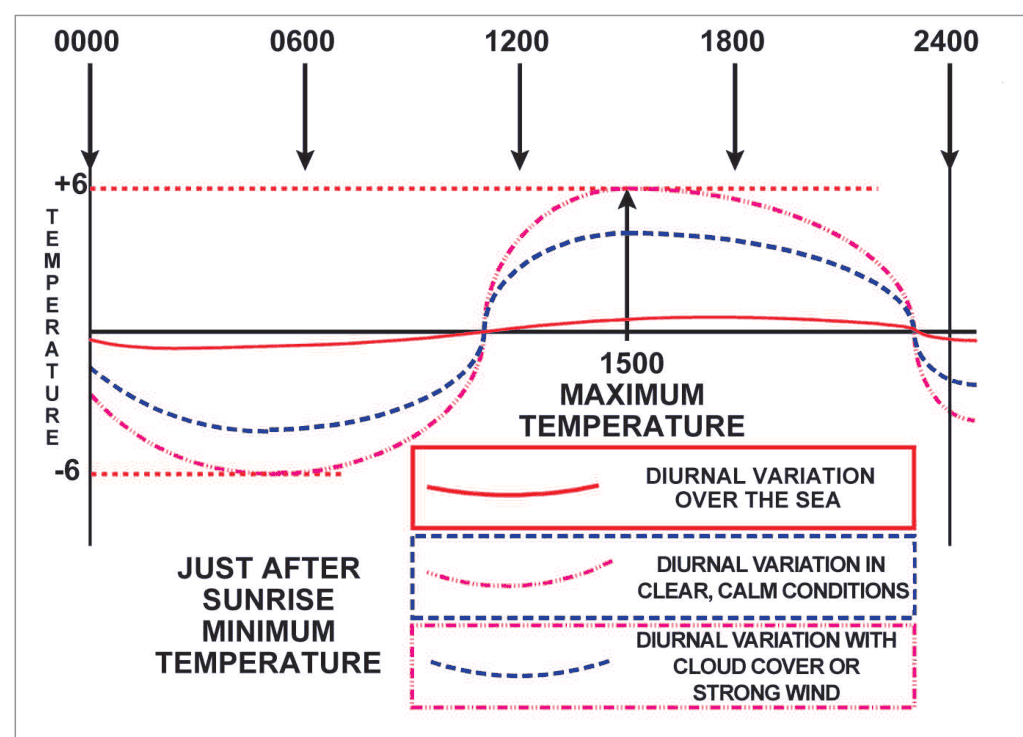
Sea vs Land: The sea surface temperature shows a variation of less than 1°C from day to night. Over land, diurnal variation may average as much as 20°C.
Near the coast, the diurnal variation near the coast may be as large as inland, but with a wind off the sea it will be small. Sea breezes have a pronounced cooling effect.
Near the coast, the diurnal variation near the coast may be as large as inland, but with a wind off the sea it will be small. Sea breezes have a pronounced cooling effect.
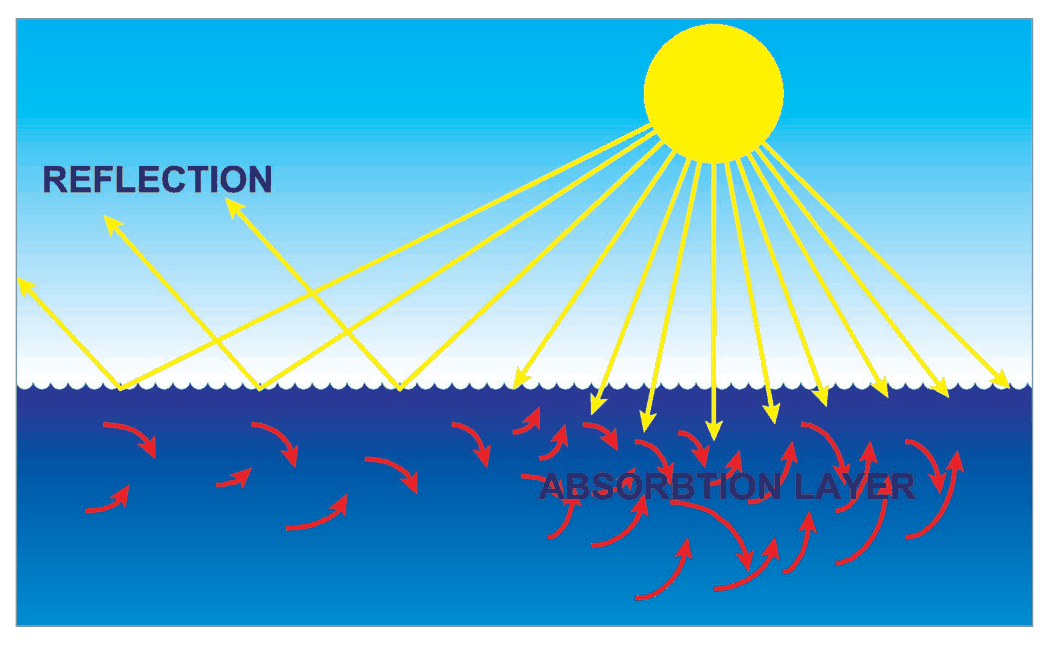
Why is the diurnal variation small over the sea?
1. Higher specific heat of water (5× that of land)
2. Larger mixing depth — surface water mixes with deeper layers
3. Evaporation from sea surface moderates temperature changes
4. Diurnal variation is maximum when wind is calm; with strong winds, surface air mixes with air above and heat spreads through the Friction Layer (up to 1 km above).
1. Higher specific heat of water (5× that of land)
2. Larger mixing depth — surface water mixes with deeper layers
3. Evaporation from sea surface moderates temperature changes
4. Diurnal variation is maximum when wind is calm; with strong winds, surface air mixes with air above and heat spreads through the Friction Layer (up to 1 km above).
Timing of Daily Temperature Extremes
| Parameter | Timing | Reason |
|---|---|---|
| Minimum Temperature | ½ to 1 hour after sunrise/dawn | Nocturnal cooling continues slightly past sunrise until incoming solar radiation exceeds outgoing terrestrial radiation. Takes 2–3 hours for heat to transfer from screen level (1.25m). |
| Maximum Temperature | Early afternoon (2–3 hours after noon) | Highest insolation at noon, but 2–3 hours needed for heat to transfer to screen level. Surface is highest at noon; screen level maximum occurs 2–3 hours later. |
Fig 3.3: Diurnal Variation of Surface Temperature
14. Effect of Clouds on Surface Temperature
A cloud cover:
The lower the cloud, the more effectively it reduces the nocturnal cooling.
- Can cut off a fair proportion of solar radiation during the day → reduces daytime heating
- A thick layer of stratus cloud can block radiation and reduces a major part going back to space
- A thick lower cloud also blocks most of the outgoing terrestrial radiation at night
The lower the cloud, the more effectively it reduces the nocturnal cooling.
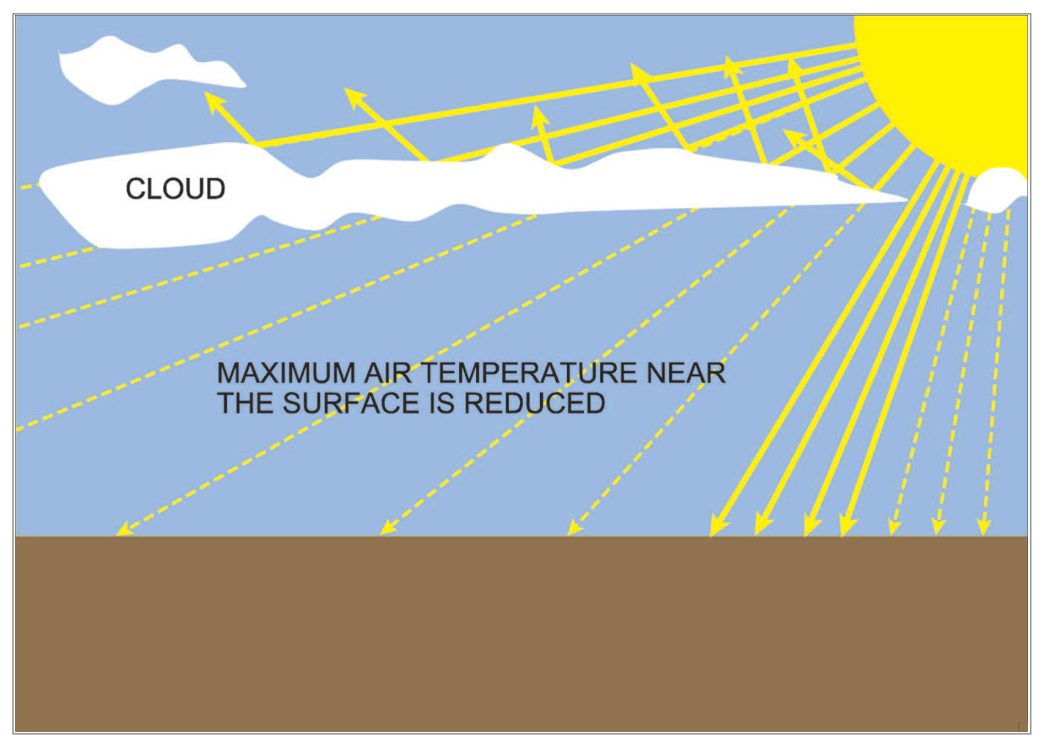
Day with Clouds:
Reduced insolation → less daytime heating
Diurnal variation is small
Reduced insolation → less daytime heating
Diurnal variation is small
Night with Clouds:
Clouds act as blanket — trap outgoing IR
Night temperature stays HIGHER
Minimum temperature NOT as low as clear night
Clouds act as blanket — trap outgoing IR
Night temperature stays HIGHER
Minimum temperature NOT as low as clear night
🎯 Exam Tip: "Cloudy nights are warmer" is a frequently tested concept. The cloud acts like a greenhouse roof — letting sunlight in (partially) and trapping the earth's heat radiation at night. Minimum temperatures on cloudy nights are higher than on clear nights.
Practice Q&A — Temperature
Practice questions with verified answer key.
Q1. Diurnal variation of temperature is greatest when wind is
(a) calm (b) light (c) strong
(a) calm (b) light (c) strong
✅ Answer: (a) calm — The diurnal range is largest with clear skies and calm or very light winds: the ground heats strongly by day and radiates freely at night, and there is no mixing to even out the temperature.
❌ (c) A strong wind mixes the air and reduces the range. (b) Even a light wind begins to blur the extremes; the largest range is in clear, calm conditions.
💡 Biggest daily swing: clear sky + calm. Cloud or wind shrinks it.
Q2. Diurnal variation of temperature is maximum over
(a) forest (b) ocean (c) land
(a) forest (b) ocean (c) land
✅ Answer: (c) land
Land has low specific heat (0.2) — heats and cools rapidly. Ocean has high specific heat (1.0) and large mixing depth.
Land has low specific heat (0.2) — heats and cools rapidly. Ocean has high specific heat (1.0) and large mixing depth.
❌ (b) Ocean — least diurnal variation (less than 1°C). (a) Forest — moderate, less than open land due to canopy and moisture.
💡 Land > Forest > Sea for diurnal temperature range. Desert land has the highest diurnal range.
Q3. On a clear day the amount of solar radiation received by earth surface is
(a) ¼ (b) 30% (c) 5/6
(a) ¼ (b) 30% (c) 5/6
✅ Answer: (c) 5/6
About 5/6 of solar radiation reaches the earth surface on a clear day (the rest is reflected, scattered or absorbed by the atmosphere).
About 5/6 of solar radiation reaches the earth surface on a clear day (the rest is reflected, scattered or absorbed by the atmosphere).
💡 5/6 ≈ 83% reaches surface on clear day. Roughly 1/6 is absorbed or reflected by clear atmosphere. Note: total absorption is 70% but this Q refers to clear day surface receipt.
Q4. ALBEDO is
(a) Radiation received by earth (b) Amount of heat (c) Reflecting power of earth
(a) Radiation received by earth (b) Amount of heat (c) Reflecting power of earth
✅ Answer: (c) Reflecting power of earth
Albedo = Reflected Radiation / Incident Radiation. It is the reflecting power.
Albedo = Reflected Radiation / Incident Radiation. It is the reflecting power.
❌ (a) Radiation received = Insolation. (b) Amount of heat = vague, not definition of albedo.
💡 Albedo = "whiteness" (from Latin albus). High albedo = white/reflective (snow). Low albedo = dark/absorptive (ocean, forest).
Q5. During Day the ambient temperature is ……… than ground
(a) Lower (b) Higher (c) Same
(a) Lower (b) Higher (c) Same
✅ Answer: (a) Lower — By day the ground heats faster than the air above it, so the air (screen) temperature is lower than the ground surface temperature. At night the ground cools faster and the air is the warmer of the two.
❌ (b) Higher and (c) Same: the ground absorbs the sunshine first and passes heat up to the air, so it is hotter than the air by day.
💡 Day: ground warmer than the air. Night: ground colder than the air.
Q6. Diurnal variation of temperature over ocean is
(a) More than land (b) Above 3°C (c) Less than 1°C
(a) More than land (b) Above 3°C (c) Less than 1°C
✅ Answer: (c) Less than 1°C
Sea surface temperature varies by less than 1°C from day to night due to high specific heat and mixing.
Sea surface temperature varies by less than 1°C from day to night due to high specific heat and mixing.
❌ (b) Above 3°C — this is typical of land. (a) More than land — the opposite is true.
💡 Key figure: Ocean diurnal variation < 1°C; Land diurnal variation up to 20°C.
Q7. At a coastal station the diurnal variation of temperature depends on
(a) Wind direction (b) Wind speed (c) Radiation
(a) Wind direction (b) Wind speed (c) Radiation
✅ Answer: (a) Wind direction — At a coastal station the daily temperature range depends mainly on the wind direction: with a wind off the sea the range is small, with a wind off the land it can be large.
❌ (b) Wind speed and (c) radiation matter everywhere, but at the coast it is the direction, sea or land, that decides the range.
💡 Coast: sea wind = small range, land wind = large range.
Q8. Snow surface reflects about ……… % of solar radiation.
(a) 75% (b) 80% (c) 90%
(a) 75% (b) 80% (c) 90%
✅ Answer: (b) 80%
Snow has a very high albedo — reflects about 80% of incident solar radiation.
Snow has a very high albedo — reflects about 80% of incident solar radiation.
❌ (a) 75% and (c) 90% — close but not the textbook value. Snow = 80% albedo.
💡 High albedo of snow explains why polar regions stay cold — most incoming solar energy is reflected away.
Q9. Amount of Solar radiation received per unit area is
(a) Insolation (b) Convection (c) Radiation
(a) Insolation (b) Convection (c) Radiation
✅ Answer: (a) Insolation
❌ (b) Convection — heat transfer method. (c) Radiation — general term for electromagnetic waves.
💡 Insolation = INcoming SOLar radiATION. Easy to remember from the acronym.
Q10. Solar radiation received by the earth is
(a) Long Wave (b) Albedo (c) Shortwave
(a) Long Wave (b) Albedo (c) Shortwave
✅ Answer: (c) Shortwave
Sun's surface temperature is about 5800 K (about 5500°C) → Wien's Law → short wavelength radiation. Earth (≈15°C) radiates long wave.
Sun's surface temperature is about 5800 K (about 5500°C) → Wien's Law → short wavelength radiation. Earth (≈15°C) radiates long wave.
💡 Rule: Hot source → Short wave. Cool source → Long wave. Sun = short wave. Earth = long wave (terrestrial).
Q11. Rise in temperature of a surface is proportional to its specific heat
(a) Directly (b) Inversely
(a) Directly (b) Inversely
✅ Answer: (b) Inversely
Higher specific heat = more heat needed per degree rise = SLOWER temperature rise. Land (sp. heat 0.2) heats faster than water (sp. heat 1.0).
Higher specific heat = more heat needed per degree rise = SLOWER temperature rise. Land (sp. heat 0.2) heats faster than water (sp. heat 1.0).
💡 Temperature rise = Heat supplied / (mass × specific heat). So rise ∝ 1/specific heat — inversely proportional.
Q12. Specific heat of land is ……… than that of water
(a) Lower (b) Same (c) Higher
(a) Lower (b) Same (c) Higher
✅ Answer: (a) Lower — The specific heat of land (about 0.2) is much lower than that of water (about 1.0), so land heats up and cools down much faster than water.
❌ (b) Same and (c) Higher are wrong: if land had the higher specific heat it would warm more slowly than the sea, the opposite of what we see.
💡 Low specific heat = heats and cools quickly (land). High specific heat = slow (sea).
Q13. Minimum temperature is reached at
(a) Sunrise (b) Midnight (c) ½–1 hour after dawn
(a) Sunrise (b) Midnight (c) ½–1 hour after dawn
✅ Answer: (c) ½–1 hour after dawn
Nocturnal cooling continues slightly after sunrise until incoming solar radiation exceeds outgoing terrestrial radiation.
Nocturnal cooling continues slightly after sunrise until incoming solar radiation exceeds outgoing terrestrial radiation.
❌ (a) Sunrise — cooling continues past sunrise. (b) Midnight — temperature continues falling after midnight through the night.
💡 "Min just after sun begins" — minimum temperature is NOT at sunrise but ½–1 hr later. Frequently tested!
Q14. An air parcel is lifted till it gets saturated. The temperature attained by it is called
(a) Potential temperature (b) Dew Point (c) Wet bulb
(a) Potential temperature (b) Dew Point (c) Wet bulb
✅ Answer: (b) Dew Point
The dew point is the temperature to which air must be cooled (at constant pressure and moisture content) to become saturated.
The dew point is the temperature to which air must be cooled (at constant pressure and moisture content) to become saturated.
❌ (a) Potential temperature — temperature a parcel would have if brought to 1000 hPa adiabatically. (c) Wet bulb — temperature after evaporative cooling.
💡 Dew Point = saturation temperature. When air parcel reaches dew point → saturation → condensation → cloud formation.
Q15. Cloudy nights are
(a) cold (b) normal (c) warm
(a) cold (b) normal (c) warm
✅ Answer: (c) warm
Clouds trap outgoing terrestrial (long wave) radiation, acting like a blanket and keeping the surface warmer at night.
Clouds trap outgoing terrestrial (long wave) radiation, acting like a blanket and keeping the surface warmer at night.
❌ (a) Cold — this applies to clear nights with strong nocturnal radiation. (b) Normal — not specific.
💡 Classic DGCA question. "Cloudy nights are warmer than clear nights" — clouds act as a greenhouse blanket. Minimum temperatures on cloudy nights are higher.
Q17. Higher the temperature, ……… would be the wavelength of emitted radiation
(a) longer (b) shorter
(a) longer (b) shorter
✅ Answer: (b) shorter — By Wien's law the wavelength of the most intense radiation is inversely proportional to the absolute temperature: the hotter the body, the shorter the wavelength. The Sun (about 5800 K) emits short waves; the Earth emits long waves.
❌ (a) Longer is the opposite: it describes cooler bodies.
💡 Hot = short wave. Cool = long wave.
Q21. The solar radiation consists of about 46%
(a) UV (b) IR (c) Visible
(a) UV (b) IR (c) Visible
✅ Answer: (b) IR (Infra-Red)
Solar radiation: IR = 46%, Visible = 45%, UV = 9%.
Solar radiation: IR = 46%, Visible = 45%, UV = 9%.
❌ (a) UV = only 9%. (c) Visible = 45%, not 46%.
💡 "Infra-Red is the biggest slice" — 46% IR, 45% Visible, 9% UV. Mnemonic: I-V-U or 46-45-9.
Q22. The wavelength of most intense radiation is ……… proportional to temperature
(a) Directly (b) Inversely
(a) Directly (b) Inversely
✅ Answer: (b) Inversely
Wien's Law: λmax = constant/T. Higher temperature → shorter (smaller) wavelength. Inversely proportional.
Wien's Law: λmax = constant/T. Higher temperature → shorter (smaller) wavelength. Inversely proportional.
💡 Wien's Law: Hot sun → Short wave; Cold earth → Long wave. The higher the temperature, the shorter the peak wavelength.
Q27. The flow of heat near earth surface is 77% by
(a) Sensible Heat (b) Latent Heat
(a) Sensible Heat (b) Latent Heat
✅ Answer: (b) Latent Heat — Latent heat (evaporation, condensation, sublimation) carries about 77% of the heat that flows from the Earth's surface to the atmosphere; sensible heat carries about 23%.
❌ (a) Sensible heat is only about 23% of the total.
💡 Latent 77%, sensible 23%.
Q28. −40°C = −40°F
(a) True (b) False
(a) True (b) False
✅ Answer: (a) True — The Celsius and Fahrenheit scales cross at −40: F = (9/5)(−40) + 32 = −40. So −40 °C = −40 °F.
❌ (b) False would be correct only if the scales never met; they meet at −40.
💡 −40 is the one temperature that is the same in both scales.
Q29. Surface Temperature is recorded at a height of ……… above ground
(a) 1.5 m (b) 1.25 m (c) 2 m
(a) 1.5 m (b) 1.25 m (c) 2 m
✅ Answer: (b) 1.25 m (4 ft)
Inside a Stevenson's Screen, in shade.
Inside a Stevenson's Screen, in shade.
💡 4 ft = 1.25 m = standard height for surface temperature measurement. Stevenson's Screen = louvred white box.
Q30. The liquid used in Minimum Thermometer is
(a) mercury (b) alcohol (c) spirit
(a) mercury (b) alcohol (c) spirit
✅ Answer: (b) Alcohol
Mercury freezes at −39°C, so alcohol (freezes below −100°C) is used in minimum thermometers to measure very low temperatures.
Mercury freezes at −39°C, so alcohol (freezes below −100°C) is used in minimum thermometers to measure very low temperatures.
❌ (a) Mercury — used in maximum thermometers and standard thermometers, but NOT minimum thermometers (freezes too easily).
💡 "Min therm = Alcohol" — remember: alcohol stays liquid at very low temperatures unlike mercury.
Q31. Freezing point of water is
(a) 0°F (b) 12°F (c) 22°F (d) 32°F
(a) 0°F (b) 12°F (c) 22°F (d) 32°F
✅ Answer: (d) 32°F
Freezing/melting point of water = 0°C = 32°F = 273 K.
Freezing/melting point of water = 0°C = 32°F = 273 K.
💡 Essential conversions: 0°C = 32°F = 273K. Boiling: 100°C = 212°F = 373K. Absolute zero: −273.15°C = 0K.
Q35. Convert 68°F to Kelvin temperature
(a) 283K (b) 294K (c) 299K (d) 293K
(a) 283K (b) 294K (c) 299K (d) 293K
✅ Answer: (d) 293K — C = 5/9 × (68 − 32) = 5/9 × 36 = 20 °C. K = 20 + 273 = 293 K.
❌ (b) 294 K and (c) 283 K do not follow from 20 °C; (a) 233 K is −40 °C.
💡 K = °C + 273 (273.15 exactly). Convert °F to °C first.
Master Reference Tables — Chapter 3
All Numerical Values
| Parameter | Value |
|---|---|
| Temperature conversion: °F from °C | F = (9C/5) + 32 |
| Temperature conversion: °C from °F | C = 5(F−32)/9 |
| Temperature conversion: K from °C | K = C + 273 |
| Special crossover temperature | −40°C = −40°F |
| Absolute zero | −273.15°C = 0 K |
| Freezing point of water | 0°C = 32°F = 273 K |
| Boiling point of water | 100°C = 212°F = 373 K |
| Surface temp measurement height | 4 ft = 1.25 m (in Stevenson's Screen) |
| Minimum temperature timing | ½ to 1 hour after sunrise |
| Maximum temperature timing | 2–3 hours after noon (early afternoon) |
| Ocean diurnal temp variation | < 1°C |
| Land diurnal temp variation | Up to 20°C |
| Specific heat of water | 1.0 (highest) |
| Specific heat of ice | 0.5 |
| Specific heat of soil/land | 0.2 |
| Solar radiation: IR component | 46% |
| Solar radiation: Visible light | 45% |
| Solar radiation: UV component | 9% |
| Solar radiation absorbed by earth surface | 51% |
| Absorbed by water vapour, dust, ozone | 16% |
| Absorbed by clouds | 3% |
| Total absorbed | 70% |
| Back-scattered by air | 6% |
| Reflected by clouds | 20% |
| Reflected by earth surface | 4% |
| Total reflected (Albedo of Earth) | 30% |
| Clear day radiation reaching earth surface | 5/6 (≈83%) |
| Snow surface albedo | 80% |
| Sun surface temperature | 6000°C |
| Friction layer depth (wind mixing) | Up to 1 km above |
| Convection covers | More than 70% of earth (water covered) |
Laws of Radiation Summary
| Law | Key Formula | Meaning |
|---|---|---|
| Stefan Boltzmann | E ∝ T⁴ | Total energy ∝ 4th power of absolute temperature |
| Wien's | λmax ∝ 1/T | Peak wavelength inversely ∝ temperature. Hot = short wave; Cold = long wave |
| Planck's | Right-skewed curve | Distribution of energy with wavelength at given temperature |
Mnemonics / Memory Aids
Solar Radiation Composition — "I-V-U 46-45-9":
IR = 46% | Visible = 45% | UV = 9%
Heat Budget — "51-16-3 = 70% absorbed; 6-20-4 = 30% reflected":
Earth 51%, Atm 16%, Clouds 3% = 70% absorbed
Air 6%, Clouds 20%, Earth 4% = 30% reflected
Specific Heat — "Water-Ice-Soil: 1 - 0.5 - 0.2" (halves each time)
Temperature Timing:
• MIN = ½–1 hr after dawn (not at dawn!)
• MAX = 2–3 hr after noon (not at noon!)
Wien's Law: "Hot = Short, Cold = Long" (Sun = short wave; Earth = long wave)
Stefan's Law: "E is T to the FOURTH" (E ∝ T⁴)
Cloudy nights are WARMER — clouds trap outgoing IR radiation
Clear nights are COLDER — nocturnal radiation escapes freely
IR = 46% | Visible = 45% | UV = 9%
Heat Budget — "51-16-3 = 70% absorbed; 6-20-4 = 30% reflected":
Earth 51%, Atm 16%, Clouds 3% = 70% absorbed
Air 6%, Clouds 20%, Earth 4% = 30% reflected
Specific Heat — "Water-Ice-Soil: 1 - 0.5 - 0.2" (halves each time)
Temperature Timing:
• MIN = ½–1 hr after dawn (not at dawn!)
• MAX = 2–3 hr after noon (not at noon!)
Wien's Law: "Hot = Short, Cold = Long" (Sun = short wave; Earth = long wave)
Stefan's Law: "E is T to the FOURTH" (E ∝ T⁴)
Cloudy nights are WARMER — clouds trap outgoing IR radiation
Clear nights are COLDER — nocturnal radiation escapes freely
Quick Revision Summary
Top 10 Exam Points — Temperature:
1. F = (9C/5) + 32; C = 5(F−32)/9; K = C + 273; Special: −40°C = −40°F
2. Surface temperature measured at 4 ft (1.25 m) in Stevenson's Screen
3. Minimum temperature occurs ½–1 hour after sunrise (NOT at sunrise)
4. Maximum temperature occurs 2–3 hours after noon
5. Ocean diurnal variation < 1°C; Land up to 20°C
6. Specific heat: Water = 1.0, Ice = 0.5, Soil = 0.2; Land heats/cools faster
7. Solar radiation: IR 46%, Visible 45%, UV 9%; Sun emits SHORT wave
8. Earth absorbs 70% (51% surface + 16% atm + 3% clouds); reflects 30% (Albedo)
9. Snow albedo = 80%; Earth surface albedo = 4% (direct reflection)
10. Stefan's Law: E ∝ T⁴; Wien's Law: λmax ∝ 1/T (hot = short wave; cold = long wave); Cloudy nights are WARMER
1. F = (9C/5) + 32; C = 5(F−32)/9; K = C + 273; Special: −40°C = −40°F
2. Surface temperature measured at 4 ft (1.25 m) in Stevenson's Screen
3. Minimum temperature occurs ½–1 hour after sunrise (NOT at sunrise)
4. Maximum temperature occurs 2–3 hours after noon
5. Ocean diurnal variation < 1°C; Land up to 20°C
6. Specific heat: Water = 1.0, Ice = 0.5, Soil = 0.2; Land heats/cools faster
7. Solar radiation: IR 46%, Visible 45%, UV 9%; Sun emits SHORT wave
8. Earth absorbs 70% (51% surface + 16% atm + 3% clouds); reflects 30% (Albedo)
9. Snow albedo = 80%; Earth surface albedo = 4% (direct reflection)
10. Stefan's Law: E ∝ T⁴; Wien's Law: λmax ∝ 1/T (hot = short wave; cold = long wave); Cloudy nights are WARMER
Ghost Aviator
Study Meteorology with other student pilots
Join the free Meteorology group on Telegram. Stuck on a doubt? Type /q and your question, and get an answer from Ghost Aviator's notes.
LIVE BATCH
Study Aviation Meteorology live with the Captain
Small batch of 10 · live doubt-clearing · 4–6 weeks · ₹12,999 ₹7,999
Reinforce Chapter 3: Temperature
Test your knowledge and practice actual exam questions for Aviation Meteorology.
Planning your Pilot Training in 2026?
Calculate exact flying hours, DGCA exam fees, and living costs with our interactive calculator.