Terrestrial Magnetism
by Ghost Aviator
Table of Contents
- The Magnet and Magnetic Field
- Poles of a Magnet – Red and Blue Poles
- Attraction and Repulsion Rules
- Methods of Magnetization
- Methods of Demagnetization
- Magnetic and Non-magnetic Materials – Hard and Soft Iron
- Terrestrial Magnetism
- Magnetic Variation
- Magnetic Dip
- Field Strength and Directive Force
- Regular Changes in Earth Magnetism
- Unpredictable Changes in Earth Magnetism
- Practice Questions & Detailed Answers
- Master Reference Tables
1. The Magnet and Magnetic Field
Magnetite — an oxide of iron — has been known for thousands of years for two properties: attracting small pieces of iron, and aligning north-south when freely suspended (the basis of the primitive compass). Modern magnets are made from ferrous metals and alloys that can be given these same properties.
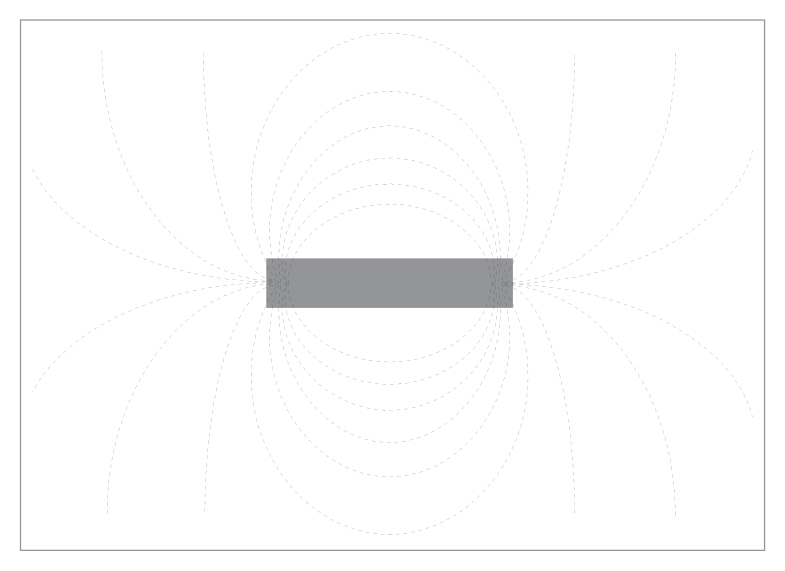
The magnetic field of a magnet is the space around it in which its magnetic influence is felt. Field lines (traced by iron filings on card) converge towards small areas near the ends of the magnet — the poles.
2. Poles of a Magnet – Red and Blue Poles
A freely suspended magnet in the earth's field aligns roughly north-south:
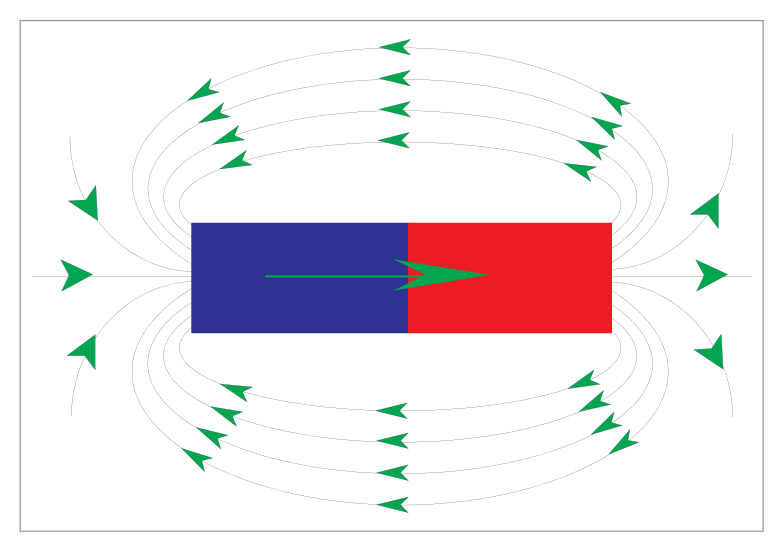
- Red pole (north-seeking pole): The end that points towards geographic north (towards the earth's magnetic north pole).
- Blue pole (south-seeking pole): The opposite end.
By convention, magnetic lines of force are directed out from the red pole and back in to the blue pole.
3. Attraction and Repulsion Rules
Like poles REPEL each other (red-red, blue-blue)
Unlike poles ATTRACT each other (red-blue)
4. Methods of Magnetization
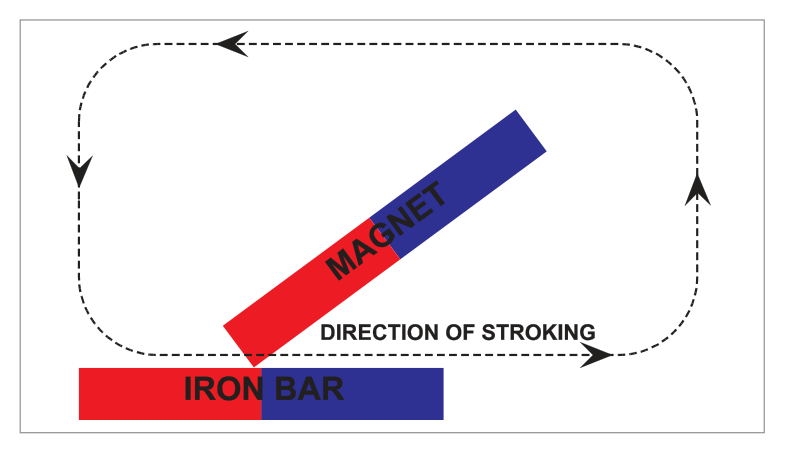
4.1 Stroking
Repeatedly stroking the bar in the same direction with one end of a magnet. The end of the bar last touched by the red pole becomes a blue pole.
4.2 Vibration or Hammering
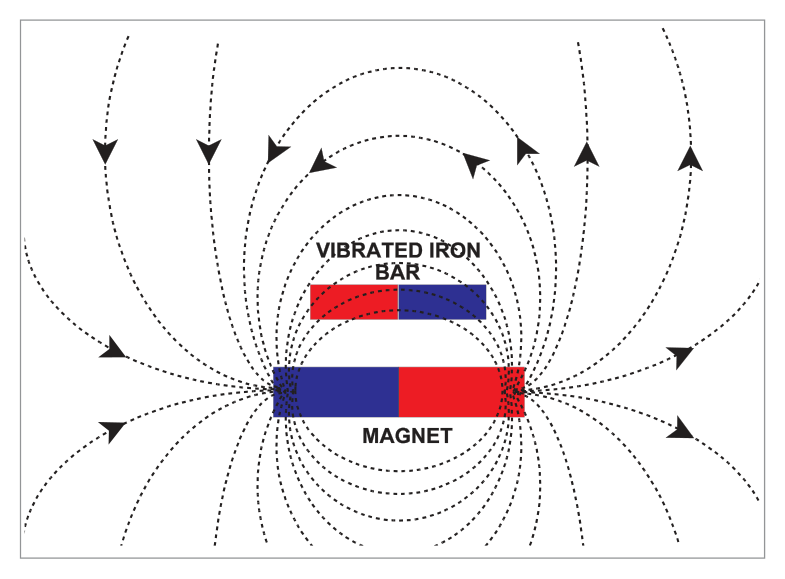
Aligning the bar with the earth's field lines and subjecting it to vibration or hammering. Induced polarity creates continuity in the field-line pattern (lines into the blue pole, out of the red pole). This is the main cause of aircraft magnetism — agitation during manufacture in the earth's field.
Example: An aircraft built on a northerly heading in the earth's field acquires a permanent red pole in the nose and a blue pole in the tail.
4.3 Placing in a Magnetic Field
Simply placing iron within a magnetic field induces polarity (especially for soft iron). Same polarity pattern as vibration method.
4.4 Solenoid (Electric Current) — Most Satisfactory
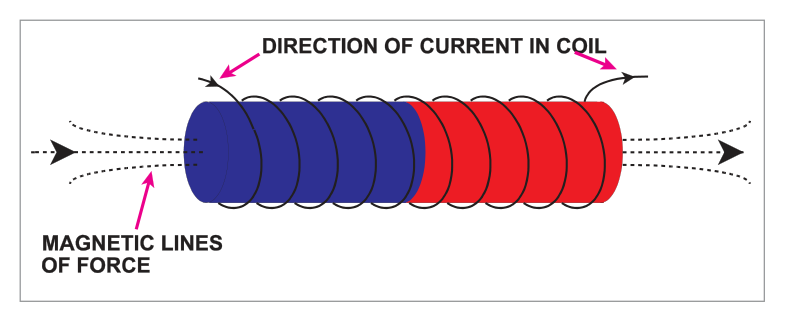
Placing the specimen inside a solenoid (cylindrical coil carrying DC). The concentrated field along the coil axis produces a high degree of magnetism. Note: magnetism induction is not unlimited — at a certain level the iron becomes magnetically saturated. Reversing current reverses the induced polarity.
5. Methods of Demagnetization
| Method | Procedure | Note |
|---|---|---|
| Shock | Place bar at right angles to earth's field and hammer | The mechanical agitation disrupts domain alignment |
| Heat | Heat to approximately 900°C | Magnetism lost permanently — does not return on cooling |
| AC Electric Current | Place in solenoid with AC, gradually reduce amplitude to zero | Most effective method — alternating field reverses polarity repeatedly while reducing intensity to zero |
6. Magnetic and Non-Magnetic Materials – Hard and Soft Iron
6.1 Ferromagnetic vs. Non-Magnetic Materials
Ferromagnetic (magnetic): Iron, steel, and alloys (nickel, cobalt, chromium, tungsten). In an aircraft these may be magnetized and cause compass deviation.
Non-magnetic (non-ferrous): Aluminium, duralumin, brass, copper, plastic, paint — do not affect the compass.
6.2 Hard Iron vs. Soft Iron
| Type | Metal Examples | Ease of Magnetization | Retention of Magnetism |
|---|---|---|---|
| Hard Iron | Cobalt steel, tungsten steel | Requires strong magnetizing field | Permanent — remains magnetized indefinitely after field removed |
| Soft Iron | Silicon iron, pure iron | Easy — weak field sufficient | Temporary (nil) — loses magnetism when field removed |
7. Terrestrial Magnetism
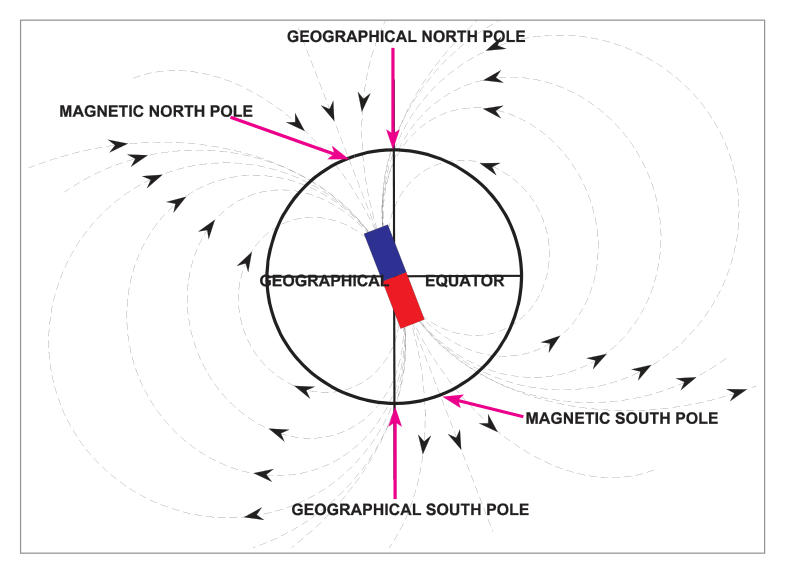
The earth behaves as though a huge permanent magnet were situated near its centre, producing a field over its surface. The poles of this hypothetical earth-magnet do not coincide with the geographic (spin-axis) poles — this misalignment is the origin of magnetic variation.
- North magnetic pole: 86°N 153°W (north of Alaska)
- South magnetic pole: 64°S 136°E (south of Australia)
- Magnetic poles are not stationary — moving at 6 to 25 NM per year
- The north magnetic pole is moving faster than the south magnetic pole
8. Magnetic Variation
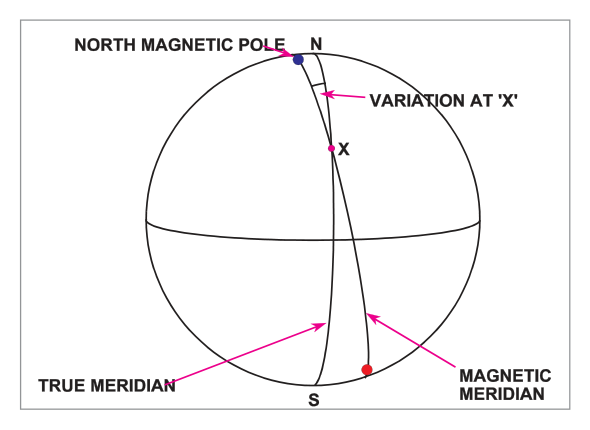
A freely suspended magnet aligns with the magnetic meridian — the direction of the horizontal component of the earth's field at that point. The magnetic meridian generally differs from the true meridian (geographic north-south).
- East variation (positive): Magnetic pole lies to the east of true north
- West variation (negative): Magnetic pole lies to the west of true north
- Range: 0° to 180°
9. Magnetic Dip
Except near the magnetic equator (where field lines are parallel to the surface), a freely suspended magnet dips below horizontal towards the nearer magnetic pole:
- North of magnetic equator: Red pole (north-seeking) dips lower
- South of magnetic equator: Blue pole (south-seeking) dips lower
- Magnetic equator: Dip = 0° (lines of force horizontal)
- United Kingdom: Dip ≈ 66°
- Magnetic poles: Dip = 90° (magnet vertical)
The magnetic equator is the line joining all points where dip = 0°. It follows approximately within 10° of latitude of the geographic equator.
10. Field Strength and Directive Force
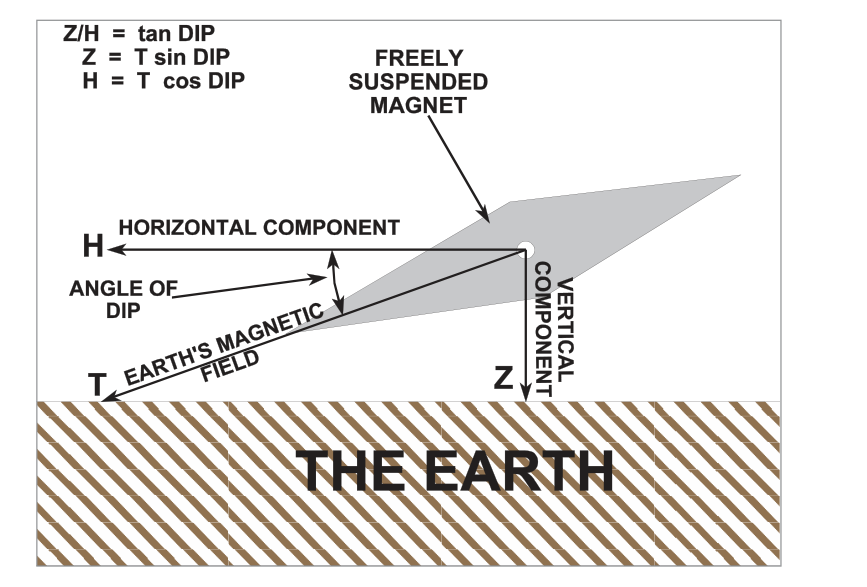
The horizontal component H is called the directive force — it is the component that aligns the compass needle with the magnetic meridian, providing the directional reference.
As latitude increases from the equator towards the poles, dip increases and H decreases. The strength of H at 60° latitude is approximately half the value of H at the magnetic equator.
graph LR
    A["Increasing Latitude
(towards poles)"] --> B["Dip increases"]
    B --> C["H (directive force) DECREASES"]
    B --> D["Z (vertical component) INCREASES"]
    C --> E["Compass becomes less reliable"]
    D --> F["Acceleration and turning errors INCREASE"]
11. Regular Changes in Earth Magnetism
11.1 Secular Change (most significant)
The most significant regular change is secular change — caused by the slow movement of the magnetic poles about the geographic poles. The cycle period is approximately 960 years.
- Westerly variation currently decreasing at 7 minutes per annum
- Predicted variation in London in year 2240 = zero
- Annual rate of change shown on navigation charts next to isogonals
11.2 Other Regular Changes (not navigationally significant)
- Diurnal (daily) variation
- Annual variation
- 11-year cycle — apparently related to the sunspot activity cycle
These regular changes (other than secular) are not of sufficient magnitude to affect normal navigation.
12. Unpredictable Changes in Earth Magnetism
- Produced by unusually large sunspots
- Occur at irregular intervals
- Can last for up to three days
- Main effect: temporary but significant change in magnetic variation
- UK: alteration unlikely to exceed 2°
- Arctic/Antarctic: change may exceed 5° and last up to 1 hour
- Directive force H can also change — in high latitudes may fall below the minimum required for efficient compass operation
- Magnetic field lines: out from red pole, into blue pole. Unit poles cannot exist.
- Like poles repel, unlike poles attract.
- Magnetization methods: stroking, vibration/hammering (main cause of aircraft magnetism), magnetic field, solenoid (best).
- Demagnetization: shock, heat (900°C), AC current (best).
- Hard iron = permanent magnetism (cobalt/tungsten steel). Soft iron = temporary (pure/silicon iron).
- Variation = angle between true and magnetic meridians (0° to 180°, E or W).
- Dip = 0° at magnetic equator, 66° in UK, 90° at poles.
- H = T cos(dip) — greatest at equator, zero at poles.
- Secular change: ~960 year cycle. UK variation decreasing 7 min/year → zero in 2240.
- Magnetic storms: caused by sunspots, last up to 3 days, up to 2° variation change in UK, up to 5° in polar regions.
Practice Questions & Detailed Answers
- (a) The nose of the aircraft is irrelevant — the magnet points to the north magnetic pole, independent of aircraft heading. "Deviation" is an error caused by aircraft magnetism.
- (b) "Variation" is the angle between true north and magnetic north — not the name for the tilt angle of the magnet.
- (c) "Declination" is an astronomical term occasionally used synonymously with variation — not the correct term for the tilt angle, which is "dip".
- (a) H = T sin dip gives Z, not H (Z is opposite to the dip angle).
- (b) H = Z tan dip is incorrect; Z = H tan dip is the correct rearrangement.
- (d) H = T tan dip would give values greater than T when dip > 45°, which is impossible since H ≤ T.
- (a) Directive force H is a property of the earth's field at a given location — it does not depend on aircraft heading.
- (b) Magnetic variation and directive force are not directly related. Variation is the angle between true and magnetic north.
- (c) As magnetic latitude increases, dip increases and H DECREASES — the opposite of this option.
- (a) "Annual" is a periodic change but much smaller in magnitude — the secular change is the dominant long-term change.
- (b) "Diurnal" means daily — a very small change unrelated to the main secular drift.
- (d) Sunspots cause magnetic storms (unpredictable changes), not the slow secular change in variation.
- (b) Hard iron is not easy to demagnetize — it requires special demagnetization treatment.
- (c) Soft iron is not difficult to magnetize — that is the defining characteristic of hard iron.
- (d) Incorrectly assigns hard-iron properties to soft iron for magnetization.
- (a) Carbon-fibre is not ferromagnetic — it does not affect compasses.
- (b) Nickel is ferromagnetic, but the source specifically lists the key ferromagnetic materials as iron, steel, and its alloys with cobalt/chromium/nickel/tungsten — option (d) is the more complete and precise answer from the source text.
- (c) Copper is explicitly listed as non-magnetic (non-ferrous) in the source text.
- (b) & (c) Magnetic moment is not a function of distance between poles in this way — these describe field strength variations at a distance from a pole (inverse square law), not the moment itself.
- (d) Magnetic moment increases with length, not decreases — more length = larger effective arm = greater moment.
Master Reference Tables
| Parameter | Value | Note | Section |
|---|---|---|---|
| Dip at magnetic equator | 0° | Field lines horizontal; H = T | §9 |
| Dip in United Kingdom | ~66° | Significant compass errors in UK | §9 |
| Dip at magnetic poles | 90° | Compass useless; H = 0 | §9 |
| Magnetic equator latitude range | Within ~10° of geographic equator | Line of zero dip | §9 |
| H at 60° latitude | ~½ of H at magnetic equator | Significant reduction in directive force | §10 |
| H formula | H = T cos(dip) | Z = T sin(dip) | §10 |
| Secular change period | ~960 years | Westerly movement of N magnetic pole | §11 |
| UK variation change rate | 7 min/year decreasing | Predicted zero in 2240 | §11 |
| N magnetic pole (2015) | 86°N 153°W | North of Alaska | §7 |
| S magnetic pole (2015) | 64°S 136°E | South of Australia | §7 |
| Pole movement rate | 6–25 NM/year | N pole moves faster | §7 |
| Magnetic storm duration | Up to 3 days | Caused by sunspots | §12 |
| Variation change in storm (UK) | Up to 2° | §12 | |
| Variation change in storm (polar) | May exceed 5°, up to 1 hour | §12 | |
| Demagnetization by heat | ~900°C | Permanent loss of magnetism | §5 |
- Pole colours: "Red = North-seeking (Red → North as in Red letter day = special/N)". Blue = south.
- H and dip: "H is Horizontal = H-orizontal = cos (adjacent side)". Z is vertical = sin (opposite).
- Soft vs Hard iron: "Soft = Soft on magnetism (in and out easily). Hard = Hard to move (permanent)."
- Secular change cause: "S for Secular, S for Slow, S for Shift of magnetic pole."
- Magnetic storms: "Sun Spots = Storms" (unpredictable, up to 3 days).
Answer Key
| Q1 | Q2 | Q3 | Q4 | Q5 | Q6 | Q7 |
|---|---|---|---|---|---|---|
| d | c | d | c | a | d | a |
Reinforce Chapter 9: Terrestrial Magnetism
Test your knowledge and practice actual exam questions for Navigation — Instrumentation.