Cockpit Voice Recorder
by Ghost Aviator
Table of Contents
1. Introduction
The principal function of the Cockpit Voice Recorder (CVR) system is to preserve, in the event of an air accident, vital information recoverable for use by the Accident Investigation Branch (AIB).
The CVR automatically records the last 30 minutes (or 2 hours on some aircraft — see regulations) of communications and conversations on the flight deck.
The CVR is operational whenever:
- 115 volts AC power is applied to the aircraft, or
- Any engine is running, or
- The aircraft is airborne.
The system comprises: a tape/digital recorder, a control unit, a monitor display, and an area microphone.
2. What the CVR Records
The CVR must record from before the aircraft is capable of moving under its own power until it is no longer able to do so. It should also record pre-start and post-engine-shutdown procedures. The five parameters recorded are:
- Voice communications transmitted from or received on the flight deck
- The aural environment of the flight deck
- Voice communications of flight crew members using the aeroplane's interphone system
- Voice or audio signals introduced into a headset or speaker
- Voice communications of flight crew using the PA system
3. The Voice Recorder Unit
| Feature | Detail |
|---|---|
| Housing | Crash-proof metal box — withstands shock, high temperature, and fire |
| Colour | Red or orange |
| Location | Rear of the aircraft, often adjacent to the FDR |
| Front fitting | Underwater Locating Device (ULD) — emits continuous ultrasonic pulses |
| ULD activation | Automatically activated by water immersion |
| ULD battery life | Several days |
4. The Control Unit
The control unit is mounted on the flight deck, usually in the roof (overhead) panel. It contains monitoring and testing circuitry and houses the area microphone which picks up general flight deck conversations and ambient sounds.
Control Functions
| Control | Position/Action | Function |
|---|---|---|
| AUTO / ON switch | AUTO | CVR starts when first engine starts; stops 5 minutes after last engine shutdown |
| AUTO / ON switch | ON | CVR begins recording immediately; latches ON until first engine start (clicks back to AUTO) |
| CVR TEST button | Press | Activates full BITE self-test; success = visual 'good' indication (needle deflection or LED) |
| ERASE button | Hold ≥ 2 seconds | Erases recordings — ONLY possible with: aircraft on ground + all engines stopped + parking brake SET |
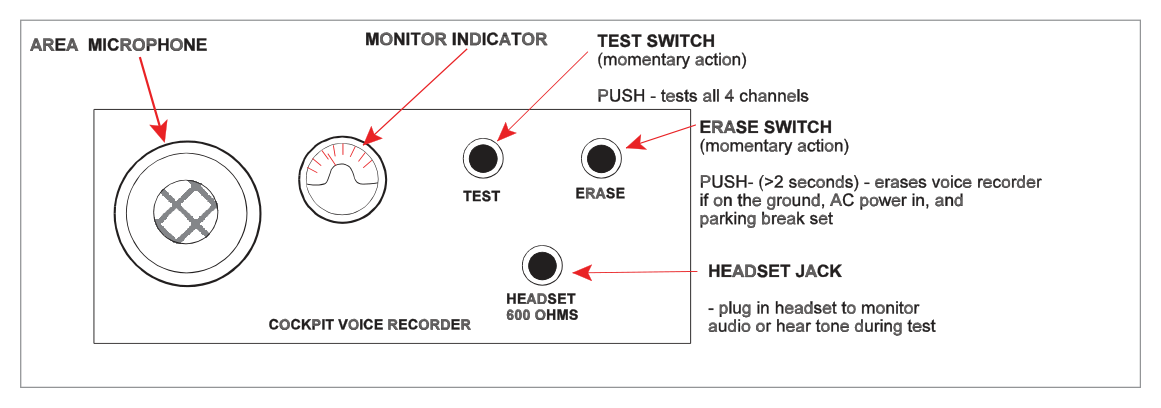
- Aircraft is on the ground
- All engines are stopped
- Parking brake is SET
- Erase button held depressed for at least 2 seconds
flowchart TD
    A[ERASE button pressed] --> B{Aircraft on ground?}
    B -- No --> C[❌ Erase inhibited]
    B -- Yes --> D{All engines stopped?}
    D -- No --> C
    D -- Yes --> E{Parking brake SET?}
    E -- No --> C
    E -- Yes --> F{Button held ≥ 2 seconds?}
    F -- No --> C
    F -- Yes --> G[✅ Erasure permitted]
- Control unit: overhead panel; contains area microphone.
- AUTO: starts on first engine start; stops 5 min after last engine shutdown.
- ON: starts immediately; latches until first engine start then reverts to AUTO.
- TEST: BITE self-test — visual "good" indication on pass.
- ERASE: Ground + all engines stopped + parking brake set + hold ≥ 2 sec.
5. European Regulations
| Case | Aircraft Category | Registration |
|---|---|---|
| Case 1 | All aeroplanes registered after 1 April 1998 which are >5,700 kg MTOM, OR turbine-powered <5,700 kg with >9 passenger seats | After 1 Apr 1998 |
| Case 2 | Turbine-powered aeroplanes <5,700 kg MTOM with >9 passenger seats | Between 1 Jan 1990 and 31 Mar 1998 |
| Case 3 | All aeroplanes with MTOM >5,700 kg | Any date |
Minimum Recording Times
| Aircraft Category | Minimum Recording Time |
|---|---|
| Standard minimum | 30 minutes |
| MTOM >5,700 kg, registered after 1 April 1998 | 2 hours |
Key Rules on Combined Recorders
| MTOM | Recorder Rule |
|---|---|
| ≤ 5,700 kg | May carry a combined CVR/FDR (single unit) |
| > 5,700 kg | If combined recorders are fitted, must have two combined units |
- Not reasonably practicable to repair before flight
- No more than 8 further consecutive flights
- Not more than 72 hours since the unserviceability was discovered
- The FDR (if required) must be operative
| Parameter | FDR | CVR |
|---|---|---|
| Standard min recording time | 25 hrs (>5,700 kg) | 30 min |
| Extended recording time | 10 hrs (<5,700 kg) | 2 hrs (>5,700 kg, post Apr '98) |
| Case 2 date range | Since 1 Jun 1990 | 1 Jan 1990 – 31 Mar 1998 |
| Dispatch limits | Identical: 8 flights / 72 hours | |
Practice Questions & Detailed Answers
- (a) 1 & 3 — Excessive vertical speed (3) is not a minimum requirement of the altitude alerting system; it relates to VSI or GPWS.
- (b) 2 & 5 — Abnormal gear/flap combination (2) is a separate configuration warning; not an altitude alerting function.
- (c) 4 & 6 — Excessive terrain closure (4) = GPWS Mode 2; setting SPS/RPS (6) is a separate altimetry check requirement.
- (a) — FDR is not manually switched; it starts and stops automatically based on engine state.
- (c) — Lift-off to weight-on-wheels would miss taxi, engine start, and post-landing ground roll data — all operationally significant.
- (d) — Taxi-only recording would miss pre-taxi engine start and post-landing ground operations.
- (a) — Conditional escalation to "pull up" applies to Mode 1, not Mode 3.
- (b) — Immediate "pull up" following "don't sink" is not correct for Mode 3.
- (d) — "Terrain" is used in Mode 2 (excessive terrain closure), not Mode 3.
- (b) — Including all 6 items is excessive; engine rpm and airspeed vector are not stall warning inputs.
- (c) — Engine rpm and airspeed vector are not relevant to angle-of-attack-based stall warning.
- (d) — Control surface position (5) and airspeed vector (6) are not standard stall warning inputs.
- (b) — (5) and (6) are incorrect: upward GS deviation and en-route terrain proximity are NOT basic GPWS modes.
- (c) — (5) upward GS deviation is not a GPWS mode.
- (d) — (6) en-route terrain proximity is EGPWS/TAWS, not basic GPWS.
Master Reference Tables
CVR vs FDR — Key Comparison
| Parameter | CVR | FDR |
|---|---|---|
| Colour | Red or Orange | Red |
| Location | Rear of aircraft | Rear, under fin |
| ULD | Yes — ultrasonic pulses | Yes — ultrasonic pulses |
| Standard min recording time | 30 minutes | 25 hours (>5,700 kg) |
| Extended recording time | 2 hours (>5,700 kg, post 1 Apr '98) | 10 hours (<5,700 kg) |
| Auto start trigger | First engine start (AUTO mode) | First engine start |
| Auto stop | 5 min after last engine shutdown | 5 min after last engine shutdown |
| Dispatch with u/s unit | Max 8 flights / 72 hours | |
| Erase safeguards | Ground + engines off + park brake + 2 sec hold | N/A (no erase function) |
| Combined unit: ≤5,700 kg | One combined CVR/FDR permitted | |
| Combined unit: >5,700 kg | Must have TWO combined units | |
Answer Key — Source Questions
| Q | Ans | Topic |
|---|---|---|
| 1 | d | Altitude alerting system functions |
| 2 | b | FDR recording start/stop requirement |
| 3 | c | GPWS Mode 3 alert |
| 4 | a | Stall warning inputs |
| 5 | a | GPWS modes covered |
Reinforce Chapter 37: Cockpit Voice Recorder
Test your knowledge and practice actual exam questions for Navigation — Instrumentation.