Flight Data Recorder
by Ghost Aviator
Table of Contents
1. Introduction
Commercial aircraft carry a Flight Data Recorder (FDR), which records various aircraft parameters throughout the entire duration of every flight. The FDR has two main functions:
- Primary function: Preserve aircraft data to determine the cause of any aircraft accident (accident investigation).
- Secondary function: Gather information for trend analysis and trouble-shooting of aircraft systems.
On smaller aircraft, the FDR may be combined with the Cockpit Voice Recorder (CVR) into a single unit.
2. FDR Designs
The FDR records the last 10 or 25 hours of aircraft data (depending on MTOM — see regulations) on a digital storage device. Key physical characteristics:
| Feature | Detail |
|---|---|
| Housing | Shock-resistant box |
| Colour | Painted red (commonly called "black box") |
| Location | Rear of the aircraft, normally under the fin |
| Front fitting | Underwater Locating Device (ULD) |
3. FDR Components
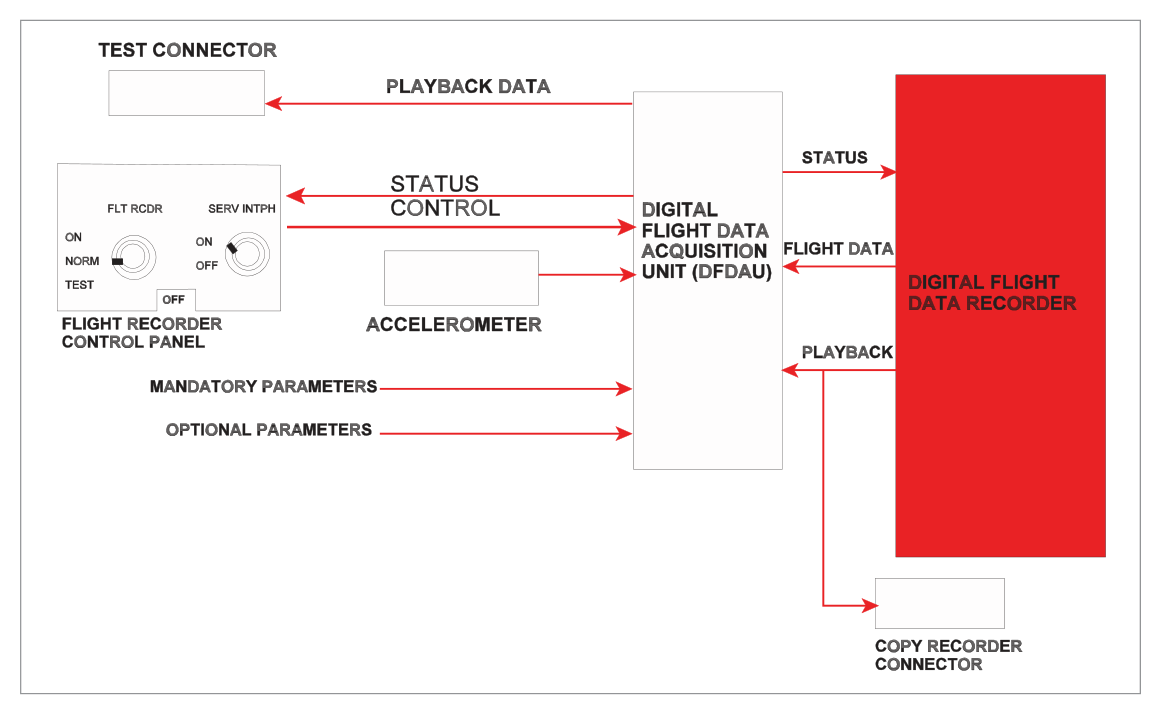
The FDR system consists of four main components:
- A recording system
- A control unit on the overhead panel
- A control unit on the pedestal
- A Data Interface and Acquisition Unit (DIAU)
The DIAU collects inputs from aircraft systems including: air conditioning, auto-flight, flight controls, fuel, landing gear, navigation systems, pneumatic systems, APU, and engines. This information is sent to the Aeroplane Condition Monitoring System (ACMS) and is used for system monitoring, trend analysis, and can be downloaded via the aircraft printer, ACARS, or the ATSU.
Overhead Panel Control Unit — GND CTL Switch
This control unit also controls the CVR. It has a spring-loaded switch labelled GND CTL with two positions:
| Position | Function |
|---|---|
| ON | CVR and DFDR are energized immediately; ON light is illuminated |
| AUTO | CVR and DFDR energize: on the ground with one engine running, OR in flight (engine running or stopped) |
Pedestal Control Unit — EVENT Button
A push-button labelled 'EVENT' sets an event mark on the DFDR recording. This acts as a bookmark to enable rapid location of a specific event during subsequent analysis.
4. Aircraft Integrated Data Systems (AIDS)
AIDS processes data from various aircraft systems to ease maintenance tasks. Key components:
flowchart TD
    A[Aircraft Systems
Air Cond / Autoflight / Engines / Fuel etc.] --> B[Data Management Unit
DMU]
    B --> C[Flight Data Interface Unit
FDIU]
    B --> D[Separate Flight
Maintenance Recorder]
    C --> E[FDR
Mandatory Parameters]
    B --> F[Aircraft Printer
In-flight & Ground]
    B --> G[ACARS / VHF Data Link
Ground Transmission]
    D --> H[Printout for
Maintenance]
The Data Management Unit (DMU) collects and processes system data to compile reports for storage and printing. Some mandatory flight parameters are sent via the Flight Data Interface Unit (FDIU) to the FDR. The remainder is recorded on a separate flight maintenance recorder.
Data can be transmitted to ground stations via ACARS (Airborne Communications and Reporting System) on a VHF data link, allowing aircraft performance monitoring from the ground at certain intervals.
5. Parameters Recorded
The mandatory parameters recorded on the FDR depend on the age and size of the aircraft and are specified in OPs Regulations. They fall into two categories:
Mandatory (Main) Parameters
- Time or relative time count
- Attitude (pitch and roll)
- Airspeed
- Pressure altitude
- Heading
- Normal acceleration
- Propulsive thrust/power on each engine
- Cockpit thrust/power lever position
- Flaps/slats configuration or cockpit selection
- Ground spoilers and/or speed brake selection
Additional Parameters
(Required for aircraft > 27,000 kg MTOM)
- Positions of primary flight controls and trim
- Radio altitude and navigation information displayed to flight crew
- Cockpit warnings
- Landing gear position
6. European Regulations — Carriage Requirements
| Case | Aircraft Category | Registration Date |
|---|---|---|
| Case 1 | All aeroplanes > 5,700 kg MTOM, OR turbine-powered with > 9 passenger seats but < 5,700 kg MTOM | Registered since 1 April 1998 |
| Case 2 | All aeroplanes > 5,700 kg MTOM | Registered since 1 June 1990 |
| Case 3 | All turbine-powered aeroplanes > 5,700 kg MTOM | Registered before 1 June 1990 |
Minimum Recording Times
| Aircraft Category | Minimum Recording Time |
|---|---|
| MTOM > 5,700 kg | 25 hours — all mandatory (main) parameters required |
| MTOM ≤ 5,700 kg (turbine, > 9 seats, registered after 1 Apr 1998) | 10 hours |
| MTOM > 27,000 kg | 25 hours + additional parameters mandatory |
7. Other Regulatory Requirements
- The FDR must start automatically before the aircraft is capable of moving under its own power (i.e., from first engine start).
- The FDR must stop automatically 5 minutes after the last engine is shut down (aircraft no longer capable of self-propelled movement).
- The FDR must have a device to assist in locating the recorder in water (Underwater Locating Device — ULD).
- Aeroplanes ≤ 5,700 kg MTOM may carry a combined FDR/CVR.
- Aircraft > 5,700 kg MTOM must have 2 recorders: either separate FDR/CVR, or two combined units.
Dispatch with Inoperative FDR
- It is not reasonably practicable to repair or replace the FDR before flight.
- The aeroplane does not exceed 8 further consecutive flights.
- Not more than 72 hours have elapsed since the unserviceability was discovered.
- Any CVR required to be carried is operative (unless it is combined with the FDR).
flowchart TD
    A[FDR Unserviceable] --> B{Practicable to repair
before flight?}
    B -- Yes --> C[Repair/Replace FDR
before departure]
    B -- No --> D{Check all 3 conditions}
    D --> E[≤ 8 consecutive flights
since u/s?]
    D --> F[≤ 72 hours since
u/s discovered?]
    D --> G[CVR serviceable?
unless combined]
    E -- All YES --> H[MAY dispatch
with u/s FDR]
    F -- All YES --> H
    G -- All YES --> H
    E -- Any NO --> I[CANNOT dispatch
Must repair first]
- FDR = last 10 or 25 hours of data. Red box. Rear of aircraft. Has ULD.
- Starts: first engine start. Stops: 5 min after last engine shutdown.
- >5,700 kg: 25 hours + mandatory params. >27,000 kg: also additional params.
- ≤5,700 kg: 10 hours, may combine with CVR.
- Dispatch u/s FDR: max 8 flights, max 72 hours, CVR must be operative.
- AIDS: DIAU → ACMS; DMU → FDIU → FDR; ACARS for ground transmission.
Practice Questions & Detailed Answers
- (a) — Engine trend monitoring is a secondary function (maintenance), not the primary purpose.
- (c) — ACARS transmission is a function of AIDS/DMU, not the FDR itself.
- (d) — Recording cockpit voice is the function of the CVR, not the FDR.
- (a) — 10 hours applies to aircraft below 5,700 kg MTOM (turbine, >9 seats, registered after 1 Apr 1998).
- (b) — 2 hours is the CVR recording time for large aircraft, not the FDR.
- (d) — 30 minutes is the minimum CVR recording time, not applicable to FDRs.
- (b) — The CVR must be operative (not inoperative); the limit is 8 flights (not 10) and 72 hours (not 48).
- (c) — Flight duration is irrelevant; there is no captain's discretion clause for FDR inoperability.
- (d) — No individual regulatory authority approval is required for each flight; the conditions are self-contained in the regulations.
- (a) — Main parameters only is insufficient; additional parameters become mandatory above 27,000 kg.
- (c) — Voice/aural recording is the CVR's function, not the FDR.
- (d) — Engine and fuel parameters are part of the mandatory main parameters, but the threshold of 27,000 kg triggers additional parameters, not a replacement set.
- (a) — Immediate shutdown would lose important post-shutdown data; the 5-minute delay is intentional.
- (b) — Weight-on-wheels switch relates to other systems; FDR stop is engine-shutdown-referenced.
- (d) — Parking brake state is not the trigger; engine shutdown time is.
- (a) — There is no erase function on the pedestal; erasure is not a feature of the FDR (only CVR has an erase function, with multiple safeguards).
- (b) — The ULD is a passive device activated by water immersion, not by a cockpit button.
- (d) — The FDR has no "manual" vs "automatic" mode distinction at the pedestal; the GND CTL switch on the overhead panel manages recording state.
Master Reference Tables
Numerical Values — Quick Reference
| Parameter | Value | Reference |
|---|---|---|
| FDR recording time (MTOM >5,700 kg) | 25 hours | Section 6 |
| FDR recording time (MTOM ≤5,700 kg, turbine, >9 seats, post Apr 1998) | 10 hours | Section 6 |
| MTOM threshold — FDR required | 5,700 kg | Section 6 |
| MTOM threshold — additional parameters required | 27,000 kg | Section 5 / 6 |
| Auto start | First engine start | Section 7 |
| Auto stop delay after last engine shutdown | 5 minutes | Section 7 |
| Max consecutive flights — dispatch with u/s FDR | 8 flights | Section 7 |
| Max time since u/s — dispatch with u/s FDR | 72 hours | Section 7 |
| Case 1 registration date | 1 April 1998 | Section 6 |
| Case 2 registration date | 1 June 1990 | Section 6 |
Answer Key
| Q | Ans | Topic |
|---|---|---|
| 1 | b | Primary function of FDR |
| 2 | c | Recording time — 6,500 kg MTOM |
| 3 | a | Dispatch with u/s FDR conditions |
| 4 | b | Parameters — 35,000 kg MTOM |
| 5 | c | FDR auto-stop timing |
| 6 | c | EVENT button function |
Reinforce Chapter 36: Flight Data Recorder
Test your knowledge and practice actual exam questions for Navigation — Instrumentation.