Airborne Collision and Avoidance System
by Ghost Aviator
Table of Contents
- Introduction — ACAS vs TCAS
- TCAS I
- TCAS II — Principle
- Aircraft Equipment (Transponder Requirements)
- Operation — Range, Bearing, Height Detection
- System Interconnections
- Synthetic Voice Prioritization
- Traffic Advisories (TAs) and Resolution Advisories (RAs)
- Resolution Advisory Types
- Traffic Symbols — Proximate, Other, TA, RA
- Data Tag and Off-Scale Advisories
- TCAS Displays and Control Panel
- No Bearing Advisories
- Action on Receiving TAs and RAs
- Practice Questions + Additional Q&A
1. Introduction — ACAS vs TCAS
TCAS = Traffic alert and Collision Avoidance System (US manufacturer name, now widely accepted alternative)
Four systems exist: TCAS I, II, III, IV (increasing levels of protection)
2. TCAS I
First generation collision avoidance system. Capabilities:
- Detects and displays range and approximate relative bearing of nearby aircraft
- If intruder carries Mode C: relative altitude also displayed
- Generates Traffic Advisories (TAs) only: "Traffic, Traffic"
- Does NOT give Resolution Advisories (no recommended manoeuvre)
3. TCAS II — Principle
Operates on secondary radar principle using SSR frequencies of 1030 MHz (interrogation) and 1090 MHz (reply) in an air-to-air role.
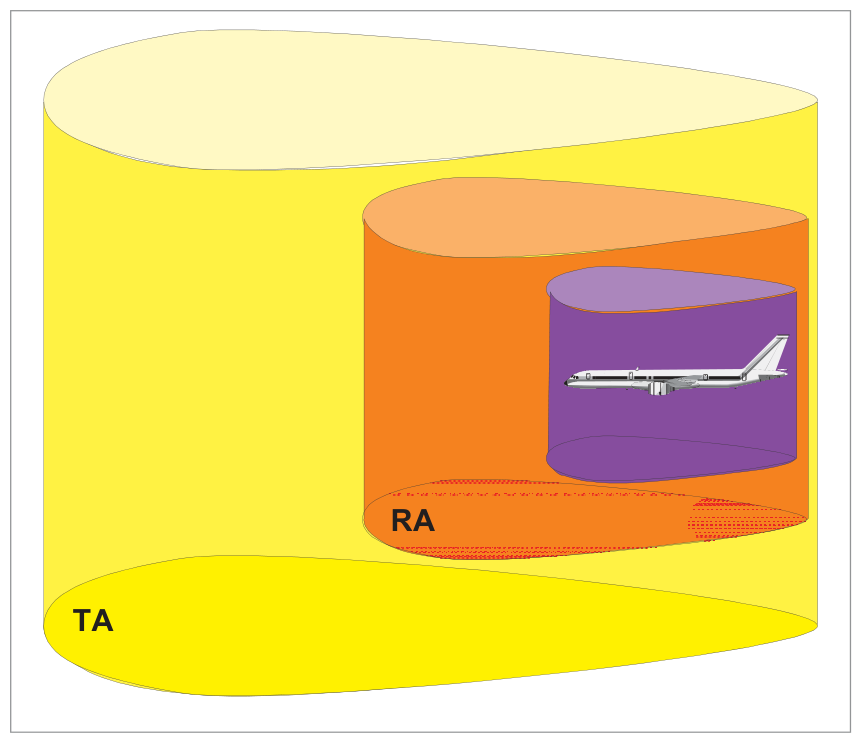
Creates two protective 3D bubbles around the aircraft:
- Outer bubble (caution area) → Traffic Advisory (TA) zone
- Inner bubble (warning area) → Resolution Advisory (RA) zone
4. Aircraft Equipment (Transponder Requirements)
| Transponder Type | Information Available | TCAS Capability |
|---|---|---|
| Mode A | Identity only (no height) | 2D — TAs only |
| Mode C | Identity + height | 3D — TAs and RAs |
| Mode S | Identity + height + discrete data link | 3D + co-ordinated RAs between TCAS aircraft |
| None / off | — | Invisible to TCAS — collision risk! |
5. Operation — Range, Bearing, Height
Range
Determined by measuring time between interrogation transmission and response (radar principle). Interrogation approximately once per second. In densely populated airspace: reduced surveillance — interrogation every 5 seconds, priority to closest aircraft.
- Normal detection range: ~30 NM
- Reduced surveillance range: ~5 NM
Bearing
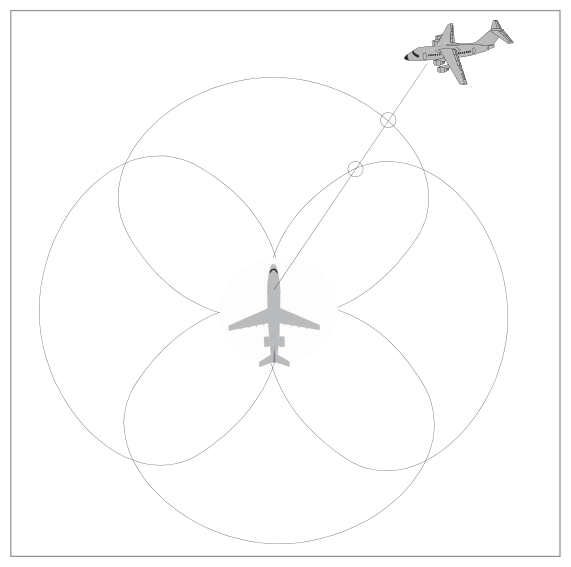
Determined by directional antenna. Due to wavelengths and antenna size, bearing is the least accurate parameter.
Height
Found by comparing intruder's Mode C altitude with TCAS aircraft's own altitude.
6. System Interconnections
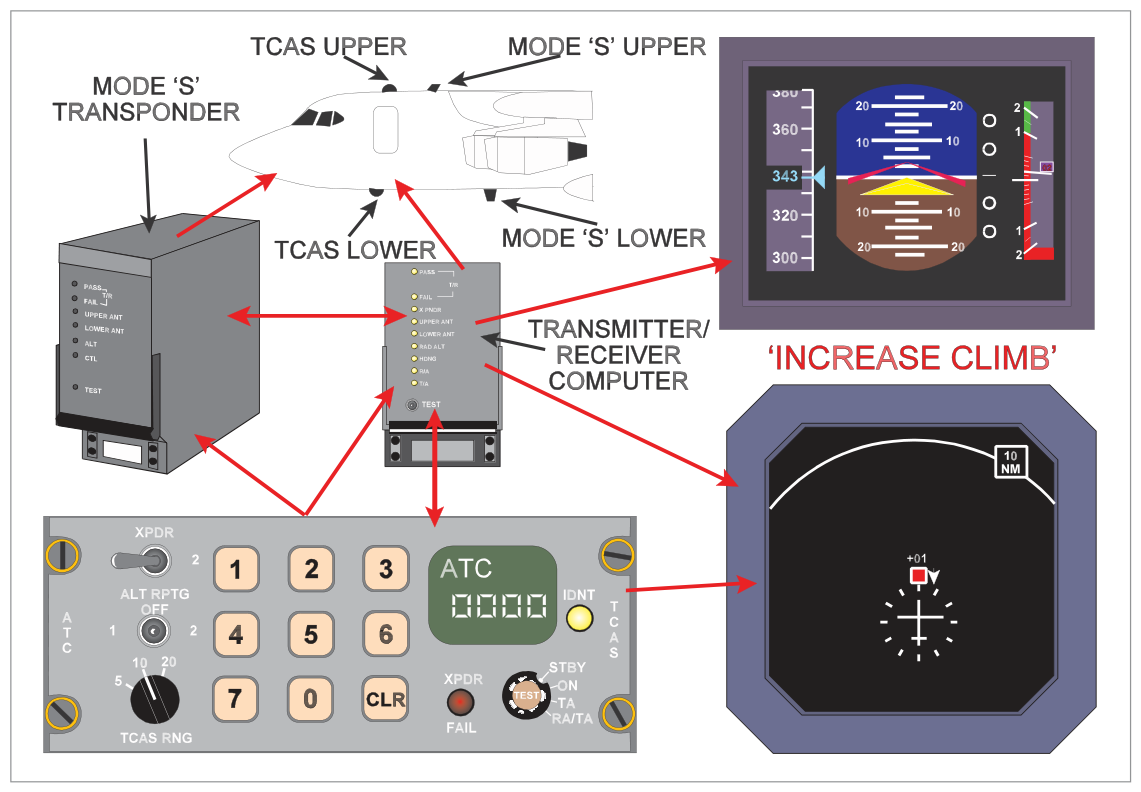
TCAS feeds from (and limitations based on):
- Radio altimeter: Modifies RAs near the ground:
- No instructions at all below 400 ft AGL
- No descent RAs below 1000 ft AGL
- No increase rate of descent below 1450 ft AGL
- Aircraft configuration (gear/flap): Poor climb performance → TCAS avoids climb demands
- ADC: At high altitude near performance ceiling → TCAS avoids climbing RA
- IRS: Inertial vertical acceleration input
7. Synthetic Voice Prioritization
- Stall Identification/Prevention (stick shake/push) — voice inhibited during stick push
- Windshear — inhibits both GPWS and TCAS
- GPWS — inhibits TCAS
- TCAS (lowest priority)
8. Traffic Advisories (TAs) and Resolution Advisories (RAs)
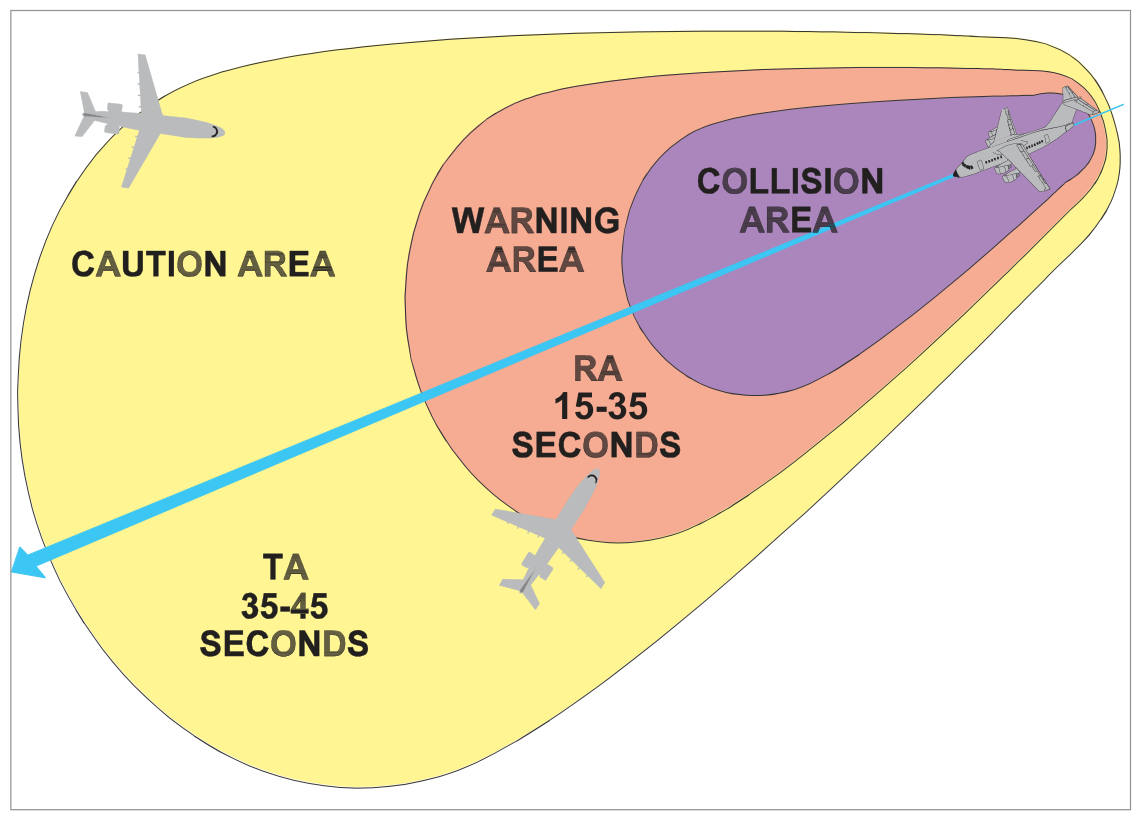
TCAS can monitor up to 30 aircraft simultaneously on display. Conflict assessment based on tau (τ) = Closest Point of Approach (CPA).
| Advisory Type | Bubble Penetrated | Time to Collision | Symbol | Voice |
|---|---|---|---|---|
| TA (Traffic Advisory) | Outer (caution) bubble | 45–35 seconds | Solid amber circle | "Traffic, Traffic" |
| RA (Resolution Advisory) | Inner (warning) bubble | 35–15 seconds | Solid red rectangle | Climb/Descend commands |
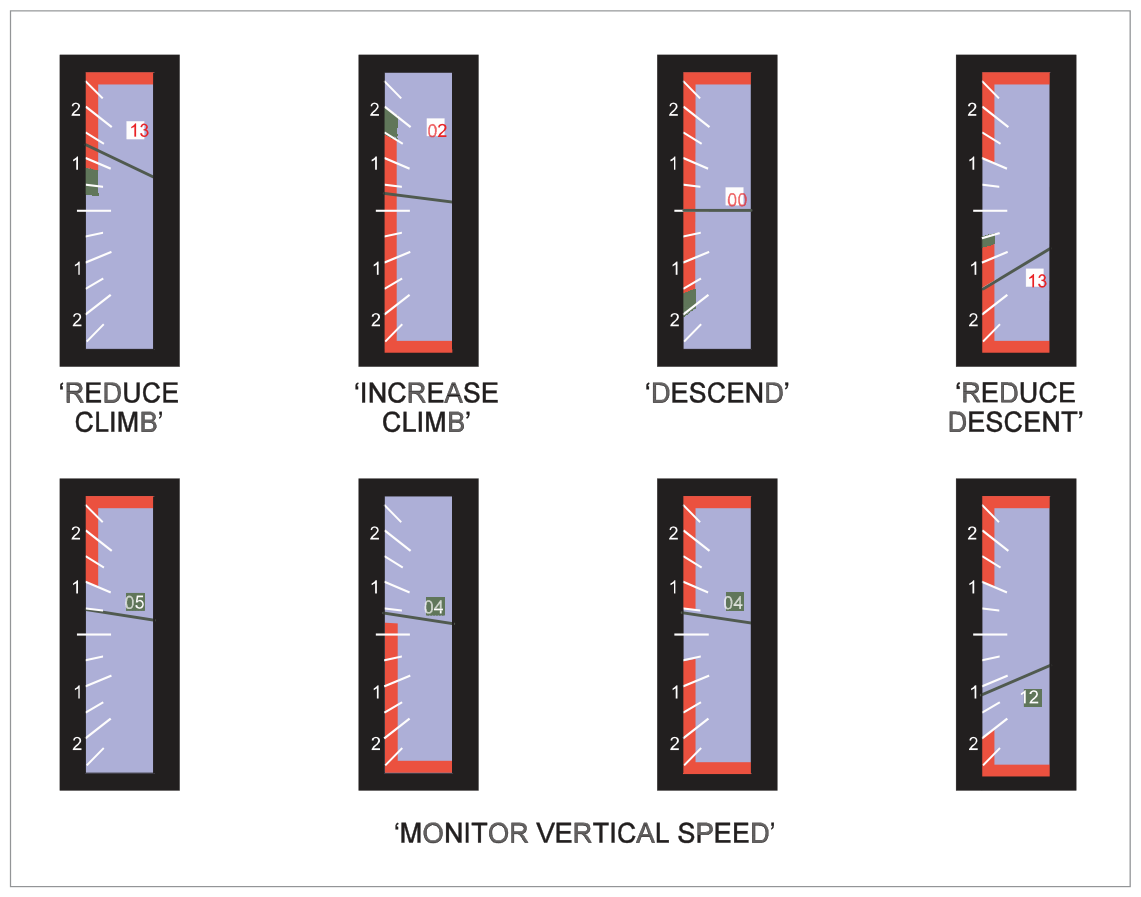
9. Resolution Advisory Types
| RA Type | Situation | Voice |
|---|---|---|
| Preventative RA | No collision risk unless one aircraft changes level | "Monitor Vertical Speed" |
| Corrective RA | Collision risk exists; manoeuvre required | "Climb" "Descend" "Increase Climb" "Decrease Descent" etc. |
10. Traffic Symbols
| Symbol | Appearance | Meaning | Range / Height |
|---|---|---|---|
| RA Traffic | Solid red rectangle | Serious collision threat — manoeuvre immediately | Inner bubble |
| TA Traffic | Solid amber circle | Potential collision threat — prepare for RA | Outer bubble |
| Proximate Traffic | Solid cyan diamond | Near traffic, not a threat | Within 6 NM and ±1200 ft |
| Other Traffic | Hollow cyan diamond | Transponder-equipped, within display range | Within range, ±2700 ft (or ±8700/2700 in climb/descent) |
11. Data Tag and Off-Scale Advisories
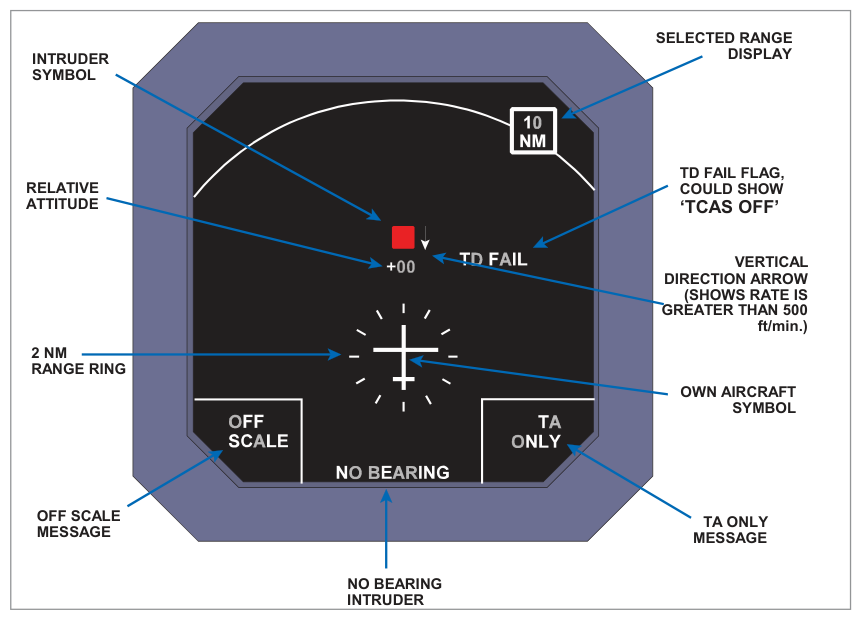
Data Tag (Mode C equipped intruders)
- Relative altitude in hundreds of feet
- + sign = intruder above; − sign = intruder below
- ↑ or ↓ trend arrow when vertical rate ≥ 500 fpm
- No number/arrow = non-altitude-reporting intruder
Off-Scale Traffic Advisory
When intruder is outside display range but inside caution/warning area: half of the appropriate symbol appears at the correct bearing at the edge of the display with data tag (if room).
12. TCAS Displays and Control Panel
Function Switch Positions
| Position | Function |
|---|---|
| STANDBY | Warm-up power only; system not operational |
| ON | Transponder only operational (visible to ACAS, but no TCAS function) |
| TA | Transponder + TCAS operational; TAs only generated. "TA ONLY" shown on display. Used for engine failure, reduced performance, parallel runway ops. |
| RA/TA | Full operation — both RAs and TAs generated (normal operation) |
| TEST | Full BITE check. Success: "TCAS SYSTEM TEST OK"; Failure: "TCAS SYSTEM TEST FAIL" |
TCAS RNG Switch
Selects display range: 5, 10, or 20 NM. Does NOT alter detection range or warning thresholds.
13. No Bearing Advisories
If TCAS cannot track intruder bearing (e.g., antenna screening), RA or TA appears lower-centre of display in appropriate colour. Up to two lines of information. Example: "TA 2.2- 04 ↑" = TA 2.2 NM away, 400 ft below, climbing ≥500 fpm.
14. Action on Receiving TAs and RAs
| Advisory | Crew Action |
|---|---|
| TA | Assimilate information. Begin visual search. Prepare for RA. Seek ATC advice if traffic not seen. Do NOT manoeuvre on TA alone. |
| RA | Initiate required manoeuvre immediately. Adjust flight path, power, trim. Inform ATC of deviation as soon as possible. |
- Never manoeuvre OPPOSITE to RA (sense may have been co-ordinated with intruder via Mode S)
- RAs may be disregarded ONLY if pilot visually identifies the conflicting traffic AND decides no deviation is necessary
- If ATC instruction conflicts with RA — FOLLOW THE RA
- ACAS = ICAO name; TCAS = manufacturer/common name. Mandatory >5700 kg or >19 seats (Europe)
- TCAS I: TAs only. TCAS II: TAs + RAs (vertical only, never horizontal)
- TCAS II frequencies: 1030 MHz (interrogate) / 1090 MHz (reply)
- Mode A: TAs only (2D). Mode C: TAs + RAs (3D). Mode S: TAs + RAs + co-ordinated RAs
- Interrogation: ~1/sec normal; every 5 sec reduced surveillance. Range: 30 NM normal / 5 NM reduced
- Bearing least accurate parameter (small antenna, SSR wavelength)
- RA height restrictions: no instructions <400 ft AGL; no descent RA <1000 ft; no increase descent <1450 ft
- TA = outer bubble = 45–35 sec = solid amber circle. RA = inner bubble = 35–15 sec = solid red rectangle
- Proximate traffic: solid cyan diamond; within 6 NM ±1200 ft
- Data tag ↑↓ when V/S ≥500 fpm; + = above; − = below
- RA types: Preventative ("Monitor VS") / Corrective ("Climb/Descend")
- Intended separation (smooth response): 300–600 ft; 700 ft above FL410
- On TA: look; prepare; do NOT manoeuvre. On RA: manoeuvre IMMEDIATELY; follow RA over ATC if conflict
- Voice priority: Stall → Windshear → GPWS → TCAS
Practice Questions & Additional Q&A
Practice Questions (Chapter 35)
Reinforce Chapter 35: Airborne Collision and Avoidance System
Test your knowledge and practice actual exam questions for Navigation — Instrumentation.