Other Applications of the 1 in 60 Rule
by Ghost Aviator
Contents
1. Overview of Applications
The 1 in 60 rule is not limited to en-route track corrections. It also applies wherever an angle, a distance, and a range form a right-angled (or near-right-angled) triangle. The main examinable applications are:
- Glide slope height — finding the correct height at a given range
- Rate of descent (ROD) — finding the ROD needed to stay on slope at a given speed
- Speed change on a glide slope — adjusting ROD when speed changes
- VOR/DME crosstrack — finding distance off an airway centre line
- Range from VOR bearing change — finding distance to a VOR by timing a bearing change
📚 Key Approximation
1 NM = 6 080 ft, but 1 NM ≈ 6 000 ft is used for all 1-in-60 calculations. This introduces only ~1% error and is accepted for all exam purposes.
2. Height on a Glide Slope
The same track-error geometry applies in the vertical plane. The angle is the glide slope angle (Z°), the adjacent side is the range, and the opposite side is the height.
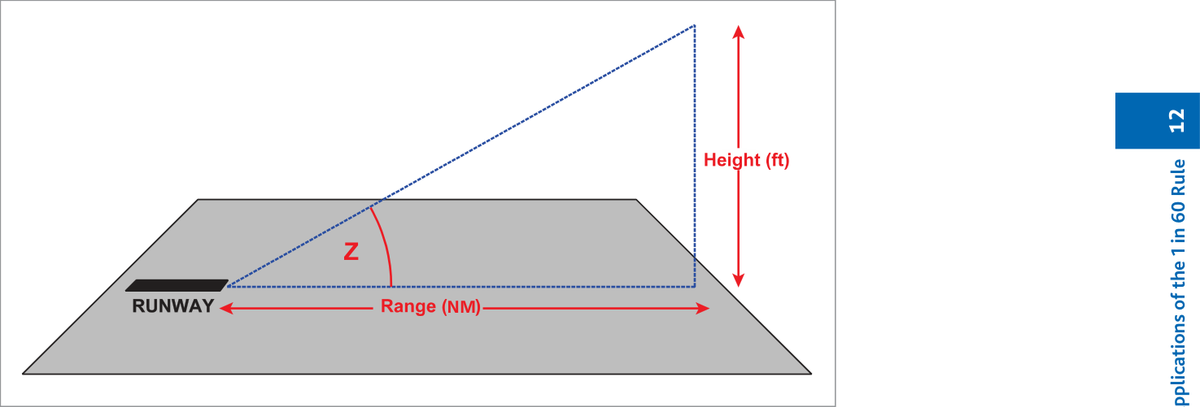
Derivation (Z = 1°)
| Glide slope angle | Height per NM | Common at |
|---|---|---|
| 2.5° | 250 ft/NM | Military fast-jet airfields |
| 3.0° | 300 ft/NM | Most civil airports (ILS standard) |
| 3.5° | 350 ft/NM | Some civilian airports near terrain |
| 5.5° | 550 ft/NM | London City Airport (steep approach) |
Worked Examples
Example 1 — 3° slope at 4 NM
Example 2 — 5.5° slope at 3 NM
3. Rate of Descent (ROD)
The rate of descent required to maintain a glide slope depends on both the slope angle and the ground speed. Think of it this way: in one minute the aircraft travels GS/60 NM, and must descend a height of 100 × Z × (GS/60) feet.
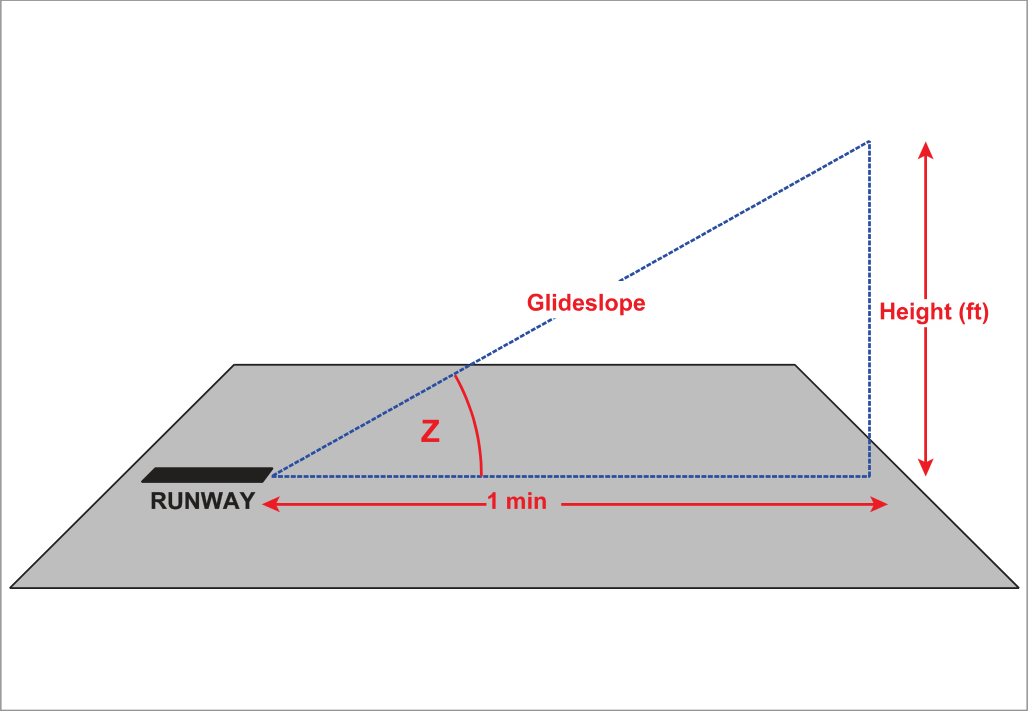
✎ Why the 5 × Rule works for 3°
At 3°: height per NM = 300 ft. Distance per minute = GS/60 NM.
ROD = 300 × (GS/60) = 5 × GS. The factor of 5 comes directly from 300/60.
Worked Examples
3° slope, GS 120 kt:
4° slope, GS 100 kt:
4. Change of Speed on a Glide Slope
Changing speed on a glide slope requires a corresponding change in ROD to stay on the slope.
✈ Speed Change Rules
- Decrease speed → Decrease ROD
- Increase speed → Increase ROD
Worked Examples
Example 1 — London Heathrow (3°), GS 140 kt
Example 2 — London City (5.5°), GS 120 kt
Example 3 — London Heathrow (3°), reduce GS from 140 → 120 kt
Example 4 — London City (5.5°), reduce GS from 120 → 110 kt
5. VOR/DME Crosstrack Problems
The 1 in 60 formula applies directly to find how far an aircraft is off an airway centre line when the RMI QDM differs from the published airway QDM.
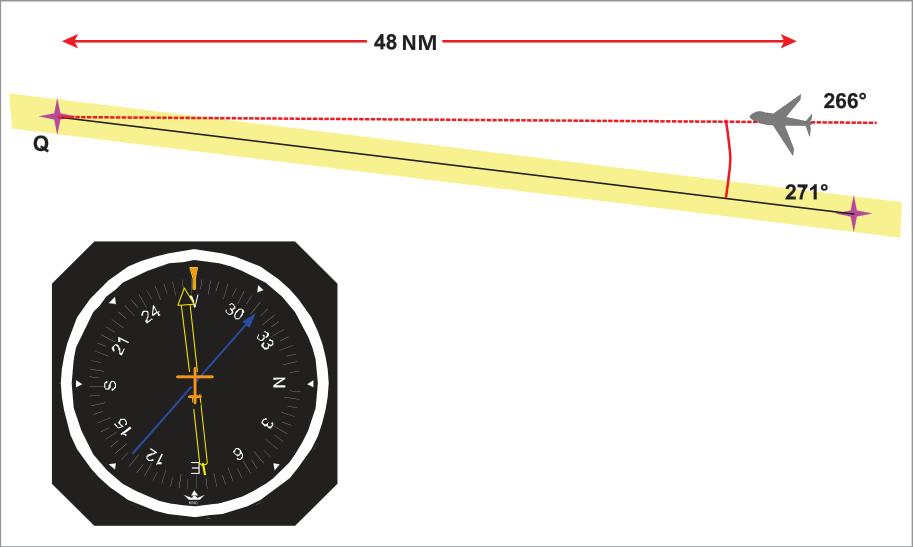
Worked Example
Airway QDM = 271°(M). RMI reads QDM 266°(M), DME 48 NM.
✎ Which side of centre line?
The QDM is the bearing to the VOR. If your QDM is higher than the airway QDM, the VOR is displaced to the right of your nose → you are left of centre line.
If your QDM is lower than the airway QDM, the VOR is displaced left → you are right of centre line.
ℹ Airway Width
Most airways extend 5 NM each side of the centre line (10 NM total). If your distance off is 5 NM or more, you are at or beyond the airway boundary and in potential conflict with ATC clearances.
6. Finding Range from Change of VOR Bearing
If you record the change in QDM (or QDR) from a VOR over a known time and ground speed, you can calculate your range from the VOR using the 1 in 60 rule.
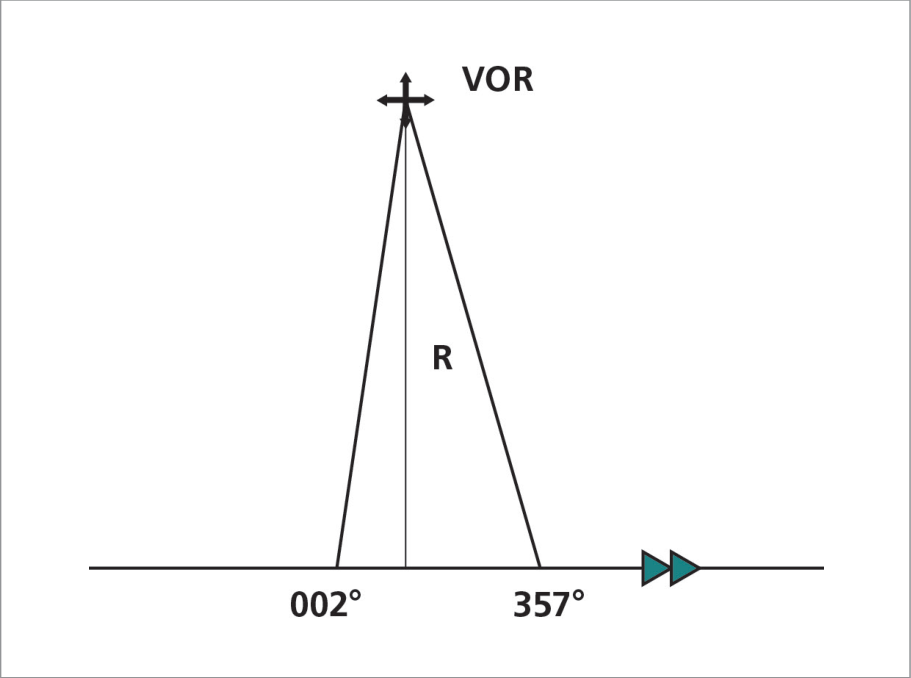
Worked Example
Tracking 090°(M) at 180 kt GS. At 1100 hrs QDM = 002°. At 1105 hrs QDM = 357°.
✎ Practical Notes
- The bearing change angle must be small enough for the 1 in 60 approximation to hold (< ~20°)
- The midpoint of the time interval should ideally be when the aircraft is abeam the VOR (QDM = 000° or 360°)
- This technique works equally with QDM or QDR, as long as you use the change consistently
📚 Chapter 12 Quick Revision
- Glide slope height: H = 100 × Z × range(NM)
- ROD (3° only): ROD = 5 × GS | other angles: multiply by Z/3
- Speed change ROD (3° only): ΔROD = 5 × ΔGS | scale for other angles
- VOR/DME crosstrack: DO = (angle off × DME) / 60
- VOR range: R = (distance flown × 60) / bearing change
- Airway width: 5 NM each side of centre line in most countries
Practice Questions & Detailed Answers
8 questions (14 sub-parts) • Glide slope, ROD, VOR/DME, bearing change range
▶ Show answer & workings
▶ Show answer & workings
▶ Show answer & workings
▶ Show answer & workings
(a) Q2 scenario (3.5°), GS 120 kt
(b) Q3 scenario (2.6°), GS 180 kt
(c) Q4 scenario (3°), GS 150 kt
▶ Show answer & workings
3° ROD = 5 × 120 = 600 ft/min
Scale to 3.5°: 600 × (3.5/3) = 700 ft/min
3° ROD = 5 × 180 = 900 ft/min
Scale to 2.6°: 900 × (2.6/3) = 780 ft/min
ROD = 5 × 150 = 750 ft/min (standard 3° rule applies directly)
▶ Show answer & workings
(a) What ROD is required to maintain the glide slope?
You regain partial hydraulics and select mid-flap, reducing approach speed to 190 kt TAS.
(b) What change in ROD is required?
(c) What is your new ROD?
▶ Show answer & workings
GS = TAS − headwind = 220 − 10 = 210 kt
3° ROD = 5 × 210 = 1 050 ft/min
Scale to 2.5°: 1 050 × (2.5/3) = 875 ft/min
Key point: use TAS change for ΔROD (GS change = TAS change if headwind component unchanged)
ΔTAS = 220 − 190 = 30 kt 3° ΔROD = 5 × 30 = 150 ft/min
Scale to 2.5°: 150 × (2.5/3) = 125 ft/min
Decrease speed → Decrease ROD by 125 ft/min
875 − 125 = 750 ft/min
(a) Are you left or right of centre line?
(b) What is your distance off the airway centre line?
(c) Are you in trouble with ATC? (Airways normally extend 5 NM from centre line.)
▶ Show answer & workings
Airway QDM = 137°(M). Your QDM = 141°(M) — higher than centre line QDM.
Higher QDM means VOR is displaced further clockwise from your nose → you are displaced anti-clockwise → LEFT of centre line
Angle off = 141° − 137° = 4°
DO = (4 × 90) / 60 = 6 NM
6 NM > 5 NM airway half-width → Yes, you are outside the airway.
You have exceeded the protected airspace boundary and are potentially in conflict with adjacent airways or uncontrolled airspace.
Master Reference — Chapter 12
All Formulae
| Application | Formula | Notes |
|---|---|---|
| Glide slope height | H (ft) = 100 × Z × range (NM) | 1 NM = 6 000 ft approx. |
| ROD (3° only) | ROD = 5 × GS (kt) | ft/min |
| ROD (any angle) | ROD = 5 × GS × (Z/3) | ft/min |
| ΔROD (3° only) | ΔROD = 5 × ΔGS | ft/min; direction matches speed change |
| ΔROD (any angle) | ΔROD = 5 × ΔGS × (Z/3) | Use TAS change if headwind constant |
| VOR crosstrack | DO (NM) = (angle off × DME) / 60 | Angle off = |RMI QDM − airway QDM| |
| VOR range | R (NM) = (distance flown × 60) / Δbearing | Range at closest point of approach |
Speed vs ROD Rules
| Action | ROD change |
|---|---|
| Decrease speed on glide slope | Decrease ROD |
| Increase speed on glide slope | Increase ROD |
Answer Key — No ⚔ Flags
| Q | Answer(s) |
|---|---|
| 1 | 90 NM |
| 2 | 700 ft |
| 3 | 1 040 ft |
| 4 | 600 ft |
| 5 | (a) 700 ft/min (b) 780 ft/min (c) 750 ft/min |
| 6 | Decrease ROD by 150 ft/min |
| 7 | (a) 875 ft/min (b) decrease 125 ft/min (c) 750 ft/min |
| 8 | (a) Left (b) 6 NM (c) Yes — outside airway |
Chapter 12 — Other Applications of the 1 in 60 Rule
Ghost Aviator | www.ghostaviator.com
For personal study use only. Ghost Aviator Interactive Colour Edition.
Reinforce Chapter 6: Other Applications of the 1 in 60 Rule
Test your knowledge and practice actual exam questions for Air Navigation.