Navigation Using the 1 in 60 Rule
by Ghost Aviator
Contents
- 1. Returning to Track — Introduction
- 2. Track Error Angle vs Drift — Critical Distinction
- 3. Double Track Angle Error Method
- 4. Track Error Angle and Closing Angle
- 5. Combined TEA + CA — Single Calculation Method
- 6. Using These Methods Practically
- 7. New Track Reference — The Preferred Method
- Practice Questions & Detailed Answers
- Master Reference
1. Returning to Track — Introduction
If you find yourself off track during a flight, the most common en-route cause is a change in wind since the flight plan was prepared. Other causes include failure to fly the planned heading accurately, or making too shallow a turn at the last waypoint.
✎ Rapid Navigation Assumption
For these techniques it is assumed that for small heading changes, a change of track equals the same change of heading. In practice drift changes slightly when you alter heading, but the error is negligible for the corrections involved.
There are three basic techniques for returning to track, plus the recommended practical method:
- Double Track Angle Error Method
- Track Error Angle and Closing Angle
- Combined TEA + CA Single Calculation
- New Track Reference — the preferred method
2. Track Error Angle vs Drift — Critical Distinction

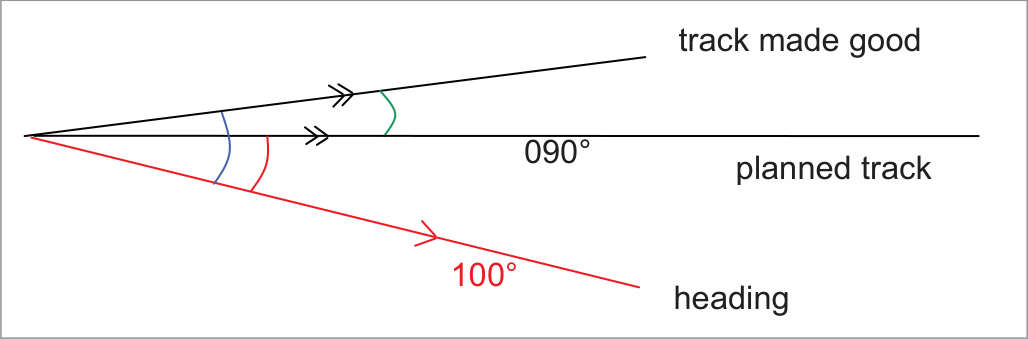
The track you intended to fly is the Planned Track. The track actually made over the ground is the Track Made Good (TMG). The angle between them is the Track Error Angle (TEA).
⚠ Common Exam Trap — TEA is NOT Drift
Drift is the angle between Heading and Track (either planned track or TMG).
Track Error Angle is the angle between Planned Track and TMG only.
TEA is the difference between expected drift and actual drift — but TEA is not drift.
You cannot calculate drift if the heading is not given.
| Term | Definition | Diagram colour (Fig 2) |
|---|---|---|
| Track Error Angle | Planned track − TMG | Green |
| Expected Drift | Heading − Planned track | Red |
| Actual Drift | Heading − TMG | Blue |
3. Double Track Angle Error Method
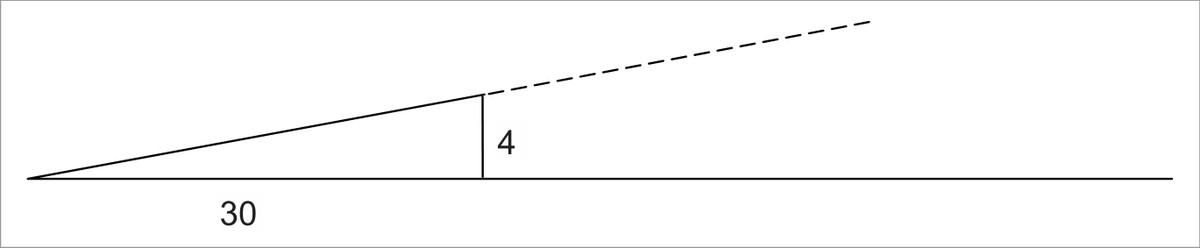
Situation: planned track 090°(T). After 30 NM you get a visual fix 4 NM left of track.
Step 1 — Calculate Track Error Angle

If no action is taken, the aircraft will continue to diverge from track at the same rate:
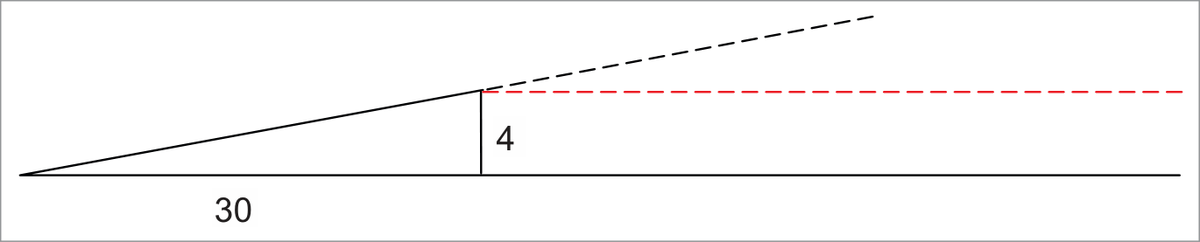
Turning 8° right stops the divergence but only parallels track — the aircraft is still 4 NM off:
Step 2 — Turn DOUBLE the TEA (16° right)

✈ No Map-Reading Required
By turning double the TEA you create a symmetrical triangle. If you deviated 1000–1020, you will regain track at exactly 1040 — just watch the clock.
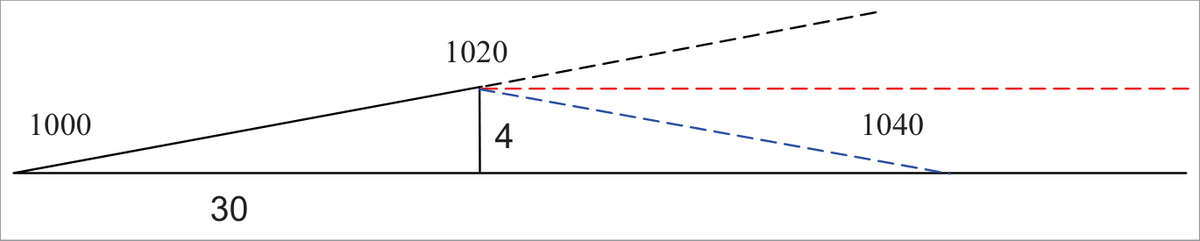
Once back on track, do not maintain that heading — you will diverge to the other side:
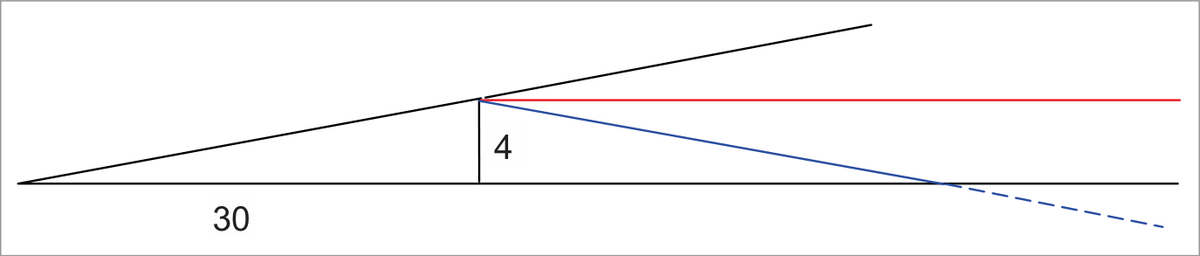
Turn 8° left on regaining track. You now fly on a heading 8° right of your original — which is the correct heading for the actual wind conditions.

✎ Limitation of Double TEA Method
If you are more than half-way along the leg when you get your first pinpoint, the doubled correction will not return you to track before the next waypoint. Use the TEA + Closing Angle method instead.
4. Track Error Angle and Closing Angle
Use this method to fly direct to destination rather than regain track, or when more than half-way along the leg.
Situation: total track = 78 NM, after 30 NM you are 4 NM left of track (TEA = 8° left).

Calculation
5. Combined TEA + CA — Single Calculation Method
This gives exactly the same answer as the TEA + CA method but skips calculating the TEA. You only need the Closing Angle, then multiply by an inverted fraction.
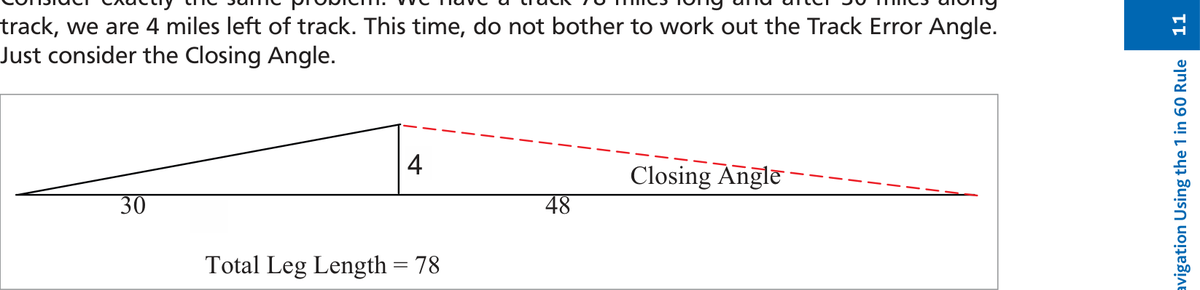
Same problem: 78 NM track, 30 NM along, 4 NM left
📚 In Practice
Simply estimate your position as approximately 1/4, 1/3, or 1/2 along the leg, then multiply the closing angle by 4, 3, or 2 respectively.
6. Using These Methods Practically
ℹ Not EASA ATPL Examined
The practical map-marking techniques in this section are not examined in the EASA ATPL. They are used in practical VFR flying training.
Mark the chart during preflight with angle guidelines and distance-to-go markers so in-flight calculations can be done rapidly by eye.
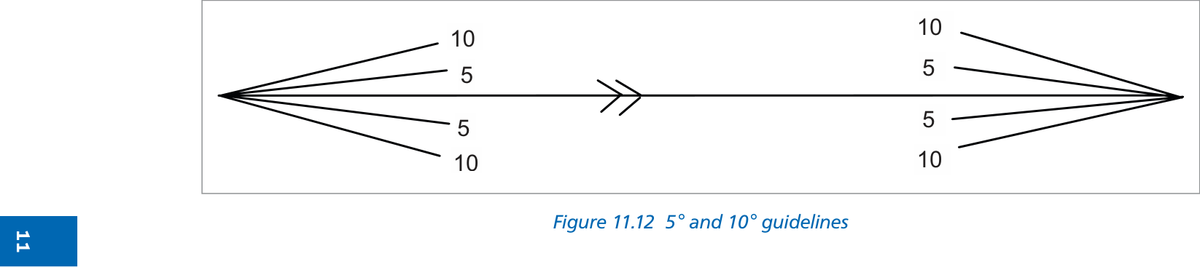


With 10° guidelines at each end of track and 10 NM distance-to-go markers, you can read off the closing angle and estimate your proportion along track at a glance — then apply the combined calculation immediately.
7. New Track Reference — The Preferred Method
New Track Reference combines the single-calculation method with a systematic re-correction procedure whenever a new fix is obtained.
✈ New Track Reference Procedure
- Maintain steady heading until position is definitely established — no hasty corrections.
- Estimate the proportion of the current leg distance covered (e.g., ¼, ½, ¾).
- Invert that fraction.
- Multiply the inverted fraction by the Closing Angle to the destination.
- Alter heading by that amount, toward the destination.
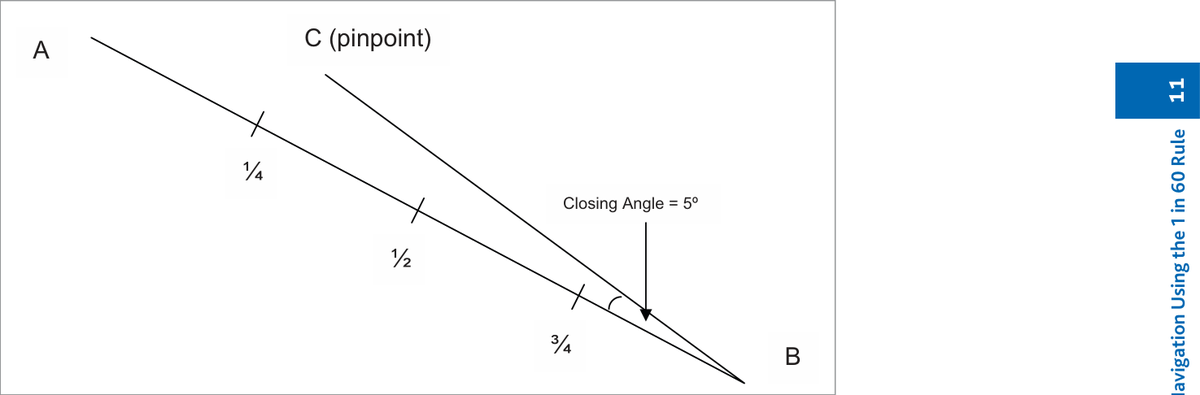
Example — First Correction at C (¼ along leg A–B, CA = 5°)
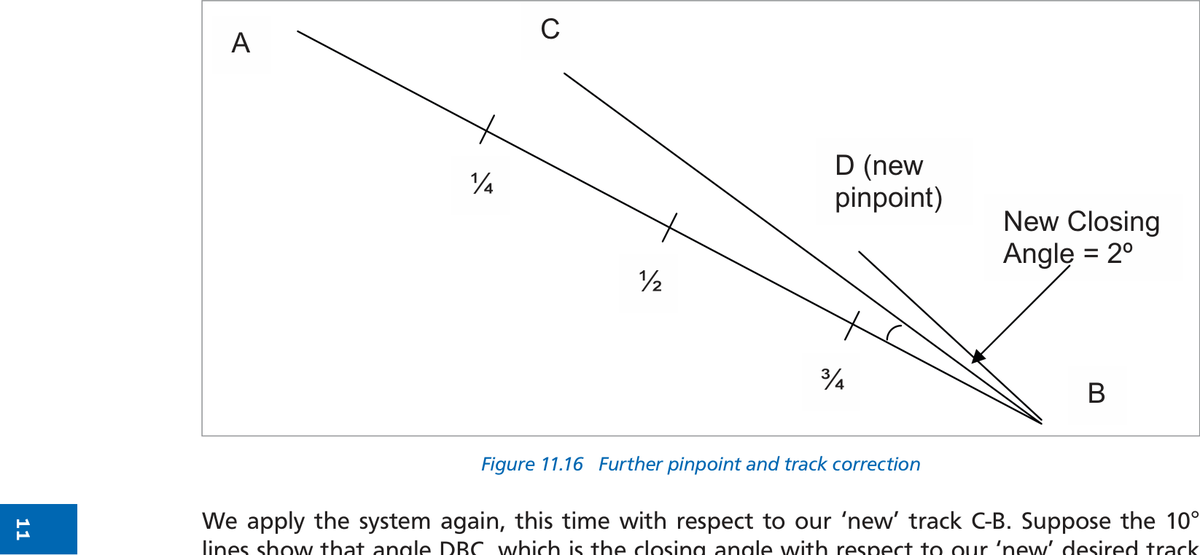
Example — Second Correction at D (½ along new leg C–B, new CA = 2°)
✎ Key Points for New Track Reference
- The Closing Angle must be measured from the new (current) track, not the original planned track
- The proportion estimate must be of the new leg (e.g., C–B), not the original leg (A–B)
- Angle guidelines on the chart were drawn for the original track — mentally adjust for each new leg
📚 Chapter 11 Quick Revision
- TEA is not drift — drift requires knowledge of heading
- Double TEA method: turn 2 × TEA → regain track in same time as it took to go off → only effective when less than halfway along leg
- TEA + CA method: fly direct to destination; turn = TEA + CA
- Combined calc: Turn = CA × (total/gone) — same result, one step
- New Track Reference: hold steady → estimate fraction → invert → multiply CA → turn
Practice Questions & Detailed Answers
5 questions (21 sub-parts) • Track error, TMG, drift, heading corrections, ETA
▶ Show answer & workings
▶ Show answer & workings
(a) What is the track error angle?
(b) What alteration of heading is required to fly direct to B?
(c) What is the drift?
▶ Show answer & workings
TEA = (7 / 35) × 60 = 12° right
Remaining = 95 − 35 = 60 NM CA = (7 / 60) × 60 = 7°
Total turn = TEA + CA = 12° + 7° = 19° left (aircraft is right of track, so turn left)
Cannot be calculated — drift is the angle between heading and track. No heading is given, so drift cannot be found. This is an intentional trap: TEA ≠ drift.
(a) Track error overhead Cranfield? (b) TMG from Airfield W? (c) Expected drift?
(d) Actual drift? (e) Heading alteration to fly direct to Cambridge? (f) New heading from Cranfield?
▶ Show answer & workings
TEA = (4 / 30) × 60 = 8° left
Aircraft is left of planned track → TMG < planned
TMG = 074° − 8° = 066°(M)
Expected drift = Planned track − Heading = 074° − 065° = 9° Starboard
(Heading is left of track → wind forecast to push aircraft right/starboard)
Actual drift = TMG − Heading = 066° − 065° = 1° Starboard
(Wind pushed only 1°S, not 9°S as forecast → aircraft ended up left of track)
Remaining = 70 − 30 = 40 NM CA = (4 / 40) × 60 = 6°
Total turn = TEA + CA = 8° + 6° = 14° right
New heading = 065° + 14° = 079°(M)
(a) Planned drift? (b) Track error at 1012? (c) TMG 1000–1012? (d) Actual drift?
(e) Alteration to fly direct to destination? (f) Heading direct?
(g) Alteration to regain track at 1024? (h) Heading 1012–1024?
(i) Change at 1024 and heading from 1024? (j) ETA at destination?
▶ Show answer & workings
Planned drift = Planned track − Heading = 250° − 260° = 10° Port
(Track is left of heading → wind forecast to push aircraft port/left)
Distance flown = 180 kt × 12/60 = 36 NM
TEA = (3 / 36) × 60 = 5° right
Aircraft right of planned track → TMG > planned
TMG = 250° + 5° = 255°(M)
Actual drift = TMG − Heading = 255° − 260° = 5° Port
(Wind pushed 5°P, not 10°P as forecast → aircraft went right of track)
Remaining = 96 − 36 = 60 NM CA = (3 / 60) × 60 = 3°
Total turn = TEA + CA = 5° + 3° = 8° left
260° − 8° = 252°(M)
Turn = 2 × TEA = 2 × 5° = 10° left
260° − 10° = 250°(M)
At 1024 aircraft regains track. Turn 5° right (half of the 10° double-TEA correction).
New heading = 250° + 5° = 255°(M)
This is the corrected heading for the actual wind conditions experienced.
1000–1012 = 36 NM | 1012–1024 = 36 NM → 72 NM covered by 1024
Remaining = 96 − 72 = 24 NM | Time = (24/180) × 60 = 8 min
ETA = 1024 + 8 = 1032 hrs
Master Reference — Chapter 11
The Four Methods Compared
| Method | Formula | Result | Best used when |
|---|---|---|---|
| Double TEA | Turn = 2 × TEA | Returns to track in same time as deviation | < halfway along leg |
| TEA + CA | Turn = TEA + CA | Flies direct to destination | Any time |
| Combined | Turn = CA × (total/gone) | Same as TEA + CA; one step | Any time |
| New Track Ref | Turn = CA / fraction along leg | Direct to dest.; re-applicable at any fix | Preferred always |
Key Definitions
| Term | Formula |
|---|---|
| Track Error Angle | Planned track − TMG | (cross-track / along-track) × 60 |
| TMG (left of track) | Planned track − TEA |
| TMG (right of track) | Planned track + TEA |
| Expected drift | Planned track − Heading |
| Actual drift | TMG − Heading |
| Closing Angle | (cross-track error / remaining distance) × 60 |
Answer Key — No ⚔ Flags
| Q | Answer(s) |
|---|---|
| 1 | 6 NM |
| 2 | 3° |
| 3 | (a) 12°R (b) 19°L [TE=12, CA=7] (c) Cannot calculate — heading not given |
| 4 | (a) 8°L (b) 066°M (c) 9°S (d) 1°S (e) 14°R [TE=8, CA=6] (f) 079°M |
| 5 | (a)10°P (b)5°R (c)255°M (d)5°P (e)8°L (f)252°M (g)10°L (h)250°M (i)5°R→255°M (j)1032 |
Chapter 11 — Navigation Using the 1 in 60 Rule
Ghost Aviator | www.ghostaviator.com
For personal study use only. Ghost Aviator Interactive Colour Edition.
Reinforce Chapter 5: Navigation Using the 1 in 60 Rule
Test your knowledge and practice actual exam questions for Air Navigation.