The 1 in 60 Rule
by Ghost Aviator
Contents
1. The 1 in 60 Rule — Concept & Application
✈ The Core Idea
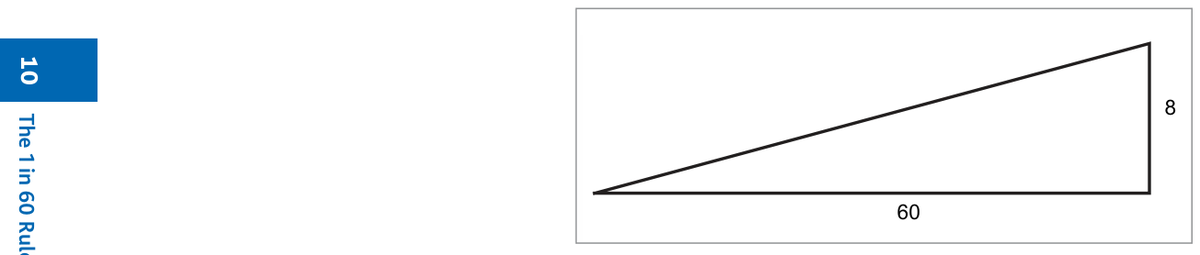
For any angle up to about 20°, if the adjacent side of a right-angled triangle is 60 units long, then the length of the opposite side (in the same units) is numerically equal to the angle in degrees.
In flight: if you have travelled 60 NM along-track and you are N NM off-track, your track error angle is approximately N degrees.
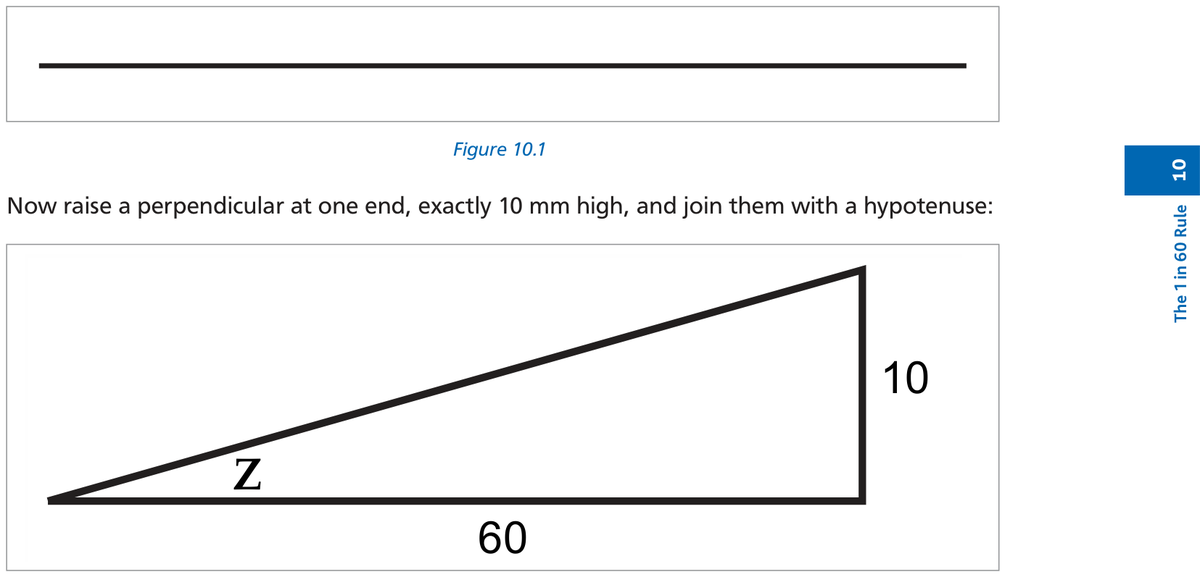
This is an enormously useful tool for in-flight calculations, removing the need for a protractor. The rule works because:
- When the adjacent = 60, tan(z°) ≈ z/60 for small angles (up to ~20°)
- Equivalently: one radian = 57.3° ≈ 60° for this approximation
2. Measuring Angles in Flight
Suppose you are flying on a planned track of 100°(T). After 60 NM from your last on-track fix, you identify a ground feature that is 4 NM right of track.
✎ Applying the rule directly:
Adjacent = 60 NM, Opposite = 4 NM → Track Error Angle = 4° right
Your Track Made Good (TMG) = 100° + 4° = 104°(T)
No protractor needed — simply read off the angle from the numbers. The next chapter covers what to do once you have the error angle.
3. Geometry of the 1 in 60 Rule — The Radian Derivation
Why does this rule work? The key lies in the definition of a radian.
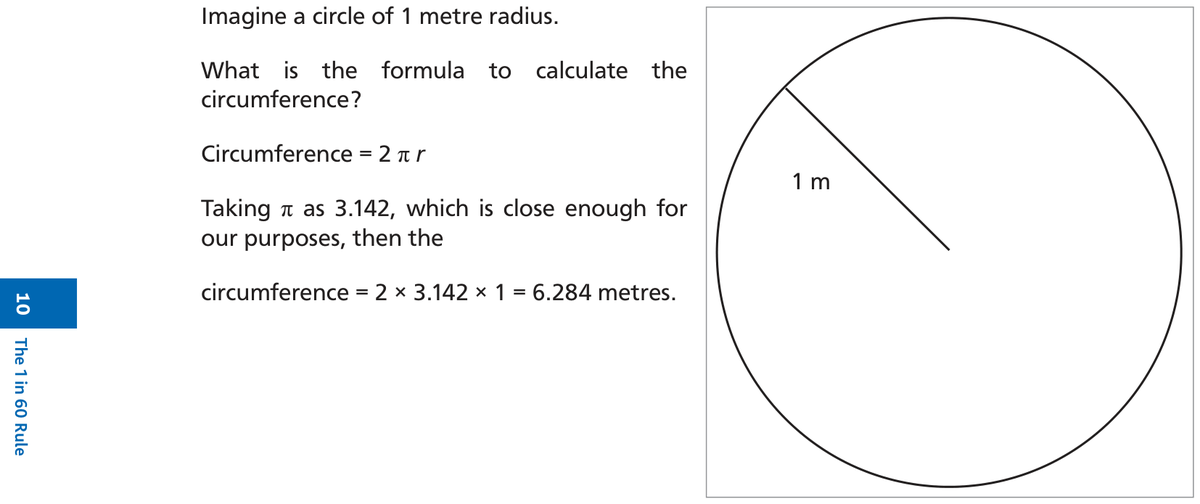
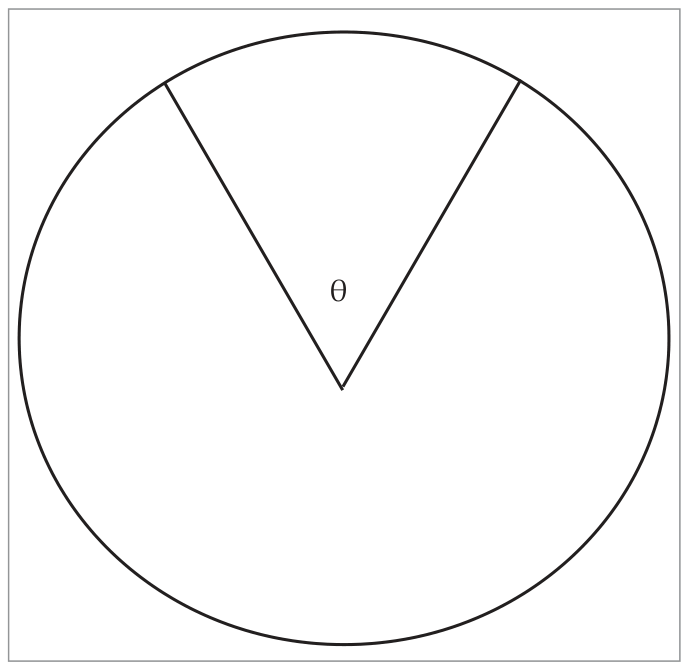
The Radian Calculation
Step-by-step derivation
📚 Why 60 and not 57.3?
Strictly, this should be the "1 in 57.3 rule". But 57.3 is awkward for mental arithmetic at high workload in the cockpit. Rounding to 60 introduces only ~5% error, which is perfectly acceptable for navigation.
4. The Tangent Explanation
An alternative derivation shows why the rule works for a flat right-angled triangle (rather than an arc).
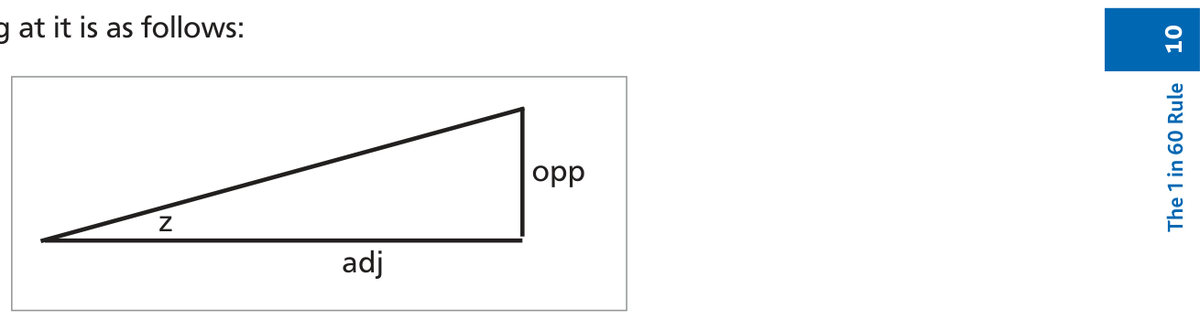


The Tangent Table
| Angle z | 1° | 2° | 5° | 10° | 15° | 20° |
|---|---|---|---|---|---|---|
| tan z | 0.017 | 0.035 | 0.087 | 0.176 | 0.268 | 0.364 |
| 60 × tan z | 1.02 | 2.10 | 5.22 | 10.56 | 16.08 | 21.84 |
Up to about 10°, the correlation between angle z and 60 × tan z is excellent (within 1%). Above 15°–20° the error grows, but in practice you should rarely need the rule for angles that large.
⚠ Validity Limit
The 1 in 60 rule is acceptably accurate for angles up to ~20°. Above this, the tangent relationship becomes significantly non-linear. For track errors larger than 20°, use the nav computer or trigonometry.
5. Expanding or Contracting the Triangle
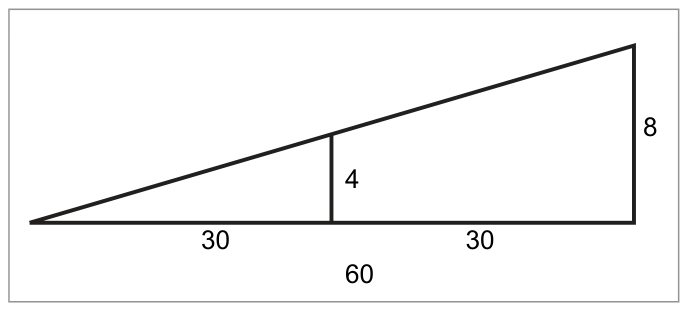
Fixes don't always occur at exactly 60 NM intervals. The 1 in 60 rule can be adapted for any along-track distance using the principle of similar triangles.
✎ Scale the Cross-Track Distance
For a given track error angle, the cross-track error scales proportionally with along-track distance:
- 4 NM off in 30 NM = 8 NM off in 60 NM → track error = 8°
- 10 NM off in 120 NM = 5 NM off in 60 NM → track error = 5°
6. The Formula & Worked Applications
Applications
| Use case | Known | Find | Formula |
|---|---|---|---|
| Track error angle | Distance off, distance gone | Angle z | z = (off/gone) × 60 |
| Cross-track distance | Angle z, distance gone | Distance off | off = (z × gone) / 60 |
| Along-track distance | Angle z, distance off | Distance gone | gone = (off × 60) / z |
| Glide slope height | GS angle, range | Height | H = (angle × range_ft) / 60 |
| Glide slope range | GS angle, height | Range | range_ft = (H × 60) / angle |
✈ TMG vs Track Error
Track Made Good (TMG) = planned track ± track error angle
If aircraft is left of track: TMG = planned track − error (track is less than planned)
If aircraft is right of track: TMG = planned track + error (track is more than planned)
✎ Glide Slope Worked Example
GS angle 3°, range 2 NM (1 NM = 6 000 ft):
Range = 2 × 6 000 = 12 000 ft
Height = (3 × 12 000) / 60 = 600 ft
GS angle 2.5°, height 1 000 ft QFE (1 NM = 6 000 ft):
Range (ft) = (1 000 × 60) / 2.5 = 24 000 ft
Range (NM) = 24 000 / 6 000 = 4 NM
📚 Quick Revision — Chapter 10
- Core rule: adjacent = 60 → opposite (numerically) = angle in degrees
- Formula: z = (off / gone) × 60
- Left of track → TMG = planned − z; Right → TMG = planned + z
- Valid up to ~20°; 5% error from using 60 instead of 57.3
- Closing angle to destination: same formula using distance from destination
- Glide slope: H(ft) = (GS angle × range_ft) / 60
Practice Questions & Detailed Answers
12 calculation questions • Track error, TMG, glide slope, closing angle • Full worked solutions
▶ Show answer & workings
z = (7 / 60) × 60 = 7° left. At exactly 60 NM, the formula simplifies directly — the off-track distance IS the angle.
▶ Show answer & workings
z = (8 / 120) × 60 = 4° right.
At 120 NM, halve the off-track distance to get the angle: 8 ÷ 2 = 4°.
▶ Show answer & workings
z = (6 / 90) × 60 = 360 / 90 = 4° right.
At 90 NM, multiply off-track by 2/3: 6 × (60/90) = 4°.
▶ Show answer & workings
z = (4 / 30) × 60 = 240 / 30 = 8° left.
At 30 NM (half of 60), double the off-track: 4 × 2 = 8°.
▶ Show answer & workings
Step 1 — Track error angle: z = (4 / 80) × 60 = 3°
Step 2 — Apply: Aircraft is left of track, so TMG < planned.
TMG = 045° − 3° = 042°(T)
▶ Show answer & workings
Step 1 — Track error: z = (3 / 45) × 60 = 4°
Step 2 — Apply: Aircraft is right of track, so TMG > planned.
TMG = 220° + 4° = 224°(T)
▶ Show answer & workings
Step 1 — Track error: z = (6 / 40) × 60 = 9°
Step 2 — Apply: Aircraft is left of track, so TMG < planned.
TMG = 315° − 9° = 306°(T)
▶ Show answer & workings
Distance off: H = (z × distance) / 60 = (4 × 660) / 60 = 2 640 / 60 = 44 m
The surveyor's 660 m horizontal distance is the 'adjacent' and the mast height is the 'opposite'.
▶ Show answer & workings
Step 1 — Convert range to feet: 2 NM × 6 000 = 12 000 ft
Step 2 — Height: H = (3 × 12 000) / 60 = 36 000 / 60 = 600 ft
▶ Show answer & workings
Step 1 — Find range in feet: range_ft = (H × 60) / angle = (1 000 × 60) / 2.5 = 60 000 / 2.5 = 24 000 ft
Step 2 — Convert to NM: 24 000 / 6 000 = 4 NM
▶ Show answer & workings
Closing angle: z = (2 / 40) × 60 = 3°
Direction: Aircraft is left of track. To close onto R, turn right (increase track).
Track to R = 125° + 3° = 128°(T)
Note: When flying toward the destination with a closing angle, the correction adds to or subtracts from the planned track to point at R — not at a parallel offset.
▶ Show answer & workings
Closing angle: z = (5 / 50) × 60 = 6°
Direction: Aircraft is right of track. To close onto T, turn left (decrease track).
Track to T = 272° − 6° = 266°(T)
Master Reference Tables — Chapter 10
The 1 in 60 Formulae
| Find | Formula | Notes |
|---|---|---|
| Track error angle | z = (off / gone) × 60 | z in degrees |
| Cross-track distance | off = (z × gone) / 60 | Units consistent |
| Along-track distance | gone = (off × 60) / z | — |
| Glide slope height (ft) | H = (angle × range_ft) / 60 | 1 NM = 6 000 ft for calcs |
| Glide slope range (ft) | range_ft = (H × 60) / angle | Then ÷ 6 000 for NM |
Key Facts
| Parameter | Value |
|---|---|
| Exact value (radians) | 57.3° |
| Practical approximation | 60° (~5% error) |
| Valid angle range | up to ~20° |
| Left of track → TMG | planned − error (TMG less than planned) |
| Right of track → TMG | planned + error (TMG more than planned) |
| Closing angle (left) | planned + closing angle |
| Closing angle (right) | planned − closing angle |
Answer Key — No ⚑ Flags
| Q | 1 | 2 | 3 | 4 | 5 | 6 | 7 | 8 | 9 | 10 | 11 | 12 |
|---|---|---|---|---|---|---|---|---|---|---|---|---|
| Ans | 7°L | 4°R | 4°R | 8°L | 042°T | 224°T | 306°T | 44 m | 600 ft | 4 NM | 128°T | 266°T |
Chapter 10 — The 1 in 60 Rule
Ghost Aviator | www.ghostaviator.com
For personal study use only. Ghost Aviator Interactive Colour Edition.
Reinforce Chapter 4: The 1 in 60 Rule
Test your knowledge and practice actual exam questions for Air Navigation.