7
HPL — CHAPTER 7 · NOTES
The Silent Killers
by Ghost Aviator
Human Performance & Limitations · Module C — The Thin AirThe Silent Killers
Chapter 7 — Two hazards that give no honest warning: carbon monoxide, the colourless killer that steals your haemoglobin, and hyperventilation, the panic that mimics hypoxia.
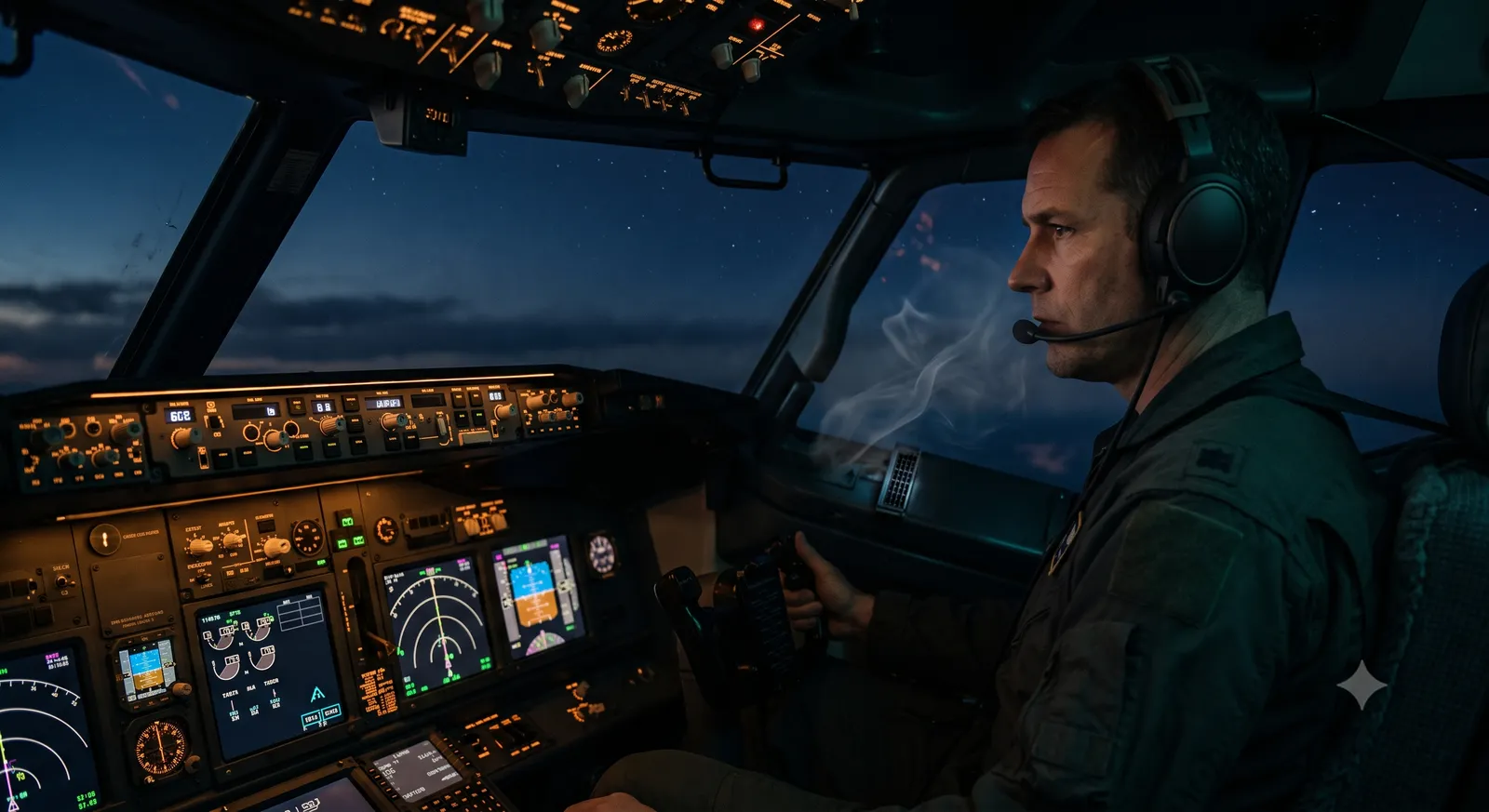
§ 11Carbon Monoxide (CO) Poisoning
11.1 The Colourless Killer
What CO is
Carbon monoxide is a colourless, odourless, tasteless gas that is a product of incomplete combustion.
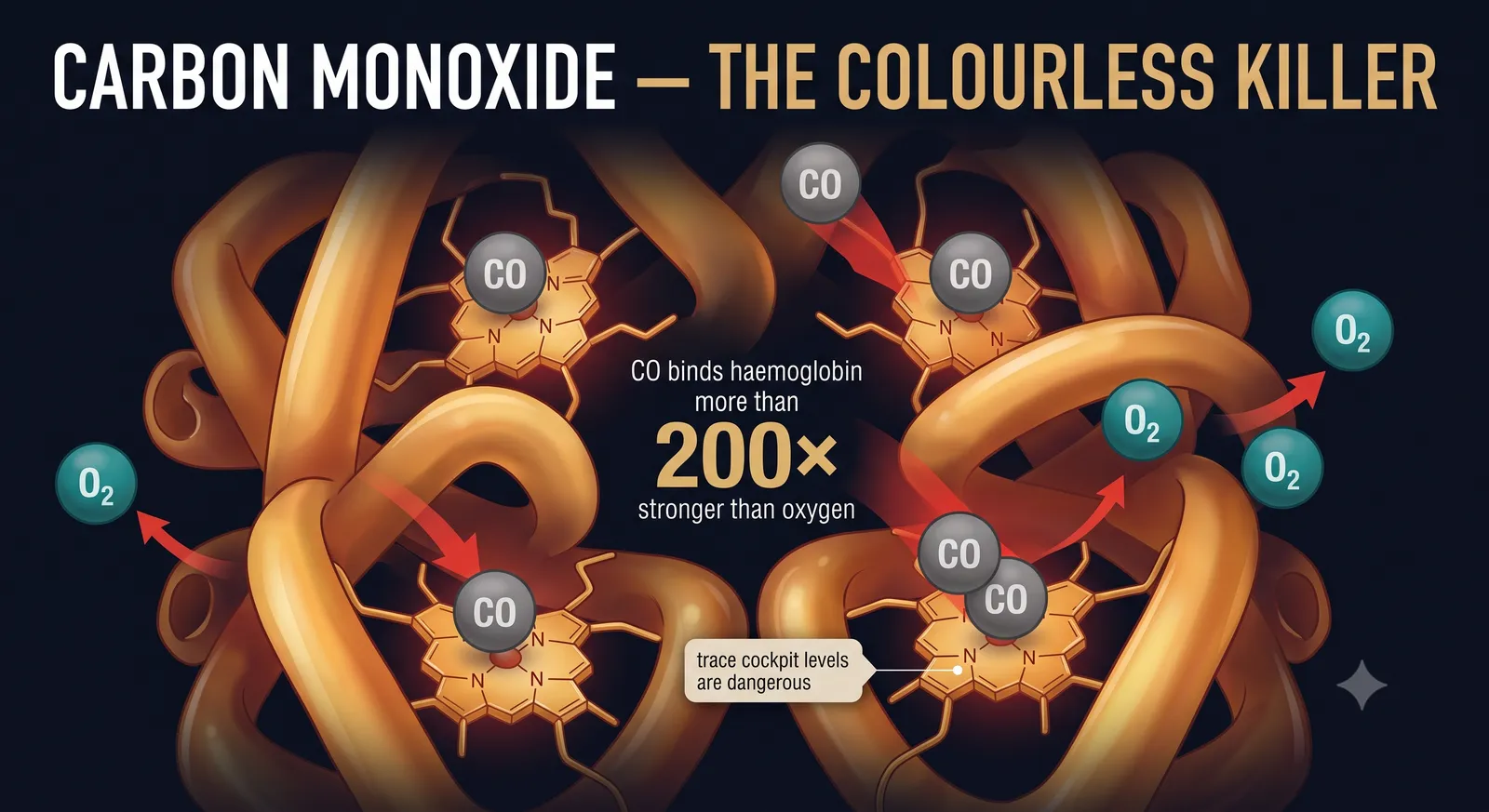
Why CO is so dangerous — the 200× rule
Haemoglobin, the oxygen-carrying chemical in the blood, picks up carbon monoxide over 200 times more readily than it picks up oxygen.
Thus, even minute quantities in the cockpit (often from improperly vented exhaust fumes) may result in pilot incapacitation. Exhaust gases from piston engines can consist of as much as 9 % carbon monoxide. So, gases from leaking exhausts can cause carbon monoxide poisoning in pilots.
Thus, even minute quantities in the cockpit (often from improperly vented exhaust fumes) may result in pilot incapacitation. Exhaust gases from piston engines can consist of as much as 9 % carbon monoxide. So, gases from leaking exhausts can cause carbon monoxide poisoning in pilots.
Sources of cockpit CO — the usual suspects
- Improperly vented exhaust fumes entering the cabin via the heating system.
- Leaking exhaust manifolds / muffler shrouds (especially common in piston singles where cabin heat is drawn over the exhaust).
- Engine combustion gases, which can contain up to 9 % CO.
- Tobacco smoke in confined cabins.
11.2 Symptoms · Actions · Prevention
Carbon Monoxide Poisoning – Symptoms
- Initially, there is an INABILITY TO CONCENTRATE
- Headache
- Dizziness
- Nausea
- Impaired vision
- Lethargy or weakness
- Impaired judgment
- Personality change
- Impaired memory
- Flushed cheeks and cherry-red lips (classic CO sign)
- Convulsions
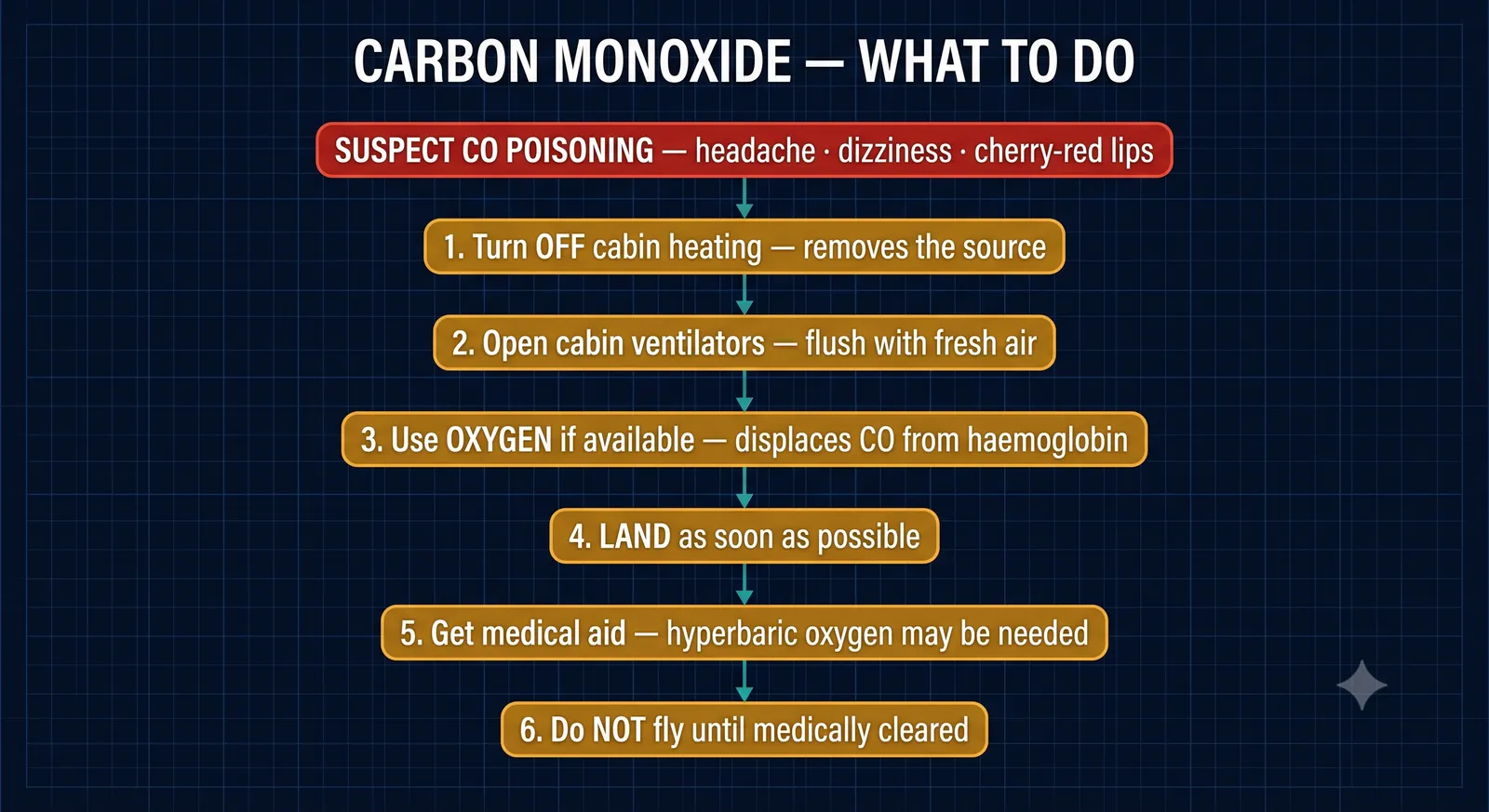
Actions if CO Poisoning is Suspected
- Turn off cabin heating
- Open cabin ventilators
- Consider using oxygen if available
- Land as soon as possible
- Take medical aid
- Do not fly till cleared by doctor
DGCA-quoted prevention rule — copy verbatim into your exam answer
AT ALL TIMES WHEN THE CABIN HEATING IS USED, FRESH AIR MUST BE CIRCULATED TO REDUCE PRESENCE OF CO.
Why the "cherry-red" colour?
Carboxyhaemoglobin (Hb-CO) is a bright cherry red — much brighter than oxygenated Hb. The pilot's cheeks and lips therefore flush bright pink/red. Don't confuse this with the bluish CYANOSIS seen in hypoxic hypoxia. They look opposite:
- Hypoxic Hypoxia → blue extremities (cyanosis)
- CO Poisoning → bright cherry-red lips/cheeks
CO affinity for Hb (vs O₂)
> 200 ×
CO in piston-engine exhaust
up to 9 %
First symptom
Inability to concentrate
Classic skin sign
Cherry-red lips
First action
Turn off cabin heat
Hypoxia type involved
Anemic (Type b)
§ 12Hyperventilation
Definition — "over-breathing"
"Hyperventilation" is another word for "over-breathing" and may be defined as lung ventilation in excess of the body's needs. Good training is the best way to avoid Hyperventilation in pilots.
Mitigation for passengers
The chances of Hyperventilation affecting your passengers can be reduced by giving them a thorough pre-flight briefing on every aspect of the flying sortie. (Briefed passengers = calm passengers; calm passengers don't hyperventilate.)
12.1 Causes at Low Altitude
At low altitude — where hypoxia is not a factor — the most common causes of hyperventilation are psychological or environmental rather than physiological.
| Category | Cause |
|---|---|
| Cognitive load | Intense concentration on a difficult task |
| Emotional | Fear |
| Emotional | Anxiety |
| Physical | Motion sickness |
| Physical | Shock |
| Environmental | Vibration |
| Environmental | Heat |
| Aerodynamic / Manoeuvring | High G-forces |
12.2 Symptoms · Treatment · the Paper-Bag Trick
Symptoms of Hyperventilation
- Dizziness
- Tingling
- Visual disturbances
- Hot or cold sensation
- Anxiety
- Loss of muscular co-ordination
- Increased heart rate
- Spasms
- Loss of consciousness
- Cramping and spasms of the hands and feet
- Cold clammy skin
- Paleness
Treatment of Hyperventilation
- Breathe oxygen at 100 percent. If hypoxia is the cause, the symptoms will improve markedly after three or four breaths.
- If the symptoms persist, consciously slow the rate of breathing to 10–12 breaths per minute and do not breathe deeply.
- If you are flying below 10,000 feet, hypoxia is unlikely and hyperventilation may be assumed.
- If you suspect that any occupant of your aircraft is suffering from hyperventilation, try to calm them down. Give them a simple task to fulfill that might take their mind off their anxiety.
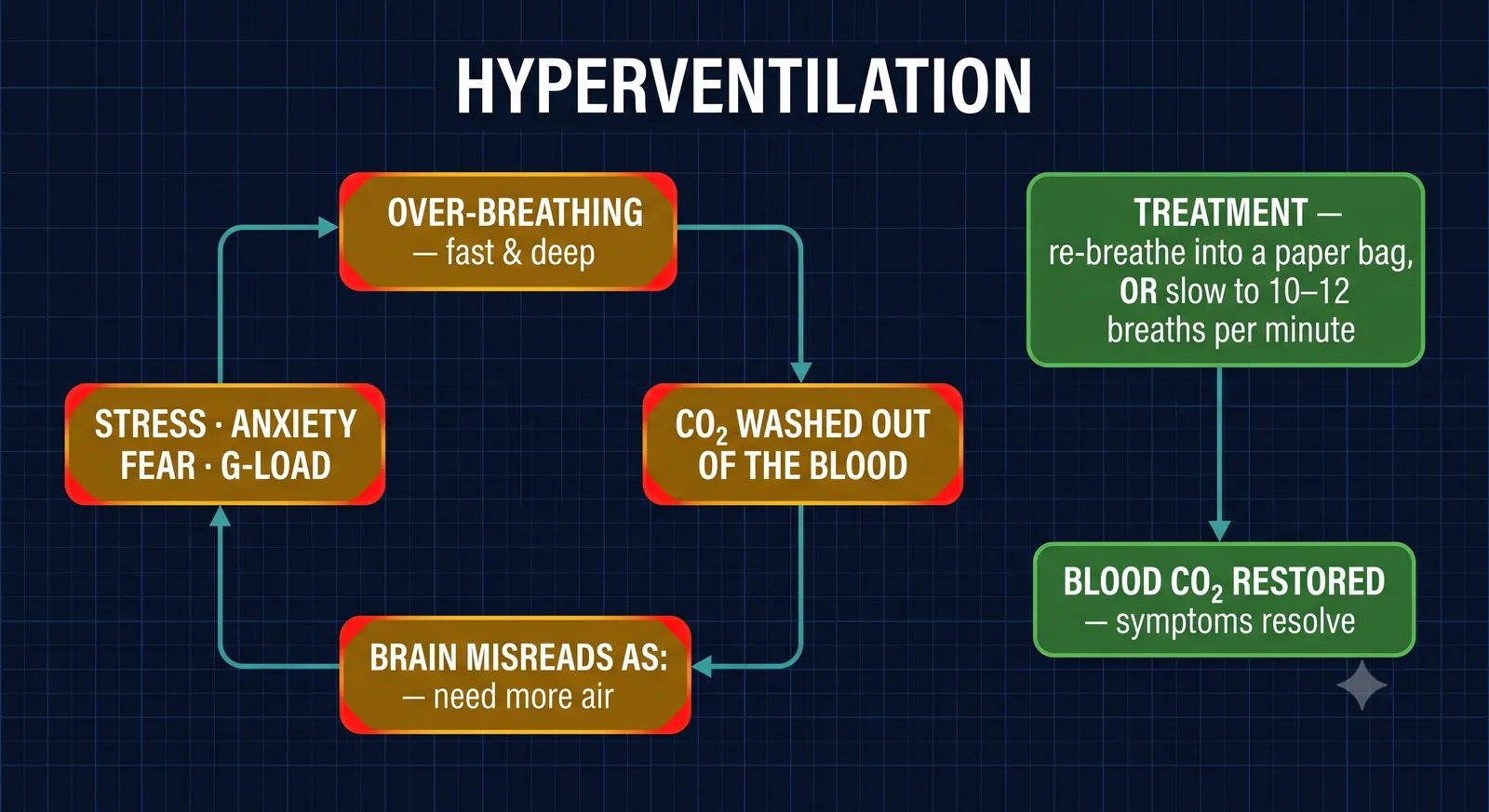
- One of the direct causes of hyperventilation is a reduction in the carbon dioxide level in the blood. The condition may be alleviated by getting the sufferer to breathe into a PAPER BAG. This action will increase the blood's carbon dioxide level, causing the brain to reduce the breathing rate.
The science behind the paper bag
Hyperventilation drives off too much CO₂ from the blood (respiratory alkalosis). Since the brain's breathing centre is regulated by CO₂ (see §8.4), low CO₂ causes the urge to keep over-breathing — a vicious circle. A paper bag traps exhaled CO₂ which is then re-inhaled, raising blood CO₂ back to normal and breaking the loop.
12.3 Hypoxia vs Hyperventilation — Telling Them Apart
A vital distinction — the symptoms overlap
Many symptoms of hypoxia and hyperventilation overlap (dizziness, tingling, visual disturbances, loss of consciousness). The DGCA syllabus gives you a clean altitude rule to distinguish:
- If flying BELOW 10,000 ft → hypoxia is unlikely → assume HYPERVENTILATION.
- If flying AT or ABOVE 10,000 ft → hypoxia is plausible → provide O₂ AND descend. If symptoms clear after 3–4 breaths of 100 % O₂, it was hypoxia.
| Parameter | Hypoxia | Hyperventilation |
|---|---|---|
| Typical altitude | > 10,000 ft | Any altitude (often below 10,000 ft) |
| Onset | Insidious, slow | Rapid — linked to a trigger (stress, fear) |
| Skin sign | Cyanosis (bluish) | Paleness · cold clammy skin |
| Heart rate | Often increased | Increased |
| Feeling of well-being? | Yes — euphoria | No — anxiety, fear |
| Blood CO₂ level | Variable / often normal | LOW |
| First-line treatment | 100 % O₂ + descend below 10,000 ft | Slow breathing to 10–12/min, or breathe into paper bag |
| How to confirm in flight | Symptoms improve in 3–4 breaths of 100 % O₂ | Symptoms persist on O₂; resolve with re-breathing technique |
Examiner's favourite trap
A pilot at 9,500 ft reports tingling in the fingers and dizziness. Hypoxia is unlikely below 10,000 ft → assume hyperventilation. Slow your breathing, calm down, optionally use a paper bag — do not declare an emergency and descend for a hypoxia event that isn't happening. (However — if O₂ is available, the standard advice "breathe 100 % O₂; if symptoms clear in 3–4 breaths it was hypoxia" lets you confirm safely.)
✦ END OF CHAPTER 7 ✦
Reinforce Chapter 7: The Silent Killers
Test your knowledge and practice actual exam questions for Human Performance & Limitations.
Planning your Pilot Training in 2026?
Calculate exact flying hours, DGCA exam fees, and living costs with our interactive calculator.