Pressure, TUC & Decompression
by Ghost Aviator
Human Performance & Limitations · Module C — The Thin AirPressure, TUC & Decompression
Chapter 8 — What happens when the pressure fails: cabin pressurisation and the shrinking Time of Useful Consciousness, decompression, the bends, and the rules for blood donation and flying after diving.
§ 16Baroreceptor Reflex
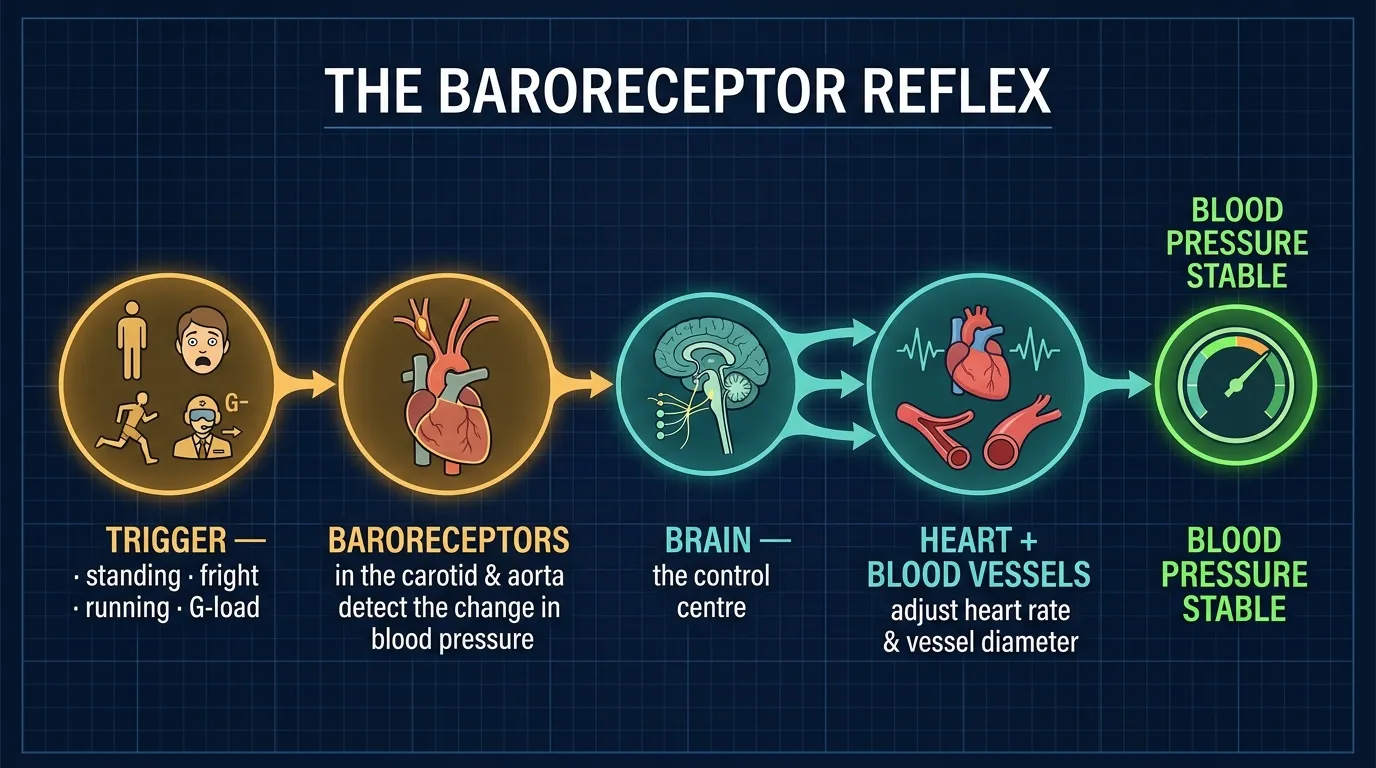
16.1 When the reflex fires — DGCA examples
For example, your body may need to adjust your blood pressure when you:
- Change your body position, such as when you stand.
- See or experience something that frightens you.
- Switch from walking to running.
- Postural changes: standing up from a long sit (e.g. after a long flight, in turbulence, or after a low-blood-sugar moment) can cause transient hypotension → light-headedness. The baroreceptor reflex normally corrects this in 1–2 seconds.
- Sudden fright / startle response: pulls in adrenaline from the ANS (§7.4), spiking HR and BP. The baroreceptor reflex moderates this so you don't pass out from a hypertensive crisis.
- Exercise & G-load: from steady cruise to sudden manoeuvring, blood demand changes rapidly. The reflex keeps cerebral perfusion stable so you don't grey out.
§ 17Donating Blood — the 48-hr rule
While the effects at ground level are minimal, flying during this period may entail a risk.
§ 18Cabin Pressurization & Time of Useful Consciousness (TUC)
18.1 What TUC / EPT is
It is the period of time from the interruption of the oxygen supply or exposure to an oxygen-poor environment to the time when useful function is lost, and the individual is no longer capable of taking proper corrective and protective action.
18.2 Why TUC Drops Sharply at Altitude
Cabin pressurization eliminates many problems associated with high altitude flying, but it introduces other potential problems, the most important being the risk of rapid decompression.
- Aircraft altitude,
- The rate at which pressure falls, and
- The level of physical activity of the individual at the time of the event.
- At typical jet transport aircraft altitudes (35,000 feet) TUC will vary between 33 and 54 seconds.
- Those average values can be expected to drop by HALF at 40,000 feet.
- This emphasizes the importance of immediate availability of supplemental oxygen to crew members.
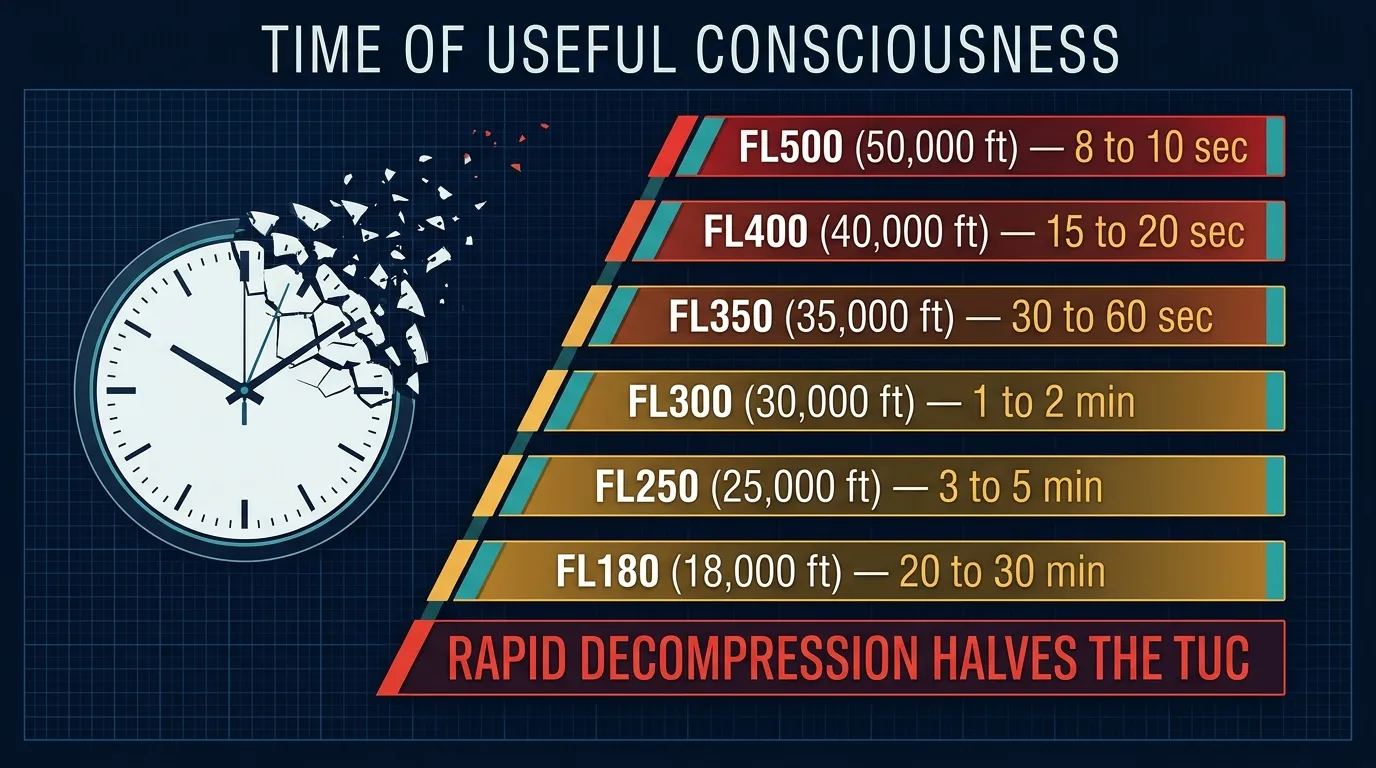
- RAPID DECOMPRESSION CAN REDUCE TUC BY HALF.
18.3 TUC Master Table — Verbatim
This is the table you must memorise — both columns. Every DGCA HPL question on TUC is drawn from these figures.
| Altitude (measured barometrically) | TUC (normal ascent) | TUC (rapid decompression) |
|---|---|---|
| FL180 (18,000 ft; 5,500 m) | 20 to 30 minutes | 10 to 15 minutes |
| FL220 (22,000 ft; 6,700 m) | 10 minutes | 5 minutes |
| FL250 (25,000 ft; 7,600 m) | 3 to 5 minutes | 1.5 to 3.5 minutes |
| FL280 (28,000 ft; 8,550 m) | 2.5 to 3 minutes | 1.25 to 1.5 minutes |
| FL300 (30,000 ft; 9,150 m) | 1 to 2 minutes | 30 to 60 seconds |
| FL350 (35,000 ft; 10,650 m) | 30 seconds to 1 minute | 15 to 30 seconds |
| FL400 (40,000 ft; 12,200 m) | 15 to 20 seconds | 7 to 10 seconds |
| FL430 (43,000 ft; 13,100 m) | 9 to 12 seconds | 5 to 6 seconds |
| FL500 (50,000 ft; 15,250 m) | 8 to 10 seconds | 5 seconds |
18.4 Rapid Decompression Halves TUC
Why? Because a rapid decompression doesn't just drop the pilot to ambient pressure — it actually sucks oxygen out of the lungs into the cabin atmosphere (Henry's law, in reverse). The pilot is left with less oxygen in the bloodstream than the new ambient pressure alone would predict.
- Don oxygen masks immediately — quick-don, regulator to EMERGENCY/100 %.
- Establish crew communication.
- Initiate emergency descent — target 10,000 ft or MSA, whichever higher.
- Squawk 7700, declare MAYDAY.
§ 19Decompression — Theory
19.1 The 8,000 ft "Maximum Comfort" Rule
19.2 Atmospheric Pressure is Halved at 18,000 ft
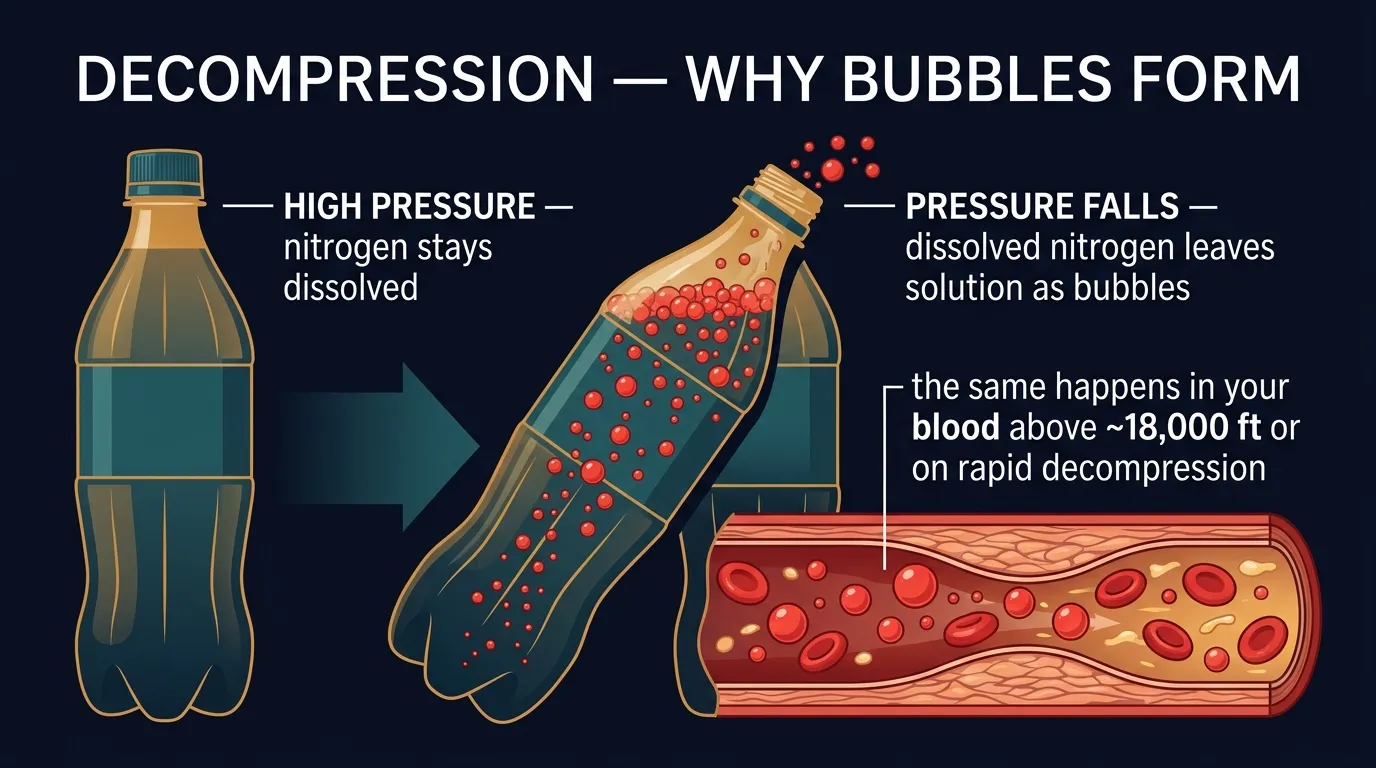
- At ground level, the body tissues are saturated with nitrogen, the inert gas which makes up 80 % of our atmosphere.
- As the aircraft climbs, atmospheric pressure is reduced.
- By 18,000 ft ASL (5,486 m) atmospheric pressure is HALVED.
- Decompression sickness symptoms may develop at 18,000 ft and above.
- Pilots flying aircraft with unpressurised cabins at altitudes greater than 25,000 feet ASL (7,620 m) may be subject to "the bends".
19.3 The Bends — Physiology of Nitrogen Bubbles
The bubbles may:
- Track into joint spaces causing a dull, sickening pain.
- More dangerously they may be released into the lungs or the brain, giving rise to chest pain and/or collapse.
19.4 Cabin Pressurization & Rapid vs Slow Decompression
FAST (Rapid) Decompression
A fast decompression is recognizable by:
- Mist in the cabin
- Blast towards the exterior of the aircraft
- Expansion of body gases
- Blast of air released violently from the lungs
SLOW Decompression
A slow decompression may be caused by:
- A slight air-tightness defect, or
- Bad functioning of the pressurization.
Insidious onset — no warning blast, no mist, but cabin altitude creeps up over minutes. Detected via the cabin-altitude warning horn (typically at ~10,000 ft cabin altitude in transport jets).
19.5 Factors that Increase the Tendency to Develop the Bends
- High rates of climb,
- Age,
- Obesity,
- Physical activity,
- Low temperatures.
§ 20Decompression Sickness (DCS)
20.1 Henry's Law Revisited — the underlying physics
A rapid reduction in ambient pressure may cause the nitrogen in our blood to come out of solution as small bubbles leading to decompression sickness.
- Bends
- Chokes
- Skin manifestations
- Neurological symptoms
- Circulatory shock
Symptoms may appear several hours after the exposure.
20.2 Effects of Nitrogen Bubbles — Four Syndromes
The DGCA syllabus names four specific syndromes based on the tissue affected. Memorise the names and the body region.
Joints: Bubbles in the joints cause rheumatic-like pain, called the Bends.
Classic shoulder & knee deep, dull ache — diver's bends, identical mechanism.
Skin: Nitrogen bubbles released under the skin cause the Creeps, a sensation of movement under the skin.
Linked to formication (§10.4) — the "ants crawling under the skin" feeling.
Respiratory System: Shortness of breath and a feeling of burning, gnawing and piercing pain. Known as the Chokes.
Bubbles in pulmonary capillaries → ventilation/perfusion mismatch. Burning chest pain.
The Brain: Loss of mental functions and control of movement. Known as the Staggers.
Neurological DCS — confusion, ataxia, weakness, paralysis. Most dangerous form.
| Tissue | Syndrome Name | Symptom Type |
|---|---|---|
| Joints | The Bends | Rheumatic-like joint pain |
| Skin | The Creeps | Sensation of movement under skin |
| Respiratory System | The Chokes | Shortness of breath; burning, gnawing, piercing chest pain |
| The Brain | The Staggers | Loss of mental function & movement control |
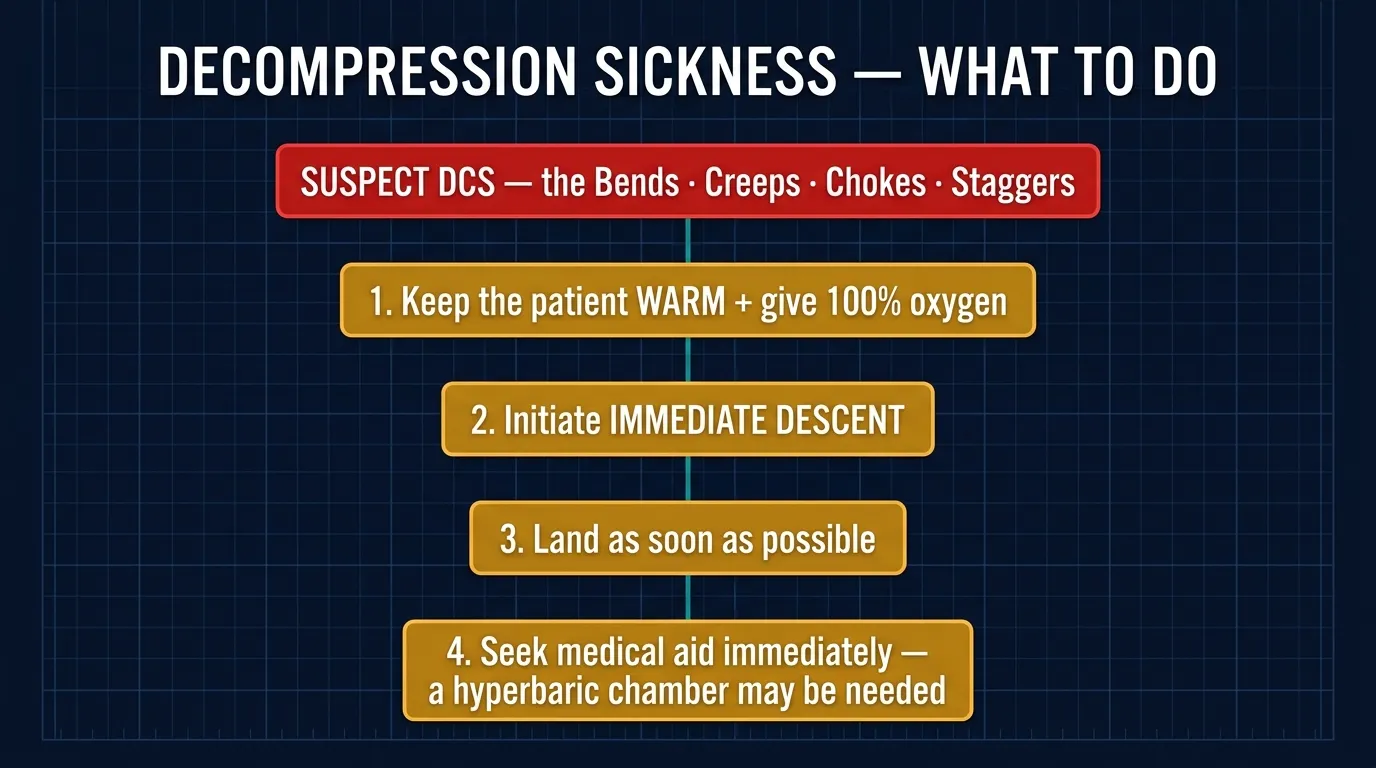
20.3 Treatment of Decompression Sickness
- Keep patient warm and on 100 % Oxygen.
- An immediate descent must be initiated.
- Land as soon as possible.
- Seek medical assistance immediately on landing.
20.4 The 12-Hour No-Fly Rule After Rapid Decompression
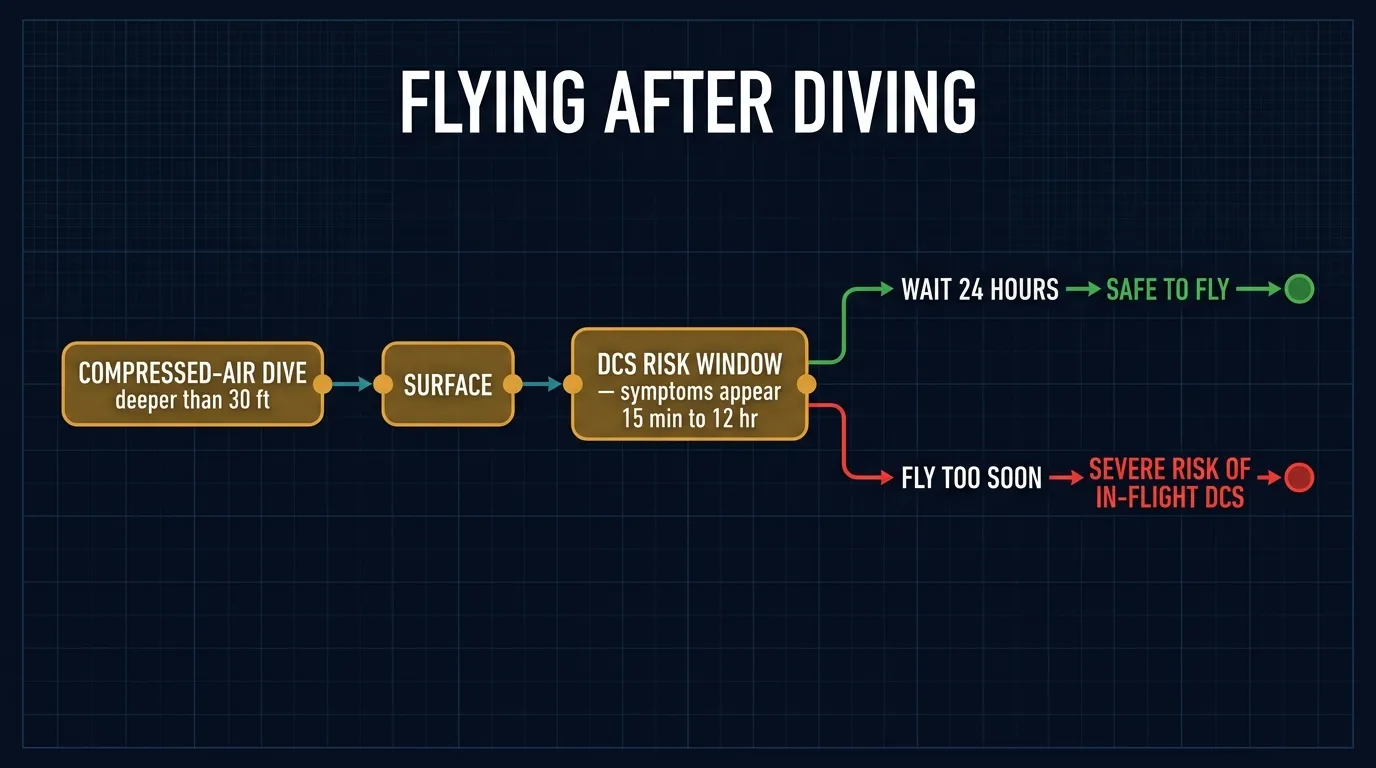
§ 21Flying After Diving — the 24-hour rule
- Alcohol — bottle to throttle: 24 hr (§14.1)
- Blood donation: 48 hr (§17)
- Flying after diving: 24 hr (§21)
- Flying after rapid decompression: 12 hr (§20.4)
§ 22Closing §21 — Delayed DCS After Diving
In plain English: even if a diver feels perfectly fine 24+ hours after surfacing, a subsequent flight can re-precipitate DCS symptoms. This is because residual nitrogen still dissolved in slow-perfused tissues (fat, bone marrow) can come out of solution when the pilot enters the lower cabin pressure of a transport flight. The 24-hour rule is a minimum, not a guarantee.
Reinforce Chapter 8: Pressure, TUC & Decompression
Test your knowledge and practice actual exam questions for Human Performance & Limitations.