Frequency Bands & Their Aviation Uses
by Ghost Aviator
Part II (ii) Radio frequency bands · principal aviation frequencies · polarization
Learning objectives — by the end of this chapter you will be able to…
- Name the radio bands VLF to EHF with their frequency ranges, wavelengths and dominant propagation.
- Explain in depth why aviation uses VHF (AM) for short range and HF (SSB) for long range.
- Recall the principal aviation frequencies and what each does.
- Explain channel spacing (25 kHz / 8.33 kHz) and calculate channel capacity.
- Define polarization, state the polarization of aviation VHF, and relate antenna length to wavelength.
8.1 The spectrum, band by band
8.2 VHF — the ATC workhorse
8.3 HF — reaching the ocean
8.4 The aviation frequency master table
8.5 Channel spacing & capacity
8.6 Polarization & antenna length
8.1 The spectrum, band by band
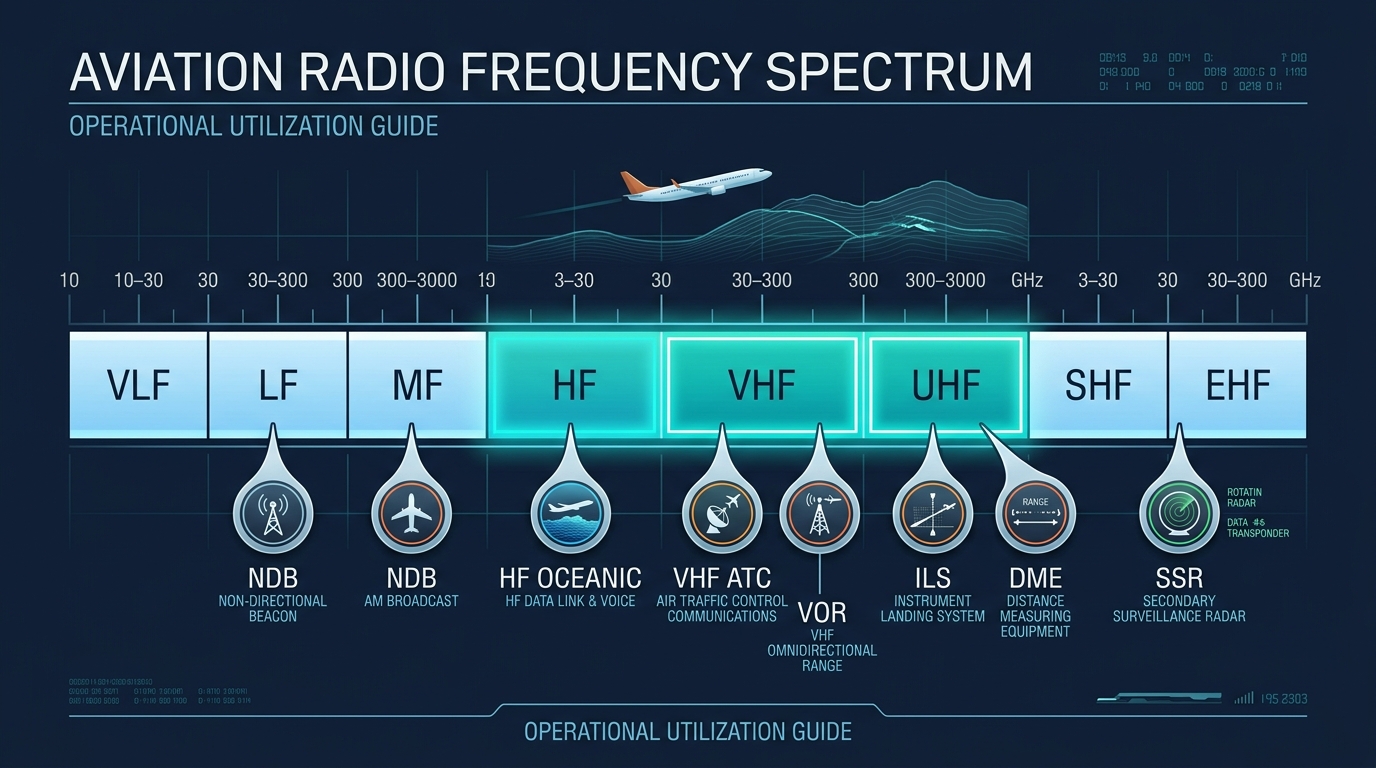
The radio spectrum is divided into bands, each a factor of ten in frequency above the one below. This matters because the dominant way a wave travels — and therefore what it is useful for — changes with frequency. Low frequencies have long wavelengths and bend around the Earth; high frequencies have short wavelengths and travel in straight lines. Aviation lives mainly in the HF, VHF and UHF bands.
| Band | Frequency | Wavelength | Dominant propagation | Typical aviation use |
|---|---|---|---|---|
| VLF | 3–30 kHz | 10–100 km | Ground/wave-guide | (Very long range; rare) |
| LF | 30–300 kHz | 1–10 km | Ground wave | NDB (low end) |
| MF | 300 kHz–3 MHz | 100 m–1 km | Ground wave | NDB; 2182 kHz maritime distress |
| HF | 3–30 MHz | 10–100 m | Sky wave | Long-range / oceanic voice (SSB) |
| VHF | 30–300 MHz | 1–10 m | Space (line-of-sight) | ATC voice, VOR, ILS LOC, markers |
| UHF | 300 MHz–3 GHz | 0.1–1 m | Line-of-sight | ILS glide path, DME, SSR, GPS, mil voice |
| SHF | 3–30 GHz | 1–10 cm | Line-of-sight | Radar, radio altimeter, satcom |
| EHF | 30–300 GHz | 1–10 mm | Line-of-sight | (Advanced / experimental) |
"Very Long Modems Help Various Useful Signals Excel" → VLF, LF, MF, HF, VHF, UHF, SHF, EHF. Each band is ×10 the previous.
8.2 VHF — the ATC workhorse
118.0 – 136.975 MHz, using Amplitude Modulation (AM), vertically polarized, propagating by line-of-sight (space wave). Range is limited to roughly the radio horizon — higher you fly, farther you reach.
VHF gives clear, static-free, short-range communication ideal for an airport's busy frequencies. AM is used so that two overlapping transmissions produce a tell-tale heterodyne squeal — alerting everyone that two stations transmitted at once, rather than one silently capturing the channel as FM would (the "capture effect", Chapter 10). AM's "you'll hear the clash" behaviour is a safety feature.
8.3 HF — reaching the ocean
3 – 30 MHz, using Single Side Band (SSB) for efficiency, propagating by sky wave (refracted off the ionosphere). This bounces signals thousands of miles — essential over oceans and polar routes where VHF line-of-sight fails. Crews change HF frequency between day and night (Chapter 9).
Tie the band to its job: VHF = AM, short-range, line-of-sight; HF = SSB, long-range, sky wave. Swapping AM/SSB or the propagation path is the classic trap.
8.4 The aviation frequency master table
| System / use | Frequency | Band |
|---|---|---|
| VHF ATC voice | 118.0 – 136.975 MHz | VHF |
| VHF emergency (guard) | 121.5 MHz | VHF |
| UHF military emergency | 243.0 MHz | UHF |
| SAR scene-of-search (aux) | 123.1 MHz | VHF |
| ELT (satellite / homing) | 406 MHz / 121.5 MHz | UHF / VHF |
| VOR | 108.0 – 117.975 MHz | VHF |
| ILS Localizer | 108.10 – 111.95 MHz | VHF |
| ILS Glide Path | 329 – 335 MHz | UHF |
| Marker beacons | 75 MHz | VHF |
| DME | 962 – 1213 MHz | UHF |
| SSR transponder | Interrogate 1030 / Reply 1090 MHz | UHF |
| NDB / ADF | ≈ 190 – 1750 kHz | LF/MF |
| Radio altimeter | 4200 – 4400 MHz | SHF |
| Maritime distress | 2182 kHz | MF |
8.5 Channel spacing & capacity
The VHF band is a fixed width, so the number of channels it holds depends on how closely they are spaced. Traditionally channels were 25 kHz apart; to fit more in the crowded European band, 8.33 kHz spacing was introduced — tripling the number of channels.
The VHF band is 118.0 to 136.975 MHz, a width of 18.975 MHz = 18,975 kHz.
At 25 kHz spacing: 18,975 ÷ 25 ≈ 760 channels. At 8.33 kHz spacing: 18,975 ÷ 8.33 ≈ 2,280 channels — roughly three times as many.
This is why 8.33-spaced frequencies read like 120.275 or 118.905 rather than ending in tidy tenths.
8.6 Polarization & antenna length
Polarization is the plane of the wave's electric field — vertical or horizontal. The antenna must match it: a vertical wave needs a vertical antenna. Aviation VHF communication is vertically polarized, which is why the COM antenna (the blade) is mounted vertically.
An efficient antenna is sized to the wavelength — commonly a half-wave or quarter-wave. Since λ shrinks as frequency rises, VHF aerials are short blades while HF aerials are long wires or probes. From Chapter 7, a 120 MHz λ is 2.5 m, so a quarter-wave whip is about 0.6 m — a practical blade. An HF λ of 100 m needs a long-wire or a tuned coupler.
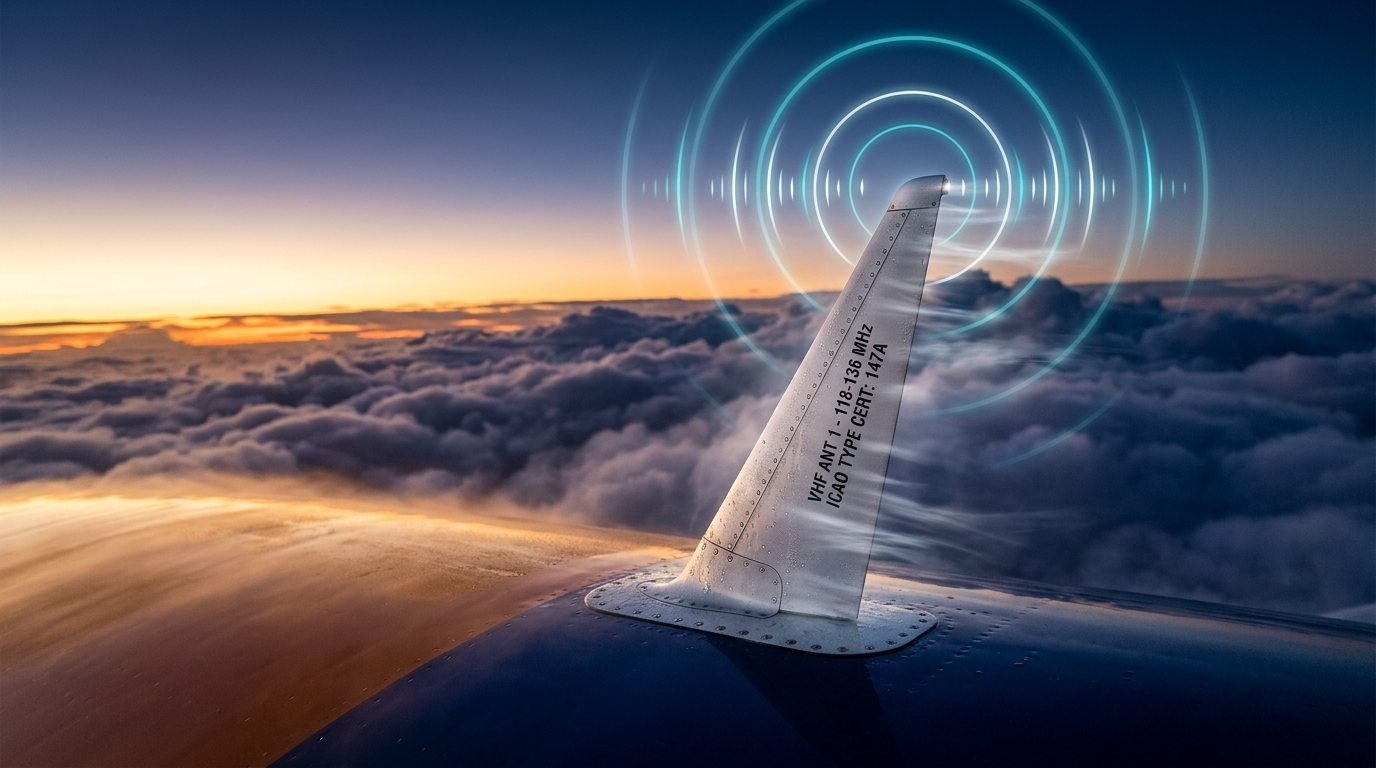
The little vertical blade on the fuselage is your VHF COM antenna, matched to the vertical polarization of the signal. Mismatch the polarization and received signal strength drops sharply — one reason antennas are mounted exactly as they are.
☆ Numbers to memorise
| Fact | Value |
|---|---|
| Band order (×10 each) | VLF · LF · MF · HF · VHF · UHF · SHF · EHF |
| VHF ATC voice | 118.0–136.975 MHz · AM · vertical · line-of-sight |
| HF voice | 3–30 MHz · SSB · sky wave · oceanic |
| Channel spacing | 25 kHz (≈760 ch) and 8.33 kHz (≈2280 ch) |
| VOR / ILS LOC | 108.0–117.975 / 108.10–111.95 MHz (VHF) |
| ILS GP / DME | 329–335 MHz / 962–1213 MHz (UHF) |
| SSR transponder | 1030 MHz interrogate · 1090 MHz reply |
| Emergency | 121.5 (VHF) · 243.0 (UHF) · 406 (ELT) · 123.1 (SAR aux) |
| Aviation VHF polarization | Vertical |
Part A — MCQs (click an option to check)
Part B — Oral / viva (tap to reveal model answers)
60-SECOND REVISION CARD
- Bands ×10: VLF·LF·MF·HF·VHF·UHF·SHF·EHF; aviation core = HF/VHF/UHF.
- VHF 118–136.975 MHz, AM, vertical, line-of-sight; HF 3–30 MHz, SSB, sky wave, oceanic.
- ILS: LOC VHF 108.10–111.95 · GP UHF 329–335 · markers 75 MHz. DME UHF 962–1213. SSR 1030/1090.
- Emergency 121.5 / 243.0 / 406, SAR aux 123.1. Channel spacing 25 / 8.33 kHz (≈760 / 2280 ch).
- Aviation VHF vertically polarized; antenna length scales with wavelength.
Reinforce Chapter 8: Frequency Bands & Their Aviation Uses
Test your knowledge and practice actual exam questions for Radio Telephony.