Voice Weather Broadcasts
by Ghost Aviator
Part III (x) VOLMET & ATIS broadcasts
Learning objectives — by the end of this chapter you will be able to…
- Define ATIS and VOLMET.
- Explain the sequence and contents of an ATIS broadcast.
- Explain the sequence and contents of a VOLMET broadcast.
- Understand how to use and acknowledge these broadcasts.
22.1 ATIS — the local picture
22.2 VOLMET — the regional picture
22.3 The broadcast sequence
22.4 Using the information
☆ Numbers to memorise
? Question bank
22.1 ATIS — the local picture
ATIS is the continuous broadcast of recorded non-control information in selected high-activity terminal areas. It contains both meteorological and operational information (runway in use, approach type, transition level) for a single aerodrome. It is updated when conditions change significantly, and each update is given an alphabetical designator (Alpha, Bravo, Charlie...).
The purpose of ATIS is to relieve frequency congestion. Because the pilot listens to the ATIS on a separate frequency before calling approach, the controller does not have to read the weather and runway details to every arriving aircraft.
22.2 VOLMET — the regional picture
VOLMET (meteorological information for aircraft in flight) is a continuous or scheduled voice broadcast of meteorological information for several aerodromes in a region. It contains only met information (METARs, TRENDs, and sometimes TAFs or SIGMETs) — no operational details like runway-in-use. It allows an aircraft in the cruise to check the weather at its destination and alternates well in advance.
| Feature | ATIS | VOLMET |
|---|---|---|
| Scope | One specific aerodrome (terminal area) | Several aerodromes in a region |
| Contents | Weather AND operational info (runway, approaches, NOTAMs) | ONLY weather (METAR, TREND, TAF, SIGMET) |
| Updates | Designated by a letter (Information Alpha) | Usually updated every half hour (no letter) |
22.3 The broadcast sequence
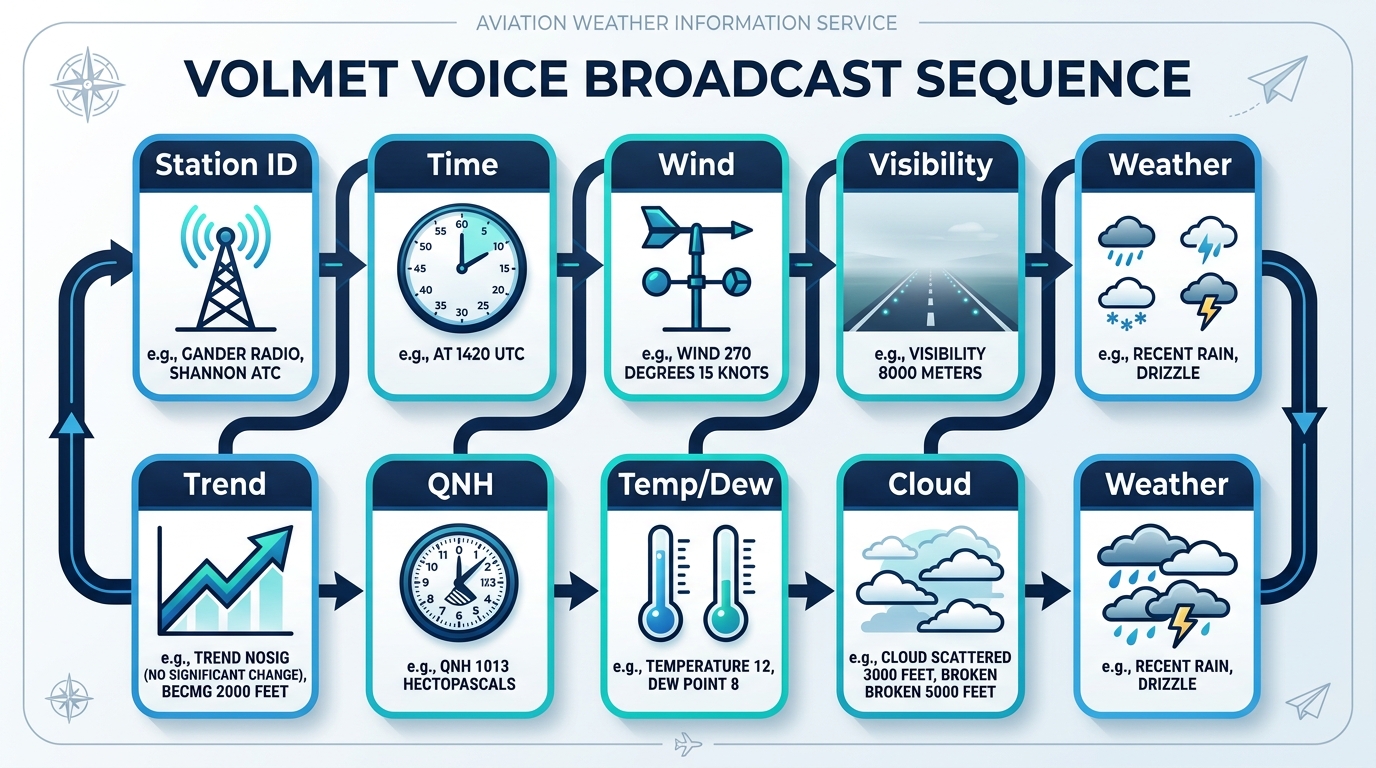
Both ATIS and VOLMET follow the standard meteorological sequence (the same order as a METAR): identification · time · surface wind · visibility/RVR · weather · cloud · temperature/dew point · QNH · trend.
22.4 Using the information
When making initial contact with Approach or Ground, the pilot states they have the ATIS by giving the letter and the QNH (to prove it is the correct current version). Example: "Delhi Approach, Ghostair ABC, descending flight level one five zero, information Charlie, QNH one zero zero nine." The controller then does not need to read the weather to them.
☆ Numbers to memorise
| Fact | Value |
|---|---|
| ATIS | Automatic Terminal Information Service |
| ATIS covers | One aerodrome; met AND operational info (runways/approaches) |
| ATIS identifier | Alphabetical letter (Alpha, Bravo, etc.) |
| VOLMET covers | Several aerodromes; ONLY met info (no runways) |
| Sequence | ID · time · wind · vis · weather · cloud · temp/dew · QNH · trend |
| Pilot action (ATIS) | State information letter and QNH on initial contact with ATC |
Part A — MCQs (click an option to check)
Part B — Oral / viva (tap to reveal model answers)
60-SECOND REVISION CARD
- ATIS = 1 aerodrome; met + operational info (runway); identified by a letter; relieves frequency congestion.
- VOLMET = regional (multiple aerodromes); ONLY met info.
- Sequence: wind · vis · weather · cloud · temp/dew · QNH.
- Acknowledge ATIS by stating the letter and QNH on initial contact.
Reinforce Chapter 22: Voice Weather Broadcasts
Test your knowledge and practice actual exam questions for Radio Telephony.