Met & Aerodrome Information on RT
by Ghost Aviator
Part III (ix) Transmission of meteorological & other aerodrome information — RVR, runway surface conditions
Learning objectives — by the end of this chapter you will be able to…
- Define RVR and distinguish it from meteorological visibility.
- Receive and read back RVR passed by ATC, including the three touchdown/mid/stop-end values.
- Receive runway surface-condition and braking-action information.
- Receive significant changes to wind, QNH and weather on the radio.
21.1 RVR — what and why
21.2 Transmission of RVR
21.3 RVR vs met visibility
21.4 Runway surface conditions
21.5 Passing changes in wind, QNH & weather
☆ Numbers to memorise
? Question bank
21.1 RVR — what and why
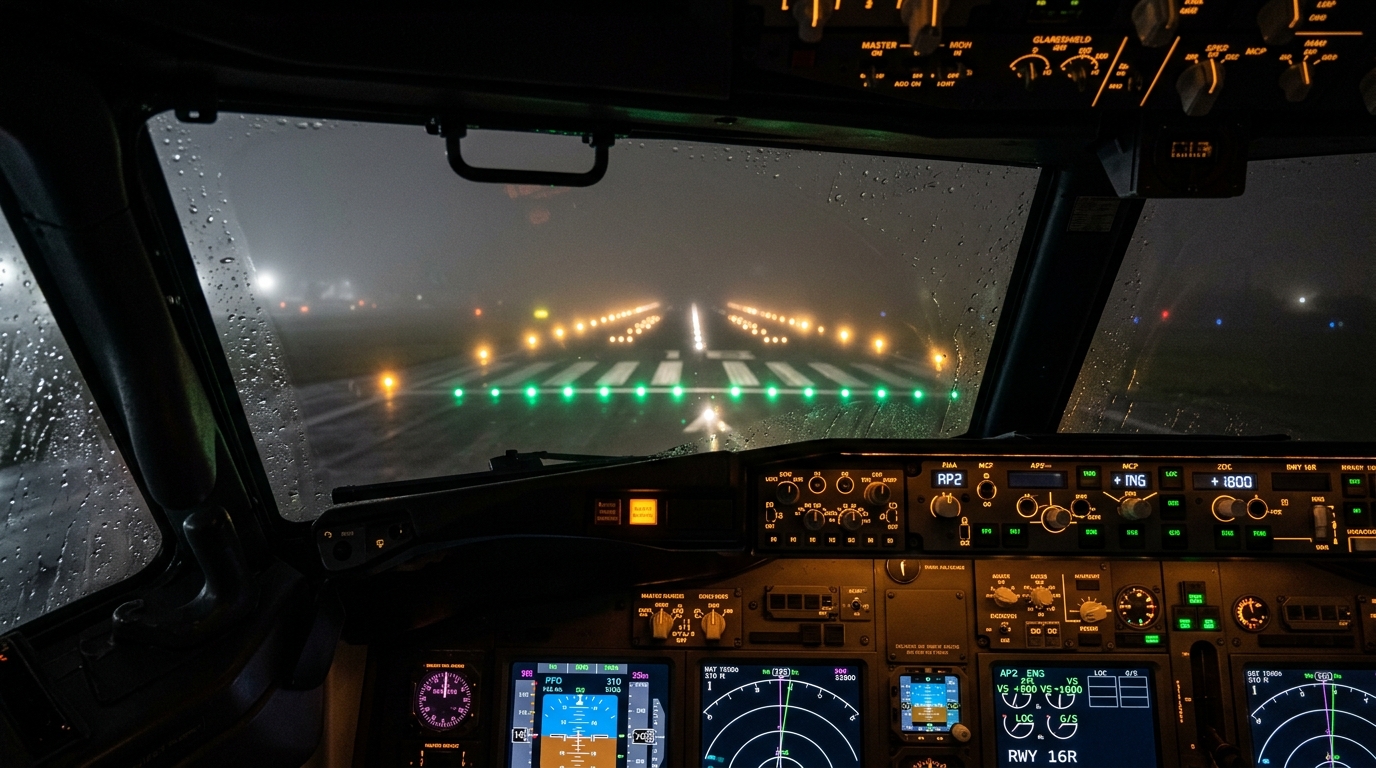
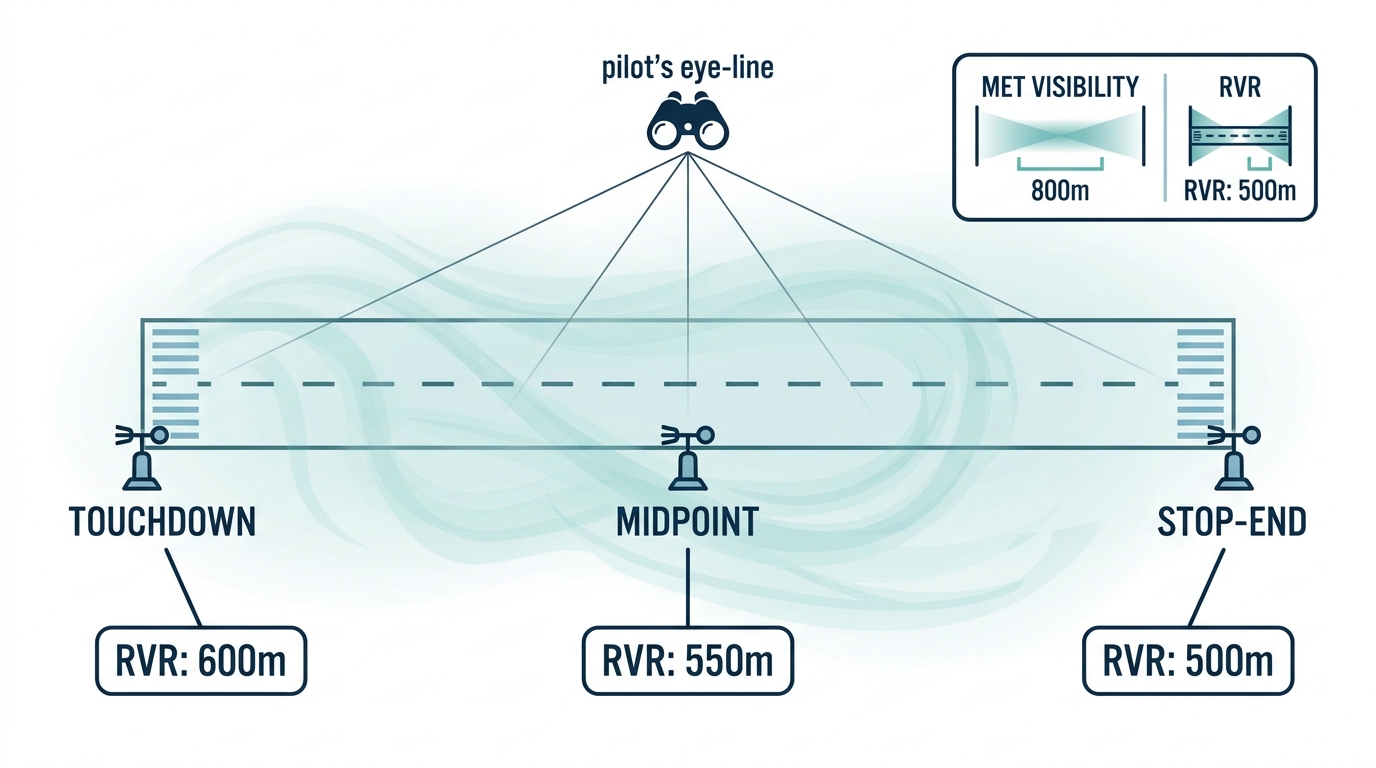
RVR is the distance over which the pilot of an aircraft on the centreline of a runway can see the runway surface markings, or the lights delineating the runway or identifying its centreline. It is measured close to the runway by transmissometers (or human observers) and is the governing visibility for low-visibility take-offs and approaches.
General met visibility is measured away from the runway and may not reflect what a pilot actually sees down the runway in fog or at night. RVR measures the operationally relevant distance at the runway itself, including the effect of the runway lighting — which is why approach minima are expressed in RVR.
21.2 Transmission of RVR
For a long runway, RVR is measured and passed at up to three points: the touchdown zone, the midpoint, and the stop-end. When passed, the values are given in that order and identified, e.g. "RVR runway two seven, touchdown six hundred metres, midpoint five fifty, stop-end five hundred". RVR is given in metres and read back.
RVR is passed when the visibility or RVR is at or below a stated value (the reporting threshold). It is in metres, and — like altitude, cloud height and visibility — it follows the whole hundreds/thousands rule: 600 is "six hundred", 1700 is "one thousand seven hundred". The touchdown RVR is normally the controlling value for the approach.
21.3 RVR vs met visibility
| Meteorological visibility | RVR | |
|---|---|---|
| Where measured | General aerodrome area / observer | Along the runway, near it |
| What it represents | Horizontal visibility in general | Distance a pilot sees runway markings/lights |
| Includes lighting? | No | Yes (lights help RVR be greater than met vis at night) |
| Used for | METAR, general picture | Approach/take-off minima |
On a foggy approach the controller's RVR call is the number you compare against your minimum. If the touchdown RVR is below your minimum, you do not continue below the decision point unless the required visual references are in sight — the RVR transmission is therefore safety-critical, not just informational.
21.4 Runway surface conditions
When the runway is contaminated, ATC passes the surface condition and, where assessed, the braking action: the type of contaminant (water, slush, snow, ice), its depth/coverage, and the braking action reported as good · medium · poor (or measured values). "Runway two seven wet" / "standing water" / "braking action medium".
Confirm the current runway-condition reporting format and braking-action terminology in use in Indian airspace (the global reporting format / RWYCC if adopted), and any standard depths/coverage wording.
21.5 Passing changes in wind, QNH & weather
Where ATIS is not current or conditions change, ATC passes the surface wind (degrees magnetic, knots) with the landing/take-off clearance, an updated QNH (read back), and any significant weather — thunderstorms, wind shear, heavy precipitation. A wind-shear or significant-weather warning is prefixed "caution" (e.g. "caution, wind shear reported on final"). Significant changes are passed as they occur.
☆ Numbers to memorise
| Fact | Value |
|---|---|
| RVR | Distance a pilot on the centreline sees runway markings/lights; in metres |
| Three RVR points | Touchdown · midpoint · stop-end (touchdown usually controlling) |
| RVR vs met vis | RVR at the runway, includes lighting; used for minima |
| Surface conditions | Wet / water / slush / snow / ice; braking action good/medium/poor |
| Updates | Wind (magnetic, knots), QNH (read back), significant weather "caution …" |
Part A — MCQs (click an option to check)
Part B — Oral / viva (tap to reveal model answers)
60-SECOND REVISION CARD
- RVR = distance a pilot on the centreline sees runway markings/lights; in metres; the minima value.
- Three points: touchdown · midpoint · stop-end (touchdown controlling), read back.
- RVR is at the runway and includes lighting (often > met visibility at night).
- Surface: wet/water/slush/snow/ice + braking action good/medium/poor.
- Updates: wind (magnetic/kt), QNH read back, significant weather "caution …".
Reinforce Chapter 21: Met & Aerodrome Information on RT
Test your knowledge and practice actual exam questions for Radio Telephony.