Transmitters & Receivers in Depth
by Ghost Aviator
Part II (iii)(iv) Communication systems · mic/squelch/AVC/tuning · simplex/duplex · advantages & limitations of RT
Learning objectives — by the end of this chapter you will be able to…
- Distinguish simplex, duplex, half-duplex and broadcast, and state which aviation VHF uses.
- Apply correct push-to-talk technique and explain the danger of a stuck microphone.
- Describe microphones, headsets, ANR, the audio panel and intercom.
- Explain squelch, AVC/AGC, volume, gain and frequency selection.
- Describe aircraft antennas, the need for matching, and the ELT and ACARS.
- Troubleshoot a radio failure and state the advantages and limitations of RT.
11.1 Simplex, duplex & half-duplex
11.2 Push-to-talk technique
11.3 Microphones, headsets & ANR
11.4 The audio panel & intercom
11.5 Squelch, AVC, volume & tuning
11.6 Antennas & matching
11.7 ELT & ACARS
11.8 Radio failure & troubleshooting
11.9 Advantages & limitations of RT
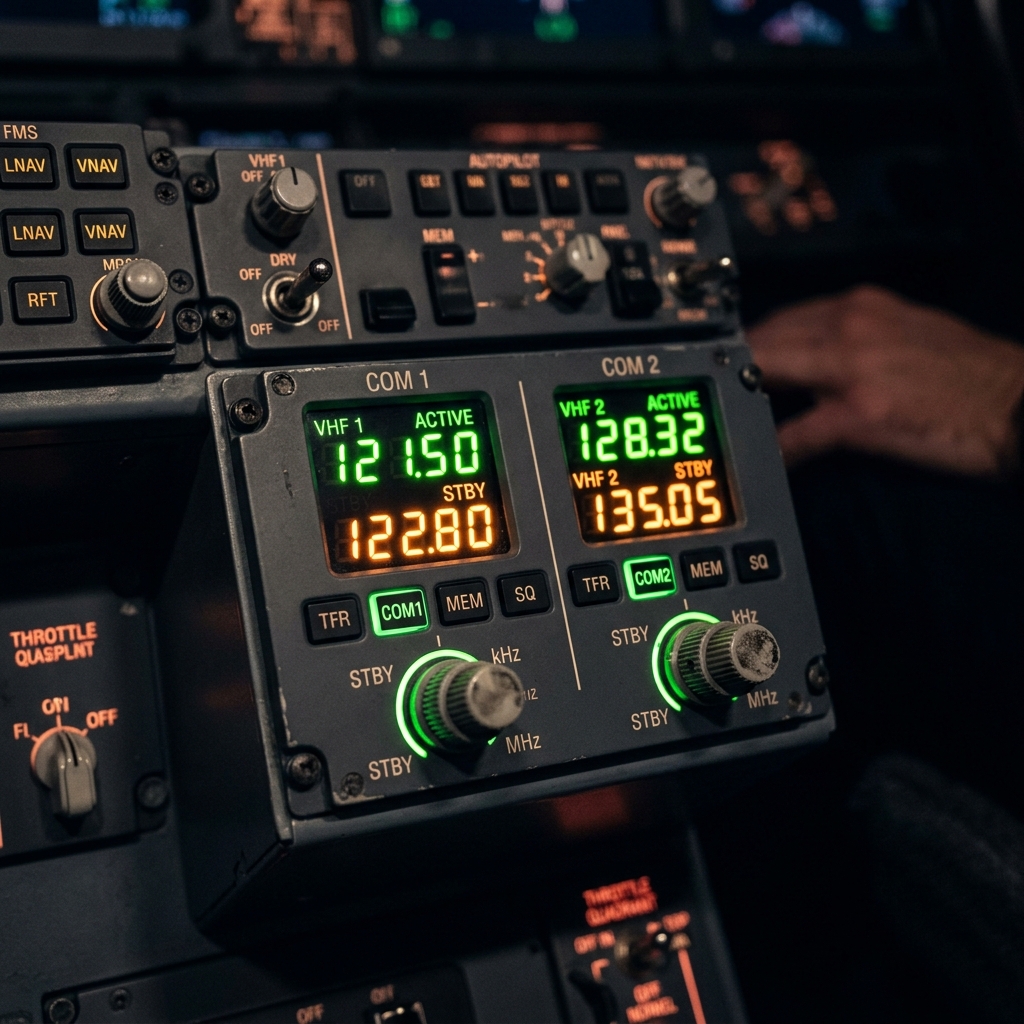
11.1 Simplex, duplex & half-duplex
The number of frequencies a link uses, and whether both ends can talk at once, defines the mode. Aviation VHF deliberately uses the simplest and most disciplined arrangement so that everyone on a shared channel hears everyone else.
| Mode | Frequencies | How it works | Example |
|---|---|---|---|
| Simplex | One | Transmit OR receive, one at a time (PTT); all stations share the channel | VHF ATC voice |
| Duplex | Two | Transmit AND receive simultaneously (different frequencies) | Telephone; some satcom |
| Half-duplex | Two | Two frequencies but still one-at-a-time at the user end | Some HF / relay links |
| Broadcast (Simplex) | One | One station transmits, others only listen | ATIS, VOLMET |
VHF aeronautical voice is simplex — a single frequency shared by all, with only one station transmitting at a time. ATIS is simplex broadcast (the ground transmits, aircraft only listen). This shared discipline is why listening-out and brevity matter so much.
11.2 Push-to-talk technique
- Listen out first — make sure the frequency is clear.
- Press the PTT and pause a beat so the first word isn't clipped.
- Speak at a steady pace, normal volume, microphone close to the lips.
- Release the PTT fully when finished so you can hear the reply.
On simplex, while you transmit you cannot hear. A PTT held down or stuck (a "stuck mic") therefore blocks the whole frequency for everyone and the offender doesn't even know — nobody else can get a word in. Never hold the button needlessly, release it fully, and if a frequency goes silent suspect a stuck mic.
Two aircraft press PTT at the same instant on the same simplex VHF frequency.
Because the channel carries AM (Chapter 10), the two carriers beat together and the controller hears a heterodyne squeal rather than either message. The controller says "two together, say again", and each aircraft re-transmits.
With FM's capture effect one would have been silently lost — which is exactly why aviation uses AM.
11.3 Microphones, headsets & ANR
A microphone converts your voice to an electrical signal; noise-cancelling (differential) types reject the steady cockpit roar so only your speech is transmitted. A boom or oxygen-mask microphone keeps it positioned consistently. The headset reproduces received audio; ANR (Active Noise Reduction) headsets generate an anti-phase signal to cancel low-frequency cabin noise, reducing fatigue and improving intelligibility.
Hold the mic close and steady and speak across it, not into it, to avoid "popping". A consistent mic position is half of good readability — the other half is a steady, unhurried pace.
11.4 The audio panel & intercom
The audio control panel selects which transmitter the PTT keys (the transmit selector) and which receivers you listen to (the receive selectors — COM1, COM2, NAV idents, etc.). The intercom (interphone) lets the crew talk to each other — and to cabin/PA — without transmitting on the radio.
Selecting the wrong transmitter is a common cause of "transmitting on the wrong box".
An intercom conversation is internal — it does not go out on the radio. Conversely, keying the PTT transmits on whichever COM the transmit selector is set to, regardless of which receivers you are monitoring.
11.5 Squelch, AVC, volume & tuning
Squelch — mutes the constant background hiss when no signal is present, opening the audio only when a real signal arrives. Set it just past the point where the hiss disappears.
AVC / AGC (Automatic Volume / Gain Control) — automatically holds the received audio at a steady level despite changing signal strength, so a distant station and a near one sound similar.
Volume — sets the listening level.
Tuning / frequency select — picks the operating channel, usually with a standby/active pair so the next frequency can be set ready and flip-flopped in.
Set squelch too tight and weak (distant) signals are muted and missed. AVC does the opposite job to squelch — it keeps a wanted signal's level constant; it does not mute noise. Don't confuse the two.
11.6 Antennas & matching
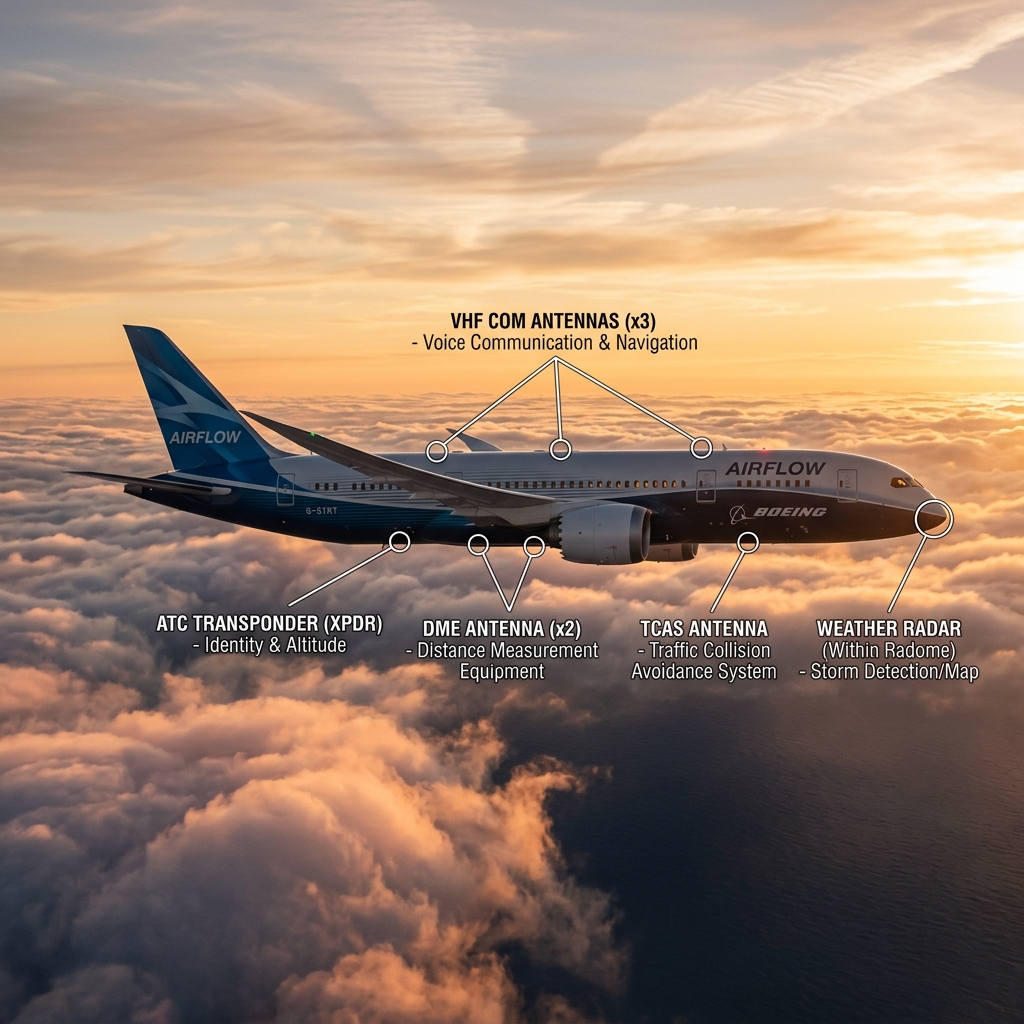
The VHF COM antenna is the vertical blade — sized to a fraction of the wavelength and matched to the vertically-polarized VHF signal. HF uses a long wire or a probe (often in the fin) with an antenna coupler/tuner, because its long wavelength makes a full-size aerial impossible. A well-matched antenna transfers nearly all the transmitter power to the air; a mismatch reflects power back (high VSWR), wasting it and risking the transmitter.
At 120 MHz the wavelength is 2.5 m (Chapter 7). A common efficient length is a quarter-wave: ¼ × 2.5 m = 0.625 m — a practical blade.
An HF signal at 3 MHz has λ = 100 m; a quarter-wave would be 25 m — impossible on an airframe, so HF uses a long-wire/probe and a coupler to make a short aerial behave as if resonant.
In a steep turn the airframe can shadow an antenna mounted on the opposite side, briefly weakening the signal. It is one reason aircraft carry two COM antennas/radios and why a momentary drop in a hard turn is normal, not a fault.
11.7 ELT & ACARS
A beacon that activates automatically on heavy impact (g-switch) or manually, transmitting on 406 MHz — detected by the Cospas-Sarsat satellite system, carrying a coded, registered identity so the aircraft is known — and on 121.5 MHz for short-range homing by rescuers. It is carried under Annex 6 (Chapter 3). Functional testing is restricted to defined windows to avoid false alerts. (Full detail in Chapter 22.)
ACARS (Aircraft Communications Addressing and Reporting System) is a digital datalink for short text messages between aircraft and ground — clearances, position reports, weather, maintenance and operational messages — reducing voice workload. CPDLC (Controller–Pilot Data Link Communications) carries ATC clearances as text, used especially in oceanic airspace (Chapter 18).
11.8 Radio failure & troubleshooting
Hearing nothing / getting no replies? Work through: correct frequency selected (active, not standby)? · volume up and squelch not too tight? · correct transmit selector and receive selectors on the audio panel? · headset/PTT plugged in and the PTT not stuck? · circuit breaker / power in? · try the second COM. If still nothing, follow the communications-failure procedure (Chapter 20) and squawk 7600.
"Frequency, Volume, Squelch, Selector, Plug, Power" — the six things to check before believing the radio has truly failed. Then squawk 7600.
11.9 Advantages & limitations of RT
| Advantages | Limitations |
|---|---|
| Instant, direct two-way voice | VHF range limited to line-of-sight |
| Simple, universal; no fixed infrastructure airborne | One-at-a-time on simplex — congestion on busy frequencies |
| Standard phraseology crosses language barriers | Subject to interference, fading and ground shadow |
| Immediate read-back confirms understanding | Voice can be misheard — discipline essential |
| Datalink (ACARS/CPDLC) offloads routine traffic | A stuck mic can block a whole channel |
☆ Numbers to memorise
| Fact | Value |
|---|---|
| Aviation VHF voice | Simplex — one frequency, one transmitter at a time (PTT) |
| ATIS / VOLMET | Simplex broadcast (listen only) |
| Squelch | Mutes background hiss until a real signal arrives |
| AVC / AGC | Keeps received audio level steady (opposite job to squelch) |
| VHF antenna | Vertical blade, ~quarter-wave; HF uses long-wire + coupler |
| ELT | 406 MHz (satellite, registered ID) + 121.5 MHz (homing) |
| Radio-failure squawk | 7600 |
Part A — MCQs (click an option to check)
Part B — Oral / viva (tap to reveal model answers)
60-SECOND REVISION CARD
- Simplex (one freq, PTT) = aviation VHF; duplex = two freqs simultaneous; ATIS = simplex broadcast.
- PTT: listen → press & pause → speak → release fully. A stuck mic blocks the channel.
- Squelch mutes hiss; AVC steadies a wanted signal (opposite jobs). Intercom is internal.
- VHF antenna = vertical blade (~¼ wave); HF = long-wire + coupler; mismatch = high VSWR.
- ELT 406 + 121.5; radio failure → check freq/vol/squelch/selector/plug/power → squawk 7600.
Reinforce Chapter 11: Transmitters & Receivers in Depth
Test your knowledge and practice actual exam questions for Radio Telephony.