Modulation
by Ghost Aviator
Part II (iii) Systems for air-ground communication — carrier, AM/FM/SSB, the Tx/Rx chain
Learning objectives — by the end of this chapter you will be able to…
- Explain what a carrier wave is and the two reasons modulation is needed.
- Describe AM in depth — sidebands, bandwidth, modulation depth and power distribution.
- Describe FM — deviation, bandwidth (Carson's rule), noise immunity and the capture effect.
- Compare DSB and SSB and calculate the power/bandwidth saving.
- Explain why aviation uses AM on VHF and SSB on HF, and read emission designators.
- Outline the transmitter chain and the superheterodyne receiver.
10.1 The carrier & why we modulate
10.2 AM — sidebands & depth
10.3 AM power distribution
10.4 FM
10.5 DSB & SSB
10.6 Why AM on VHF, SSB on HF
10.7 Emission designators
10.8 The Tx & Rx chains
10.1 The carrier & why we modulate
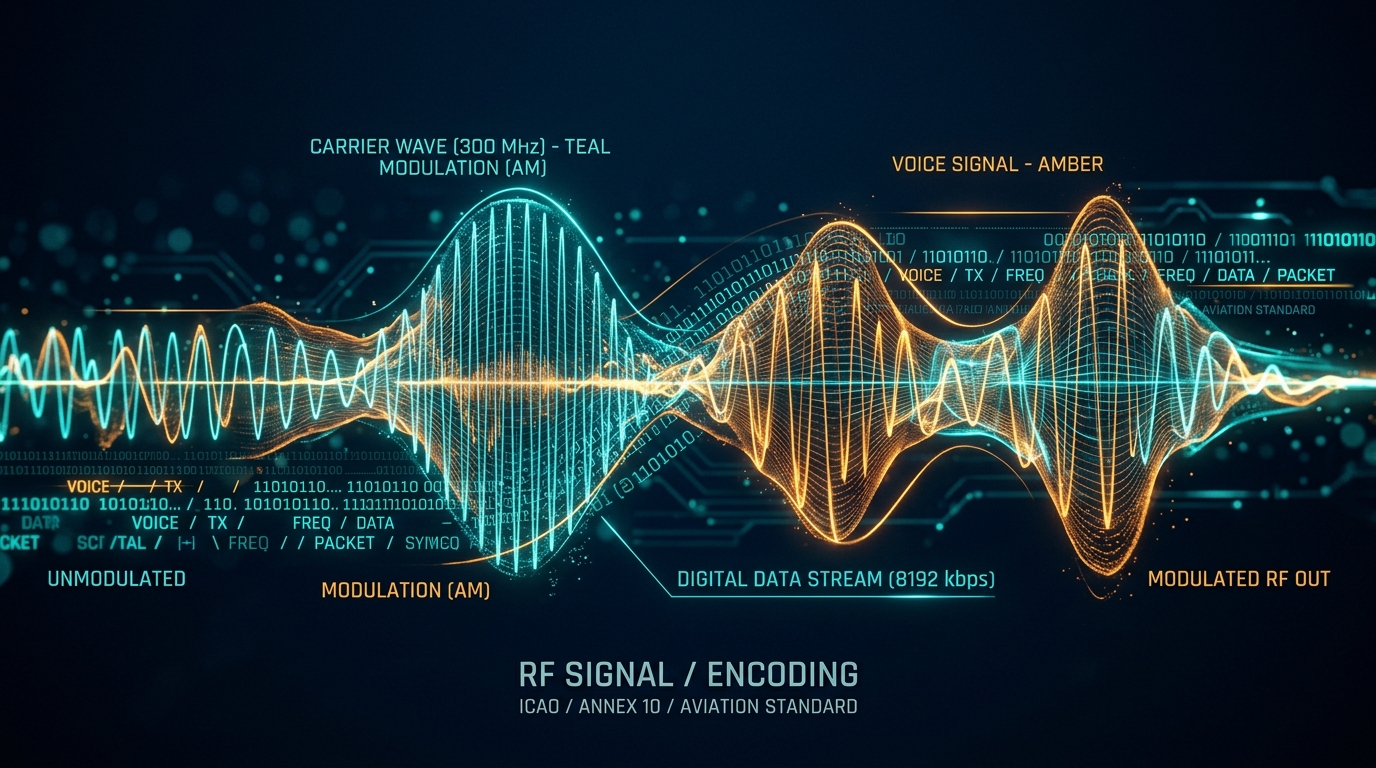
You cannot simply connect a microphone to an antenna. First, an efficient antenna must be a fair fraction of a wavelength; a 1 kHz audio tone has a wavelength of 300 km, demanding an absurd aerial. Second, every voice would occupy the same low band, so no two stations could share the air. The solution is to put the voice onto a high-frequency carrier: the carrier needs only a short antenna, and each station can use a different carrier frequency. Modulation is the act of loading the voice onto the carrier.
The carrier wave is a high-frequency wave generated by the transmitter; on its own it carries no information. Modulation varies one property of the carrier — its amplitude or its frequency — in step with the low-frequency audio, so the information rides on the carrier and can be recovered at the receiver.
10.2 AM — sidebands & modulation depth
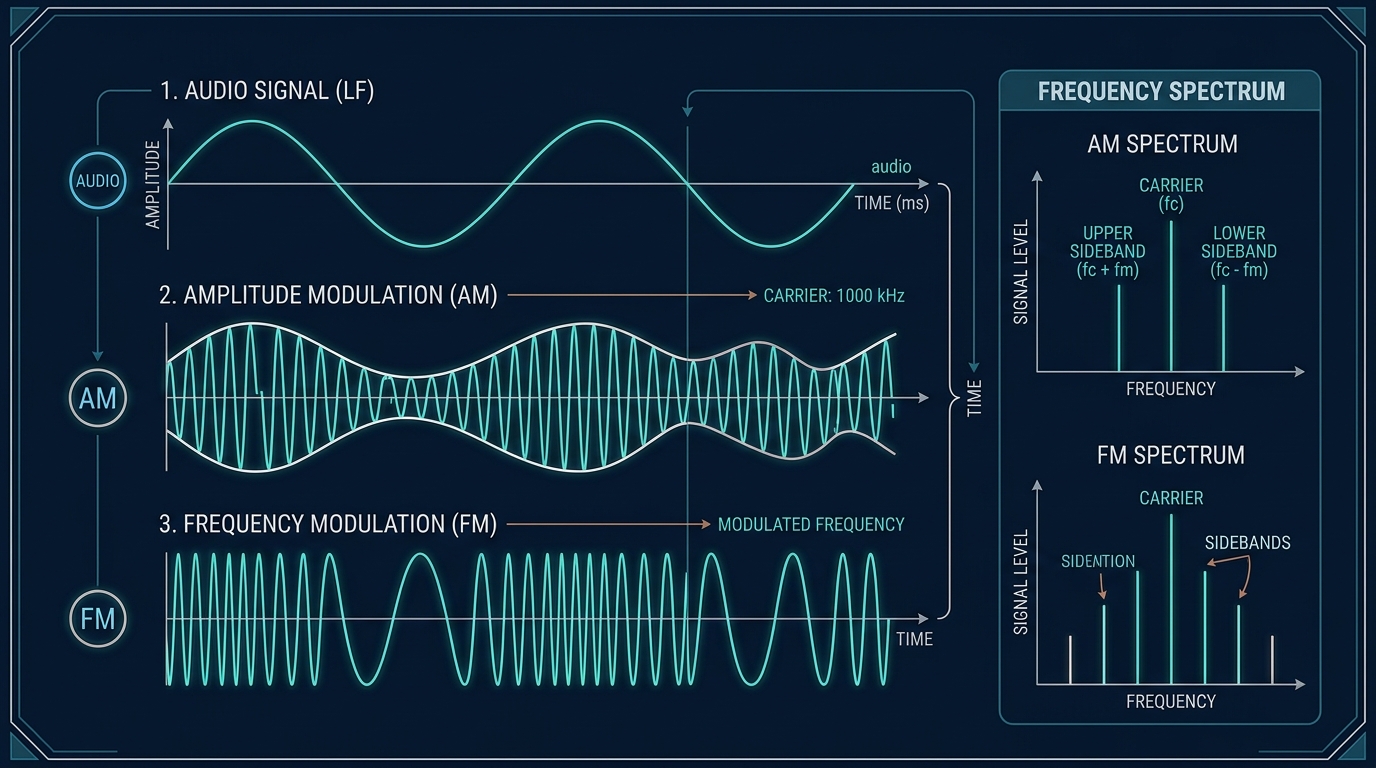
In Amplitude Modulation, the height (amplitude) of the carrier is varied in step with the voice, while its frequency stays fixed. The outline (envelope) of the wave traces your voice.
Mixing a carrier (fc) with an audio tone (fa) produces two new frequencies either side of the carrier: an upper sideband (fc + fa) and a lower sideband (fc − fa). The information lives in the sidebands; the carrier itself carries none.
The total AM bandwidth = 2 × highest audio frequency.
The depth of modulation is how strongly the carrier is varied. Too little (low %) wastes power and gives a weak, quiet signal; over 100% (over-modulation) distorts the audio and "splatters" energy into adjacent channels, causing interference.
10.3 AM power distribution
Even at full 100% modulation, two-thirds of the transmitted power sits in the carrier, which carries no information; only one-third is shared between the two sidebands. That waste is the motivation for SSB.
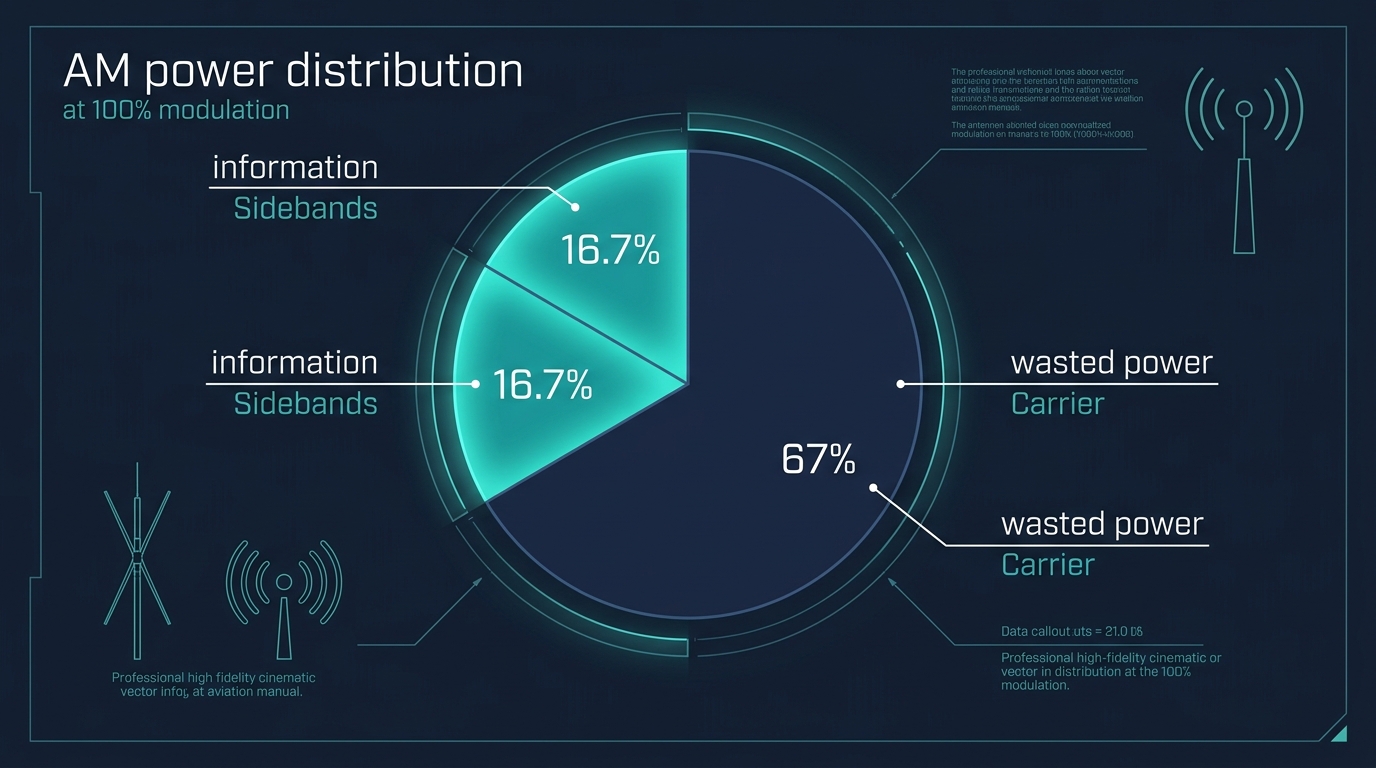
At 100% modulation, of the total power: ~67% is in the carrier, ~16.7% in each sideband. The information-bearing power is only the two sidebands ≈ 33%.
SSB throws away the carrier and one sideband, putting essentially all the transmitter's power into the single information-bearing sideband — a large efficiency gain, decisive over long HF distances.
10.4 FM — Frequency Modulation
In FM the carrier's frequency is varied in step with the voice while its amplitude stays constant. The amount of frequency swing is the deviation. Because most noise affects amplitude, FM is far more noise-resistant — which is why it is used for music broadcasting.
FM bandwidth ≈ 2 × (deviation + highest audio frequency). FM generally needs more bandwidth than AM, which is part of why narrow aviation channels stayed with AM.
FM has a capture effect: the stronger of two signals captures the receiver and the weaker is silenced. In aviation that is dangerous — a second aircraft transmitting would be silently lost. This is the key reason aviation does NOT use FM for VHF voice.
10.5 DSB & SSB
| Mode | What is transmitted | Trade-off |
|---|---|---|
| DSB (full AM) | Carrier + both sidebands | Simple receiver; but wasteful — most power in the carrier |
| DSB-SC | Both sidebands, carrier suppressed | Saves the carrier power; needs carrier reinsertion |
| SSB | One sideband only; carrier & other sideband suppressed | Far more power- and bandwidth-efficient — ideal for HF long range |
10.6 Why AM on VHF, SSB on HF
VHF voice = AM: if two aircraft transmit together on the same VHF frequency, AM produces an audible heterodyne squeal — everyone hears that two stations "stepped on" each other and can re-transmit. With FM's capture effect, one would simply be lost. AM's "you'll hear the clash" behaviour is a safety feature.
HF voice = SSB: over oceanic distances, efficiency and bandwidth matter most, so HF uses the power- and bandwidth-saving SSB.
SSB puts all the transmitter's power into the one sideband that carries information and uses half the bandwidth of full AM. Over thousands of miles of HF that efficiency is decisive — so HF aviation voice uses SSB. The receiver must reinsert a local carrier to demodulate it.
That brief squeal you sometimes hear after a call is two aircraft transmitting together. Because VHF is AM, you know it happened and can say "say again, two together." That awareness is exactly what AM buys aviation — and what FM would hide.
10.7 Emission designators
An emission is classified by three symbols: type of modulation · nature of the signal · type of information. The two you must recognise:
A3E = amplitude-modulated double-sideband telephony (aviation VHF voice)
J3E = single-sideband suppressed-carrier telephony (aviation HF voice).
10.8 The transmitter & receiver chains
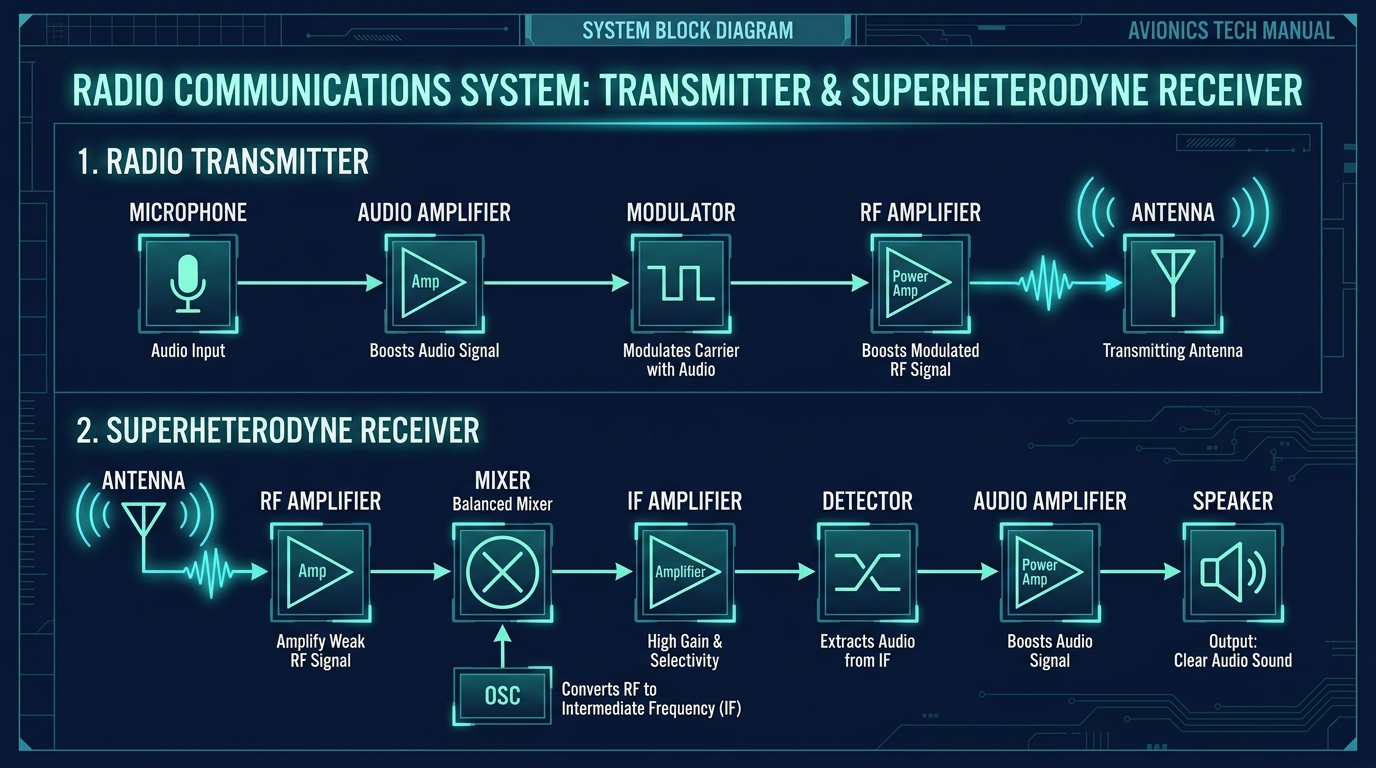
Microphone → audio amplifier → oscillator (generates the carrier) → modulator (mixes audio onto the carrier) → RF power amplifier → antenna.
Antenna → RF amplifier → mixer + local oscillator (shifts the signal to a fixed intermediate frequency, IF) → IF amplifier (most gain/selectivity) → detector / demodulator (recovers the audio) → audio amplifier → speaker/headset. AGC/AVC holds the output level steady (Chapter 11).
Converting every incoming signal to one fixed IF means the gain and selectivity stages are always tuned to the same frequency — far easier to make highly selective than tuning every stage to each station. It is the architecture of virtually every aviation receiver.
☆ Numbers to memorise
| Fact | Value |
|---|---|
| Carrier | High-frequency wave; carries no info until modulated |
| AM | Amplitude varied; bandwidth = 2 × highest audio; info in sidebands |
| Modulation depth | m = Vm/Vc; over 100% → distortion & splatter |
| AM power (100%) | ≈ 67% carrier, ≈ 33% sidebands (the only useful part) |
| FM | Frequency varied; noise-resistant; capture effect; Carson BW = 2(dev + fmax) |
| SSB | One sideband, carrier suppressed; efficient; HF voice |
| Aviation choice | VHF voice = AM (A3E) · HF voice = SSB (J3E) |
| Receiver | Superheterodyne — converts to a fixed IF |
Part A — MCQs (click an option to check)
Part B — Oral / viva (tap to reveal model answers)
Part C — Numerical problems (tap for worked solutions)
60-SECOND REVISION CARD
- Carrier = blank vehicle; modulation loads the voice (needed for a short antenna + frequency sharing).
- AM varies amplitude; BW = 2 × fmax; info in sidebands; ≈67% power wasted in the carrier.
- FM varies frequency, noise-resistant, wider bandwidth, has the capture effect.
- SSB = one sideband, carrier suppressed, half the bandwidth → HF (J3E); AM = VHF voice (A3E).
- Over-modulation (>100%) → distortion & splatter. Receiver = superheterodyne (fixed IF).
Reinforce Chapter 10: Modulation
Test your knowledge and practice actual exam questions for Radio Telephony.