The Machmeter
by Ghost Aviator
Table of Contents
- High Speed Flight – Why Mach Number Matters
- Speed of Sound
- Machmeter Principle of Operation
- Machmeter Construction
- Machmeter Errors
- Blockages
- Abbreviations
- Climb at Constant CAS – Standard Atmosphere
- Descent at Constant Mach Number – Standard Conditions
- Climb/Descent through Isothermal Layer and Inversion
- Climb/Descent Summary
- Worked Example Problems
- Mach/Airspeed Indicator
- Practice Questions & Detailed Answers
- Master Reference Tables
1. High Speed Flight – Why Mach Number Matters
As an aircraft approaches the local speed of sound, airflow over parts of the fuselage or wings may be accelerated to, or beyond, the speed of sound, forming shock waves. Consequences include:
- Increased drag
- Reduced lift
- Mach tuck — a sudden, severe downward-pitching trim change
- Buffeting
- Reduction in, or loss of, control effectiveness
A limiting Mach number (MMO) is specified for each aircraft based on flight trials. This must not be exceeded. The Machmeter displays the current Mach number so the pilot can remain below MMO.
2. Speed of Sound
The speed of sound is not constant — it varies with air temperature only, not pressure or density directly.
FL300 (−45°C = 228K): LSS = 38.95 × √228 = 589 knots
Tropopause and above (−56.5°C = 216.5K): LSS = 38.95 × √216.5 ≈ 573 knots
graph LR
    A["Temperature Increases"] --> B["LSS Increases"]
    C["Altitude Increases (below tropopause)"] --> D["Temperature Decreases"] --> E["LSS Decreases"]
    F["Above Tropopause (ISA)"] --> G["Temperature Constant −56.5°C"] --> H["LSS Constant ~573 kt"]
3. Machmeter Principle of Operation
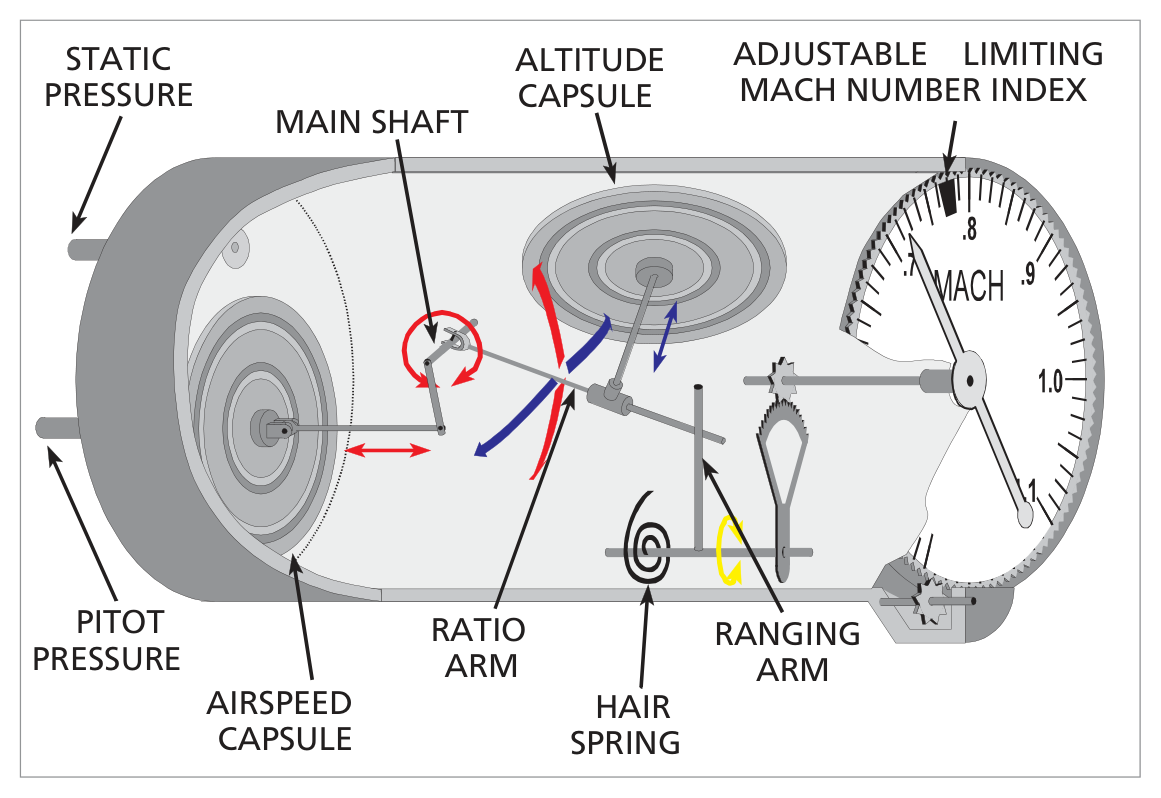
The Machmeter uses two capsules:
- Airspeed Capsule — expands/contracts with dynamic pressure (pitot − static). Senses TAS component.
- Altitude (Aneroid) Capsule — expands/contracts with changes in static pressure in the instrument case. Compensates for the effect of altitude on the speed of sound.
Their combined mechanical output via the ratio arm and ranging arm drives the pointer to display Mach number directly.
4. Machmeter Construction
- Static pressure enters the instrument case (acts on the altitude capsule).
- Pitot pressure is fed directly into the airspeed capsule.
- Expansion of the airspeed capsule is transmitted via the airspeed link and main shaft to the ratio arm.
- The altitude capsule also governs the position of the ratio arm.
- The spring-loaded ranging arm transmits ratio arm movement to the pointer.
An adjustable Mach limit index can be set via a small knob to the aircraft's MMO, providing a visual speed warning.
5. Machmeter Errors
- Instrument Error — manufacturing imperfections
- Position Error — disturbed airflow at pitot/static sources; can change sign at high Mach numbers
- Manoeuvre-Induced Error — unpredictable changes in static source airflow during manoeuvres
- Temperature Error — cancels out (density appears in both numerator and denominator)
- Density Error — same reason, density cancels
- Compressibility Error — the Machmeter is calibrated to the dynamic/static pressure ratio, so compressibility is inherently calibrated out
5.1 Position Error at High Mach Numbers
At higher Mach numbers, changes in airflow can cause position error to increase in magnitude and even change sign. If position error causes the Machmeter to under-read, this could become dangerous. The normal arrangement in modern jet transport aircraft is to bias instrument and position error so the Machmeter always over-reads — providing a safety margin.
6. Blockages
| Source Blocked | Condition | Effect on Machmeter |
|---|---|---|
| Static | Climb at constant IAS | Altitude capsule doesn't move; airspeed capsule contracts (static in pitot falls but case static frozen) → Under-reads |
| Static | Descent at constant IAS | Airspeed capsule expands (pitot static rises, case static frozen) → Over-reads |
| Pitot | Climb at constant IAS | Airspeed capsule expands in error (capsule static > case static) → Over-reads |
| Pitot | Descent at constant IAS | Airspeed capsule contracts (capsule static < case static) → Under-reads |
7. Abbreviations
| Abbreviation | Meaning |
|---|---|
| MMR | Machmeter Reading — the uncorrected raw reading |
| IMN | Indicated Mach Number — MMR corrected for instrument error (values quoted in Flight Manuals are normally IMN) |
| TMN | True Mach Number — IMN corrected for position error |
| MMO | Maximum Operating Mach Number — the never-exceed limit |
8. Climb at Constant CAS – Standard Atmosphere
Example: Climbing at 330 kt CAS from sea level to FL360 in ISA:
- TAS increases from 330 kt to 593 kt
- Mach number increases from M 0.5 to M 1.05
This rapid rise in Mach number is why high-performance aircraft are flown at constant CAS (or IAS) in the lower part of the climb, then transition to a constant Mach number for the remainder — to avoid inadvertently exceeding MMO.
9. Descent at Constant Mach Number – Standard Conditions
During a descent in ISA, temperature increases → LSS increases. To maintain constant Mach number, TAS must also increase (MN = TAS/LSS). As density also increases during descent, CAS increases even more rapidly (Dynamic Pressure = ½ρV²). Example: M 0.8 descent from FL400 to MSL:
- At FL400: TAS = 450 kt, CAS = 242 kt
- At MSL: TAS = 528 kt, CAS = 528 kt (would exceed VMO)
This is why CAS is used in the descent rather than constant Mach number below a certain altitude.
10. Climb/Descent through Isothermal Layer and Inversion
10.1 Isothermal Layer (temperature constant)
| Condition | LSS | TAS | CAS |
|---|---|---|---|
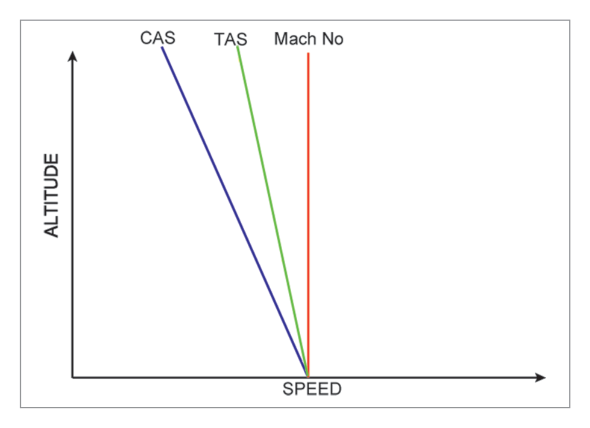
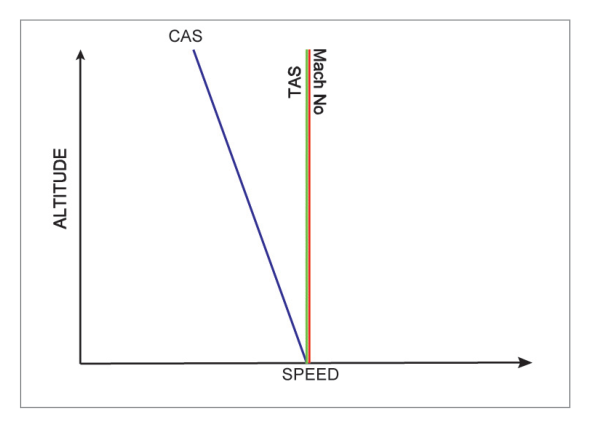
| Constant Mach — climbing | Constant (temp constant) | Constant (MN×LSS) | Decreases (density reduces) |
| Constant Mach — descending | Constant | Constant | Increases (density increases) |
| Constant CAS — climbing | Constant | Increases | Constant |
10.2 Inversion (temperature increases with altitude)
| Condition | LSS | TAS | CAS |
|---|---|---|---|
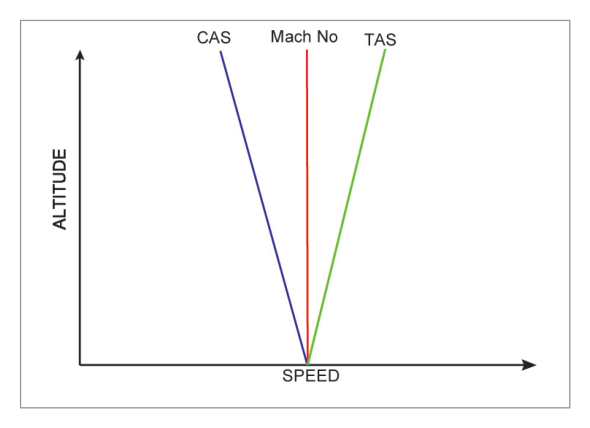
| Constant Mach — climbing | Increases (temp rises) | Increases (MN×LSS) | Decreases (density reduces faster than TAS rises) |
| Constant Mach — descending | Decreases | Decreases | Increases |
| Constant CAS — climbing | Increases | Increases (greater rate than MN) | Constant |
11. Climb/Descent Summary
- TAS always increases when climbing at a constant CAS.
- Climbing at constant TAS → CAS always decreases.
- Climbing at constant CAS → Mach number always increases.
- Climbing at constant Mach → CAS always decreases.
flowchart TD
    A["Climb"] --> B{"What is constant?"}
    B -->|CAS| C["TAS increases
Mach number increases"]
    B -->|TAS| D["CAS decreases
Mach number: depends on temp"]
    B -->|Mach number| E["TAS depends on LSS
CAS always decreases"]
12. Worked Example Problems
LSS = 38.95 × √216.5 = 38.95 × 14.71 = 573 knots
TAS = MN × LSS = 0.70 × 661 = 463 knots
√T = 562.5 / 38.95 = 14.44 → T = 14.44² = 209K = −64°C
−64°C occurs at FL395 in the JSA (no tropopause in JSA).
LSS = ΔTAS / ΔMN = 80 / 0.12 = 667 knots
Same Mach (0.8) and TAS (467 kt) at FL320 → LSS unchanged → temperature unchanged = −48°C.
JSA at FL320 = −49°C → deviation = +1°C.
(This shows the aircraft is flying through an isothermal layer.)
- Set Mach index arrow against temperature (°C) in Airspeed window.
- Read TAS against Mach number on inner scale.
- M 1.0 is marked as the blue "10" on the inner scale.
13. Mach/Airspeed Indicator
Since commercial aircraft need both IAS and Mach indications, the instruments are combined. Two versions exist:
- Self-contained instrument — fed directly from pitot and static sources.
- ADC-fed instrument — receives computed data from the Air Data Computer.
Construction Features
- Airspeed pointer moves clockwise over a fixed scale.
- From M 0.5, Mach number is read from the same pointer against a moving Mach scale that rotates anticlockwise as Mach increases.
- A striped VMO needle may mark the maximum operating airspeed.
- Corrects for instrument and position errors → displays CAS instead of IAS.
- Can show digital displays for both Mach and CAS.
- LSS = 38.95 × √T (Kelvin) in knots. At MSL ISA = 661 kt; tropopause = 573 kt.
- Machmeter uses 2 capsules: airspeed + altitude (aneroid).
- Errors: instrument, position, manoeuvre-induced ONLY. No temp/density/compressibility error.
- Static blocked in climb → under-reads; in descent → over-reads (same as ASI).
- Constant CAS climb: TAS↑ Mach↑. Constant Mach climb: CAS↓.
- Isothermal: constant Mach = constant TAS. Inversion: constant Mach = increasing TAS (climb).
Practice Questions & Detailed Answers
- (a) °F cannot be used — the formula requires absolute temperature.
- (c) °C cannot be used because 0°C ≠ 0 absolute; must add 273 to convert to Kelvin.
- (d) The unit is knots, not m/s (a different constant would be required for m/s).
- (a) 460 kt would correspond to a warmer temperature (ISA or less cold).
- (c) 447 kt and (d) 490 kt result from incorrect temperature calculations or wrong JSA lapse rate assumptions.
- (a) CAS cannot increase — density effect always dominates in a climb at constant Mach.
- (b) TAS cannot decrease — the rising LSS in an inversion forces TAS upward at constant Mach.
- (d) Reverses the correct answer.
- (b) Incorrectly suggests both increase — that would be a constant CAS climb, not descent.
- (c) & (d) Incorrect combinations — in a constant CAS descent, the pressure/density effect dominates and both TAS and MN decrease.
- (a) −17 and (d) −19 would mean a colder-than-ISA temperature — but we calculated a warmer temperature.
- (c) +19 is close but the arithmetic gives +17 when rounded correctly.
- (a) Compressibility error does not apply — it's calibrated out in the Machmeter.
- (c) No barometric or temperature error in the Machmeter.
- (d) No density error — density cancels in the Mach number calculation.
- (a) LSS = MNo/TAS is the inverse of the correct relationship.
- (b) MNo = LSS/TAS inverts numerator and denominator.
- (d) MNo = LSS × TAS would give huge numbers — dimensionally and physically incorrect.
- (a) Pitot/static gives the ratio used in ASI calculations (total pressure ratio), not pure Mach.
- (b) Inverted ratio — would decrease as Mach increases.
- (c) Dynamic/pitot is not a meaningful aerodynamic ratio.
- (a) +8 would mean the deviation is the same — but JSA standard temperature changes between FL350 and FL300.
- (c) +2 and (d) −18 result from incorrect temperature or JSA calculations.
Master Reference Tables
| Parameter | Value | Condition | Section |
|---|---|---|---|
| LSS at MSL ISA (+15°C) | 661 knots | T = 288K | §2 |
| LSS at FL300 ISA (−45°C) | 589 knots | T = 228K | §2 |
| LSS at tropopause ISA (−56.5°C) | 573 knots | T = 216.5K | §2 |
| LSS formula constant | 38.95 | Output in knots, T in Kelvin | §2 |
| JSA lapse rate | 2°C/1000 ft | No tropopause in JSA | §12 |
| Machmeter errors (only) | Instrument, Position, Manoeuvre-induced | No temp/density/compressibility | §5 |
| Static blocked — climb | Under-reads | Constant IAS | §6 |
| Static blocked — descent | Over-reads | Constant IAS | §6 |
- Machmeter errors: "I Put My foot down" → Instrument, Position, Manoeuvre-induced (only 3!)
- Static blocked climb: "STATIC CLIMB = UNDER" (same as ASI)
- Constant CAS climb: "Everything goes UP" → TAS↑, Mach↑, LSS↓ (exception)
- Constant Mach climb: "CAS always DOWN"
Answer Key
| Q1 | Q2 | Q3 | Q4 | Q5 | Q6 | Q7 | Q8 | Q9 |
|---|---|---|---|---|---|---|---|---|
| b | b | c | a | b | b | c | d | b |
Reinforce Chapter 7: The Machmeter
Test your knowledge and practice actual exam questions for Navigation — Instrumentation.