The Team & The Machine
by Ghost Aviator
Human Performance & Limitations · Module H — The Mind AloftJudgment, Automation & the Cockpit
Chapter 22 — The pilot, the crew and the machine: judgment and decision-making, personality, attitude and situational awareness, communication and crew resource management, automation, and the human-centred design of the cockpit and its displays.
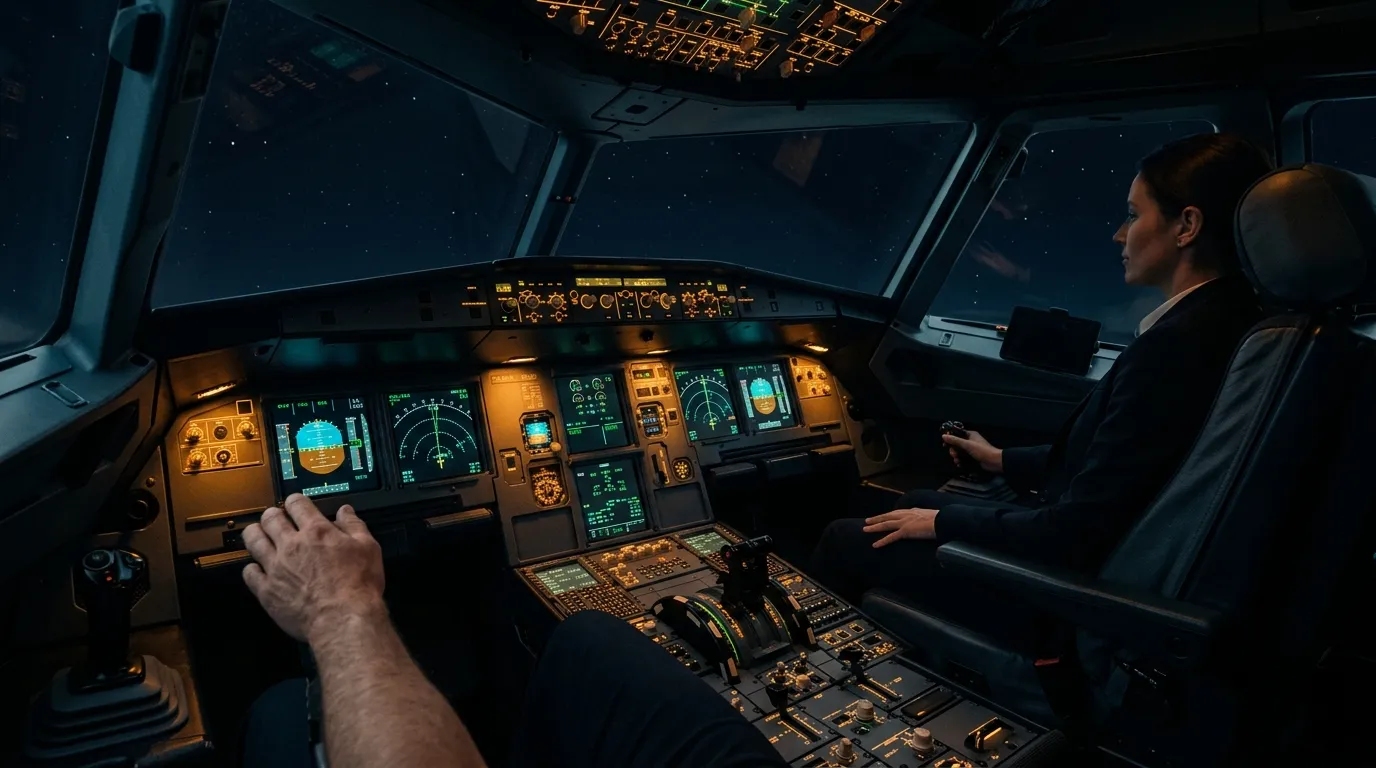
15. Judgment & Decision Making
Making good decisions is one of the important aspects of piloting an aircraft. Good decisions can help lead to safe, successful flights, whereas bad decisions and even indecision have led to many aircraft accidents. Talk to your instructor and other pilots about different flying situations to obtain advice about what a good decision would be in a given circumstance.
When flying with another pilot, it is possible to increase the chance of a good decision being made by discussing the potential problems beforehand. If as an inexperienced pilot you are flying with someone of more experience and you see him doing something you consider to be dangerous, you should immediately question their course of action.
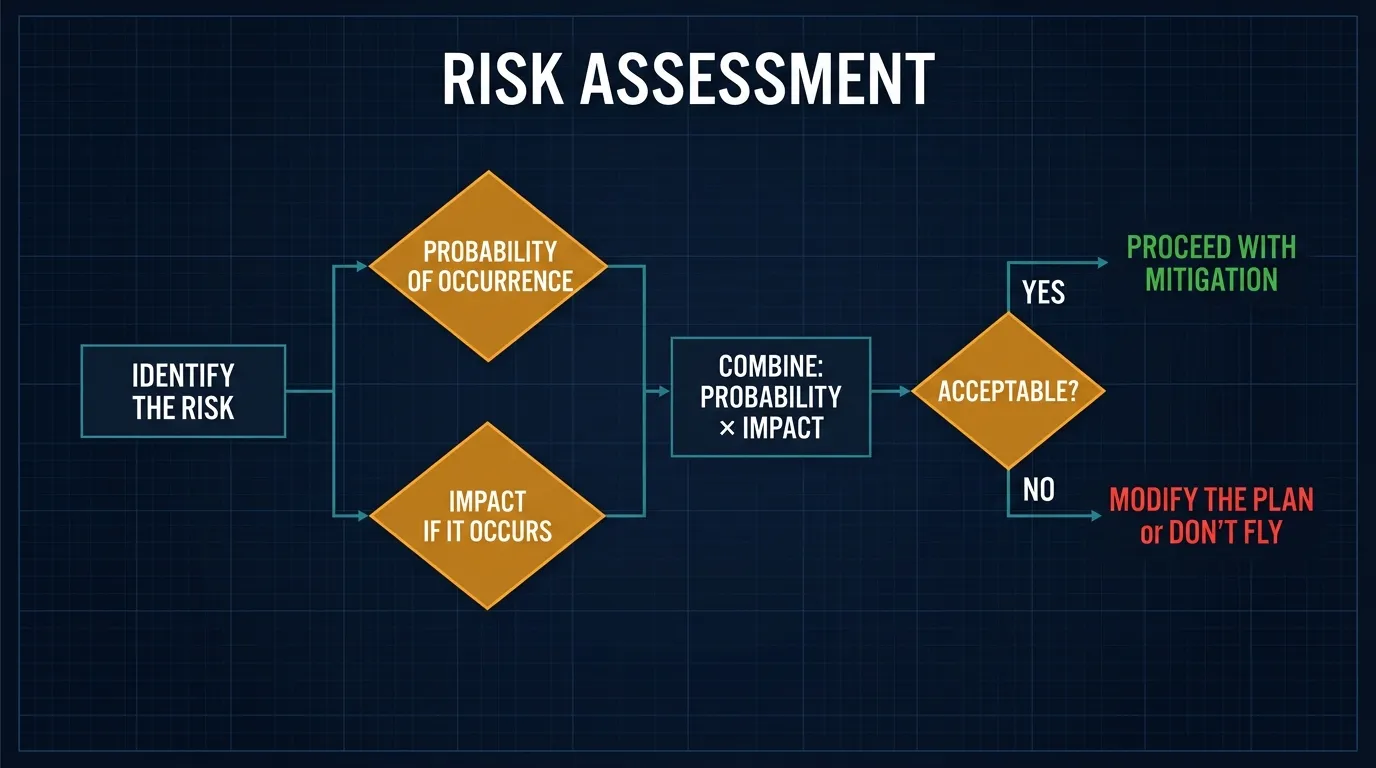
15.1 Risk Assessment
Risk assessment is based on:
- The probability of the risk occurring.
- The impact of that risk if it did occur.
You will have to weigh up the risk and the possible consequences of the risk in order to determine your course of action.
16. Personality, Attitude & Situational Awareness
16.1 Personality, Attitude and Behaviour
Someone who is too introverted or anxious may not make a good pilot. Examples of desirable characteristics in a pilot are:
- The ability to cope with stress and adventure.
- The ability to assess and control risks.
As captain of an aircraft, you will need to show good leadership skills.
16.2 Situational Awareness
A good leader displays good situational awareness and accurately assesses his own performance. The following factors can interfere with accurate situational awareness:
- Stress
- Boredom
- Fatigue
- Emotional disturbance
- Poor communication
- Interruptions
17. Mechanics of Decision Making
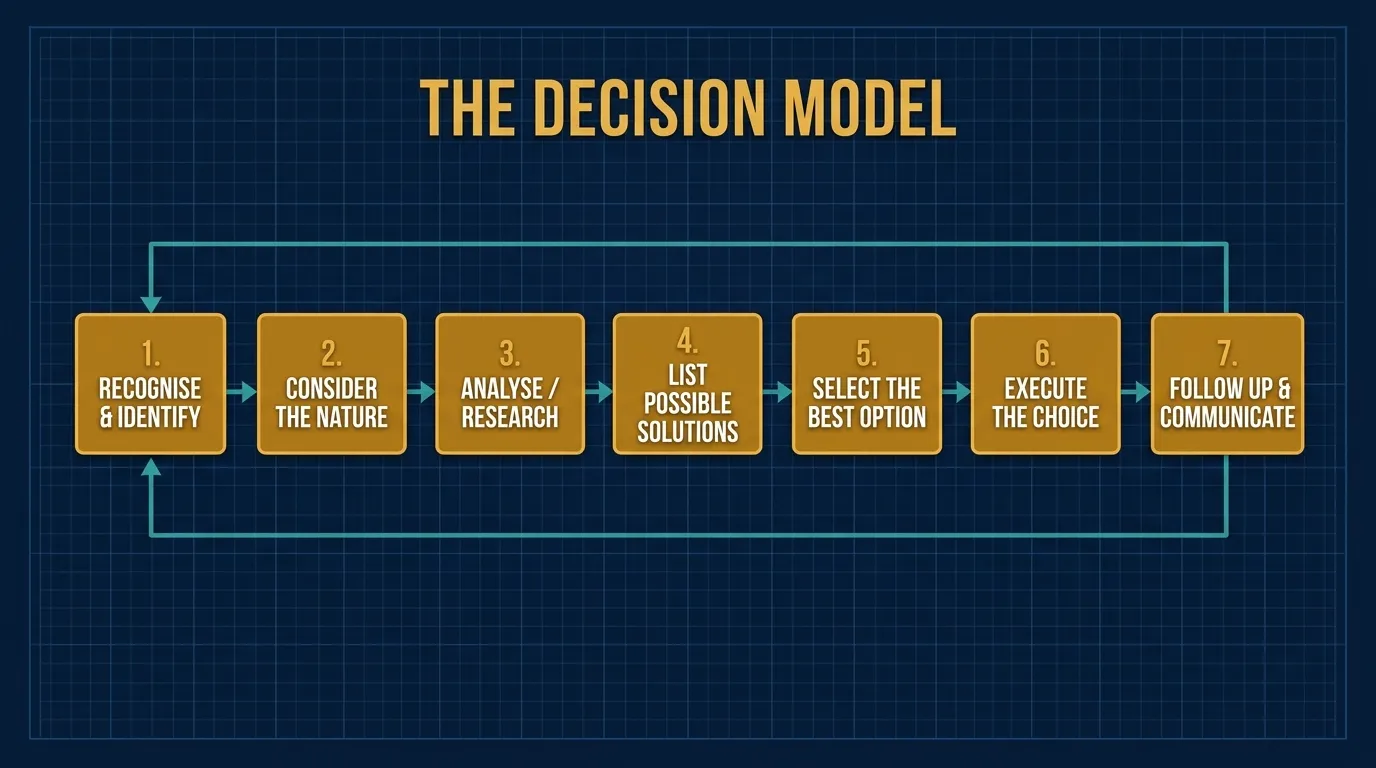
Pilots operate in a dynamic and constantly changing environment. A good decision reached a minute ago will not necessarily be the same good decision in two minutes' time.
17.1 The Seven Steps
- Recognize and identify the problem — have a clear definition of what needs addressing.
- Consider the nature of the problem — type of issue, why it needs a decision, hoped-for results.
- Analyze or research the problem — gather all information so informed choices can be made.
- Develop a list of possible solutions — list decisions and their consequences.
- Select the best alternative — choose the best solution for the situation.
- Execute the best choice — taking action is often the hardest part.
- Follow up and communication — keep the process going with constant communication; Feedback determines the overall success of and reaction to the decision.
18. Communication & Team Work
When piloting an aircraft — whether with a passenger, another pilot or an instructor — good verbal communication will help the flight go more smoothly and contribute to flight safety.
Concise and unambiguous communication is essential to the safe conduct of air traffic.
18.1 Barriers to Communication & Team Work
Several things can be done by team leaders to facilitate good teamwork. In the end, it is the team leader who takes the decisions on behalf of the team.
- Aggressiveness
- Arrogance
- Anti-authoritarian behaviour
- Impulsiveness
- Feelings of invulnerability
- Resignation
18.2 Expectation
19. Automation
Automation refers to a system or method in which many of the processes of production are automatically performed or controlled by self-operating machines, electronic devices, etc.
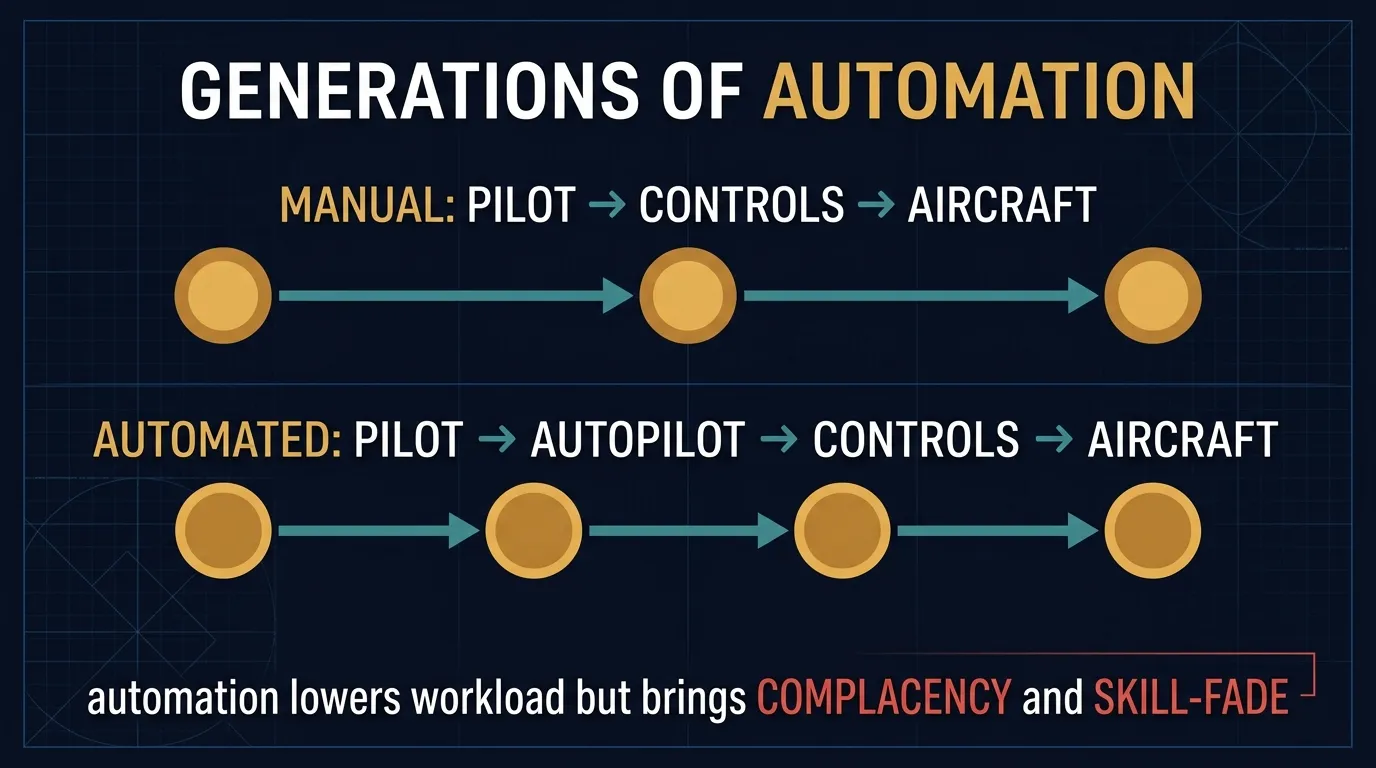
Through microprocessor technology, navigational tasks and aircraft system management have been automated, making the flight crew more peripheral to the actual operation of the aircraft. Pilots who at one time had direct authority over all aspects of aircraft control and management have now become responsible for the management of complex hardware and software interfaces.
These technological advances have given rise to new forms of error. Automation is almost always introduced with the expectation of reducing human error and workload, but what frequently happens is that the potential for error is simply relocated. More often than not, automation does not replace people in systems; rather, it places the person in a different, and in many cases, more demanding role.
19.1 Definition of Automation
"The technique of controlling an apparatus, a process or a system by means of electronic and/or mechanical devices that replaces the human organism in the sensing, decision-making and deliberate output."
19.2 Evolution of Transport Aircraft Automation
19.3 Mismatch Between Automation and the Human Element
Nevertheless, a few accidents point to a mismatch between automation and the human element. Studies identified nine categories to focus on:
- Situational awareness
- Automation complacency
- Automation intimidation
- Captain's command authority
- Crew interface design
- Pilot selection
- Training and procedures
- The role of pilots in automated aircraft
- (Studies concluded scope for improvement in fields like: human capabilities and limitations, ergonomics, cognitive suitability and instrument standardization.)
19.4 Qualities of Human-Centred Automation
Human-centred automation should possess these qualities in proper measure:
- Accountable
- Subordinate
- Predictable
- Adaptable
- Comprehensible
- Flexible
- Dependable
- Informative
- Error-resistant
- Error-tolerant
20. Human Characteristics & Cockpit Design
20.1 Personality
Personality involves two major factors:
- Neuroticism – Stable continuum
- Introversion – Extroversion continuum
Extroverts are said to be impulsive and sociable; introverts are more withdrawn and cautious.
A low-neuroticism personality is one of an emotionally stable person, whereas a high-neuroticism person will worry and get upset easily.
20.2 Cultural Differences
The way people behave, think and interact with each other generally — as well as what motivates them — will be partly a factor of their national and cultural background. One culture may value subordinates speaking up, whereas another culture may value subordinates who obey their superiors unquestioningly. The latter might perceive a subordinate who points out a concern as being impolite, aggressive or disruptive.
20.3 Competencies
The main area where personality and background culture are important is interpersonal interaction. In terms of competencies, this means communication, leadership and teamwork — crew interactions or interactions with outside agencies such as air traffic control.
20.4 Design Considerations
The following human characteristics must be taken into account in the design of aviation systems:
- Physical dimensions
- Capability for data sensing
- Capability for data processing
- Capability for motor activity
- Capability for learning
- Physical and psychological needs
- Sensitivities to physical environment
- Sensitivities to social environment
- Coordinated action
- Differences among individuals
20.5 Hardware, Design of Flight Decks, Size & Anthropometry
Therefore a great deal of attention is required to design the equipment. The most important requirement in the design of both displays and controls is STANDARDIZATION.
20.6 Anthropometry
This is the study of human measurement. The information is grouped into:
- Static measurements
- Dynamic measurements
- Contour surface measurements
It is not practical to design a cockpit for both the very short and the very tall individual. Those in the central 90 % of size distribution will be catered for. Normally the design of aircraft uses measurements taken from the entire population disregarding both the 5 % lowest and the 5 % highest.
20.7 Eye Datum
Cockpit space must be designed around a defined position of the pilot's eye. This may be called the Eye Datum, the Design Eye Position or the Reference Eye Point.
| Position | Effect |
|---|---|
| Too high | Poor view of instruments, obstructed high view, good downward view |
| Just right | Optimum view of outside and instruments |
| Too low | Good view of instruments but poor forward and downward view |
Once the design eye position has been set, the size of the cockpit can be established.
20.8 Design of Cockpit Seats
It is of the utmost importance that the seating is comfortable and adjustable to the individual pilot's size and shape. Pilots should adjust their seats to establish a comfortable position giving full control movement, with optimum instrument scan and outside visibility. This position should be used for all phases of the flight.
21. Hardware — Displays & Controls
21.1 Presentation Requirements
| Information Type | Best Display |
|---|---|
| Purely quantitative information | Digital |
| Qualitative information | Analogue (more easily assessed) |
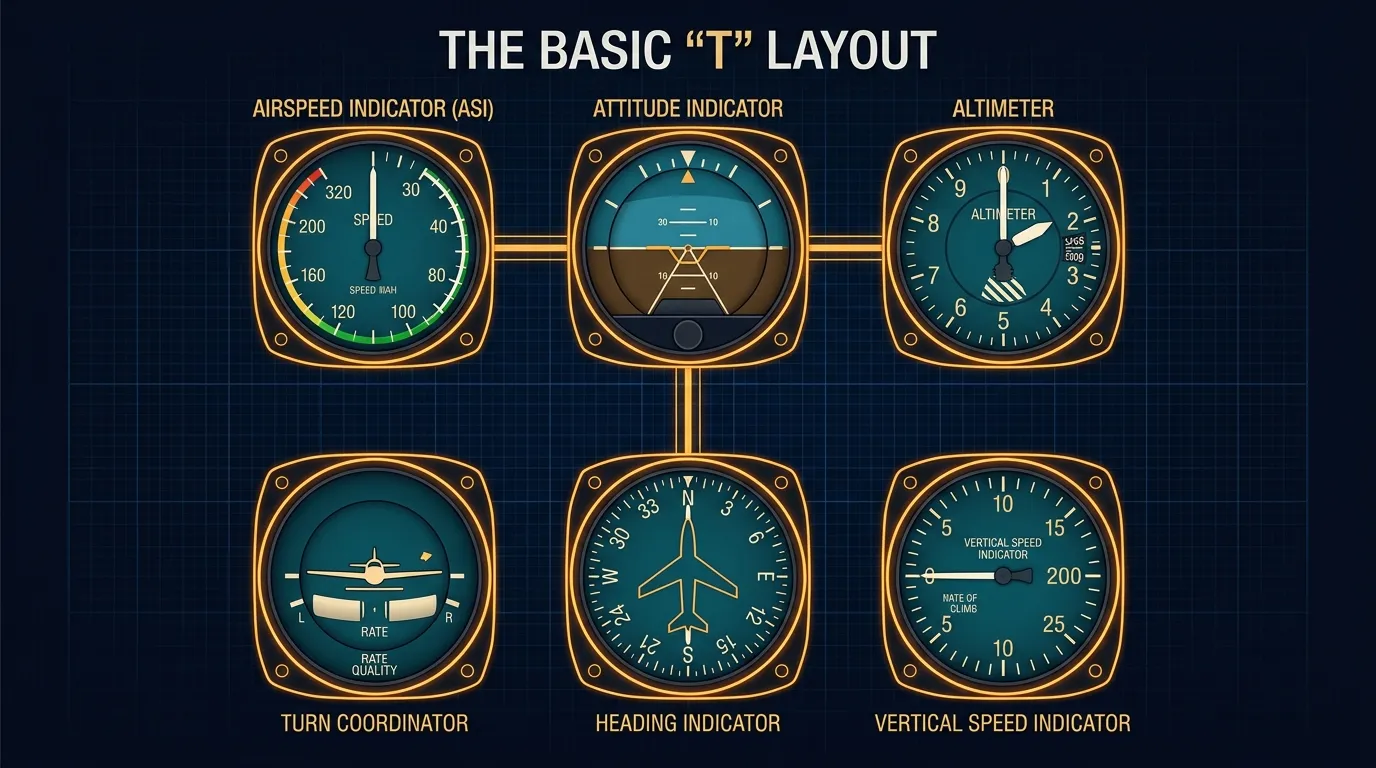
21.2 Conventional Analogue Standard 'T' Display
A standard 'T' layout has the artificial horizon / attitude indicator at the centre with the altimeter, airspeed indicator and direction indicator grouped around it. Digital Display and the Compass. The conventional analogue type of compass card gives a better picture of the aircraft orientation than would a digital readout.
21.3 Combination or Analogue and Digital Displays
In some instances, both digital information and analogue information can be combined in a single instrument.
21.4 Hardware, Controls — Basic Considerations
| Principle | Description |
|---|---|
| Standardization | Control of location and sense of use from one aircraft to another should be standardized. |
| Frequency of Use | Controls used frequently or for protracted periods should be located so that they do not require the pilot to adopt an awkward or fatiguing position. |
| Sequence of Use | Controls that should normally be used in a given order should be laid out so that the sequence of use is represented in that layout. |
| Importance | Important controls must be located in easily reached and unobstructed positions. |
| Visual/Tactile Dissimilarity | Switches and knobs that control different systems or functions should look and feel different from each other. |
| Symbolism | Controls, if possible, should be designed to contain some reference to their function. |
| Simultaneous Use | Controls which may require simultaneous use should be located to enable this to take place. |
| Warnings | All warnings should be 'attention getting' without being startling. The most conspicuous visual warnings rely on head and gaze orientation. |
Reinforce Chapter 22: The Team & The Machine
Test your knowledge and practice actual exam questions for Human Performance & Limitations.