The Limits of Sight
by Ghost Aviator
Human Performance & Limitations · Module E — The SensesThe Limits of Sight
Chapter 12 — Where vision fails the pilot: night vision and dark adaptation, the blind spot, protecting the eyes, refractive defects, colour vision and colour blindness, and how speed steals reaction time.
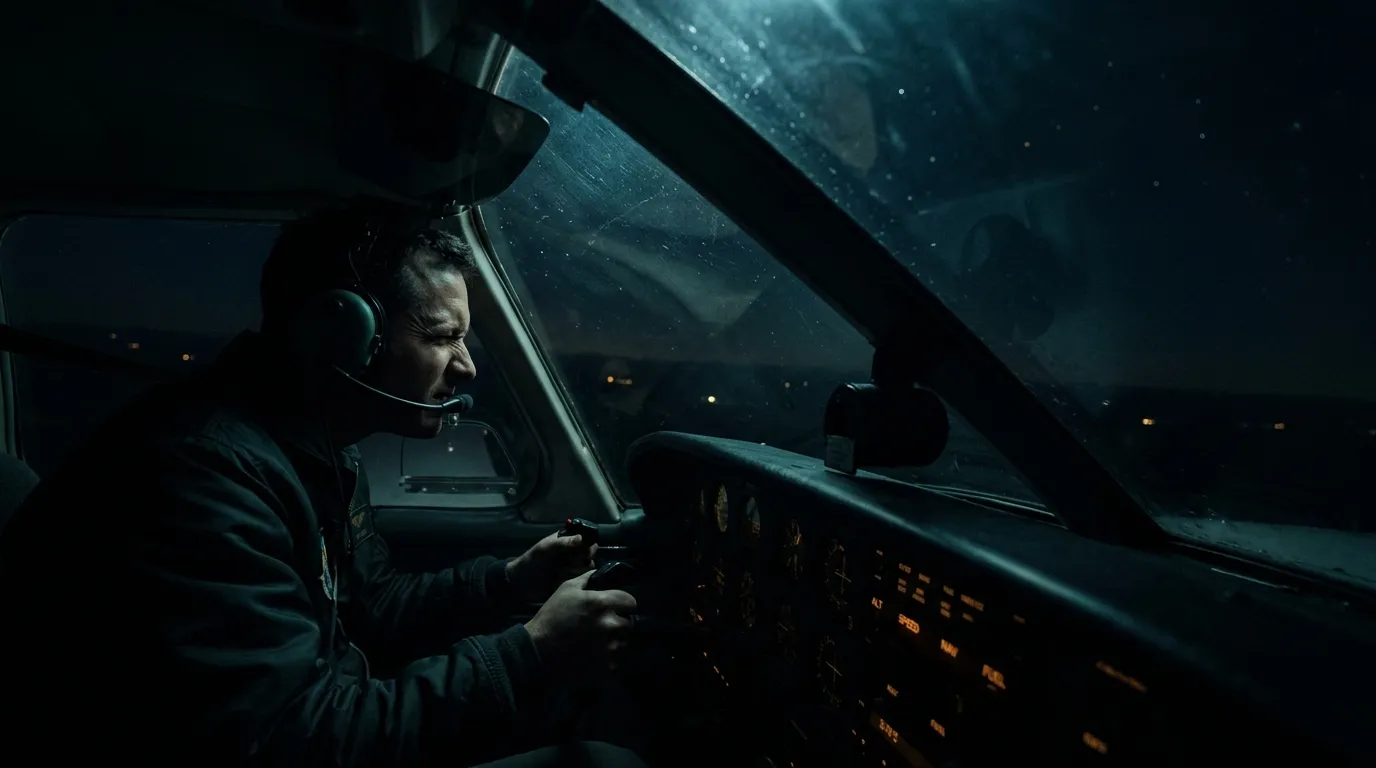
§ 31LIMITATIONS OF THE VISUAL SYSTEM
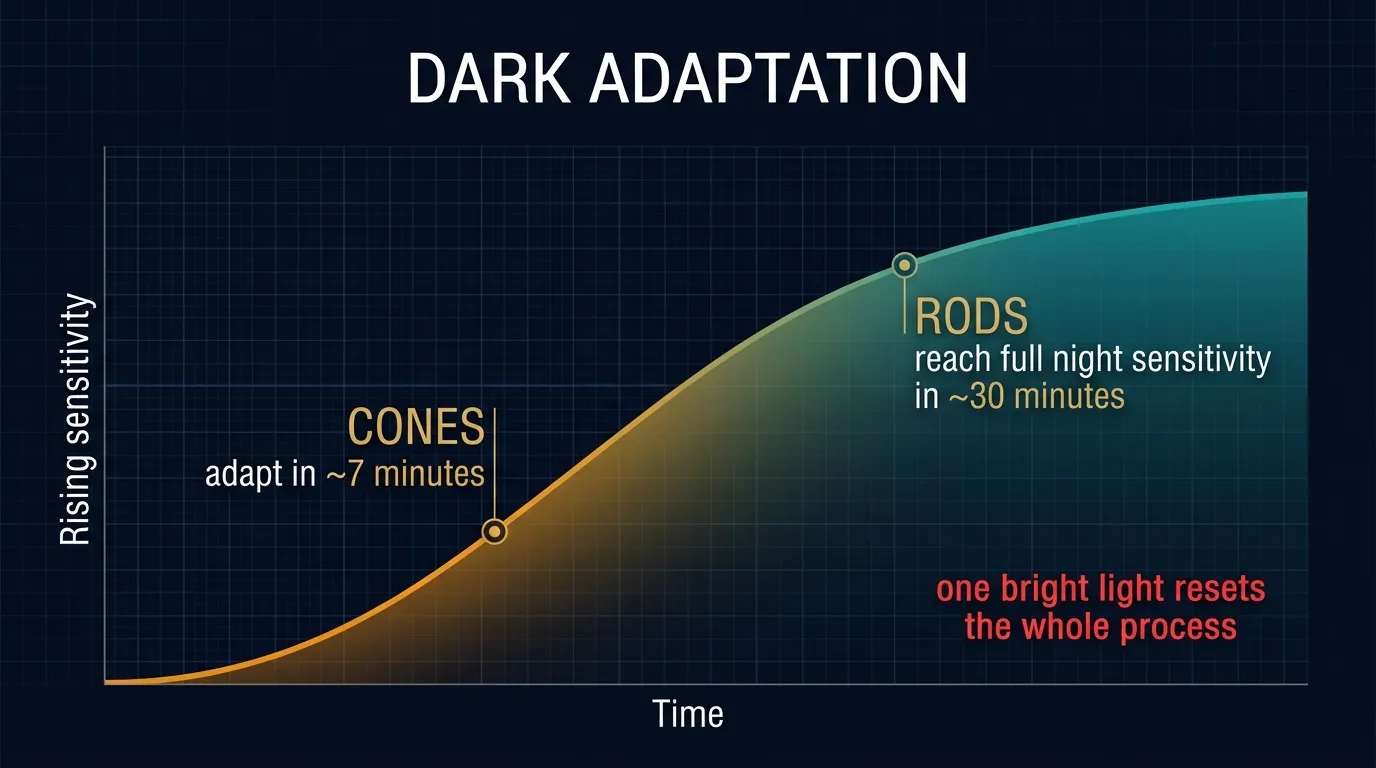
31.1 Night Vision & Dark Adaptation — the critical 7 vs 30 minutes
The time required for:
- Complete adaptation for HIGH levels of illumination is 10 seconds, and
- For full DARK adaptation, 30 minutes.
- About 7 minutes for the CONES,
- And 30 minutes for the RODS.
31.2 Vision Under Dim & Bright Illumination
In darkness, vision becomes more sensitive to light, a process called dark adaptation. Although exposure to total darkness for at least 30 minutes is required for complete dark adaptation, a pilot can achieve a moderate degree of dark adaptation within 20 minutes under dim red cockpit lighting.
Even so, white cockpit lighting must be available when needed for map and instrument reading, especially under IFR conditions.
- Exposure to cabin pressure altitudes above 5,000 feet,
- Carbon monoxide inhaled in smoking and from exhaust fumes,
- Deficiency of Vitamin A in the diet, and
- By prolonged exposure to bright sunlight.
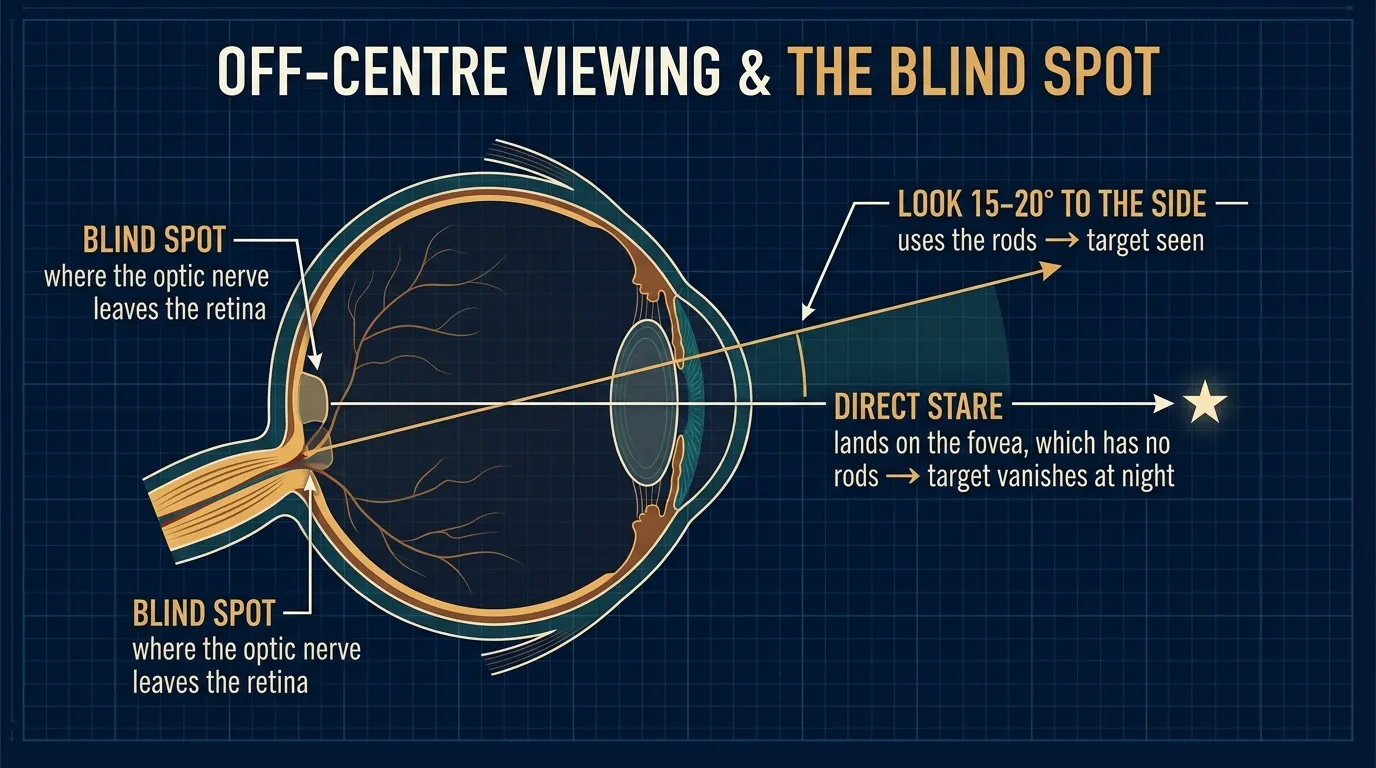
31.3 Off-Centre Viewing — "Look 15–20° to the Side"
Counterintuitive but vital: at night, the way to see something is NOT to look at it. This is taught in night-VFR training as "off-centre / scan viewing".
31.4 The Blind Spot
With both eyes open, the blind spot of one eye is covered by the other eye. But be aware of obstructions to your visual field such as passengers or canopy structures.
31.5 Empty Visual Field (Empty Field Myopia)
Pilots should minimize the risks associated with empty visual field by periodically and deliberately focusing on objects, both close and at a distance.
31.6 Damage to the Visual System — UV at Altitude
31.7 Vibrations & Blurred Vision
(Recall §25 — the eyeball's natural resonance is 30–40 Hz. Aircraft vibration that hits that band → vision-blur. This is one of the most direct cross-links between Part 6 and Part 7.)
§ 32Protection of the Visual System — Sunglasses
- Turning up the intensity of cockpit lights,
- Looking inside the cockpit,
- Wearing sunglasses, and
- Using face blinds or face curtains when installed.
- Absorb at least 85 % of visible light to eliminate glare without decreasing visual acuity,
- Absorb UV and IR radiation,
- Absorb all colors equally.
- Be impact resistant.
- Have thin frames (minimum visual obstruction).
- Be coated with poly carbonate for strength.
- Be of good optical quality.
- Have a luminescence transmittance of 10 – 15 %.
- Possess appropriate filtration characteristics.
§ 33VISUAL DEFECTS
33.1 The Four Refractive Defects — Myopia, Hypermetropia, Presbyopia, Astigmatism
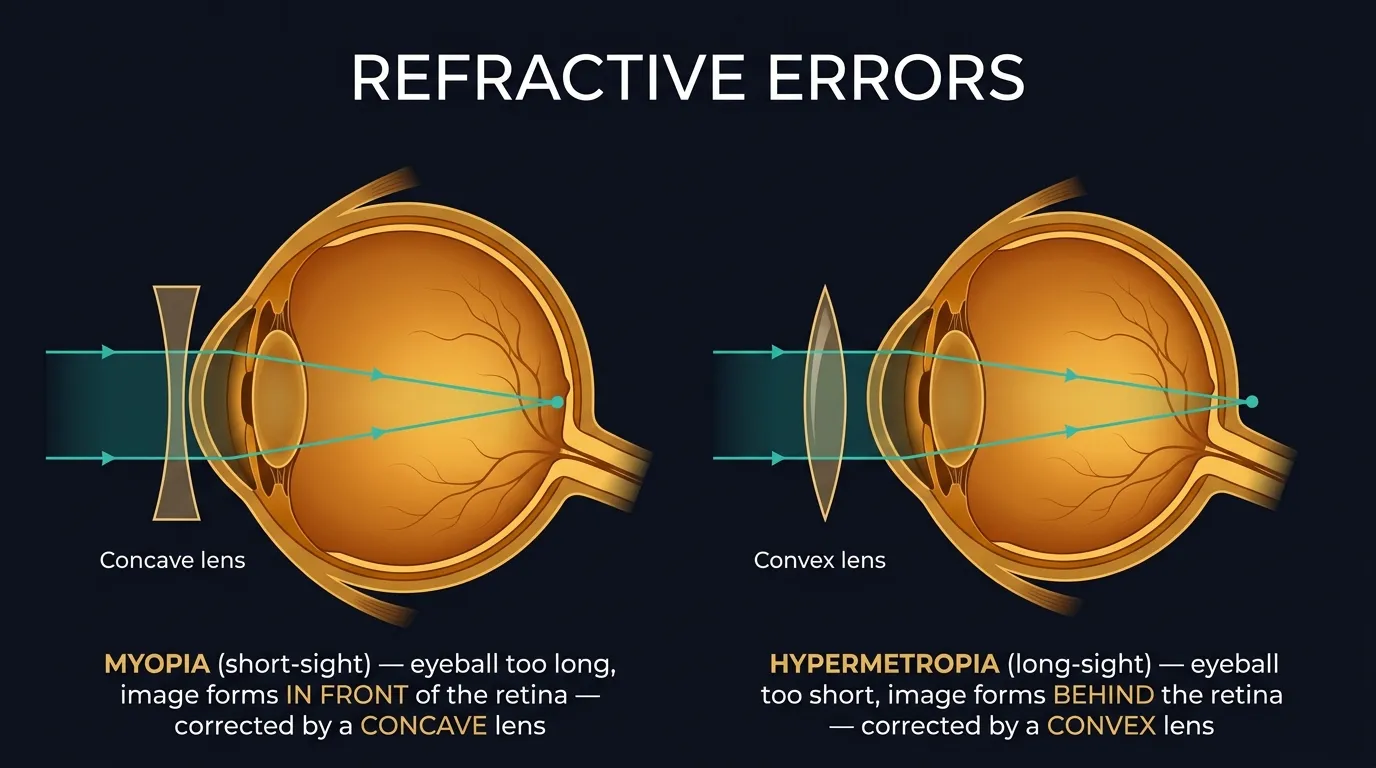
MYOPIA (Short-sightedness)
Myopia is more commonly known as short-sightedness. In a myopia eye, the eyeball is LONGER than normal causing the image to fall in FRONT of the retina.
Correction: A CONCAVE lens will correct Myopia by bending the light from distant objects OUTWARDS before it hits the cornea.
Normal pilot distance vision: "may be very approximately assessed as the ability to read a car number plate at 40 meters".
HYPERMETROPIA (Long-sightedness)
Hypermetropia is also known as long-sightedness, because only objects at a distance can be seen clearly.
Correction: A CONVEX lens will overcome Hypermetropia by bending the light rays from near objects INWARDS before they meet the cornea.
(Eyeball is shorter than normal — image would form behind the retina. Convex lens converges the rays earlier.)
PRESBYOPIA
Presbyopia is the inability of the lens to change its shape to accommodate adequately, to focus as an image from a near object onto the retina.
This condition normally arises in people between the ages of 40 and 50. It is a form of long-sightedness and is corrected using a CONVEX lens.
(This is why pilots at middle age often need bi-focals — see §29.5.)
ASTIGMATISM
Astigmatism is caused by a misshapen or oblong cornea. For a person with astigmatism objects will appear irregularly shaped.
(Corrected with a cylindrical lens that compensates for the corneal irregularity.)
| Defect | Common Name | Mechanism | Correction |
|---|---|---|---|
| Myopia | Short-sightedness | Eyeball longer → image in front of retina | Concave lens |
| Hypermetropia | Long-sightedness | Eyeball shorter → image behind retina (only distance clear) | Convex lens |
| Presbyopia | Age-related (40–50 yrs) | Lens can't change shape — accommodation fails | Convex lens (often bi-focal) |
| Astigmatism | — | Misshapen / oblong cornea — objects irregular | Cylindrical lens |
33.2 Wearing of Corrective Spectacles by Pilots
33.3 Glaucoma
- Progressive narrowing of the visual field,
- Insidious onset and concealed progression,
- An increase in intra-ocular pressure.
Glaucoma can lead to total blindness and undetected reduction of the visual field. It reduces visual acuity in its final stage.
§ 34Colour Vision
| # | Item | Operational use of colour |
|---|---|---|
| 1 | Navigation light of aircraft | Red (left wingtip) · Green (right) · White (tail) — defines aircraft direction at night. |
| 2 | Runways and airfields | White runway edge lights · red runway end · green threshold · PAPI (white/red) glide-path. |
| 3 | Ground obstructions | Red obstruction lights on towers · obstacle markings. |
| 4 | Cockpit displays and instruments | Red = warning · amber = caution · green = normal · cyan = sky · brown = ground (PFD). |
| 5 | Maps and charts | VFR/IFR charts use colour-coded airspace, terrain, MSA values. |
| 6 | Emergency flares | Distress flares — red = distress · white = signalling. |
| 7 | Light signals | ATC light-signal codes (steady green = clear to land · red flashing = airport unsafe, etc.) |
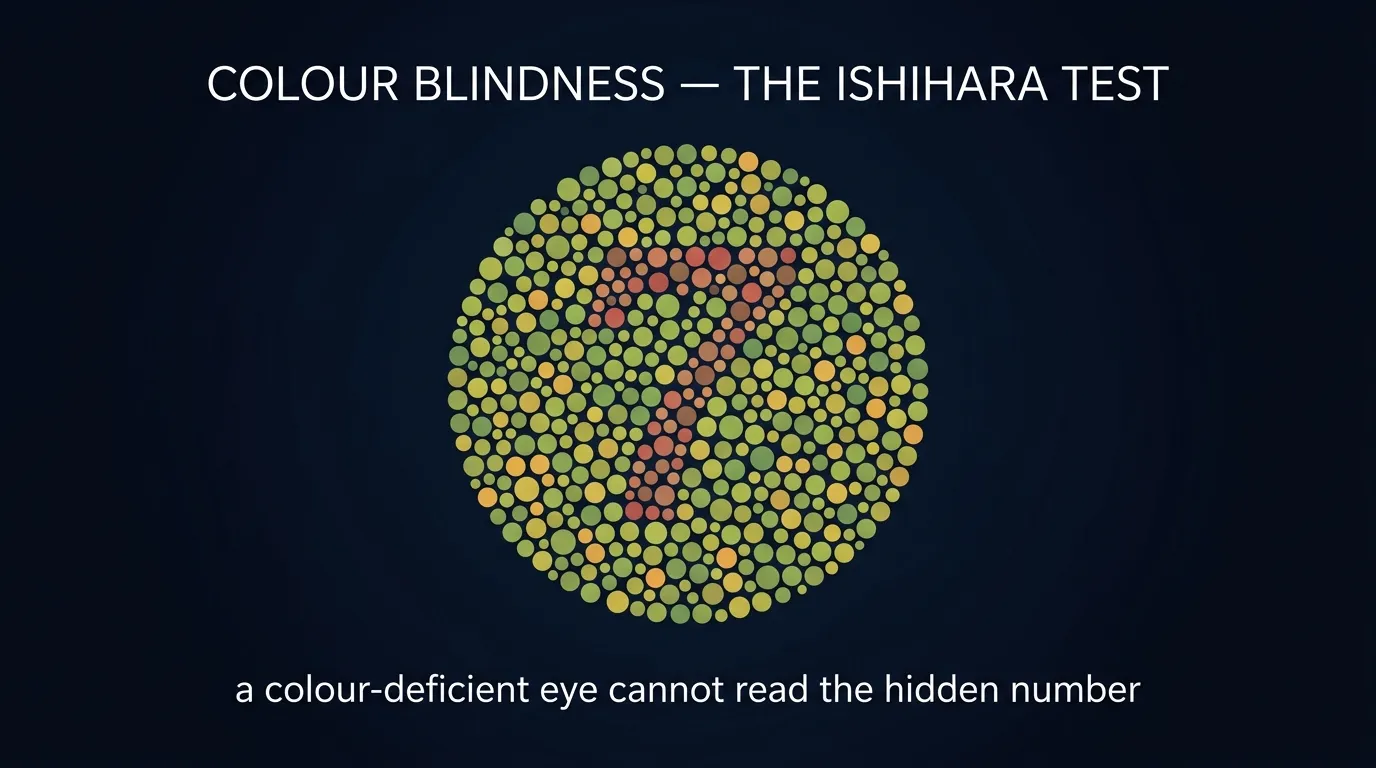
§ 35Colour Blindness
§ 36Vision & Speed — Reaction Times
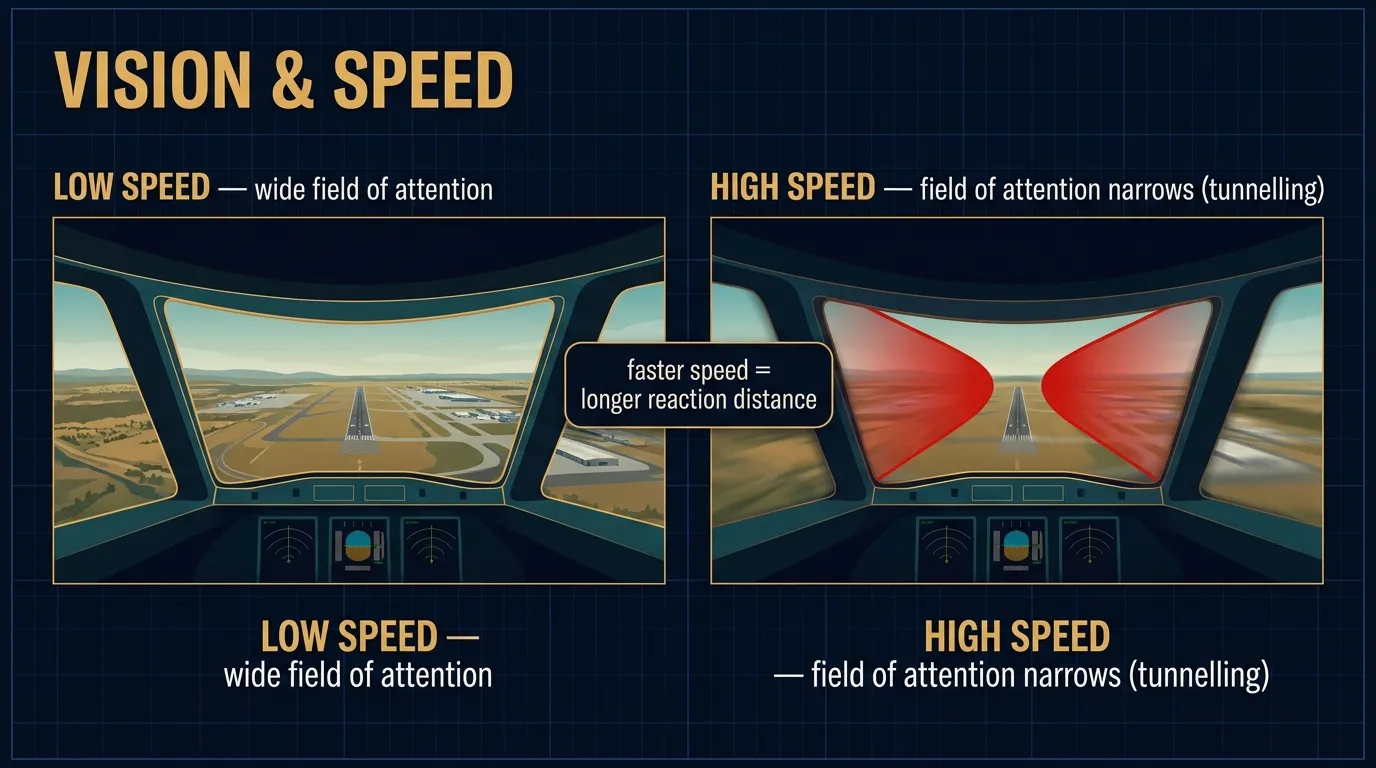
- ~ 0.1 s to detect a moving target
- ~ 1 s to recognise it as another aircraft
- ~ 1 s to decide on an evasive action
- ~ 4 s for the controls + airframe to respond
Reinforce Chapter 12: The Limits of Sight
Test your knowledge and practice actual exam questions for Human Performance & Limitations.