10
HPL — CHAPTER 10 · NOTES
The Cabin Environment
by Ghost Aviator
Human Performance & Limitations · Module D — Poisons & The CabinThe Cabin Environment
Chapter 10 — The physical environment around the pilot: humidity, temperature, vibration, glare and UV, and what happens when a pilot is incapacitated in flight — from a simple faint to a fit.
§ 23Humidity
23.1 Why Humidity Matters Up High
DGCA-quoted
Humidity may become an issue with high-altitude jet transport aircraft because of the low relative humidity at their operational altitudes. The discomfort arising from low relative humidity may not imply physical indisposition.
DGCA-quoted humidity ranges
- 40 – 60 % relative humidity is NORMAL.
- < 20 % may create minor discomfort, such as skin, eye, nose, throat dryness.
40–60%
Normal relative humidity
< 20%
Minor discomfort — skin, eye, nose, throat dryness
3–8% → 22%
Modern humidifiers raise cabin RH from 3–8% to ~22%
Prevention & management
- Overall dehydration can be prevented with adequate fluid intake.
- Diuretics like coffee or tea should be avoided. They drive fluid out of the body via increased urination — the opposite of what is needed at altitude.
23.2 Aircraft Humidifier Systems
DGCA-quoted
The installation of humidifiers on aircraft raises cabin/cockpit humidity, but there are potential problems such as:
- Weight penalty,
- Condensation, and
- Mineral contamination that the designer must consider.
§ 24Temperature
DGCA-quoted
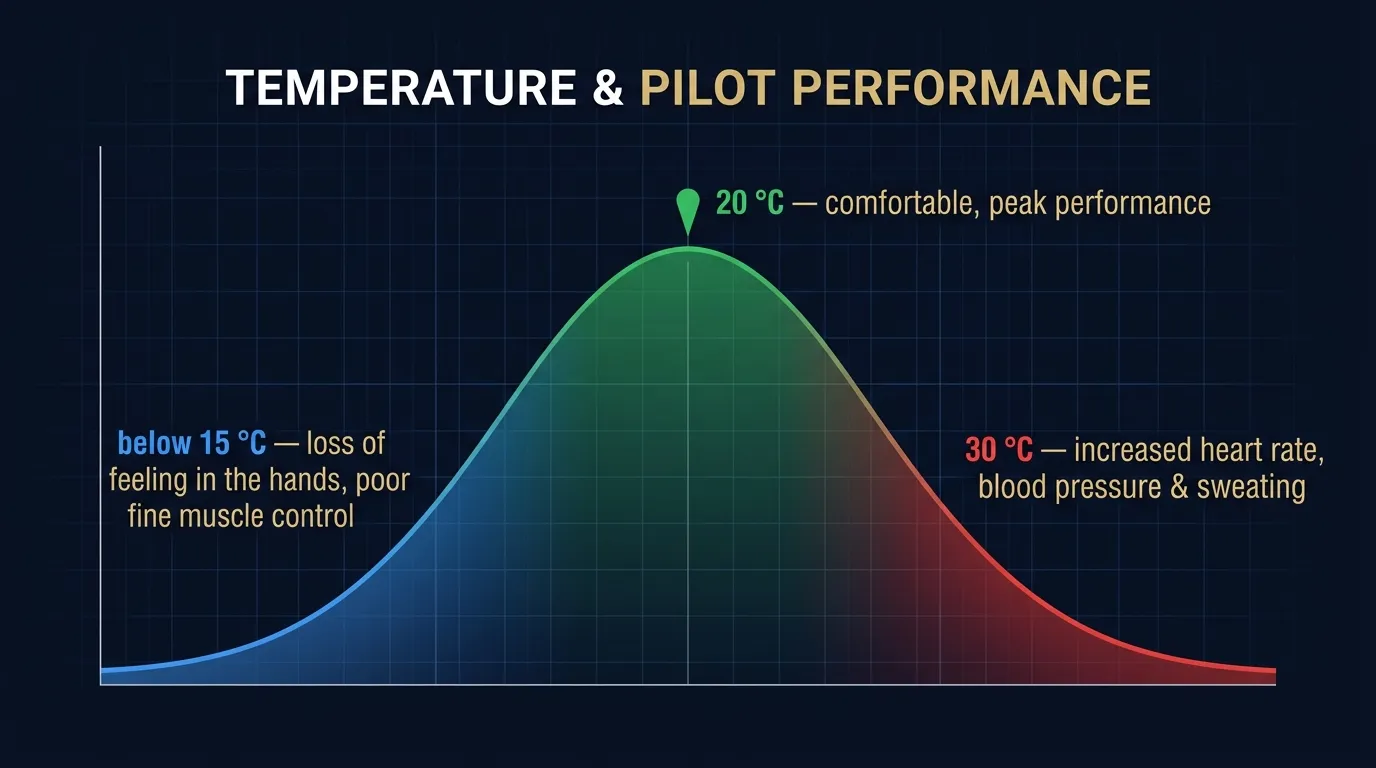
Temperature affects performance as follows:
24.1 The Three Reference Temperatures — memorise verbatim
| Temperature | Effect on Performance |
|---|---|
| 20 °C | Comfortable temperature for most people in normal clothing. |
| 30 °C | Increased heart rate, blood pressure, and sweating. |
| > 15 °C | Discomfort, loss of feeling in hands, poor control of fine muscle movement. (Note: source phrasing uses "> 15 °C" — referring to deviations beyond 15 °C from a comfortable baseline, i.e. cold-stress.) |
Cockpit-temperature considerations
- At 20 °C the pilot is comfortable — fine motor skills, judgement and reaction time are optimal.
- At 30 °C the body's ANS responds to heat stress by raising HR, BP and triggering sweating to cool the skin. Cognitive performance starts to degrade.
- In cold conditions — far below the comfort baseline — the pilot loses sensation in the fingers, struggles with fine-motor tasks like switch selection or fast checklist scanning, and may shiver involuntarily.
- For both extremes, cabin temperature management is a flight-safety task, not merely a comfort one. Climate control should be set to keep cockpit temperature near 20 °C for sustained operations.
§ 25Vibration
25.1 Natural Resonance — Why Frequency Matters
DGCA-quoted opening
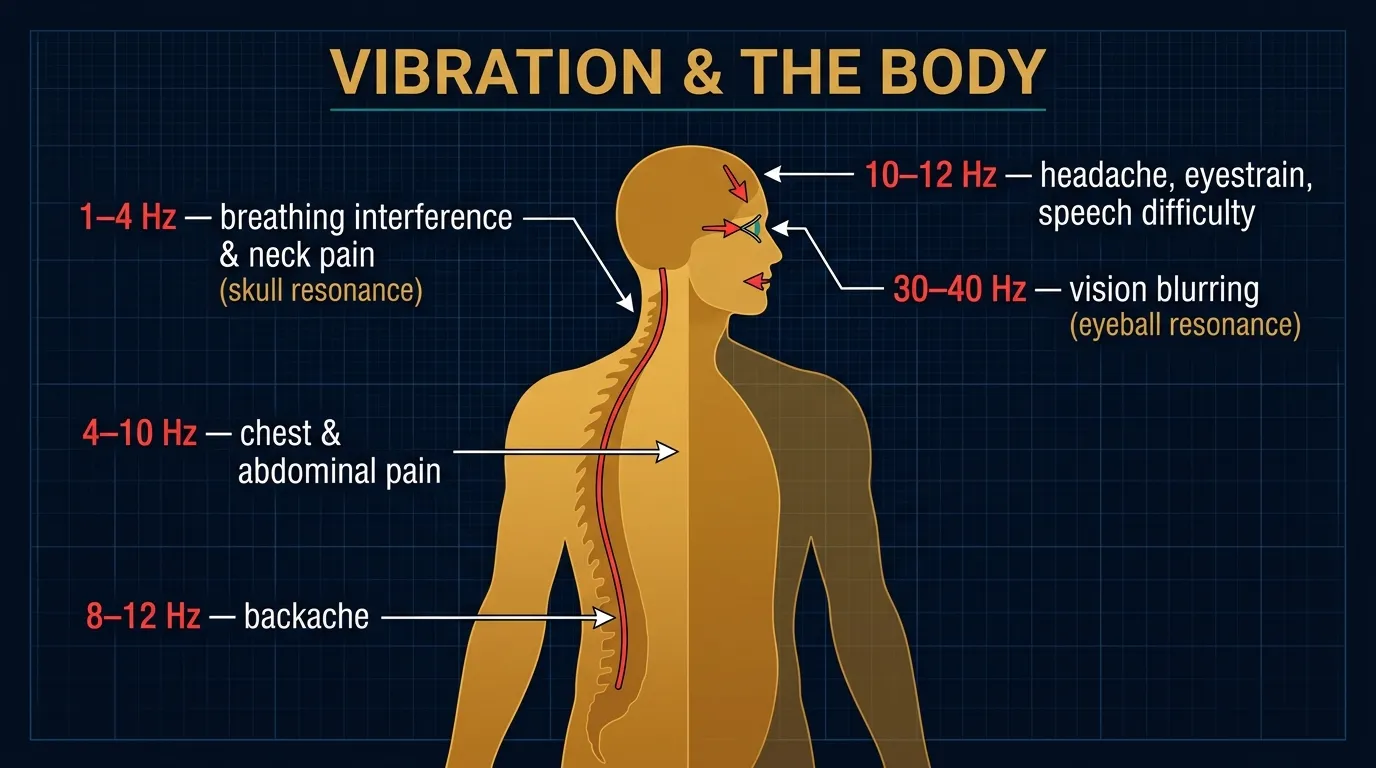
Different parts of the body show a natural resonance at different periods of vibration. For example:
- The natural resonance of the eyeball is 30 – 40 Hz, and
- The skull is 1 – 4 Hz.
What "natural resonance" means in plain English
Every physical structure has a frequency at which it wants to vibrate — push it at that frequency and small inputs build up into huge oscillations (think of pushing a child on a swing in time with the swing's natural period). When external aircraft vibration matches a body part's resonant frequency, that part suffers maximum disturbance. The eyeball resonating at 30–40 Hz is precisely why vision becomes blurred at certain helicopter or propeller-vibration frequencies.
25.2 Effects of Vibration — Full DGCA Frequency Table
Memorise this table — direct exam target
Effects of vibration include:
| Frequency Range | Effect on the Body |
|---|---|
| 1 – 4 Hz | Interference with breathing; neck pain. (Skull resonance range.) |
| 4 – 10 Hz | Chest and abdominal pain. |
| 8 – 12 Hz | Backache. |
| 10 – 12 Hz | Headache, eyestrain, throat pain, speech difficulty, muscle tension. |
| 30 – 40 Hz | Interference with vision. (Eyeball resonance range.) |
Operational vibration sources in aviation
- Helicopter rotors: typically 4–7 Hz (main rotor) → chest/abdominal pain & backache range.
- Piston / turboprop engines: 10–30 Hz on the airframe → headache, eyestrain, vision interference.
- Jet engine buffet: higher-frequency, but resonant peaks in the seat may still strike critical body-part frequencies.
- Turbulence: low-frequency buffeting (1–10 Hz) → fits the skull / neck / chest range.
§ 26Glare & UV Radiation
DGCA-quoted
UV radiation from sunlight can cause visual fatigue, as well as affect visual health.
Why glare and UV deserve their own section
At cruise altitudes (FL300+), the protective filtering of the atmosphere is reduced. Cockpit windows admit significantly more UV-A and UV-B than ground-level glass would. Over a long career, this contributes to:
- Visual fatigue — the immediate effect of glare on the working pilot. Squinting, eyestrain, reduced contrast sensitivity, headache.
- Cumulative visual health damage — cataract formation, macular degeneration risk, conjunctival/skin damage.
Practical pilot precautions
- Use aviation-grade polarised or non-polarised UV-blocking sunglasses (note: certain LCD instruments may distort under polarised lenses — check before adoption).
- Use cockpit sun-visors appropriately — don't leave them stowed when the sun is over the nose.
- For long-haul crews, schedule vision rest breaks on autopilot legs.
- Periodic aero-medical eye examinations — already mandated by DGCA — pick up early cataract / retinal changes.
§ 27INCAPACITATION IN FLIGHT
27.1 Why Pilot Incapacitation is a Flight-Safety Issue
DGCA-quoted introduction — verbatim
The risk of seizure in flight is obvious. Incapacitation is in most cases:
- Sudden,
- Unpredictable,
- Unavoidable,
- Prolonged,
- Complete, and
- Potentially more frequent in the stressful flying environment,
DGCA-quoted prevention measure
Periodical medical examinations minimize the risk of incapacitation in flight. The frequency of medical checks increases with advancing age.
Class-1 medical (commercial pilot) under 40
12 months
Class-1 medical, 40+
6 months
Class-2 medical (PPL) under 40
5 years (varies)
Class-2 medical, 40+
2 years (varies)
(The DGCA medical-frequency periods are referenced in the syllabus generally and shown above for context; exact CAR / Schedule periods should be confirmed against the latest DGCA medical CAR / FAA Part 67 equivalent.)
27.2 Obvious Incapacitation
DGCA-quoted definition
Obvious incapacitation normally refers to a state in which all of a crew member's physical or mental functions are lost, including:
- Loss of consciousness, OR
- Being unable to move while retaining consciousness,
Onset patterns & presentation
- Obvious incapacitation can sometimes involve convulsions,
- OR the victim may lapse into unconsciousness several minutes after the incapacitation occurs.
DGCA-quoted causes of obvious incapacitation
The source PDF uses the phrasings shown — students should be aware of the modern medical terminology in parentheses.
- Cardiac arrest
- Myocardial infection (textual variant — "myocardial infarction" — heart attack)
- Interracial hemorrhage (intended: "intracranial haemorrhage" — bleed in the brain)
- Cerebral apoplexy (stroke)
- Epilepsy
The source PDF uses the phrasings shown — students should be aware of the modern medical terminology in parentheses.
27.3 Subtle / Insidious Incapacitation
DGCA-quoted definition
SUBTLE (develops slowly and gradually), incapacitation refers to a state of a partial or temporary loss of physical or mental function which manifests itself in the form of:
- Partial paralysis,
- A dulling of perception, judgment, or responses or lack thereof,
- A state of absence of mind, distraction of attention,
- Trouble with speech,
- Inadequate responses,
- Meaningless utterances, etc.
The hidden-danger warning — DGCA verbatim
Particular attention must be paid to the fact that a crew member may become incapacitated EVEN THOUGH THEIR APPEARANCE IS NO DIFFERENT FROM NORMAL.
Possible causes of subtle incapacitation — DGCA list
- Temporary hypoglycemia (low blood sugar — pilot skipped meals)
- Reduction in blood pressure
- Cerebropathy or psychopathy
- Excessive muscular fatigue
- Excessive drinking (see §14)
- Insufficient sleep
- Emotional instability
- Toothache
- Stomachache
- Headache
27.4 Obvious vs Subtle — Why Subtle is MORE Dangerous
DGCA-quoted — the counterintuitive truth
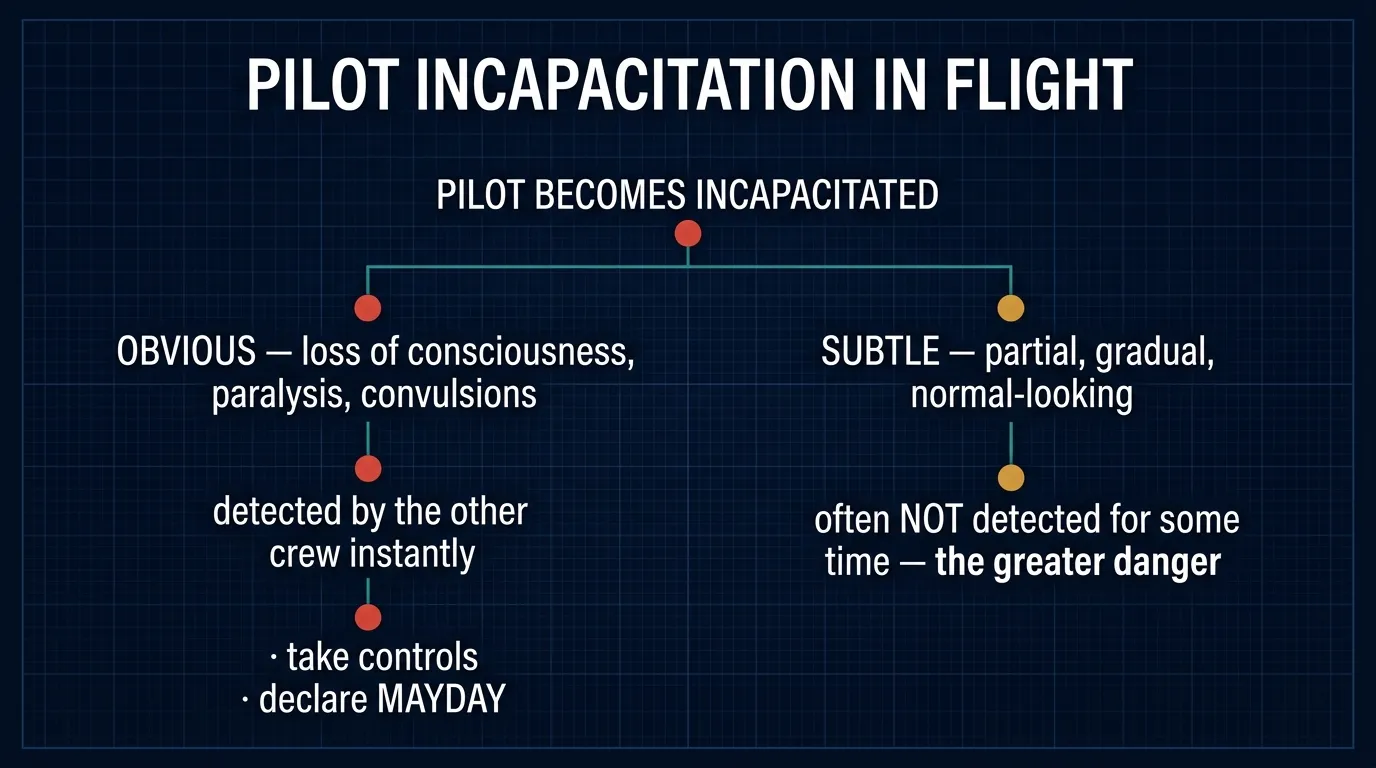
Since other crew members are often unable to detect subtle incapacitation quickly, from a flight safety point of view, it is possible that SUBTLE INCAPACITATION MAY LEAD TO A SITUATION OF COMPARATIVELY GREATER DANGER THAN OBVIOUS INCAPACITATION.
Why this matters in two-crew operations
With obvious incapacitation, the other crew member sees the captain slumped or convulsing, declares emergency, takes control, gets the aircraft on the ground. The hand-off is instant.
With subtle incapacitation, the captain is still moving switches, talking on the radio, even responding to questions — but his judgement is impaired. He may set the wrong altitude, mis-tune a NAV, mishear an ATC clearance, or fail to initiate a missed approach. The other pilot may not detect this until after the wrong outcome unfolds. This is the rationale behind two-crew CRM: a healthy independent cross-check that catches subtle drift before it becomes an accident.
With subtle incapacitation, the captain is still moving switches, talking on the radio, even responding to questions — but his judgement is impaired. He may set the wrong altitude, mis-tune a NAV, mishear an ATC clearance, or fail to initiate a missed approach. The other pilot may not detect this until after the wrong outcome unfolds. This is the rationale behind two-crew CRM: a healthy independent cross-check that catches subtle drift before it becomes an accident.
OBVIOUS Incapacitation
- All functions lost — LoC or paralysed-conscious
- May include convulsions / delayed LoC
- Detected instantly by the other crew
- Causes: cardiac arrest, MI, intracranial bleed, stroke, epilepsy
- Handover happens fast
SUBTLE Incapacitation
- Partial or temporary loss of function
- Appearance may be normal
- Often undetected for some time by the other crew
- Causes: hypoglycemia, ↓ BP, fatigue, sleep loss, drinking, emotional/dental/stomach/headache
- Greater overall flight-safety danger
§ 28FITS & FAINTS
28.1 Epilepsy — Grand Mal & Petit Mal
DGCA-quoted definition
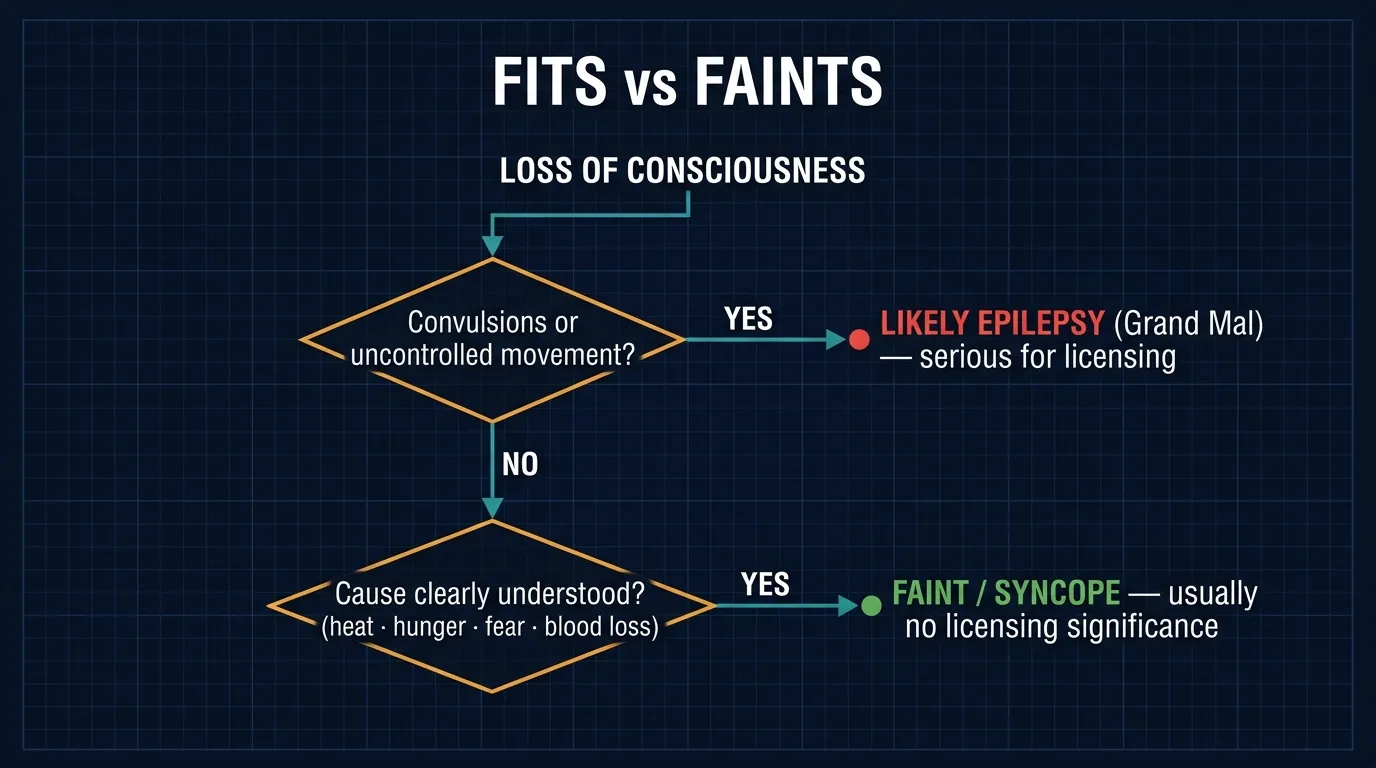
A fit or seizure is usually referred to as "epilepsy". A fit or a seizure is not a specific disease but a set of signs or symptoms in response to a disturbance of the electrical activity in the brain.
Grand Mal Epilepsy
- Manifests as a generalized seizure
- Associated with a transient loss of consciousness
- May be associated with a prodromal phase (warning aura before the seizure)
- Normally accompanied by convulsions and uncontrolled physical movement
Petit Mal Epilepsy
- Also a generalized seizure
- Not associated with a loss of consciousness
- Petit Mals are a MINOR attack
- Often presents as brief "absence spells" — staring, blanking out for a few seconds
DGCA-quoted — the absolute bar
A seizure may or may not be associated with a loss of consciousness… but ANY FIT, MAJOR OR MINOR, IS ASSOCIATED WITH AN UNPREDICTABLE LOSS OF CONSCIOUSNESS AND IS THEREFORE AN ABSOLUTE BAR TO THE HOLDING OF A FLYING LICENCE.
Pilot-medical implication
This is one of the very few absolute medical disqualifications in aviation. Even controlled epilepsy on medication — even a single documented seizure event in adult life — is grounds for medical refusal. The reason is the word "unpredictable" — DGCA cannot certify the probability of an in-flight seizure as acceptably low.
28.2 Faint & Vasovagal Syncope
DGCA-quoted definition
Faint is a common cause of a loss of consciousness in adults. The most common causes of faints are:
| # | Cause |
|---|---|
| 1 | Standing up quickly after prolonged sitting especially when hot or dehydrated |
| 2 | A sudden shock |
| 3 | Loss of blood after an accident |
| 4 | Lack of food or fluid |
| 5 | Other physiological stress |
DGCA-quoted — Syncope & Vasovagal Syncope
Syncope is a temporary but sudden loss of consciousness when blood flow to the brain is compromised. In young individuals, fear, anxiety, sight of blood, etc., can result in a temporary loss of consciousness. This is referred to as VASOVAGAL SYNCOPE.
Frequently, syncope is associated with symptoms like:
Frequently, syncope is associated with symptoms like:
- Light-headedness,
- Muscle weakness, and
- Dizziness before the actual fainting occurs.
DGCA-quoted — flight-licence implication
A faint has NO SIGNIFICANCE as far as future flying is concerned, so long as the cause is clearly understood.
Epilepsy vs Faint — the critical comparison
This is the most frequently tested contrast in DGCA HPL papers. Memorise it:
| Parameter | Epilepsy (Grand/Petit Mal) | Faint (Syncope) |
|---|---|---|
| Underlying cause | Disturbance of brain electrical activity | Compromised blood flow to the brain |
| Loss of consciousness | Often (Grand Mal) / Absent (Petit Mal) | Yes, temporary & sudden |
| Convulsions / uncontrolled movement | Yes (Grand Mal) | No |
| Predictability | Unpredictable | Cause is usually identifiable (heat, hunger, fear, blood loss) |
| Typical warning signs | Prodromal aura (Grand Mal) | Light-headedness, muscle weakness, dizziness |
| Effect on flying licence | ABSOLUTE BAR — no licence | No significance — fit to fly if cause is clear |
✦ END OF CHAPTER 10 ✦
Reinforce Chapter 10: The Cabin Environment
Test your knowledge and practice actual exam questions for Human Performance & Limitations.
Planning your Pilot Training in 2026?
Calculate exact flying hours, DGCA exam fees, and living costs with our interactive calculator.