ATS Surveillance Phraseology
by Ghost Aviator
Part III (iv) General ATS surveillance — identification & vectoring · traffic info & avoiding action · SSR · radar assistance to comms-failure aircraft · alerting
Learning objectives — by the end of this chapter you will be able to…
- Use identification and vectoring phraseology and respond correctly.
- Receive traffic information and act on avoiding-action instructions.
- Use the full set of SSR (transponder) phraseology.
- Understand how radar assists an aircraft that has a communications failure.
- Recognise alerting and service-termination phraseology.
19.1 Identification
19.2 Vectoring
19.3 Traffic information & avoiding action
19.4 SSR / transponder phraseology
19.5 Radar assistance to comms failure
19.6 Alerting & termination of service
☆ Numbers to memorise
? Question bank
19.1 Identification
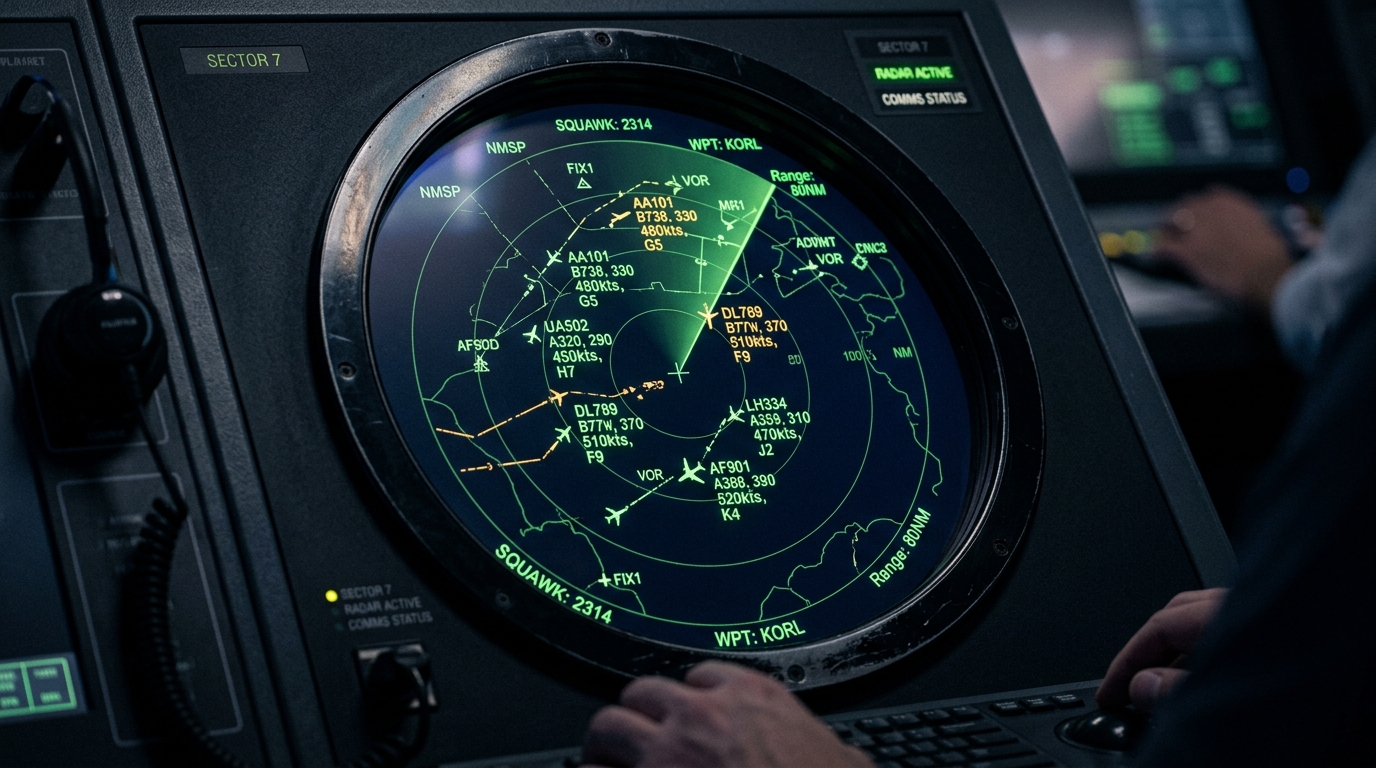
Before a controller can vector you or give you radar separation, they must positively identify your return on the display. They confirm it with "identified" (often with a position), or tell you "not identified". Common methods are a squawk ident, observing a turn, or correlating your reported position.
| Phrase | Meaning |
|---|---|
| "Squawk [code]" | Set the transponder code |
| "Squawk ident" | Press IDENT to flash the return for identification |
| "Identified [position]" | You are identified on radar |
| "Not identified, resume own navigation" | You are not identified; navigate yourself |
| "For identification, turn left heading …" | Turn so the controller can identify you |
19.2 Vectoring
A vector is a heading the controller assigns — for sequencing, spacing, separation or to position for an approach. It usually states the reason: "turn left heading two seven zero for spacing". When the vectoring is finished, the controller says "resume own navigation" (with a position/route).
19.3 Traffic information & avoiding action
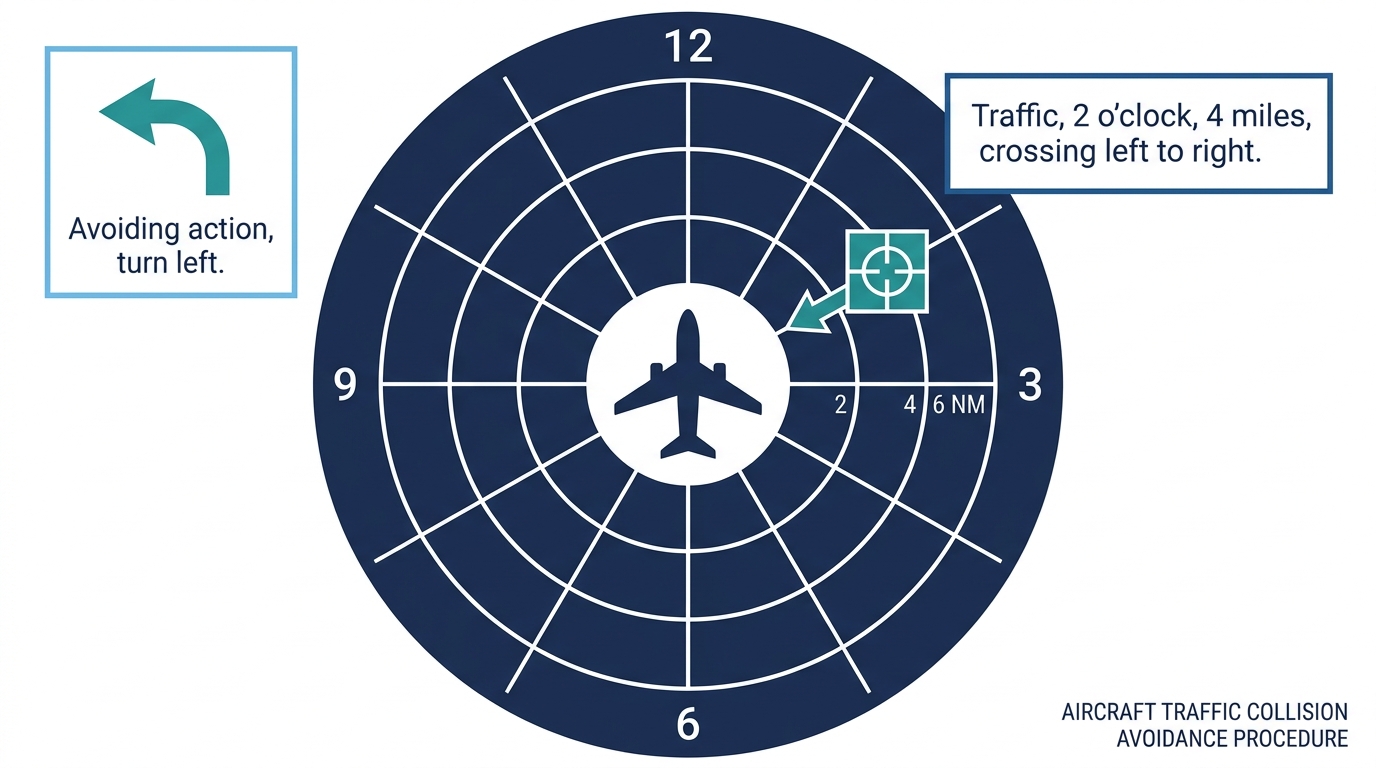
The controller describes conflicting traffic by its clock-bearing, distance, direction of movement and (if known) level/type: "traffic, eleven o'clock, five miles, opposite direction, indicating flight level three five zero". You reply "looking out" and, if you see it, "traffic in sight".
"Avoiding action" is an immediate instruction to turn (and/or climb/descend) to avoid a confliction — for example "avoiding action, turn left immediately heading one eight zero, traffic …". It is obeyed at once and read back; the reason follows the instruction so no time is lost.
19.4 SSR / transponder phraseology
| Phrase | Meaning |
|---|---|
| "Squawk [code]" | Set the four-digit code |
| "Squawk ident" | Operate the IDENT feature |
| "Squawk Charlie" / "squawk Mode C" | Select altitude reporting (Mode C) |
| "Confirm squawk [code]" | Confirm the code set |
| "Reset squawk [code]" | Re-select the code (e.g. after a fault) |
| "Squawk standby" | Select standby (no replies) |
| "Stop squawk Charlie, wrong indication" | Switch off altitude reporting (faulty) |
| "Check altimeter setting and confirm level" | Mode C disagrees — verify QNH and level |
7500 hijack · 7600 radio failure · 7700 emergency · 7000 conspicuity (VFR) · 2000 entering from a non-SSR area. These are set without being told, in the relevant situation.
19.5 Radar assistance to a comms-failure aircraft
If an aircraft has a receiver-only or partial communications failure but its transponder still works, the controller can still see and assist it. The controller transmits instructions blind and asks the pilot to acknowledge by transponder: "reply not received, if you read [station], squawk ident" or "acknowledge by [a stated transponder action / a turn]".
Even with no voice, a working transponder turns your aircraft from a guess into a tracked, instructable target — which is why you keep the transponder ON and squawk 7600 the moment a radio fails (full procedure in Chapter 20).
19.6 Alerting & termination of service
The controller may give your position relative to a feature for situational awareness or for an aircraft in difficulty: "position five miles east of [VOR]". When radar service ends — leaving cover, or at transfer — the controller says "identification terminated [instructions]" or "radar service terminated, resume own navigation".
Identify → Vector → Inform/Avoid → (manage SSR) → Terminate. Every surveillance interaction runs through this loop.
☆ Numbers to memorise
| Fact | Value |
|---|---|
| Identification | "Identified" / "not identified"; squawk ident, turn, or position correlation |
| Vector | Heading + reason ("for spacing/sequencing"); ends "resume own navigation" |
| Traffic info | Clock bearing · distance · direction · level/type |
| Avoiding action | Immediate turn/climb; instruction first, reason after; read back |
| SSR phrases | Squawk · ident · Charlie (Mode C) · confirm · reset · standby |
| Comms-failure assistance | Transmit blind; "if you read, squawk ident"; acknowledge by transponder |
| Termination | "Identification/radar service terminated, resume own navigation" |
Part A — MCQs (click an option to check)
Part B — Oral / viva (tap to reveal model answers)
60-SECOND REVISION CARD
- Identify (squawk ident / turn / position) → "identified" or "not identified".
- Vector = heading + reason; ends "resume own navigation".
- Traffic = clock · distance · direction · level/type. Avoiding action = immediate, read back.
- SSR: squawk · ident · Charlie (Mode C) · confirm · reset · standby. Codes 7500/7600/7700/7000/2000.
- Comms failure: "if you read, squawk ident", vectors acknowledged by transponder. Service ends "terminated, resume own navigation".
Reinforce Chapter 19: ATS Surveillance Phraseology
Test your knowledge and practice actual exam questions for Radio Telephony.