Time (3)
by Ghost Aviator
Sunrise & Sunset
Sunrise, sunset and twilight calculations using the Air Almanac. Polar day, polar night, and high-latitude phenomena.
Sunrise and Sunset
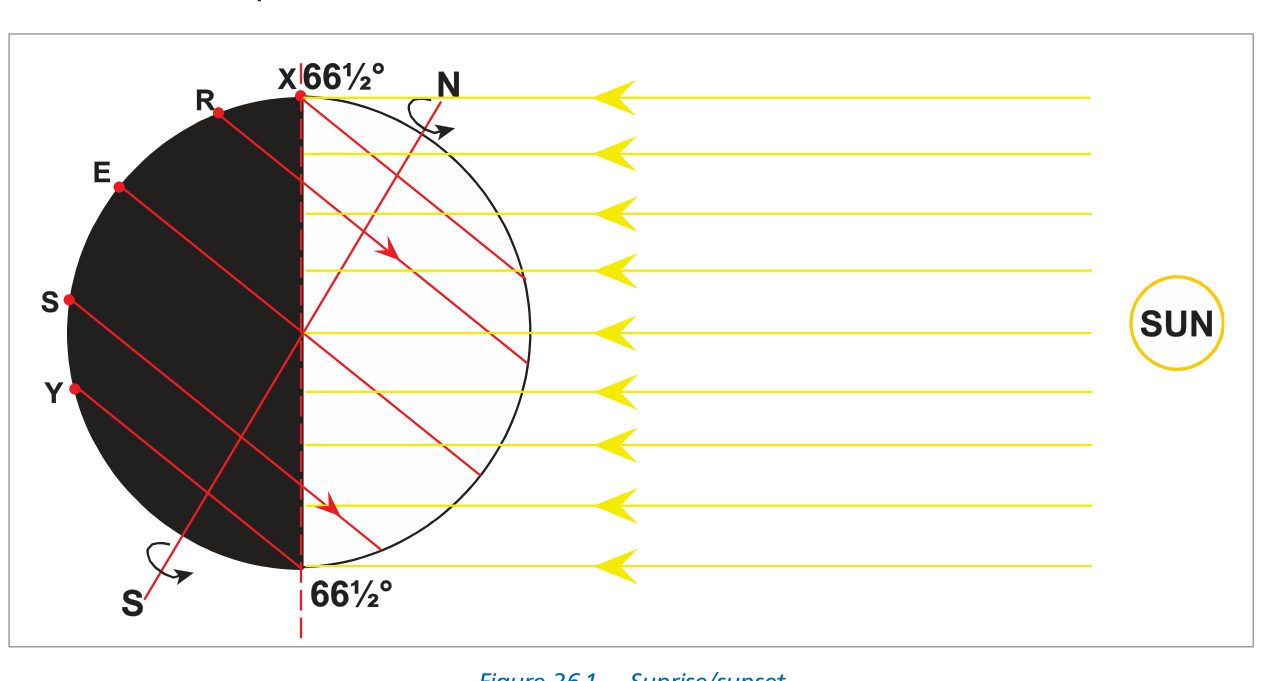
Local noon occurs at the same Local Mean Time on all meridians — it is always 1200 LMT. By extension, sunrise and sunset occur at the same LMT at all places on the same parallel of latitude, on any given day.
📌 Sunrise LMT and Sunset LMT are the same at a given latitude on a given date, regardless of longitude.
📌 To find UTC of sunrise/sunset: look up LMT from Air Almanac → convert using arc-to-time for your longitude.
📌 As the Sun rises due East and sets due West only at the equinoxes — at other times of year, the Sun rises/sets north or south of East/West.
Polar Phenomena
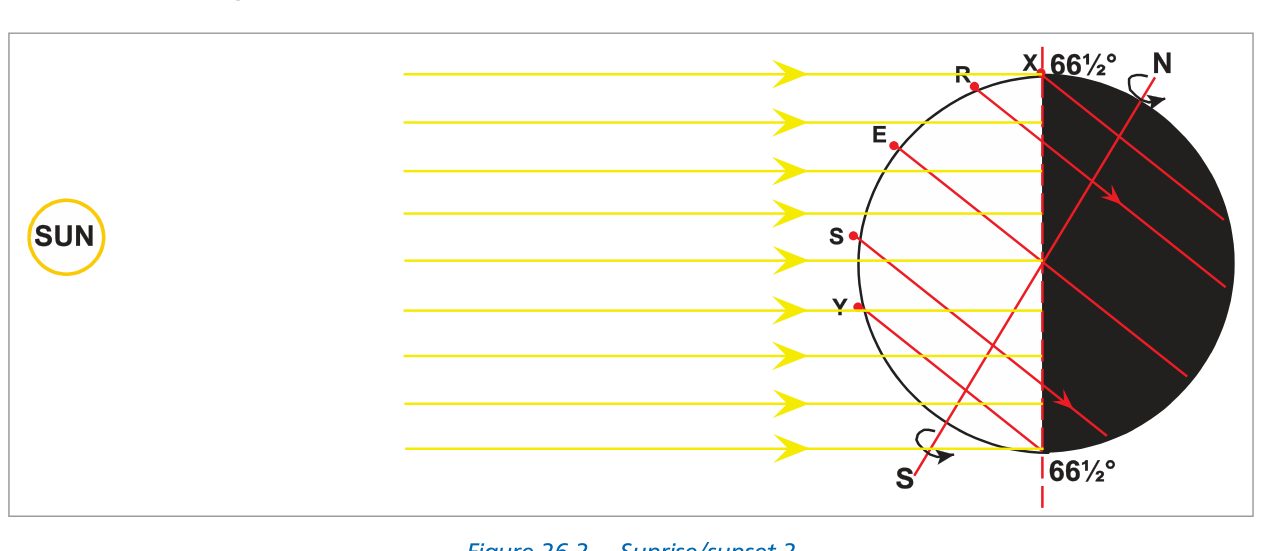
The combination of Earth's axial tilt and high latitudes produces remarkable seasonal effects:
| Phenomenon | Condition | Where? | When (NH)? |
|---|---|---|---|
| Midnight Sun (☀️ all day) | Sun above horizon 24 hrs | 66°N and higher | Around 21 June |
| Polar Night (❄️ all night) | Sun below horizon 24 hrs | 66°N and higher | Around 21 December |
| Equal Day/Night | 12 hrs day, 12 hrs night | Equator (all year) | Equinoxes (all lat) |
☀ (filled circle) = Sun above horizon all day (Midnight Sun — no sunrise/sunset)
☾ (empty circle/crescent symbol) = Sun below horizon all day (Polar Night — no sunrise/sunset)
// (slashes) = Permanent twilight during the period the Sun is below the horizon
The lowest latitude at which Midnight Sun occurs is approximately 66°N/S — the Arctic/Antarctic Circle — on the relevant solstice. In the Air Almanac, this is listed as approximately 66N for June and 66N for December polar night (when the question asks for lowest latitude where Sun never rises).
Twilight
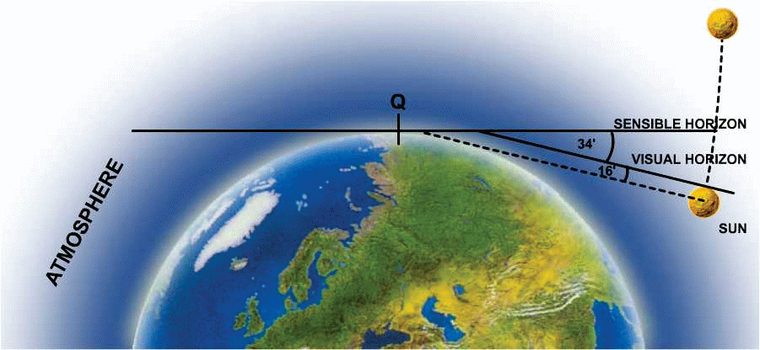
Twilight is the period before sunrise and after sunset when the Sun is below the sensible horizon but still illuminates the sky. It is defined by how far the centre of the Sun is below the sensible horizon.
☀️ Civil Twilight
Sun 0° to 6° below horizon
Enough light for most outdoor tasks
Used in EU-OPS day/night definition
🌙 Nautical Twilight
Sun 6° to 12° below horizon
Horizon visible, stars visible for navigation
Used by mariners for star sights
⭐ Astronomical Twilight
Sun 12° to 18° below horizon
Sky not completely dark
Ends when full darkness begins
Civil Twilight definition (full):
• The period between sunset and End of Evening Civil Twilight (ECT)
• The period between Start of Morning Civil Twilight (MCT) and sunrise
• Related to the centre of the Sun being 6° below the sensible horizon
• A period when it is possible to carry out daylight tasks without artificial lighting
• Used in the EU-OPS definition of day flying / night flying
Air Almanac Abbreviations:
Twilight at the Equator
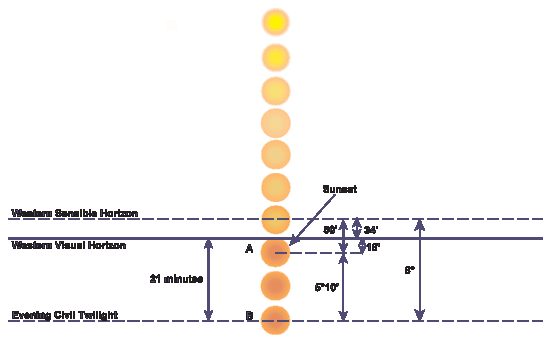
Despite popular belief, it is not immediately dark after sunset at the Equator. Civil twilight still exists. However, because at the Equator the Sun sets almost vertically (perpendicular to the horizon), the twilight period is short.
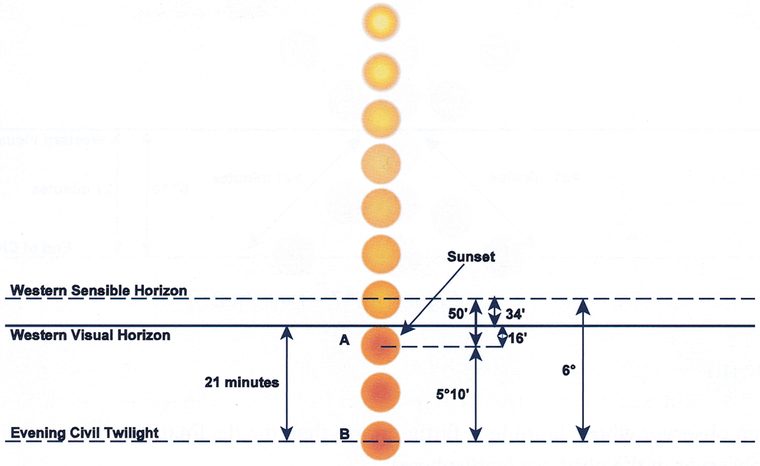
Minimum Duration of Civil Twilight
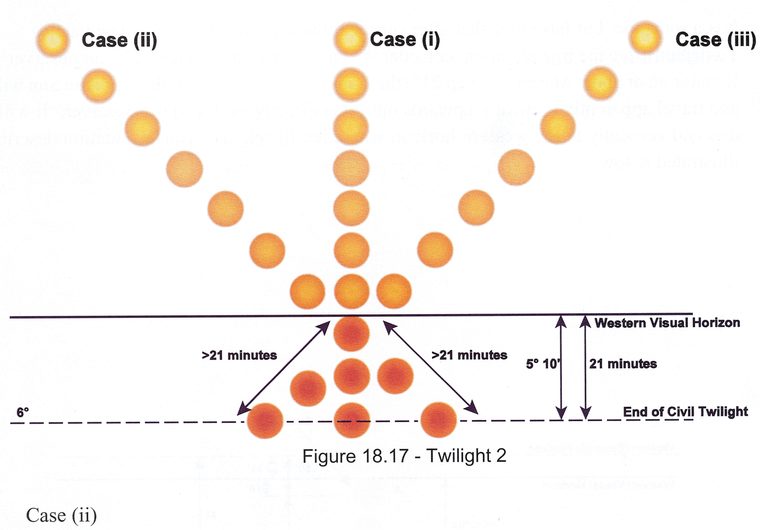
Between 60°N and 60°S, the minimum duration of civil twilight is 21 minutes. This occurs at the Equator at the equinoxes, when the Sun sets most steeply.
Twilight Between the Equator and 60°N/S
As latitude increases, the Sun's path makes a shallower angle with the horizon at sunset. This means it takes longer for the Sun to descend through the 6° zone, so twilight duration increases with latitude.
Twilight in High Latitudes (above ~60°)
In polar and sub-polar regions, extraordinary effects can occur:
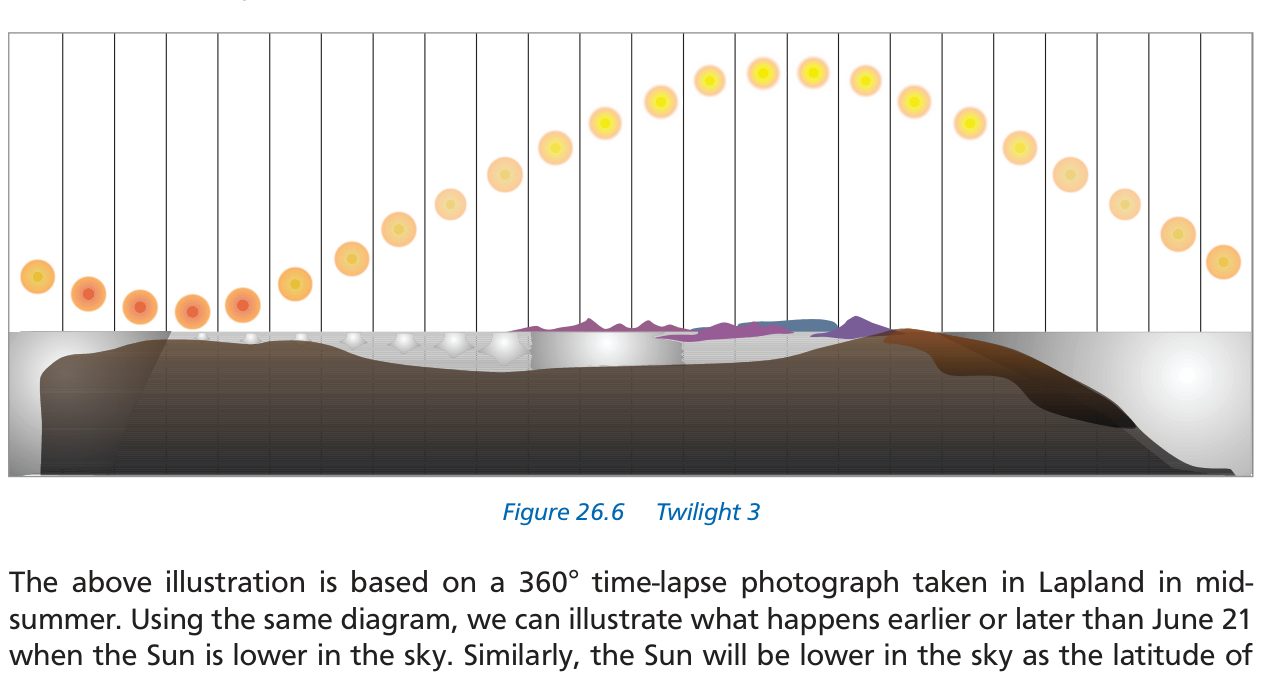
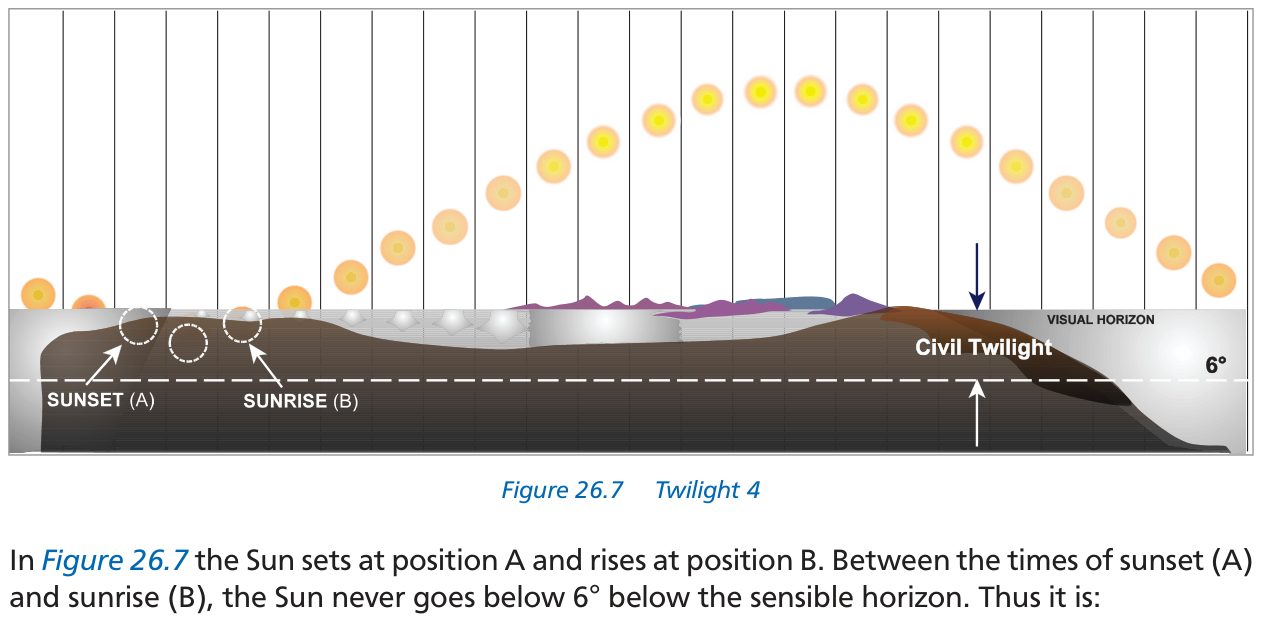
Permanent Twilight (////) — In high latitudes in summer, the Sun may remain within 6° of the horizon all night. It never rises (so no sunrise time listed) but never reaches true darkness — this is shown as "//// " in the Air Almanac, indicating permanent civil twilight through the night.
Effect of Altitude on Sunrise/Sunset
The Air Almanac tables assume a sea-level observer. An aircraft at altitude has a depressed sensible horizon (the dip increases with altitude).
🛩 At FL350, the depression of the horizon is approximately 3°.
⬆ Sunrise is earlier — you can see the Sun before it rises above the sea-level horizon.
⬇ Sunset is later — you can still see the Sun after it has set at sea level.
⏱ Duration of twilight is shorter — because the Sun must travel 6° below the depressed sensible horizon (not the geometric horizon), and with the horizon already depressed by ~3°, this 6° arc is covered faster.
Air Almanac Table Methodology
The Air Almanac sunrise/sunset tables list LMT times for specific latitudes at 3-day intervals. To use them for an arbitrary position:
Step 1 — Interpolate for exact latitude between the two tabulated latitudes.
Step 2 — Interpolate for date between the two bracketing dates in the table.
Step 3 — Result is LMT of sunrise/sunset at your latitude.
Step 4 — Convert LMT → UTC using arc-to-time for your longitude (East: subtract; West: add).
Step 5 — If Standard Time is required, apply ST correction to UTC.
Practice Questions
Q1. On June 21, what is the lowest northerly latitude (in the Air Almanac) at which the Sun is above the horizon for 24 hours?
Q2. On December 21, what is the lowest northerly latitude at which the Sun never rises?
Q3. Civil twilight is: (choose all that apply)
Q4. Nautical twilight occurs when the Sun is between _______ and _______ below the sensible horizon:
Q5. Between 60°N and 60°S, the minimum duration of Civil Twilight is:
Q6. An aircraft at FL350 would experience: Sunrise _____, Sunset _____, twilight duration _____
Q1. At 30°00'S 124°14'E on 9th August: LMT of SR, SS, MCT, ECT?
SR 0640 LMT | SS 1732 LMT
MCT 0615 LMT | ECT 1757 LMT
Q2. Duration of morning civil twilight for all positions in lat 55°N on 28th June. What do symbols ●, ☾, //// mean?
SR 0323 LMT
MCT 0225 LMT
Duration of MCT: 58 minutes
Symbols:
● = Sun continuously above horizon (Midnight Sun)
☾ = Sun continuously below horizon (Polar Night)
//// = Permanent twilight (Sun below horizon but within 6° — never fully dark)
Q3. UTC of sunset at Karachi (24°54'N 067°10'E) Pakistan on 18th August. Also find duration of evening civil twilight.
Arc/Time 067°10'E −4:29
SS UTC 1404 UTC
ECT 1857 LMT
SS 1833 LMT
Duration of ECT: 24 minutes
Q4. Interval between ECT on 14th October and MCT on 15th October at 60°N.
15 Oct MCT @ 60N 0556 LMT
Interval (darkness): 12h 18min
Q5. For Perth (31°57'S 115°57'E) Western Australia on 3rd January: (a) LMT SR, (b) UTC SS, (c) ST of ECT
b) SS LMT (Perth, 3 Jan) 1910 LMT
Arc/Time 115°57'E −7:44
SS UTC 1126 UTC
c) ECT LMT 1938 LMT
Arc/Time 115°57'E −7:44
ECT UTC 1154 UTC
WA ST correction +8:00
ECT Standard Time 1954 ST
Q6. Buenos Aires (35°00'S 052°29'W): (a) UTC of SR on 9th September, (b) ST of SS on 25th July
Arc/Time 052°29'W +3:30
SR UTC 0939 UTC
b) SS @ 35S, 25 Jul 1713 LMT
Arc/Time 052°29'W +3:30
SS UTC 2043 UTC
Argentina ST −3:00
SS Standard Time 1743 ST
Q7. At 1500 UTC on 4th July, what is the Standard Time at (a) New York DST, (b) Christmas Island Indian Ocean, (c) Algeria, (d) Tonga?
a) New York (DST=−4) 1100 DST on 4 July
b) Christmas Is (IO +7) 2200 ST on 4 July
c) Algeria (+1) 1600 ST on 4 July
d) Tonga (+13) 0400 ST on 5 July
Q8. Find UTC and date for: (a) 0400 ST Madrid Spain 5 Nov, (b) 1215 LMT Wellington 10 Jul, (c) 2200 UTC Singapore Flight Ops clock
ST −1 0300 UTC 5 November
b) Wellington 1215 LMT 10 Jul (174°46'E):
Arc/Time 174°46'E −11:39
0036 UTC 10 July
c) Singapore Flight Ops clock = UTC:
2200 UTC 18 September
Q9. Difference in LMT between Kabul (34°30'N 070°00'E) and Thule (69°30'N 054°00'W). Which is fast?
Arc/Time 124° = 8 hours 16 minutes
Kabul (East) is 8h 16min FAST on Thule
Q10. Rome (41°50'N 012°30'E) departs at sunset 3 Aug → New York (40°00'N 075°00'W) lands at ECT same day. Flight time?
Arc/Time 012°30'E −0:50
SS Rome UTC 1827 UTC
ECT New York, 3 Aug 1942 LMT
Arc/Time 075°00'W +5:00
ECT NY UTC 0042 UTC (4 Aug)
Flight Time: 1827 UTC → 0042 UTC = 6h 15min
Q11. Tokyo (36°N 140°E) to Hawaii (22°N 157°52'W), departs 1h after SR on 14 Nov, flight 6h 12min. Find ST and date of landing Hawaii.
Take-off LMT 0734 LMT (1h after SR)
Arc/Time 140°E −9:20
Take-off UTC 2214 UTC 13 November
Flight time +6:12
Landing UTC 0426 UTC 14 November
Hawaii ST (−10) −10:00
Landing ST Hawaii 1826 ST on 13 November
Q12. At 018°15'E on 29th October, the observer sees the Sun rise at 0355 UTC. What is his latitude?
Arc/Time 018°15'E −1:13
SR LMT 0508 LMT
Look up SR = 0508 in Air Almanac for 29 Oct → Latitude 30°S
Q13. South Georgia (60°S 037°15'W) — observer sees sunset at watch time 2257 on 19 November. Is watch fast or slow on UTC?
Arc/Time 037°15'W +2:29
SS UTC 2255 UTC
Observer's watch 2257
Difference: watch − UTC = 2257 − 2255 = 2 minutes
Watch is 2 minutes FAST on UTC
Q14. Must land Anchorage (61°N 149°W) Alaska at ECT on 25 Sept. Flight from Hong Kong (22°N 109°14'E) takes 10h 45min. Latest departure ST from HK?
Arc/Time 149°00'W +9:56
ECT Anchorage UTC 0432 UTC 26 September
Flight time −10:45
Take-off UTC 1747 UTC 25 September
HK ST (+8) +8:00
Latest departure HK ST 0147 ST 26 September
Q15. LMT and date at A (35°N 178°W) when it is 2020 LMT on 28th October at B (70°S 176°E)?
Arc/Time 176°E −11:44
UTC 0836 on 28 October
Arc/Time 178°W −11:52
LMT at A (178°W) 2044 on 27 October
Reinforce Chapter 17: Time (3)
Test your knowledge and practice actual exam questions for Air Navigation.