Altitude & Oxygen
by Ghost Aviator
Human Performance & Limitations · Module A — The Ocean of Air Altitude & Oxygen
Chapter 3 — The partial pressure of oxygen and the altitude penalty, the four physiological zones of the atmosphere, and the numbers every pilot must know cold.

§ 4Partial Pressure of Oxygen — Effects of Increasing Altitude
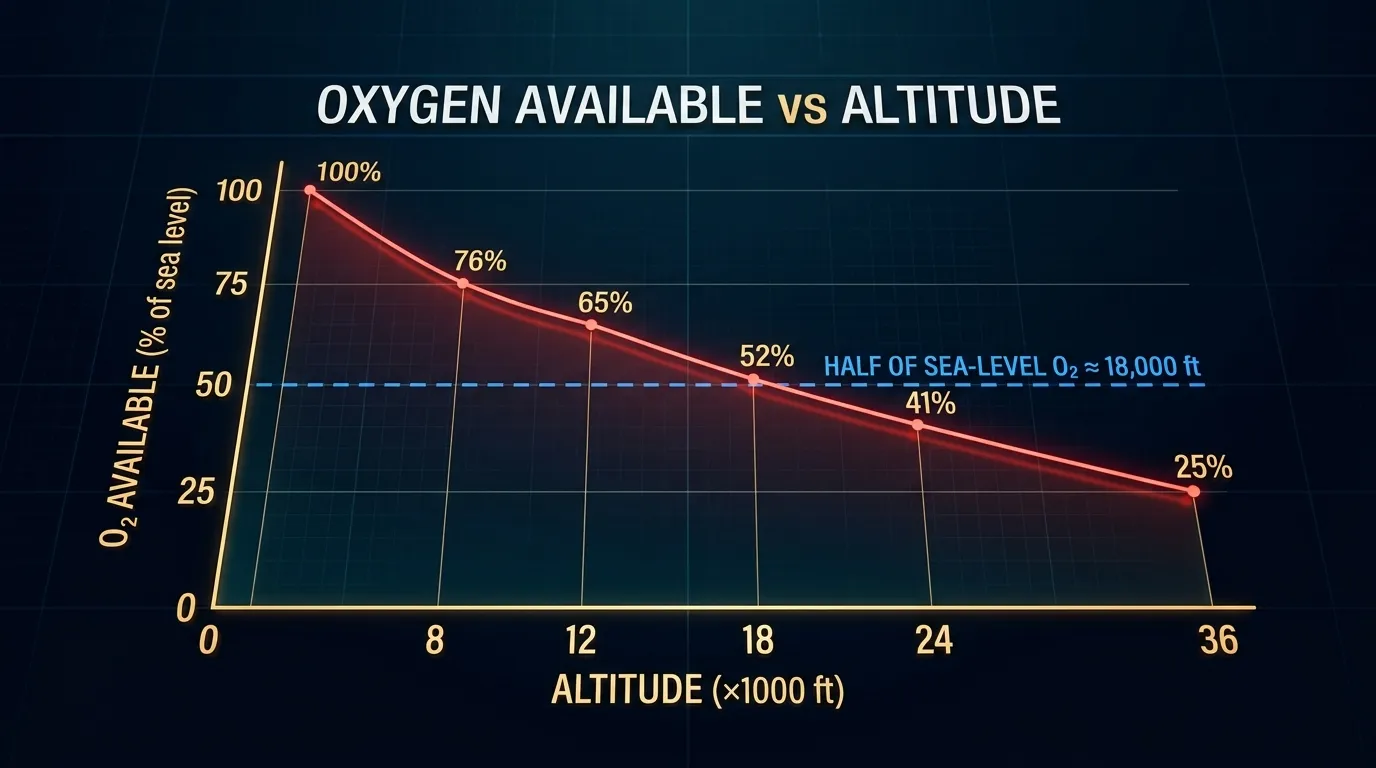
As you climb, the total barometric pressure drops, and with it the partial pressure of oxygen (pO₂). Because the diffusion of oxygen across the alveolar membrane depends on the pressure gradient, what matters to your blood is not the percentage of O₂ — it is the pO₂. Here are the standard values the DGCA expects you to know:
| Altitude | Standard Barometric Pressure | O₂ Available (% of Sea Level) | Pilot Significance |
|---|---|---|---|
| Sea Level (0000 ft) | 101 kPa (760 mmHg) | 100 % | Normal physiological baseline. |
| 8,000 ft | 77 kPa (574 mmHg) | 76 % | Cabin pressure is maintained between 6,000 – 8,000 ft. |
| 12,000 ft | 66 kPa (496 mmHg) | 65 % | Lower edge of the Physiological-Deficient Zone. |
| 18,000 ft | 53 kPa (395 mmHg) | 52 % (≈ half) | Half the O₂ of sea level. |
| 24,000 ft | 41 kPa (311 mmHg) | 41 % | Without supplemental O₂ — incapacitation imminent. |
| 36,000 ft | 25 kPa (187 mmHg) | 25 % (one-fourth) | Only ¼ of sea-level oxygen. |
- The availability of oxygen and barometric pressure DECREASE with altitude.
- The oxygen available is one-fourth at 36,000 ft and half at 18,000 ft of the oxygen available at sea level.
- Atmospheric pressure drops faster at lower altitudes in comparison to the same altitude changes at higher altitudes (the pressure–altitude curve is exponential, not linear).
§ 5The Physiological Zones of the Atmosphere
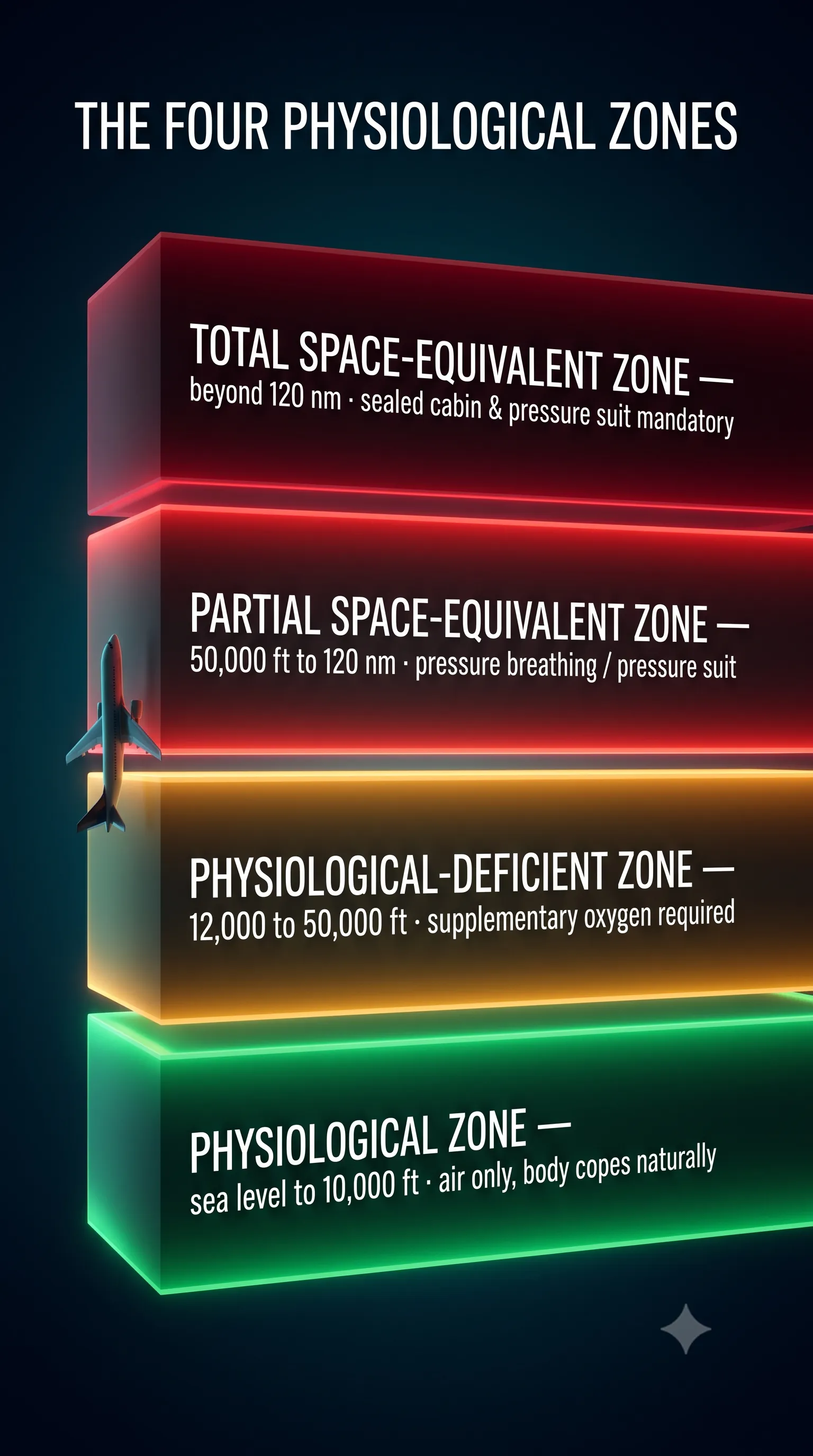
The atmosphere is divided — from the pilot's body's point of view — into four functional zones, each demanding a different protective strategy. You must know the boundaries and the SOP for each.
5.1 The Physiological Zone
5.2 The Physiological-Deficient Zone
- Middle ear and sinus blockage
- Shortness of breath
- Dizziness
- Headache
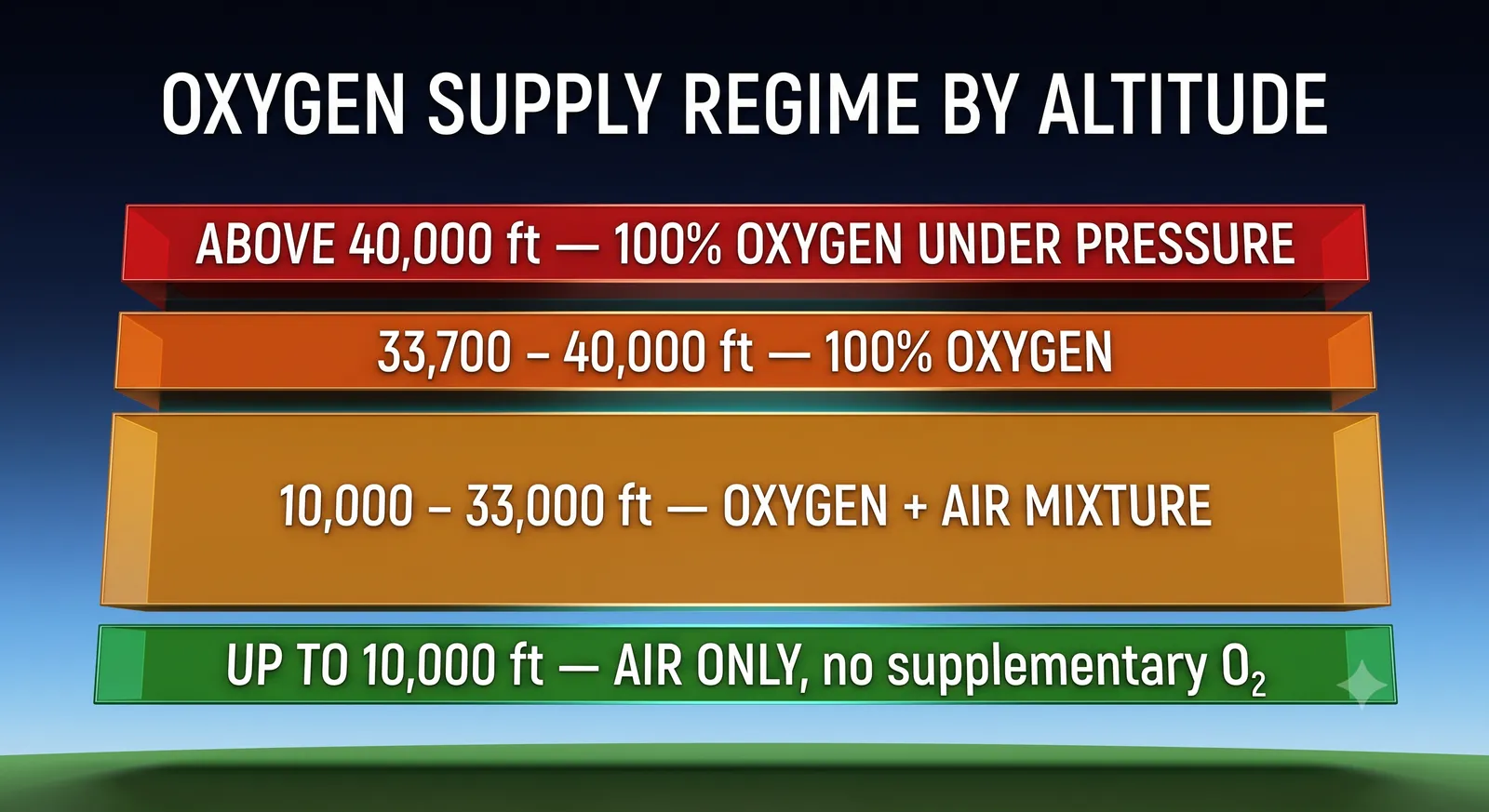
- A pilot climbing in a non-pressurised aircraft and WITHOUT using supplemental oxygen will pass the "critical threshold" at approximately 22,000 ft.
- Breathing 100 % oxygen will lift the pilot's physiological safe altitude to approximately 38,000 ft.
5.3 The Partial Space-Equivalent Zone
5.4 The Total Space-Equivalent Zone
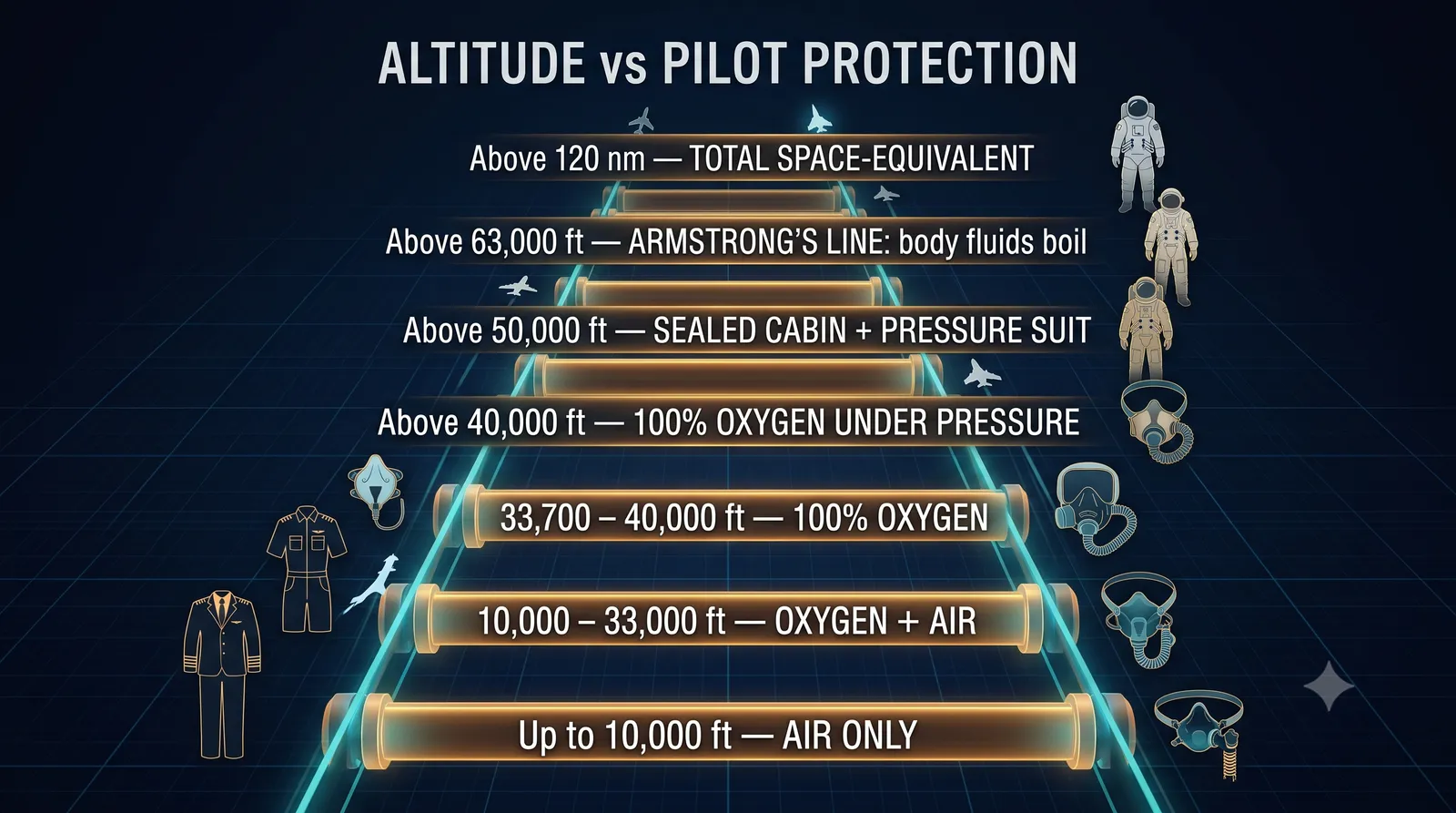
- 100 % oxygen does NOT protect from hypoxia — pressure-breathing required.
- Sealed cabins and pressure suits are a MUST.
- Blood and body fluids BOIL above 63,000 ft (Armstrong's Line — vapour pressure of body fluids equals ambient pressure).
- Gravitational changes affect the body (micro-G adaptation, fluid shift, motion-sickness, etc.).
§ 6Self-Check & Memory Aids
6.1 Numbers you MUST know by heart
| Parameter | Exact Value | Where it comes from |
|---|---|---|
| Top of troposphere (average) | 13 km / 8.1 mi / 43,000 ft | §1 Atmospheric layers |
| Top of stratosphere (over) | 100,000 ft | §1 |
| Troposphere holds | 75 % of atmospheric mass | §1 |
| Nitrogen / Oxygen / Other | 78.084 / 20.95 / ~1 % | §1.2 |
| Water vapour content | 1 – 4 % (variable) | §1.2 |
| ISA sea-level pressure | 1013.25 hPa = 760 mmHg = 29.92 inHg = 14.7 psi | §3.1 |
| ISA lapse rate | 1.98 °C / 1000 ft | §3.1 |
| Tropopause altitude (ISA) | 36,090 ft | §3.1 |
| Isothermal temperature | −56.5 °C | §3.1 |
| Cabin altitude maintained | 6,000 – 8,000 ft | §4 |
| O₂ available at 18,000 ft | 52 % (half of SL) | §4 |
| O₂ available at 36,000 ft | 25 % (one-fourth of SL) | §4 |
| Compensatory reactions begin | 6,000 – 7,000 ft | §5.2 |
| Pilot starts supplementary O₂ | 10,000 ft | §5.1 |
| Physiological-Deficient Zone | 12,000 – 50,000 ft | §5.2 |
| Critical threshold (no O₂, unpressurised) | ~22,000 ft | §5.2 |
| Safe altitude on 100% O₂ | ~38,000 ft | §5.2 |
| 100% O₂ Under Pressure (PBA) from | Above 40,000 ft | §5.1 fig. |
| Partial Space-Equivalent Zone | 50,000 ft – 120 nm | §5.3 |
| Armstrong's Line (body fluids boil) | 63,000 ft | §5.4 |
| Total Space-Equivalent Zone | Outwards from 120 nm | §5.4 |
6.2 Common DGCA-style probe questions
- State the percentage composition of nitrogen and oxygen in the atmosphere. Does it change with altitude?
- Give the ISA sea-level values in five different units.
- What is the ISA lapse rate, and up to what altitude does it apply?
- Why does hypoxia occur with altitude, when the % of O₂ is unchanged? (Hint: Dalton's Law.)
- At what altitude does a pilot normally start using supplementary oxygen?
- State the four physiological zones with their altitude boundaries.
- At what altitude does an unpressurised pilot, NOT using supplemental O₂, hit the critical threshold?
- Why is a pressure suit mandatory above 50,000 ft? Quote Armstrong's Line value.
- Explain Boyle's Law and give two flight-medical situations where it applies.
- How does Henry's Law explain both hypoxia and decompression sickness?
Reinforce Chapter 3: Altitude & Oxygen
Test your knowledge and practice actual exam questions for Human Performance & Limitations.