17
HPL — CHAPTER 17 · NOTES
Fitness to Fly
by Ghost Aviator
Human Performance & Limitations · Module G — The Fit AviatorFitness to Fly
Chapter 17 — The small conditions that ground a pilot: blocked sinuses and barosinusitis, dental barodontalgia and the post-treatment rule, dehydration, personal hygiene, and the common ailments that quietly degrade performance.

§ 71Sinus Blockage
DGCA-quoted
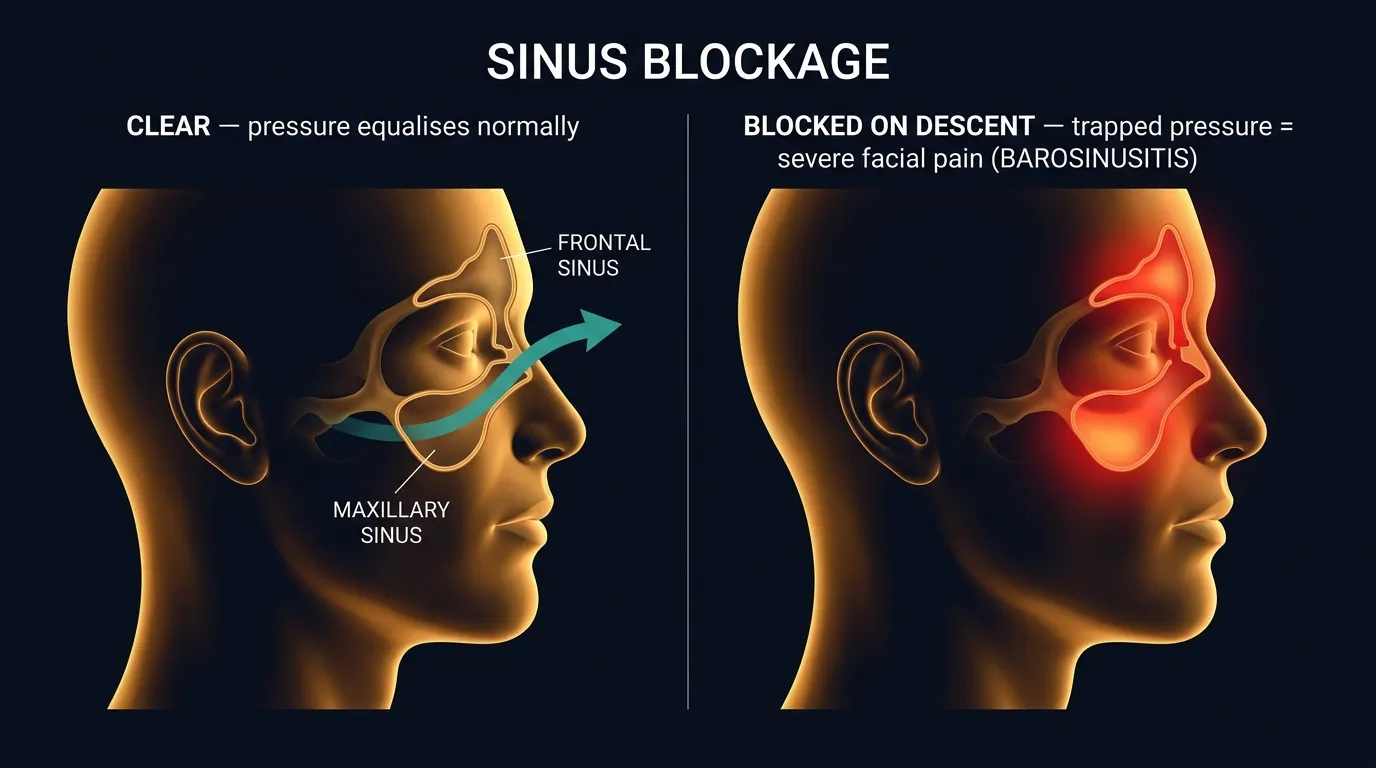
If the sinuses are congested, then air trapped there can also produce a painful condition. This sinus block occurs most frequently during DESCENT.
Slowing or stopping the descent until the pressure inside the sinus equalizes with the external pressure is the best course of action once this condition occurs.
Of course, NOT FLYING when the pilot has a congested sinus is even better.
Slowing or stopping the descent until the pressure inside the sinus equalizes with the external pressure is the best course of action once this condition occurs.
Of course, NOT FLYING when the pilot has a congested sinus is even better.
Why descent — the same one-way-valve problem as ears (§38.2)
The sinuses are air-filled cavities in the skull (frontal, maxillary, ethmoid, sphenoid) that normally drain through narrow ostia into the nasal cavity. On climb, sinus air expands and pushes outward — easy. On descent, ambient pressure rises and sinus air must contract by drawing more air in from the nose. If the ostium is blocked by mucus/inflammation (cold, hay fever, sinusitis), incoming air cannot enter — a vacuum forms in the sinus → severe pain over the forehead, cheeks or behind the eyes ("sinus squeeze" / barosinusitis).
Mitigation in flight: stop or slow the descent and allow time for pressure to equalise. Prevention on the ground: if you have a head cold, don't fly.
Mitigation in flight: stop or slow the descent and allow time for pressure to equalise. Prevention on the ground: if you have a head cold, don't fly.
§ 72Dental Pain — Barodontalgia
DGCA-quoted — definition
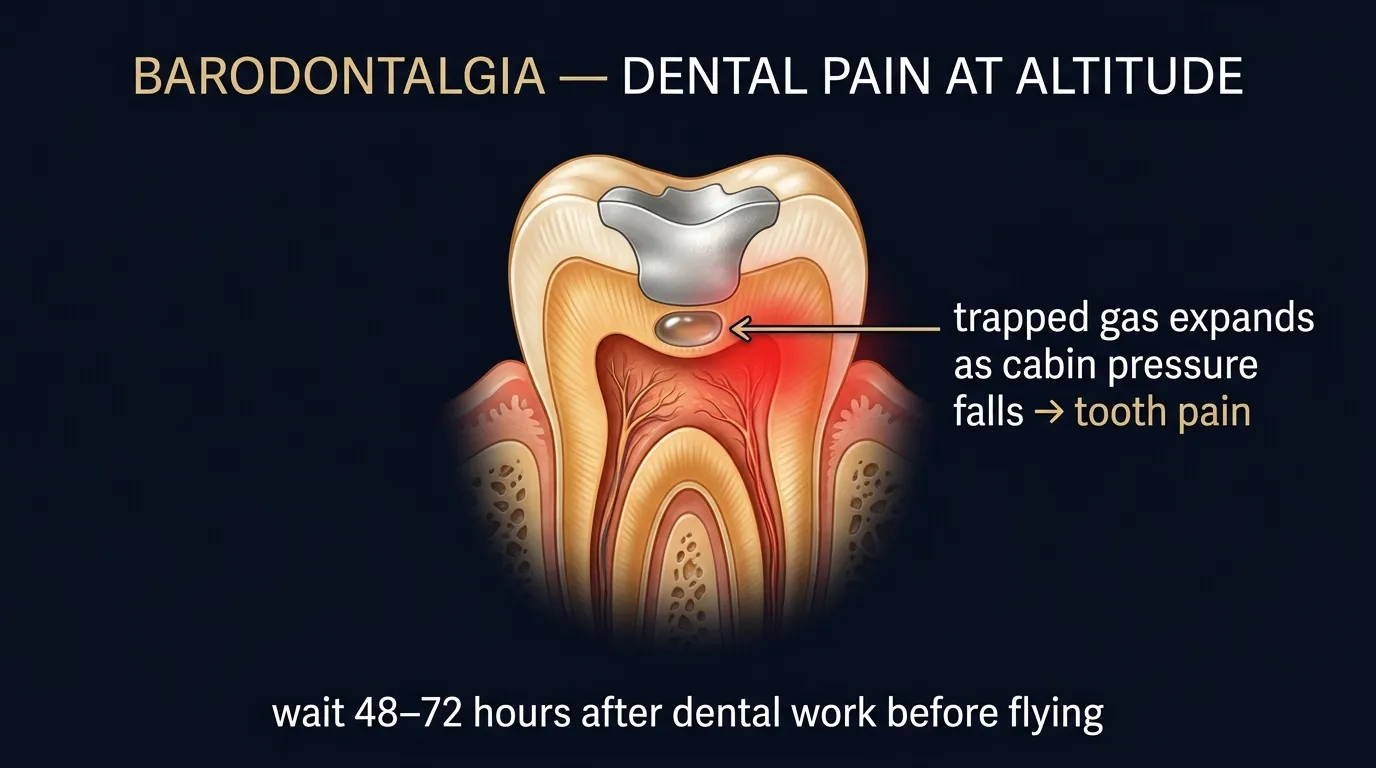
Reduction in atmospheric pressure may also result in BARODONTALGIA — tooth pain.
72.1 Six Dental Conditions That Cause Barodontalgia
DGCA-quoted — verbatim list
This may be caused by a number of dental conditions including:
- (a) Dental disease,
- (b) Dental caries (a cavity),
- (c) Defective tooth restoration,
- (d) Pulpitis,
- (e) Cysts, and
- (f) Impacted teeth.
Mechanism — gas trapped in tooth cavities + Boyle's Law
A small gas pocket under a filling, in a decayed pulp, or inside a sealed cyst expands as cabin altitude rises (Boyle's Law again — §2.1). The expanding gas pushes outward against the tooth nerve → sharp, throbbing pain that becomes excruciating at typical airline cabin altitude (6,000–8,000 ft). It often resolves on descent — but if the affected tooth is fractured by the expansion, the pain persists on the ground.
72.2 The 48–72 Hour Post-Dental Rule
DGCA-quoted — the no-fly rule
This condition may be avoided by NOT FLYING for 48 – 72 hours following a major dental work.
As with the other problems associated with lower atmospheric pressure, descending to a lower altitude (and correspondingly higher atmospheric pressure) is often the best antidote.
As with the other problems associated with lower atmospheric pressure, descending to a lower altitude (and correspondingly higher atmospheric pressure) is often the best antidote.
48–72hr
No-fly window after major dental work
6
DGCA-listed dental causes of barodontalgia
↓ alt
In-flight cure — descend to higher-pressure altitude
§ 73Dehydration
DGCA-quoted
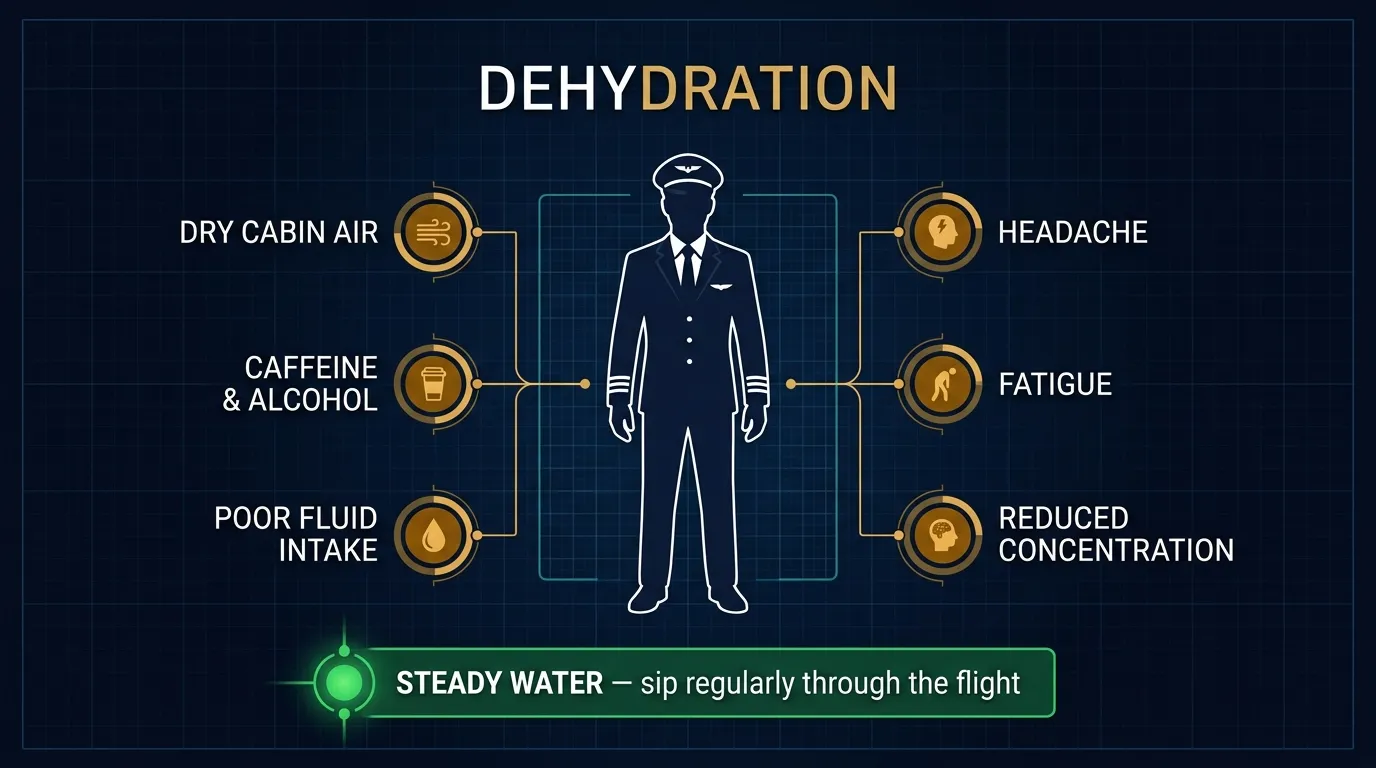
Besides watching what and when they eat, pilots should also be aware of the effects of dehydration. Low fluid intake and dehydration have ADVERSE EFFECTS ON COGNITIVE FLIGHT PERFORMANCE of pilots.
Cross-links — dehydration is everywhere in this chapter
Dehydration has already been flagged repeatedly in earlier parts:
- §14 (Alcohol) — alcohol is a diuretic; "masked hangover" includes dehydration.
- §23 (Humidity) — cabin RH below 20 % drives over-all dehydration if fluid intake is inadequate; avoid coffee/tea (diuretics).
- §28.2 (Fainting) — "standing up quickly after prolonged sitting especially when HOT or DEHYDRATED" is the first DGCA cause of faint.
- §64 (G-tolerance) — excessive heat (sweating + lost blood volume) reduces tolerance.
§ 74Personal Hygiene
DGCA-quoted
A high standard of personal hygiene must be practiced if the body is to remain healthy and free from infection.
Practical implications for crew
- Frequent hand washing — particularly before meals and after lavatory use; crew in pressurised, low-humidity cabins are at elevated risk of respiratory infections.
- Oral hygiene — directly reduces barodontalgia risk (§72) by reducing the prevalence of caries.
- Skin care — low humidity dries skin; lotion/moisturiser reduces cracking that can introduce infection.
- Foot hygiene & well-fitting shoes — long sectors with feet on rudder pedals make foot-fungal infections more common in crew.
§ 75Common Ailments
DGCA-quoted — verbatim
The in-flight environment can increase the severity of symptoms which may be minor whilst on the ground. If there is any doubt whatsoever in a pilot's mind about his fitness to fly, he should STAY ON THE GROUND.
The "minor on ground, major in flight" principle
A head cold is a nuisance on the ground; in the air it becomes otic barotrauma + sinus block. A gastric upset on the ground is a meal-skip; in the air the trapped gases expand and incapacitate (§70.2). A mild headache becomes incapacitating under cabin vibration and G-load. The DGCA-codified rule for any doubt is binary: stay on the ground. The cost of a cancelled flight is always less than the cost of a sick pilot in command.
✦ END OF CHAPTER 17 ✦
Reinforce Chapter 17: Fitness to Fly
Test your knowledge and practice actual exam questions for Human Performance & Limitations.
Planning your Pilot Training in 2026?
Calculate exact flying hours, DGCA exam fees, and living costs with our interactive calculator.