15
HPL — CHAPTER 15 · NOTES
The Forces
by Ghost Aviator
Human Performance & Limitations · Module F — The Deceived PilotThe Forces
Chapter 15 — Acceleration and the pilot's body: the effects of increased "G", the cascade from grey-out to G-LOC, the 1.41 G reference at 45° of bank, the factors that erode G-tolerance, and negative G with red-out.

§ 61Acceleration and "G" Forces — Introduction
DGCA-quoted — definition of 1 G
Flying can expose the human body to conditions for which it is not naturally suited. On the ground, the body is subject to normal gravitational acceleration: "1G". This is 32 ft/sec² or 9.81 m/sec². The reaction of the earth's surface to this acceleration gives us the sensation we call "weight".
A pilot will experience 1 G in straight and level flight.
A pilot will experience 1 G in straight and level flight.
61.1 Load Factor at Bank Angles
DGCA-quoted — load-factor numbers (memorise)
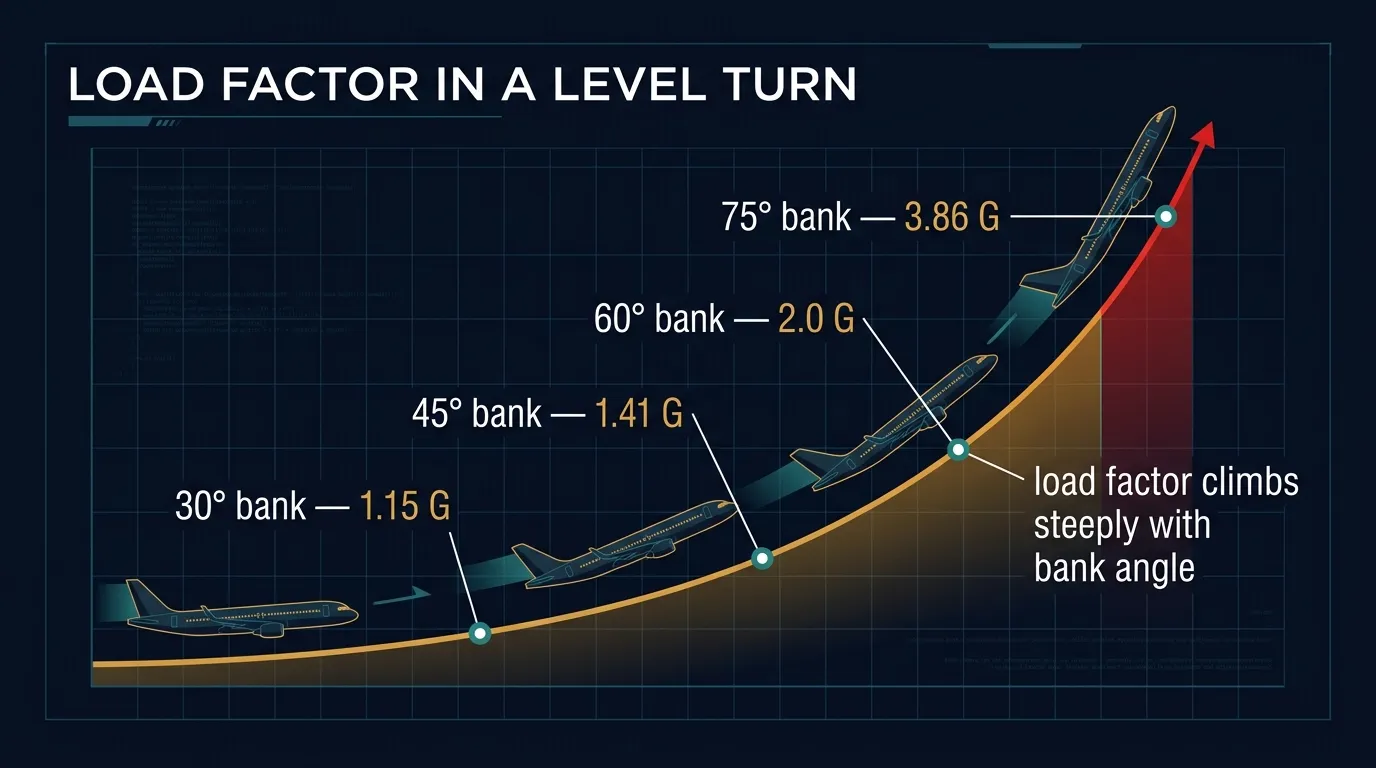
- At 60° of bank a pilot is subject to an acceleration of 2 G acting vertically through his seat. His weight will also increase by a factor of 2. This is called the LOAD FACTOR.
- In a 70° level turn, the load factor increases to 3.
1 G
Straight & level flight (32 ft/s² · 9.81 m/s²)
2 G
60° level bank turn
3 G
70° level bank turn
DGCA-quoted — aerobatic certification
A typical light aircraft cleared for aerobatics would be stressed to withstand positive load factors of up to 6.
61.2 Counter-measures against adverse G-effects
DGCA-quoted
The adverse effects of increased "G" can be delayed or relieved by:
- Tensing the thigh and stomach, and
- Easing off the backward pressure on the control column.
Physiological background
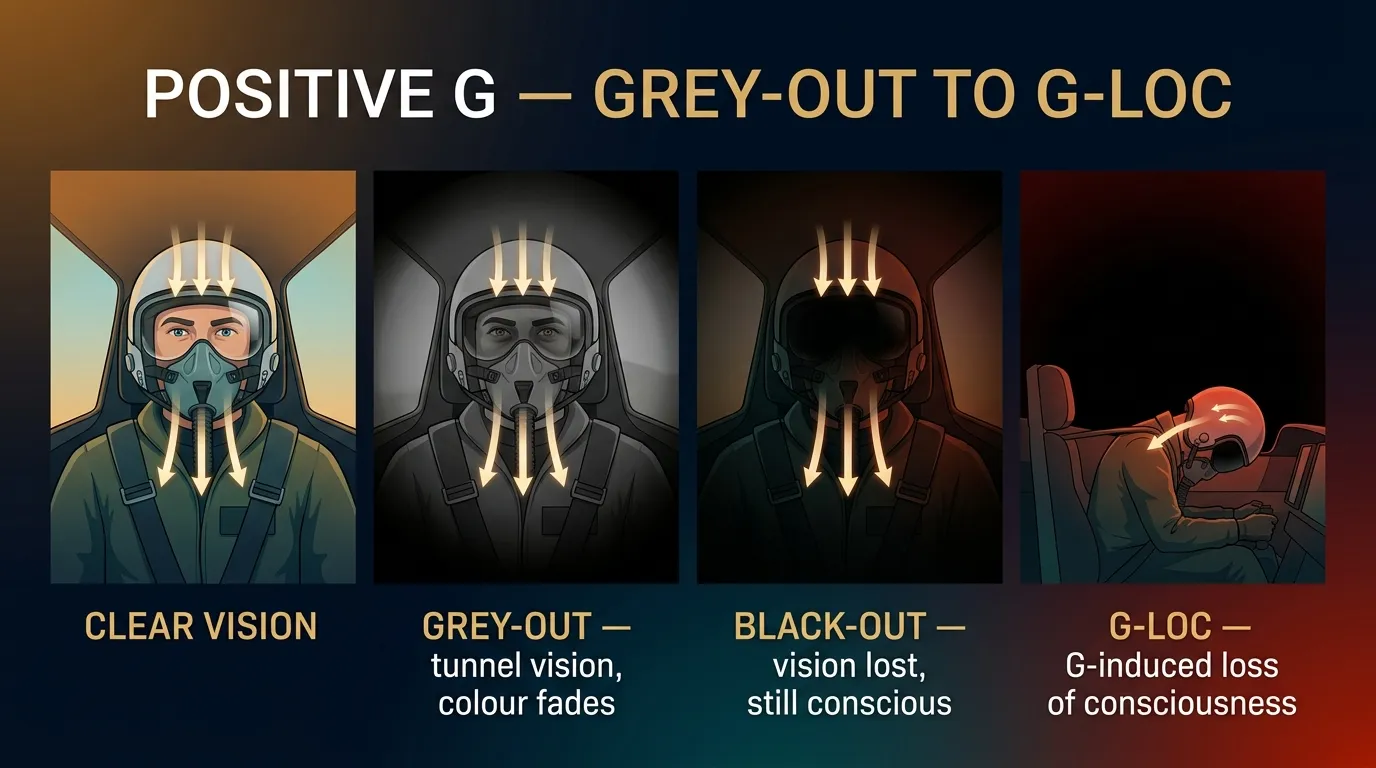
Under high positive G, blood pools in the lower body — cerebral blood pressure drops. Early symptoms are greyout (loss of peripheral vision), then blackout (loss of central vision), then G-LOC (G-induced Loss of Consciousness). Tensing the lower body's muscles (the "AGSM" — Anti-G Straining Manoeuvre) raises arterial pressure and forces blood back up to the brain. Easing off the control column reduces the G being demanded.
(More detail in continuation of the chapter.)
(More detail in continuation of the chapter.)
§ 62Effects of Increased "G" Manoeuvres
DGCA-quoted — the six effects (memorise the order)
During increased "G" manoeuvres the pilot will feel the following effects:
- Increase in body weight.
- Mobility is impaired.
- Internal organs displaced.
- Onset of tunnel vision.
- Grey out.
- Possible blackout.
62.1 The Cascade — From Heaviness to Blackout
1
Body weight ↑
2
Mobility impaired
3
Organs displaced
4
Tunnel vision
5
Grey-out
6
Blackout
Why each effect happens in this order — physiological context
- Effects 1–3 (heaviness, immobility, organ displacement) are mechanical: with apparent weight multiplied by the load factor, limbs become difficult to lift, the head is forced down/sideways, and abdominal organs sag against the diaphragm.
- Effects 4–6 (tunnel → grey → black) are cerebrovascular: high positive G pulls blood downward, away from the head. Retinal arterial pressure falls first (cones in the fovea drain → tunnel vision = peripheral vision fails first), then central vision goes (grey-out), then cerebral perfusion fails (blackout / G-LOC).
- The ORDER of the six effects is the standard DGCA exam point — they happen in this sequence as G increases.
62.2 Tilted-Back Seat — the DGCA-quoted mitigation
DGCA-quoted
A tilted back seat can reduce the chance of a black-out during positive G-manoeuvres.
Why a reclined seat helps
The taller the column of blood from the heart to the brain along the G-vector, the harder it is for the heart to pump against it. By reclining the seat, the vertical distance from the heart to the brain (measured along the seat-to-head axis, which is the G axis in a turn) is reduced. The blood column is shorter, the heart has less hydrostatic head to overcome, and cerebral perfusion is preserved at higher G loads. This is exactly why fighter cockpits (F-16, etc.) recline the pilot's seat ≈ 30° — to push the G-LOC threshold above where the airframe gives up first.
§ 631.41 G at 45° — the DGCA Reference Number
DGCA-quoted — exact load-factor reference
1.41 G is the acceleration experienced in a LEVEL TURN at 45° angle of bank. In normal flying, angles of bank greater than this are not usually necessary.
Any physical disorder or immoderate consumption of alcohol or tobacco will reduce the body's tolerance to accelerations in excess of 1 G.
Any physical disorder or immoderate consumption of alcohol or tobacco will reduce the body's tolerance to accelerations in excess of 1 G.
| Bank Angle | Load Factor (G) | Notes |
|---|---|---|
| 0° (level flight) | 1.00 G | Straight & level |
| 15° | 1.04 G | Shallow turn |
| 30° | 1.15 G | Standard rate turn (most light a/c) |
| 45° | 1.41 G | DGCA reference · upper limit of "normal flying" |
| 60° | 2.00 G | Steep turn · weight doubles |
| 70° | 3.00 G | Aerobatic turn |
| 75° | 3.86 G | — |
| 80° | 5.76 G | — |
| 85° | 11.5 G | Far beyond airframe / human limits |
45°
Maximum "normal" bank — DGCA quoted
1.41 G
Load factor at 45° level turn
↓ tol.
Reduced by disorder / alcohol / tobacco
§ 64Factors Adversely Affecting G-Tolerance
DGCA-quoted — the six factors (verbatim, in order)
- Alcohol.
- Smoking.
- Fatigue.
- Excessive heat.
- Obesity.
- Sickness.
| Factor | Physiological Effect |
|---|---|
| Alcohol | Vasodilation + dehydration + histotoxic hypoxia (§14) — blood pressure regulation degraded. |
| Smoking | 5–8 % O₂-capacity loss + vasoconstriction + CO competition (§13) — less reserve when cerebral flow falls. |
| Fatigue | Cardiovascular reserve drops; muscle tone (for AGSM) is weakened; reaction time slows. |
| Excessive heat | Vasodilation for cooling + reduced blood volume from sweating → lower BP under G. |
| Obesity | Reduced cardiovascular fitness; abdominal fat reduces effectiveness of the AGSM straining manoeuvre. |
| Sickness | Dehydration, low BP, weakness — all the above multiplied. |
§ 65Negative G & Red-out
DGCA-quoted — tolerance asymmetry
Most pilots can learn to tolerate moderate increases in positive "G", but many find even the smallest exposure to negative "G" to be unpleasant.
DGCA-quoted — when negative G is experienced in flight
During flight negative "G" is experienced if, after pulling out of a steep dive, the control column is instinctively and firmly moved FORWARD because the pilot might feel that he has his nose too high in an attitude that may lead to a stall.
DGCA-quoted — what negative G does to the body
Negative "G" manoeuvres INCREASE the flow of blood TO THE HEAD. Blood pressure there increases, the face becomes very FLUSHED, and the EYES BULGE. The combined effect of these symptoms causes what is described as a "RED OUT".
To relieve symptoms select a normal flying attitude.
To relieve symptoms select a normal flying attitude.
POSITIVE G → BLACK-OUT
- Blood pulled away from head, into legs
- Cerebral perfusion falls
- Cascade: tunnel → grey → black
- Can progress to G-LOC (G-induced LoC)
- Tolerable up to ~6 G with training (light aerobatic limit)
NEGATIVE G → RED-OUT
- Blood pushed into the head
- Cerebral & ocular pressure rise
- Face flushes red, eyes bulge
- "Red-out" — vision tinged red
- Even small exposures unpleasant
- Mitigation: return to normal flying attitude
Why pilots are far worse at negative G than positive
Human cardiovascular anatomy is built for a 1 G "head-up" world. We have valves and reflexes that, under positive G, pump blood upward against gravity (the baroreceptor + sympathetic reflex). Under negative G the body has NO compensatory mechanism — blood floods the head, ocular and intracranial pressure rises, and small blood vessels in the eyes and brain can rupture. Even highly trained aerobatic pilots rarely tolerate more than −3 G sustained.
✦ END OF CHAPTER 15 ✦
Reinforce Chapter 15: The Forces
Test your knowledge and practice actual exam questions for Human Performance & Limitations.
Planning your Pilot Training in 2026?
Calculate exact flying hours, DGCA exam fees, and living costs with our interactive calculator.