Radio Wave Propagation
by Ghost Aviator
Part II (ii) Propagation · day/night frequencies · skip distance · fading · ground shadow
Learning objectives — by the end of this chapter you will be able to…
- Describe the three propagation paths — ground, sky and space wave — their mechanisms and bands.
- Explain the structure of the ionosphere and its daily, seasonal and solar variation.
- Define MUF, LUF and the optimum working frequency, and explain day/night frequency choice.
- Explain skip distance and dead space, with the geometry.
- Calculate line-of-sight range from the radio-horizon formula.
- Explain attenuation, fading and ground shadow.
9.1 The three paths
9.2 The ground wave
9.3 The ionosphere
9.4 The sky wave: MUF, LUF & OWF
9.5 Day & night frequencies
9.6 Skip distance & dead space
9.7 The space wave & radio horizon
9.8 Attenuation, fading & ground shadow
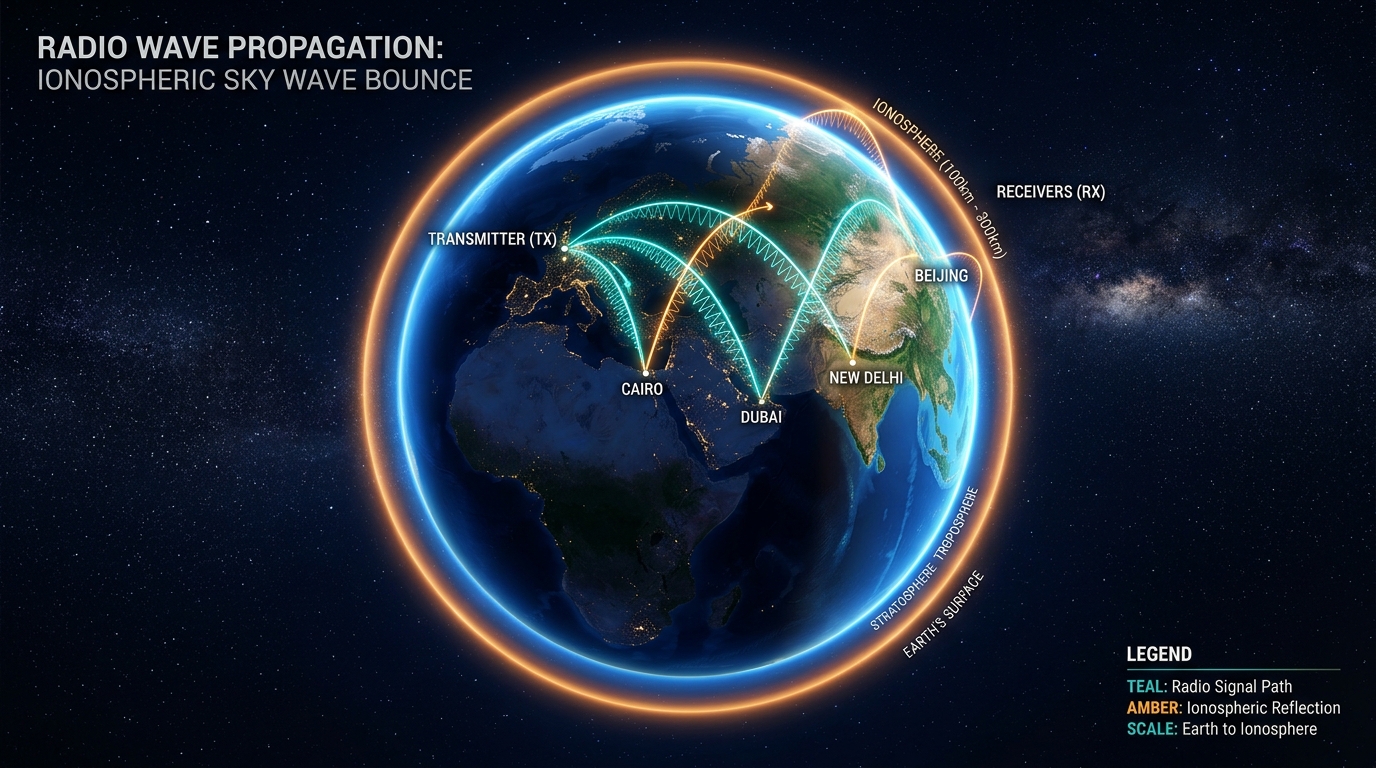
9.1 The three paths a radio wave takes
| Path | How it travels | Band | Used by |
|---|---|---|---|
| Ground (surface) wave | Follows the curve of the Earth, hugging the surface | LF / MF | NDB; maritime |
| Sky wave | Refracted (bent back) by the ionosphere | HF | Long-range / oceanic HF voice |
| Space wave | Straight line (line-of-sight) to the radio horizon | VHF & above | ATC VHF voice, VOR, ILS |
Low hugs, High bounces, VHF shoots straight. LF/MF follow the ground; HF bounces off the ionosphere; VHF and up go line-of-sight.
9.2 The ground wave
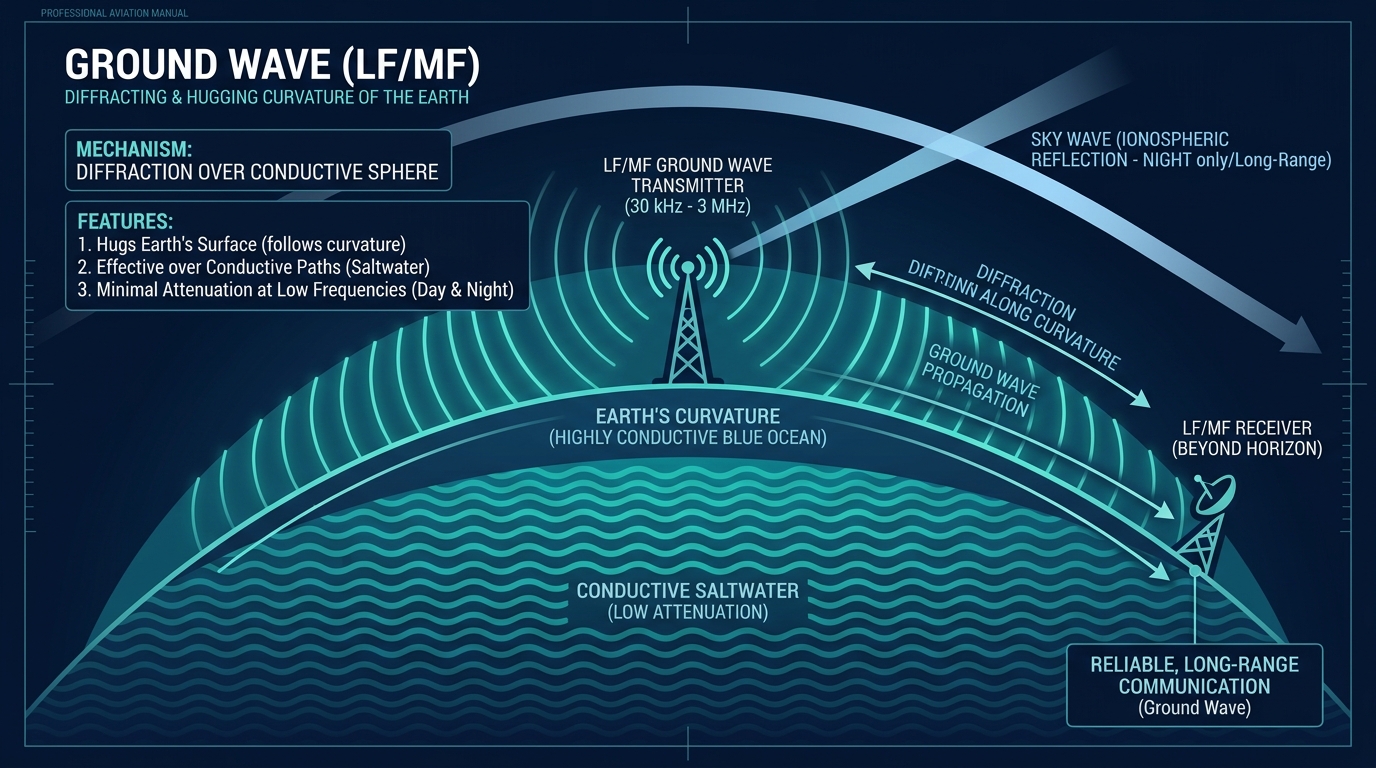
A vertically-polarized wave at low frequency induces currents in the conducting surface of the Earth; these slow the bottom of the wavefront, tilting it forward so it diffracts around the curve of the planet. The lower the frequency, the better it clings — and the farther it reaches.
Range grows with transmitter power, with lower frequency, and with the conductivity of the surface — so it is much greater over sea water (highly conductive) than over dry land or mountains. This is the path the NDB relies on, giving useful range beyond line-of-sight at low level.
9.3 The ionosphere
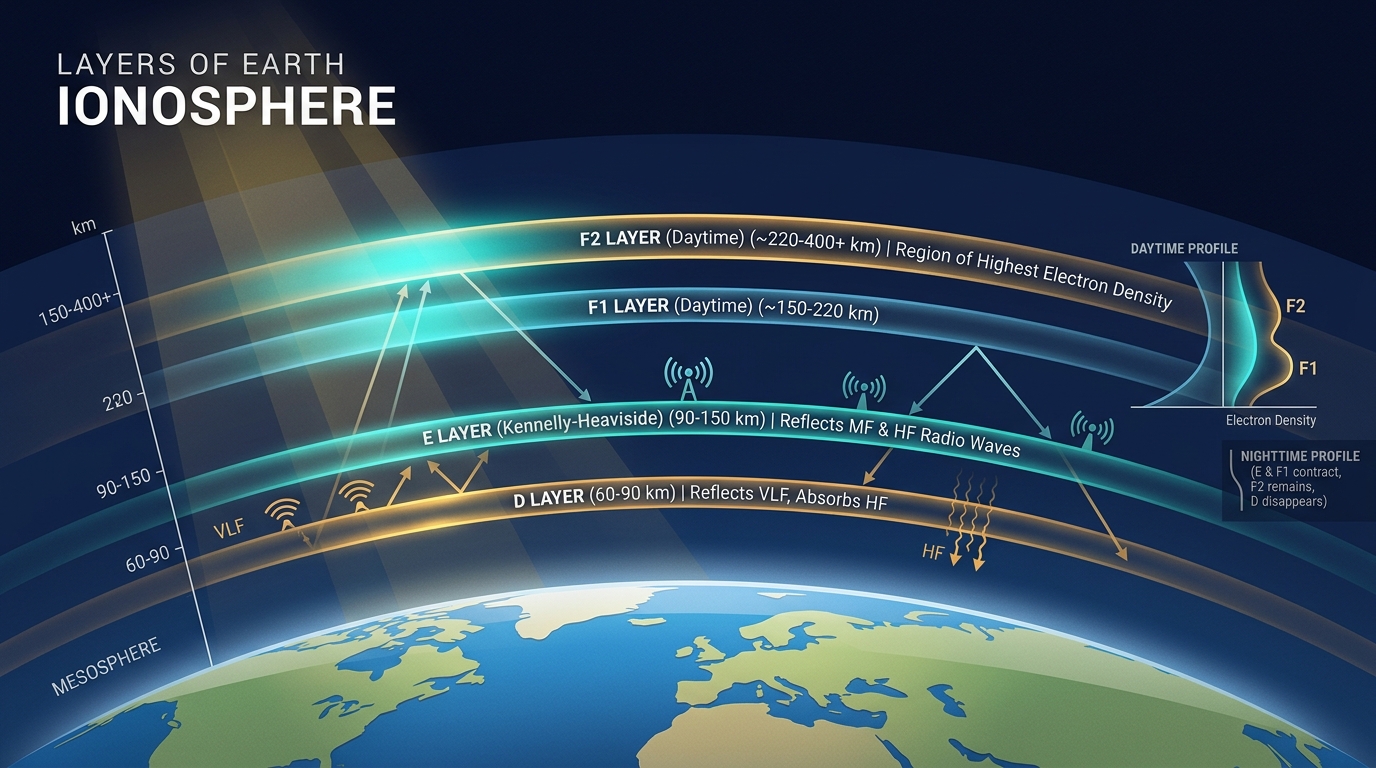
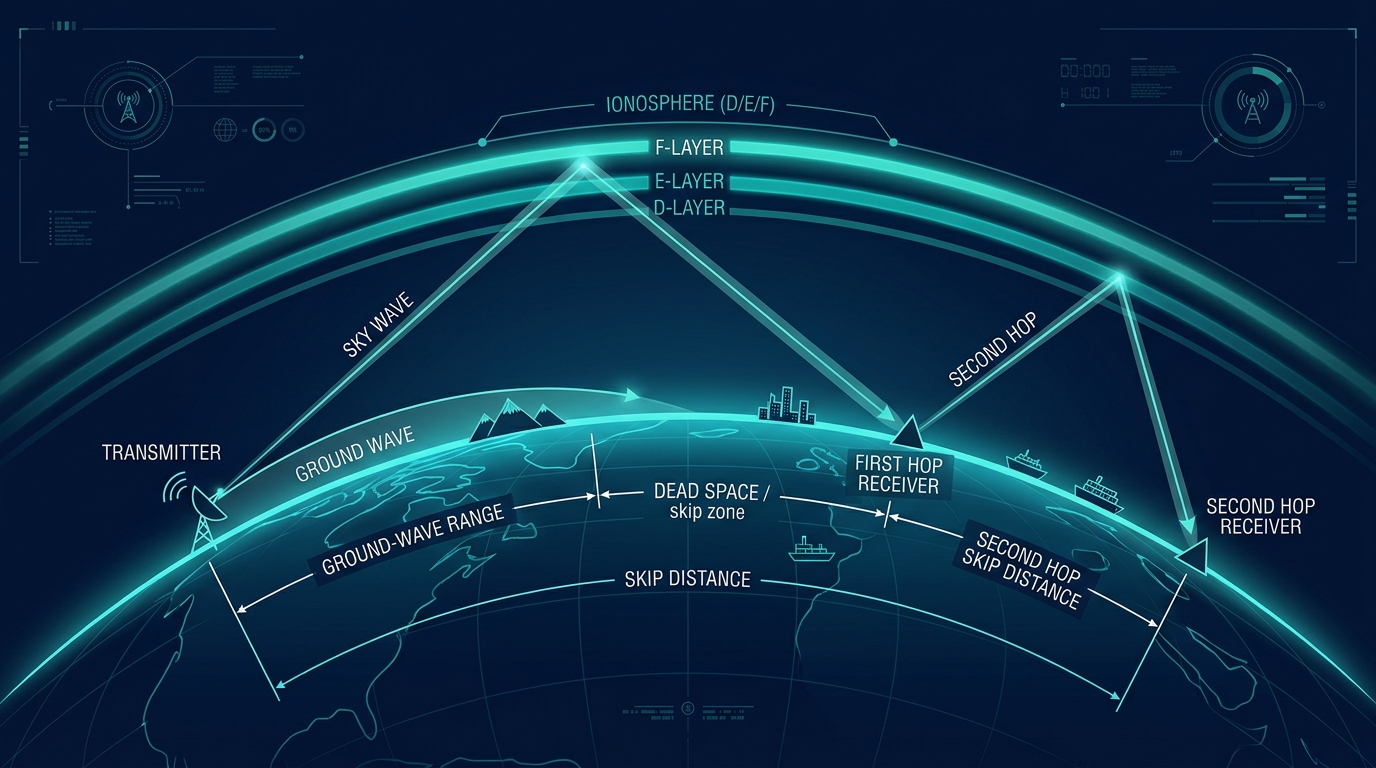
High above the Earth, solar radiation strips electrons from thin air, creating electrically charged layers. These act like a mirror for HF radio, bending the wave back to Earth and giving HF its enormous range.
D layer (lowest, ≈60–90 km) — forms only by day and absorbs lower HF frequencies. E layer (≈90–150 km). F1 & F2 layers (highest, ≈150–400 km) — the main HF-refracting layers; at night F1 and F2 merge into a single, weaker F layer.
Ionisation depends on the Sun, so it varies diurnally (strong by day, weak by night), seasonally, and with the 11-year solar cycle (sunspots). The critical frequency is the highest frequency a layer will reflect at vertical incidence; above it the wave punches straight through.
9.4 The sky wave: MUF, LUF & OWF
MUF — Maximum Usable Frequency: the highest frequency the ionosphere will still refract back to a given point. Above it, the wave escapes into space and is lost.
LUF — Lowest Usable Frequency: the lowest frequency that still arrives usable; below it, D-layer absorption kills it.
OWF — Optimum Working Frequency: typically about 85% of the MUF — set safely below the MUF so normal ionospheric variation doesn't push the working frequency above it. The usable window lies between LUF and MUF.
A wave striking the ionosphere at a shallow (grazing) angle is refracted back over a long distance; a steep angle may punch through. By bouncing between the ionosphere and the ground, a sky wave can make several hops, reaching right around the world.
9.5 Day & night frequencies
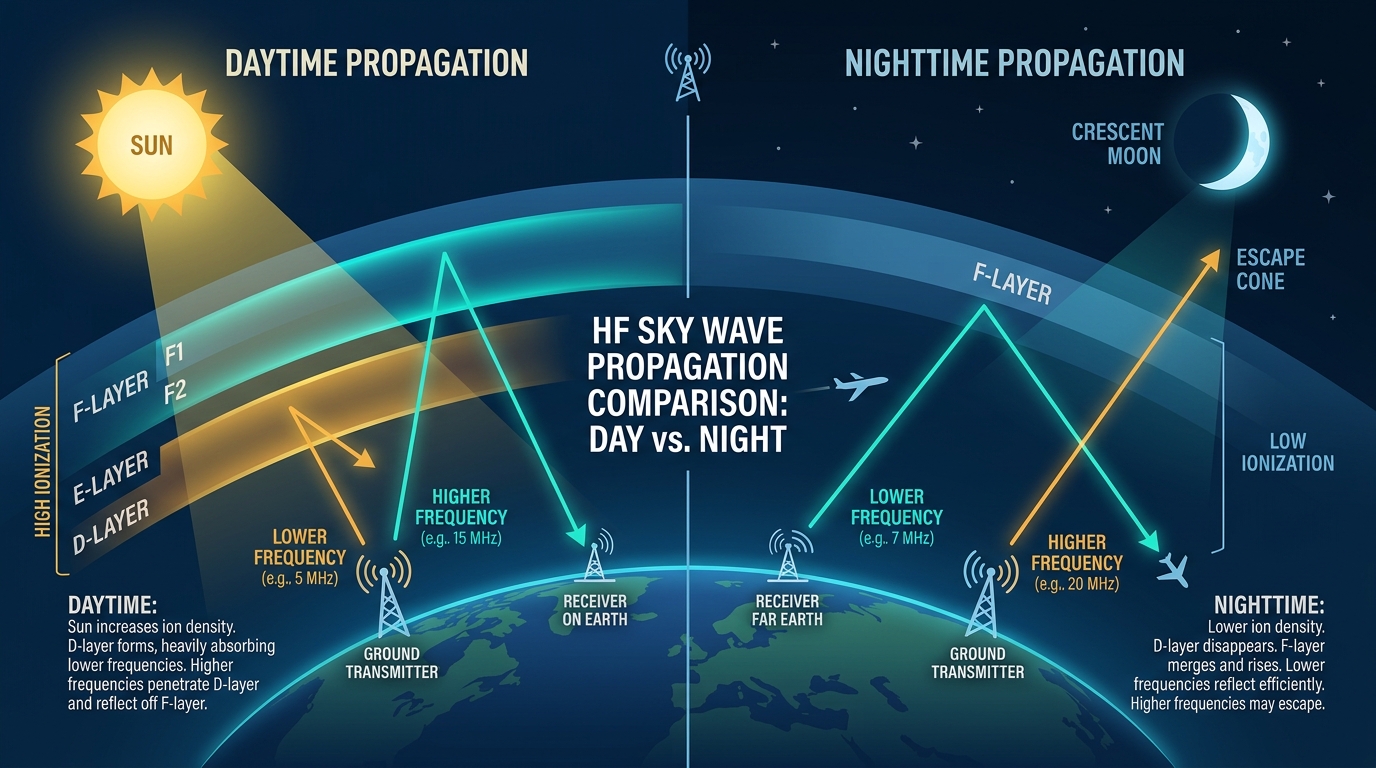
By day the D layer is present and absorbs lower frequencies, so you must use a higher HF frequency to get through. By night the D layer disappears and the ionosphere weakens, so a lower HF frequency works best.
Higher frequency by DAY, lower frequency by NIGHT for HF sky-wave communication. This is why long-haul crews change their HF frequency as they cross the day/night terminator.
"Day = High, Night = Low." Sun up, frequency up.
9.6 Skip distance & dead space
Skip distance: the distance from the transmitter to the point where the first sky wave returns to Earth.
Dead space (skip zone): the silent ring between the end of ground-wave coverage and the point where the first sky wave lands — a region where neither wave reaches and reception fails.
Skip distance increases as you raise the frequency (toward the MUF) and as the ionosphere weakens at night — which is why dead space changes through the day. Above the MUF there is no sky-wave return at all.
9.7 The space wave & radio horizon
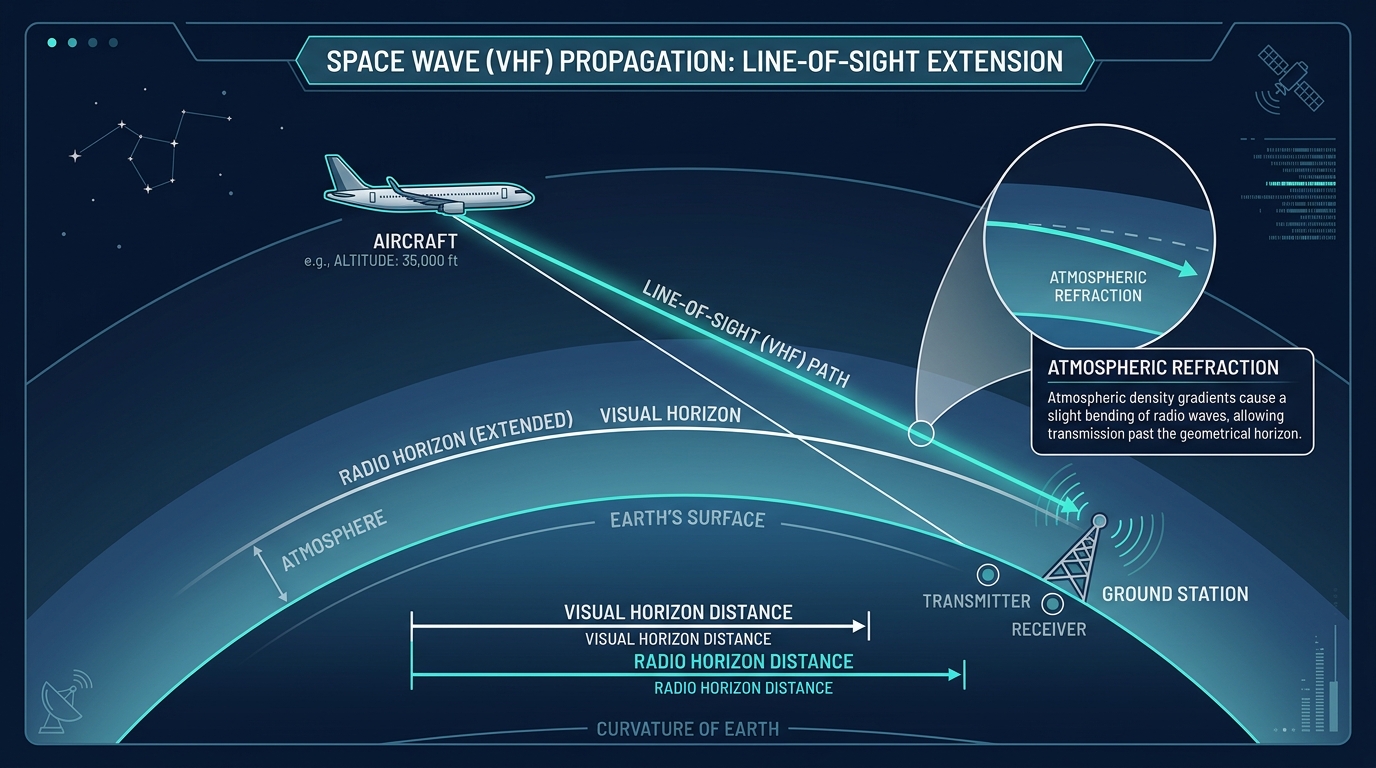
VHF and above travel in essentially straight lines (the space wave), so range is set by the radio horizon — and the higher you (or the station) are, the farther that horizon. This is why a VHF call that fails on the ground works once you climb.
At 10,000 ft: d ≈ 1.23 × √10,000 = 1.23 × 100 = 123 NM to the radio horizon.
If the ground station antenna is at 400 ft: its horizon ≈ 1.23 × √400 = 1.23 × 20 = ≈ 25 NM. The total path is the sum: 123 + 25 ≈ 148 NM.
Takeaway: more height, more range — the exact figure isn't usually required, but the principle and the formula are.
9.8 Attenuation, fading & ground shadow
Attenuation — the natural weakening of a signal with distance and absorption.
Fading — fluctuation in received strength, typically when two paths (ground + sky, or two sky paths) arrive together and interfere; common on HF at dusk.
Ground shadow — loss of a line-of-sight (space) wave behind a hill, building or terrain that blocks it.
Low on approach behind high ground, your VHF can drop out — that's ground shadow; climb a little and the line-of-sight clears. On HF over the ocean at night you'll hear the signal swell and fade — that's sky-wave fading, eased by selecting a better frequency.
☆ Numbers to memorise
| Fact | Value |
|---|---|
| Ground wave | LF/MF, follows Earth's curve, better over sea (NDB) |
| Sky wave | HF, refracted by ionosphere (long range, multi-hop) |
| Space wave | VHF+, line-of-sight to radio horizon |
| Ionosphere layers | D, E, F1, F2 (D absorbs by day; F1/F2 merge at night) |
| HF day/night | Higher freq by day, lower by night |
| MUF / LUF / OWF | Max usable / Lowest usable / ≈85% of MUF |
| Dead space | Gap between ground-wave range and first sky-wave return |
| Radio horizon | d (NM) ≈ 1.23 × √h(ft) |
Part A — MCQs (click an option to check)
Part B — Oral / viva (tap to reveal model answers)
Part C — Numerical problems (tap for worked solutions)
60-SECOND REVISION CARD
- Ground (LF/MF, NDB, better over sea) · Sky (HF, ionosphere, multi-hop) · Space (VHF+, line-of-sight).
- Layers D E F1 F2; D absorbs by day. Ionisation varies day/season/solar cycle.
- HF: day high, night low. MUF above = lost · LUF below = absorbed · OWF ≈ 85% MUF.
- Dead space = gap before first sky wave; skip distance grows with frequency/at night.
- Radio horizon d ≈ 1.23√h(ft); ground shadow blocks VHF behind terrain; fading = multi-path.
Shared Ghost Aviator reference notes. Read alongside the official ATPL syllabus and current approved aircraft documentation.
Question practice is in CPL →