Distress, Urgency & Communications Failure
by Ghost Aviator
Part III (viii) Distress & urgency · imposition/termination of silence · urgency · emergency descent · communications failure
Learning objectives — by the end of this chapter you will be able to…
- Distinguish distress (MAYDAY) from urgency (PAN-PAN) and their priorities.
- Compose and transmit a complete distress message.
- Apply the imposition and termination of silence (SEELONCE).
- Carry out and broadcast an emergency descent.
- Follow the communications-failure procedure, squawk 7600, and read light signals.
20.1 Distress vs urgency
20.2 The distress message
20.3 Acknowledgement & handling
20.4 Imposition & termination of silence
20.5 Urgency messages
20.6 Emergency descent
20.7 Communications failure
20.8 Light signals
☆ Numbers to memorise
? Question bank
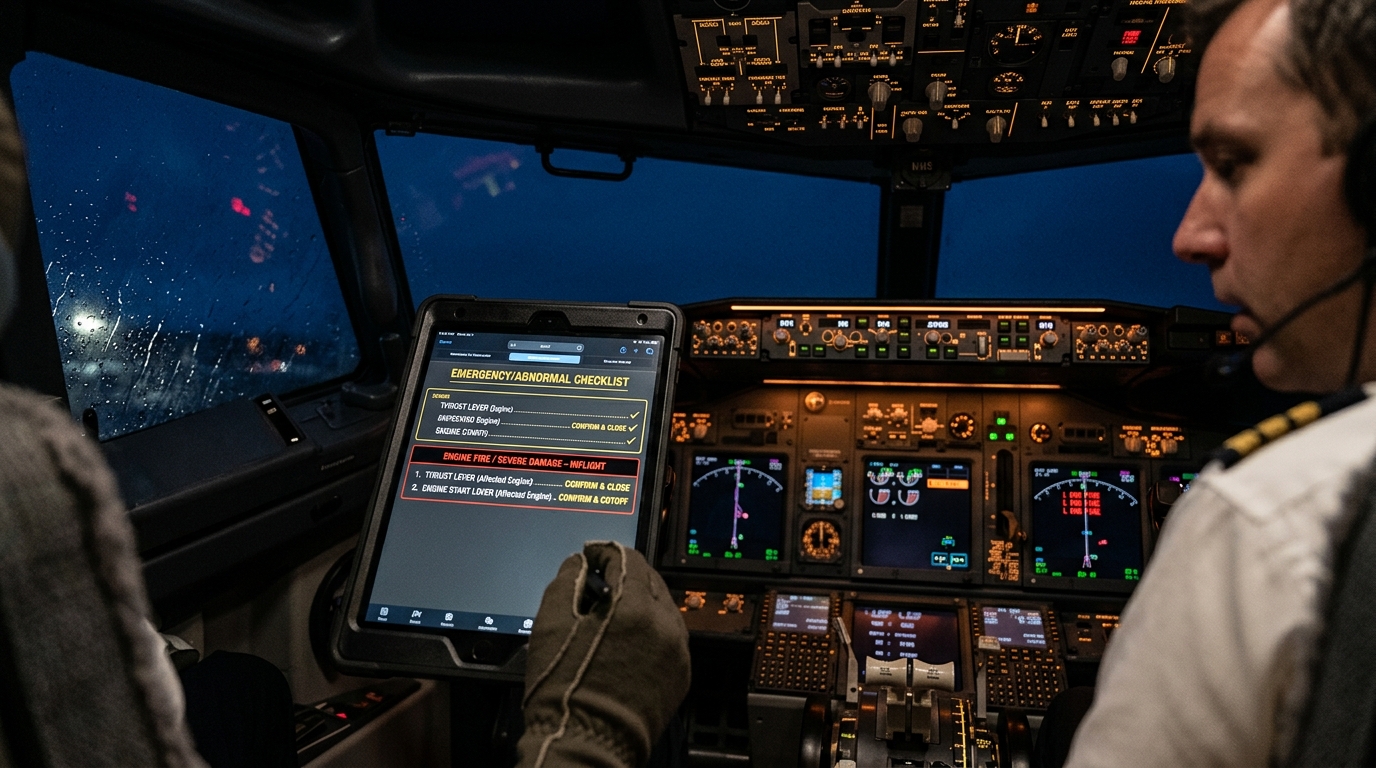
20.1 Distress vs urgency
Distress — MAYDAY (spoken three times): a condition of being threatened by grave and imminent danger and requiring immediate assistance. It has absolute priority over all other transmissions.
Urgency — PAN-PAN (spoken three times): a condition concerning the safety of the aircraft or a person, but not requiring immediate assistance. It has priority over all communications except distress.
MAYDAY = "M'aider" (help me) — life in danger, help now. PAN = "Panne" (breakdown) — a problem, but not life-threatening yet. Both are said three times. If in doubt, MAYDAY is never wrong.
Make the call on the frequency in use (don't change away from the controller already helping you); if not in contact, use 121.5 MHz. Squawk 7700 (Chapter 12) so you light up on every radar.
20.2 The distress message
1. MAYDAY MAYDAY MAYDAY · 2. name of the station addressed (if time/known) · 3. aircraft call sign · 4. nature of the emergency · 5. intentions of the pilot-in-command · 6. position, level and heading · 7. any other useful information (e.g. persons on board, fuel). Speak slowly and clearly; you may not get a second chance.
"Mayday × 3, who, who I am, what's wrong, what I'll do, where I am, anything else." Or remember it as nature · intentions · position as the three things ATC most needs.
20.3 Acknowledgement & handling
The station addressed (or the first to hear it) acknowledges the distress, takes charge, gives the aircraft priority, and may impose silence on other traffic. Any station hearing a distress call that is not acknowledged should relay it and assist. The aircraft in distress (or the controlling station) is the controlling station for the distress traffic.
20.4 Imposition & termination of silence
To keep the frequency clear for the distress, silence is imposed: in the aeronautical service the signal is "STOP TRANSMITTING, MAYDAY", from the controlling station (or the aircraft in distress), addressed to all stations or to the one interfering. In the maritime mobile service — also on your syllabus — the equivalent is SEELONCE MAYDAY (silence, mayday) by the station in control, or SEELONCE DISTRESS by another station. All other stations stop transmitting until released.
When the distress is over, the controlling station announces the end and lifts the silence: aeronautical "DISTRESS TRAFFIC ENDED"; maritime "SEELONCE FEENEE" (silence finished). Normal working then resumes on the frequency.
SEELONCE = silence; FEENEE = fini (finished). Maritime: "SEELONCE MAYDAY" imposes, "SEELONCE FEENEE" ends. Aeronautical: "STOP TRANSMITTING, MAYDAY" imposes, "DISTRESS TRAFFIC ENDED" ends.
20.5 Urgency messages
The format mirrors the distress message but begins PAN-PAN PAN-PAN PAN-PAN: station addressed, call sign, the nature of the urgency, intentions, position/level, and other information. A medical emergency, a minor technical problem, or a low-fuel situation that is concerning but not yet critical are typical urgency calls.
20.6 Emergency descent
An emergency descent — typically after a pressurisation failure — requires the aircraft to descend rapidly to a safe (breathable) level. The danger is to other traffic below, so the procedure is as much about warning them as about the descent itself. This is the topic your original notes left out entirely.
The crew declares it (often as a MAYDAY): "MAYDAY MAYDAY MAYDAY, Ghostair ABC, emergency descent". ATC immediately broadcasts to all other aircraft in the area: "ATTENTION ALL AIRCRAFT in the vicinity of [position], emergency descent in progress from flight level [X]", and clears traffic out of the way. The descending aircraft turns off the airway if able and may continue to a lower level until cleared.
20.7 Communications failure
1. Squawk 7600 (radio failure).
2. Try the basics — frequency, volume, squelch, selector, PTT, alternate radio (Chapter 11).
3. Listen out — you may still be able to receive (a "transmitter failure"); follow instructions you hear and acknowledge by transponder/turns.
4. Transmit blind your intentions, prefixed "transmitting blind" (and "due to receiver failure" if you cannot hear).
5. Continue in accordance with the last acknowledged clearance / the flight plan, flying the cleared or expected levels and routing, and complete the flight, joining and landing using light signals if necessary.
Distinguish a complete failure (you can neither transmit nor receive) from a transmitter-only failure (you can still hear). If you can hear, comply with what you are told and acknowledge by transponder ident or turns — the controller can still help you (Chapter 19).
20.8 Light signals
If you arrive with no radio, the tower directs you with a signal lamp. Know these cold — they are the last line of communication.
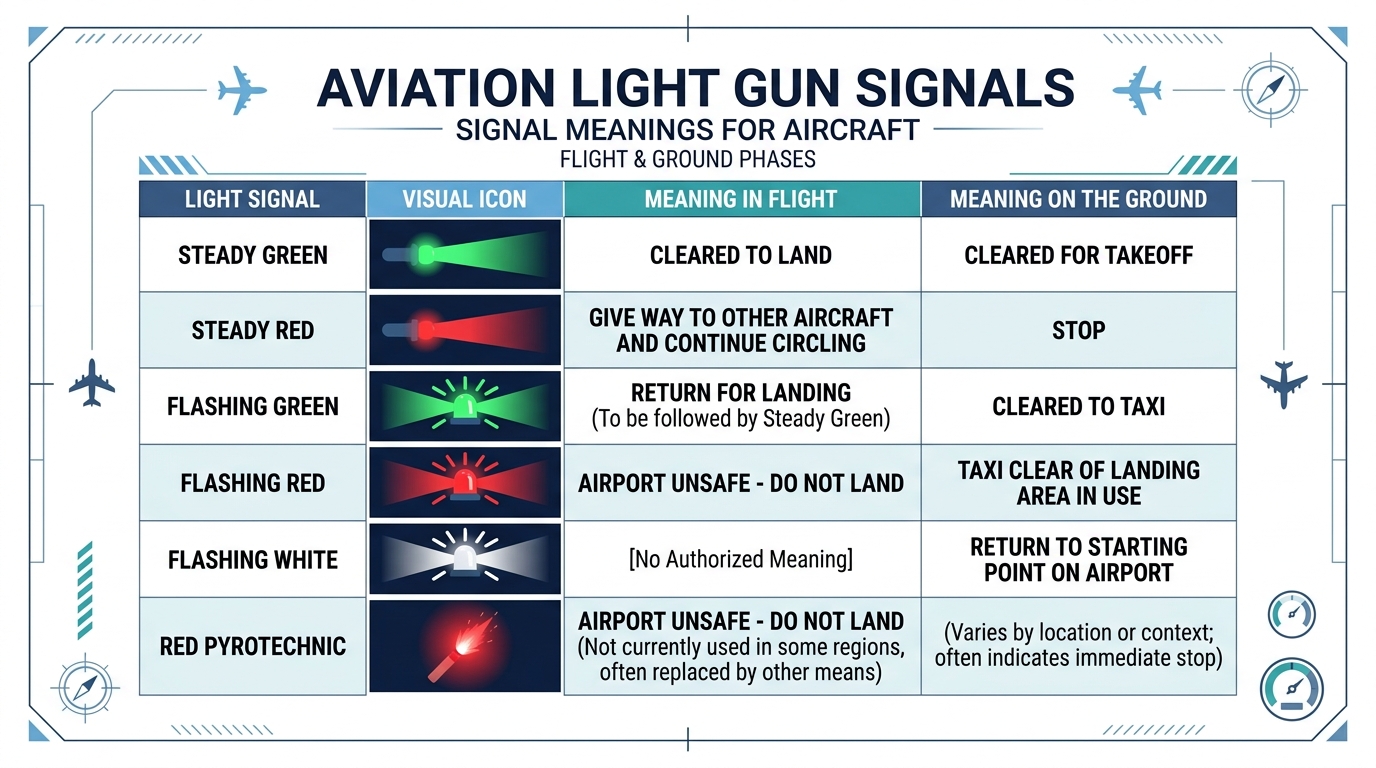
| Signal | Aircraft in flight | Aircraft on the ground |
|---|---|---|
| Steady green | Cleared to land | Cleared for take-off |
| Steady red | Give way to other aircraft and continue circling | Stop |
| Green flashes | Return for landing* | Cleared to taxi |
| Red flashes | Aerodrome unsafe — do not land | Taxi clear of the landing area in use |
| White flashes | Land at this aerodrome and proceed to apron* | Return to starting point on the aerodrome |
| Red pyrotechnic / flare | Notwithstanding any previous instructions, do not land for the time being | |
Green = go / good; Red = stop / danger. Steady = the clearance; flashing = an instruction to position. *Clearances to land/taxi will follow.
Confirm the exact light-signal wording and any nuances against the current ICAO Annex 2 / DGCA CAR, and confirm the precise comms-failure routing/level rules (IFR vs VFR) in Indian airspace.
☆ Numbers to memorise
| Fact | Value |
|---|---|
| Distress | MAYDAY ×3 — grave & imminent danger, immediate assistance, absolute priority; squawk 7700 |
| Urgency | PAN-PAN ×3 — safety concern, not immediate; priority over all except distress |
| Emergency frequency | 121.5 MHz (if not already in contact) |
| Distress message | MAYDAY ×3 · station · call sign · nature · intentions · position/level/heading · POB/info |
| Silence | Impose: "STOP TRANSMITTING MAYDAY" (aeronautical) / SEELONCE MAYDAY (maritime); end: DISTRESS TRAFFIC ENDED (aeronautical) / SEELONCE FEENEE (maritime) |
| Emergency descent | MAYDAY + "emergency descent"; ATC "ATTENTION ALL AIRCRAFT … emergency descent in progress" |
| Comms failure | Squawk 7600 · listen/transmit blind · continue per last clearance/flight plan · light signals |
| Light signals | Green = cleared (land/take-off); red = stop/give way; flashes = position |
Part A — MCQs (click an option to check)
Part B — Oral / viva (tap to reveal model answers)
60-SECOND REVISION CARD
- MAYDAY ×3 = distress (grave danger, immediate help, absolute priority, squawk 7700); PAN-PAN ×3 = urgency.
- Distress message: nature · intentions · position (+ call sign, POB). On 121.5 if not in contact.
- Silence: impose STOP TRANSMITTING, MAYDAY (maritime SEELONCE MAYDAY); end DISTRESS TRAFFIC ENDED (maritime SEELONCE FEENEE).
- Emergency descent: MAYDAY + "emergency descent"; ATC "ATTENTION ALL AIRCRAFT … emergency descent in progress".
- Comms failure: squawk 7600, listen/transmit blind, continue per last clearance; light signals — green = cleared, red = stop.
Shared Ghost Aviator reference notes. Read alongside the official ATPL syllabus and current approved aircraft documentation.
Question practice is in CPL →