Human Performance & Limitations · Module H — The Mind AloftSkills, Reaction & Learning
Chapter 21 — Speed and depth of the mind: reflexes, reaction time and the startle response; quantitative overload and human reliability; short- and long-term memory; learning, retention and motivation; and the traps of cognition and hallucination.
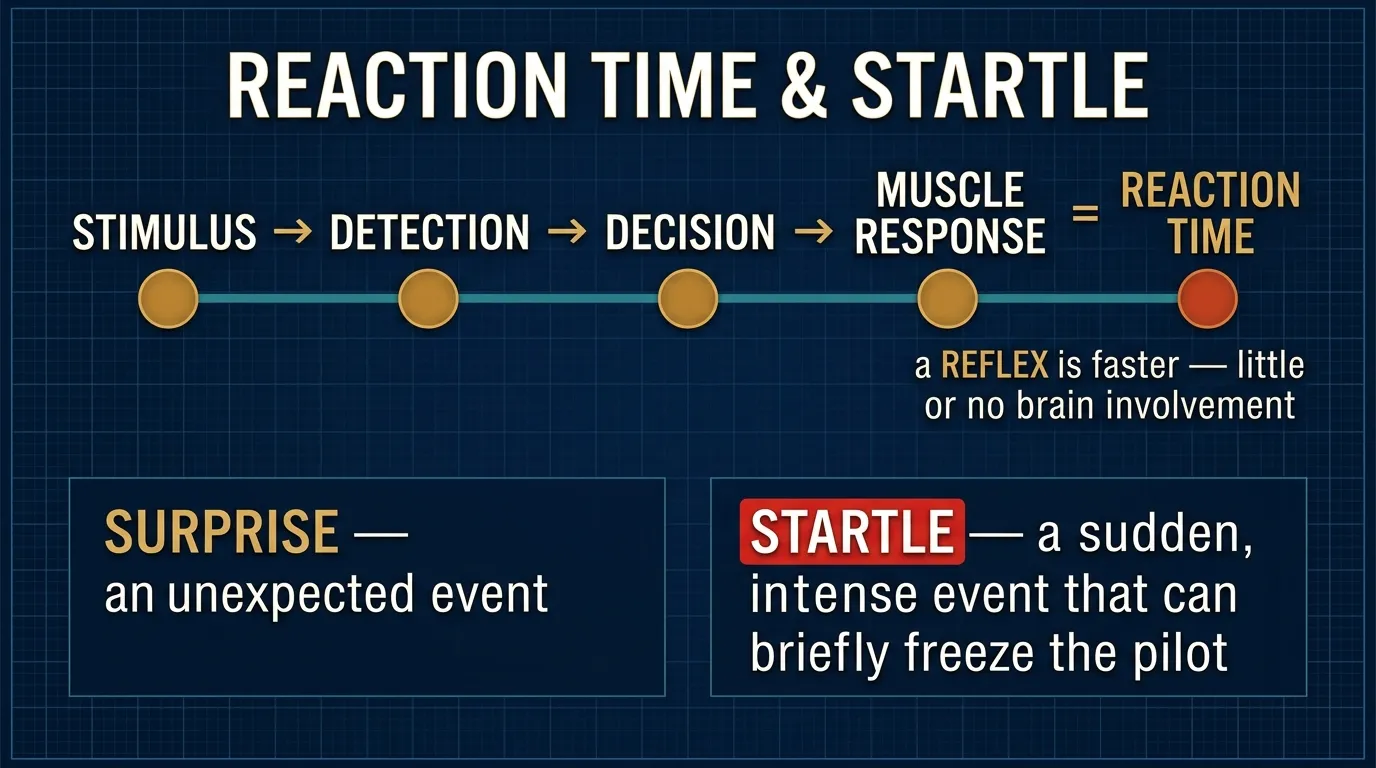
Figure 21.1 — Reflex vs reaction time, and the difference between surprise (unexpected) and startle (sudden and intense) — both steal precious seconds.
What this section covers
Reflex types, what reaction time depends on, and the operational impact of the startle reflex on pilots.
Reflexes occur with little or no involvement of the central nervous system.
10.1 Reaction Time
There is a delay between detection, stimulus and muscle contraction called reaction time. Reaction time depends on the type of reflex action being used.
10.2 Three Types of Reflex Actions
Type
Description
Example
Unconditioned
Instinctive natural reflexes
Blinking
Conditioned
Reflexes that may be learned
Foot-on-rudder on swing
Trained
Reflexes that may be increased by repeated practice
Stall recovery inputs
10.3 Surprise and Startle
The startle reflex is a reflex-like event that blinks the eyes and causes a whole-body 'jerk' to occur (similar to that sometimes caused in sleep). The reflex has a relatively basic neural pathway from the sense organ. Many things can cause (or contribute to) a startle reflex:
Sudden noises
Unexpected tactile sensations
Abrupt shocking perceptions
The sensation of falling
An abrupt visual stimulus
There is little evidence that a startle reflex alone creates much of a sustained or lasting impact on cognitive functions, although there are some minor and short-lived physiological changes such as raised heart rate.
Key Value — Startle Recovery
A skilled motor task will be momentarily disrupted by a startle reflex but return to normal within 5 to 10 seconds.
10.4 Effects on Pilots
The main effects of the pure startle reflex on pilots are:
Interruption of the on-going process.
Distraction of attention toward the stimulus.
These happen almost immediately and can be quickly dealt with if the cause is found to be non-threatening.
Hazard — Fear Potentiates Startle
A perception of fear can cause a startle reflex to be potentiated (more pronounced) should it occur, and attention to become more focused. In a state of fear, very little is required to trigger a full 'fight or flight' response.
11. Quantitative Overload & Human Reliability
What this section covers
When workload is acceptable, what overload looks like, error rates with practice, and the cumulative nature of errors.
Quantitative Overload — a very high workload can be interpreted as 'Stress'.
SOP — Acceptable Workload
Workload may be said to be acceptable if it requires about 60 % of the crew resources, depends on the pilot's expertise and corresponds to the amount of resources available.
11.1 Most Common Symptoms of Overload
A sharp degradation of performance
Funneling of attention or focus
Regression
Mental "blocking"
Mood swings
Restlessness and trembling
Panic
11.2 Human Reliability
The rate of human error during simple and repetitive tasks might be expected to be 1 in 100, but after practice, a rate of 1 in 1,000 could be achieved.
Definition — Human Reliability
The individual functioning in the manner in which he or she is supposed to function.
11.3 Error Generation
Errors tend to be cumulative. One slip rarely stays isolated — it sets up the next.
Worked Example — Human Error Rate
A pilot performs 200 routine pre-flight checks per week.
• Before practice (1 in 100): expected errors ≈ 200 ÷ 100 = 2 errors / week.
• After practice (1 in 1,000): expected errors ≈ 200 ÷ 1,000 = 0.2 errors / week (i.e., about 1 every 5 weeks). Practice yields a 10-fold reduction in error rate, but never reaches zero — hence the value of cross-checking and SOPs.
12. Short-Term & Long-Term Memory
What this section covers
Duration and capacity of short-term memory, methods to expand it, the three subtypes of long-term memory and its capacity characteristics.
12.1 Short-Term Memory (Working Memory) — 10 to 20 Seconds
Short-term memory enables information to be retained for a short period of time. That information will be lost in 10 to 20 seconds unless it is actively rehearsed and deliberately placed in our long-term memory.
Auditory information is considered easier to retain than visual information as it is easier to rehearse sounds than data in a visual form.
12.2 Limitations of Short-Term Memory
The capacity of our short-term memory is limited. The maximum number of unrelated items which can be maintained in the short-term memory is about 7 ± 2. Once this limit is exceeded one or more of the items are likely to be lost or transposed.
12.3 Methods of Increasing Short-Term Memory
Method
Description
Chunking
Breaking items to be remembered into small pieces and remembering them one at a time.
Association
Used to remember spoken lists of items. A wild and bizarre association is imagined and attached to each item on the list.
Worked Example — Chunking an ATC Clearance
Raw clearance string: "VTBL VTBS RWY01L SQK4732 ALT FL310 HDG270" — 7+ unrelated tokens, near STM limit.
Chunked: "VT-BL → VT-BS" (route), "RWY 01L" (departure), "4732" (squawk), "FL310" (level), "HDG 270" (heading) = 5 chunks — comfortably within 7 ± 2.
12.4 Long-Term Memory — Unlimited Time Period
It is believed that information is stored in the Long-Term Memory for an unlimited time period, although frequently there may be retrieval problems.
12.5 Three Subtypes of Long-Term Memory
Type
Definition
Example
Semantic Memory
Stores general knowledge of the world
Knowing that "QNH is altimeter setting"
Episodic Memory
Memory of events or 'episodes' in our life
Recalling your first solo flight
Procedural Memory
Skills are included within the make-up of the LTM
Executing a coordinated turn
Exam Tip — Memory Quick Facts
• STM duration = 10–20 seconds, capacity = 7 ± 2 items.
• LTM capacity = unlimited, but retrieval problems may exist.
• Motor programmes live in LTM (Procedural), not STM.
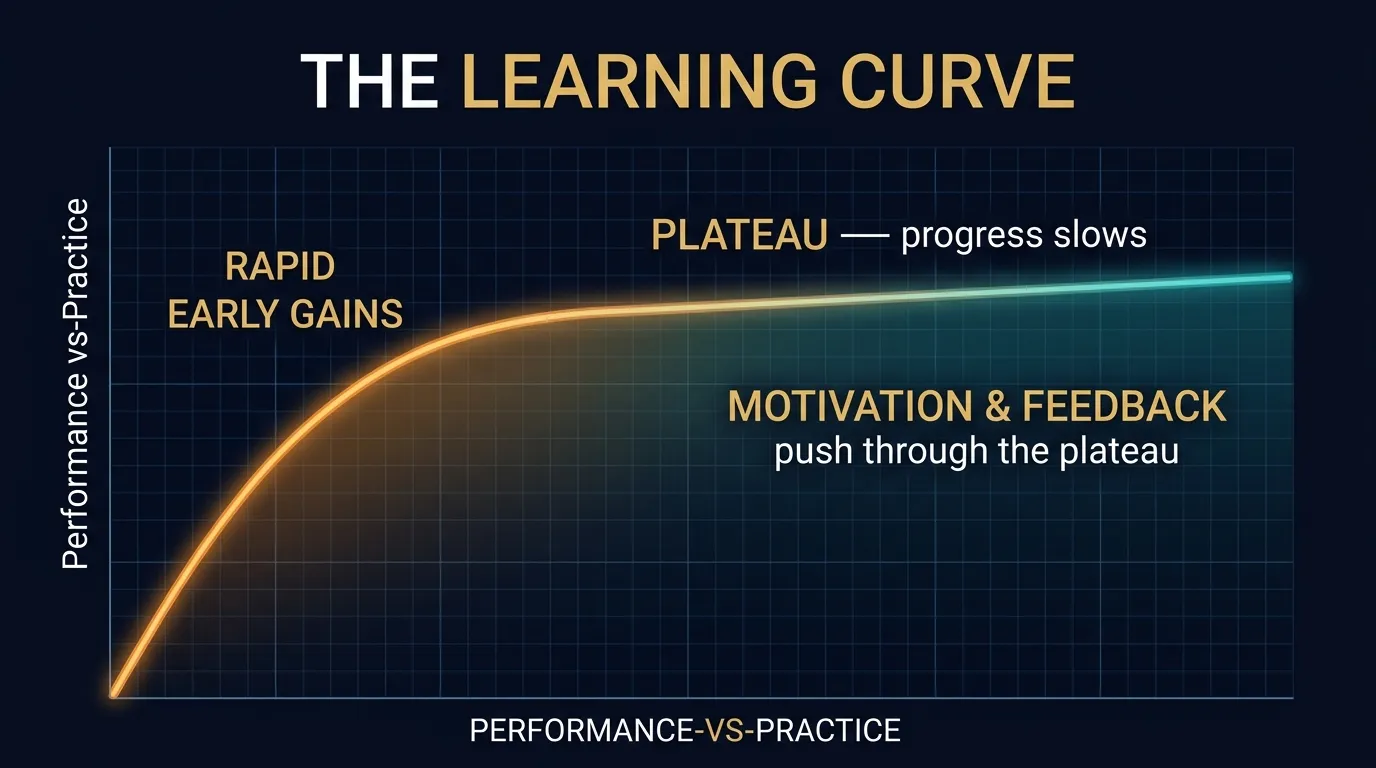
Figure 21.3 — The learning curve: rapid early gains, then a plateau; motivation and feedback drive it forward.
What this section covers
Types of learning, methods to retain information, and the role and sources of motivation.
13.1 The Learning Process
Learning is an internal process which allows the mental acquisition and retention of data. Types include:
Insight
The data is intellectually and cognitively understood and is retained. Observational Learning / Imitation — data from an outside source is replicated. Experience — learning from our mistakes.
Skill Learning
Involves motivation, attention, observation, much practice and corrective feedback.
13.2 Retention of Information
Retention can be increased by:
Mnemonics — the practice of improving or helping the memory, or the systems used to achieve this.
Memory Training
13.3 Motivation
Motivation is the combination of a person's desire and energy directed at achieving a goal. It is the cause of action.
Type
Examples
Intrinsic
Satisfaction and feelings of achievement
Extrinsic
Rewards, punishment, and goal obtainment
Not all people are motivated by the same thing and over time their motivations might change.
SOP — Motivation and Performance
The learning process is vastly improved with motivation, and high performance is rarely achieved without it.
What this section covers
How experience shapes us, response characteristics with age, error of commission, response times, cognition in flight, and hallucinations.
14.1 Experience
We all have the ability to learn from our experiences and mistakes, and from those of others.
14.2 Response
Any response will cause a detectable change which, in turn, will be noted by the senses. The feedback may alter the action being taken.
Auditory stimuli (noises) are more likely to attract attention than visual stimuli, but they are also more likely to be responded to in error.
An increase in age between 20 and 60 years tends to lead to slower but more accurate responses.
14.3 Response Error (Error of Commission)
If an unexpected stimulus occurs, we will be more likely, under pressure, to make an error of commission.
14.4 Response Times
Response to reaction time is the interval between the onset of a given signal and the production of a response to that signal.
14.5 Cognition in Aviation
Cognition = the mental faculty or process of acquiring knowledge by the use of reasoning, intuition or perception. In aviation, flight puts the pilot into an environment which can distort sense organs, and the changed perspective which is experienced in flight can result in information being presented which is outside the individual's expectations.
14.6 Hallucination
A hallucination is actually a false perception characterised by a distortion of real sensory stimuli. (Not a fabrication of stimuli — the stimuli are real, but their perception is distorted.)
14.7 Workload and Limitations
Too high or too low a workload can result in degraded performance. Several types of situations may cause mental overload.
Exam Tip — Age and Response
Between 20 and 60 years → responses become slower but more accurate. Experience compensates for slower reflexes.