Human Performance & Limitations · Module H — The Mind AloftMemory, Perception & Attention
Chapter 20 — The machinery of the mind: the three types of memory, how we anticipate and perceive, the limits of attention, vigilance and complacency, and how motor skills become automatic.
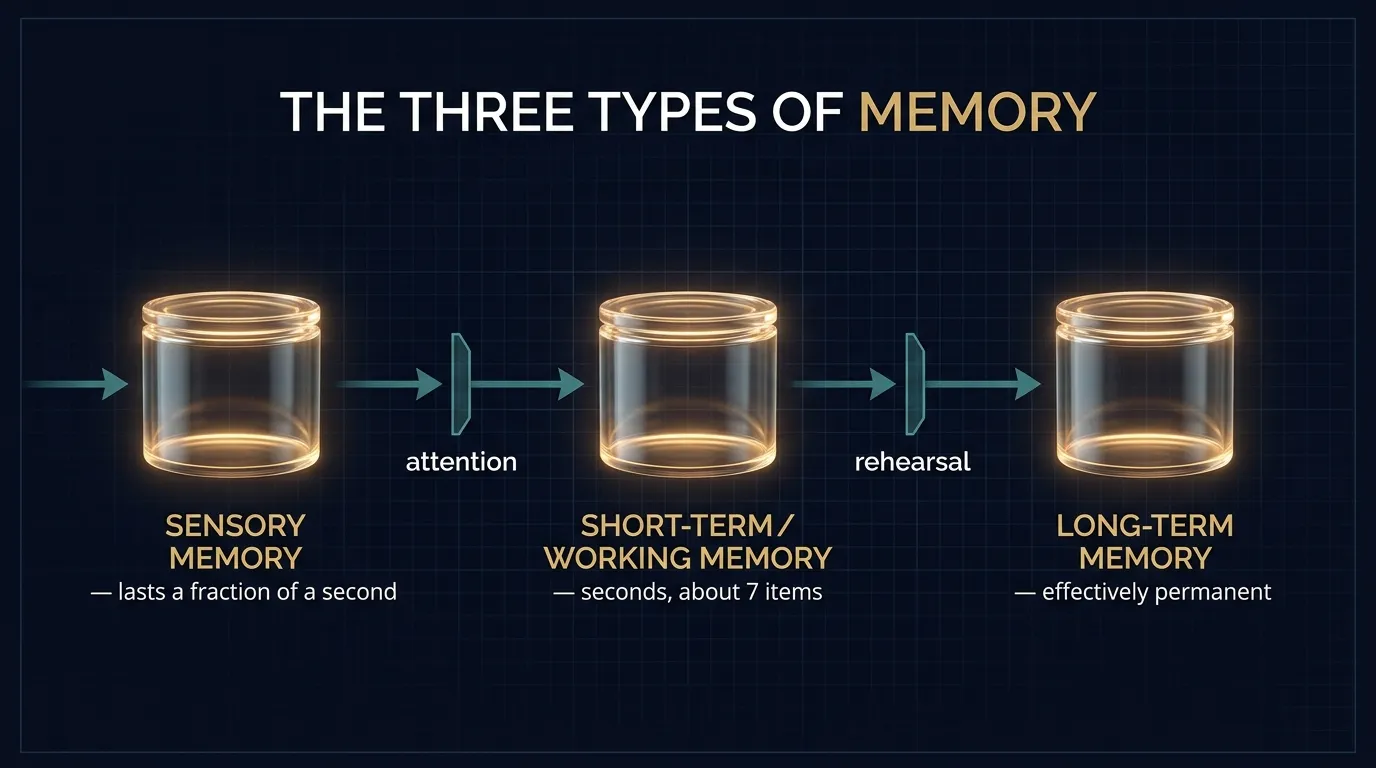
Figure 20.1 — The three memory stores: sensory memory (fractions of a second), short-term / working memory (seconds), and long-term memory.
5.4 Sensory Memory for Sight — Iconic Memory
The Iconic Memory is the visual sensory store. It only lasts for between 0.5 and 1 second.
70–80 % of the information processed by humans is received through the visual channel.
5.5 Sensory Adaptation (Habituation)
All senses adapt, either partially or completely, to their stimuli after a period of time.
Exam Tip — Sensory Memory ValuesIconic memory = 0.5–1 second. Visual channel carries 70–80 % of all received information.
6. Anticipation & Perception
What this section covers
How sensory input becomes meaning, the role of expectation, mental models and the concept of funneled perception.
6.1 Perception
Perception involves the conversion of the sensory information received into a meaningful structure.
Sensory information that we expect to receive is more easily perceived and integrated when it actually occurs, compared with totally unexpected information.
"We can 'perceive' only that which we can 'conceive', but we perceive only a fraction of the information reaching our senses at any moment."
The process of perception is greatly assisted by our ability to form mental and three-dimensional visual models.
6.2 Funneled Perception
Perception of a situation can differ depending upon the starting point of an observer.
Hazard — Confirmation Bias / Funneling
In an abnormal situation, if a pilot has an apparently correct explanation for the problem, the chance that he/she now ignores or devalues other relevant information not fitting into the mental picture is increasing. Stay open-minded; verify, don't rationalize.
7. Attention
What this section covers
Definition, the two types of attention, why an attention mechanism is required, the cocktail party effect and the dangers of attention mismanagement.
Attention is the process of directing and focusing psychological resources to enhance perception, performance and mental experience. To pay attention to something is to concentrate on it — a stimulus, threat, decision or calculation. Critically, attention is limited; if some attention is being used for one thing, it cannot be used for something else.
7.1 Types of Attention
Selective Attention — inputs are sampled continually to decide their relevance to the present task at hand.
Divided Attention — when our central decision-making channel can time-share between a number of tasks, executing several mental activities at almost the same time (e.g. switching attention from outside the aircraft to the airspeed indicator and monitoring the progress of a motor programme such as flying or taxiing on a relatively subconscious level, while making a radio call at the same time).
The human brain has different reservoirs of resources for information-gathering, information-processing, or the action phase.
7.2 Lack of Attention
The major danger for pilots is the poor management of attention.
7.3 Attention Mechanism — Why It Is Required
Because of two potentially limiting stages in processing information:
There is a limit to the number of items held or maintained in short-term memory (working memory).
Our channel capacity is limited.
7.4 Choice of Item
Attention is the deliberate devotion of cognitive resources to a specific item. Although attention can move very quickly from item to item, it can only deal with one at a time — so the pilot must consciously prioritize.
7.5 The Cocktail Party Effect
With many conversations occurring all around, one conversation can suddenly break through to attention because a word or phrase was particularly meaningful — the classic example is a person hearing their own name mentioned in another conversation that they were not paying attention to.
Exam Tip — Cocktail Party Effect
Defined as the ability to pick up relevant information unintentionally. It demonstrates that the brain monitors even unattended channels for personally significant cues.
8. Vigilance & Complacency
What this section covers
Definition of vigilance, the three states (hypo, optimum, hyper), causes and signs, plus the trap of complacency in automated cockpits.
Vigilance = the capability to be sensitive to potential changes in one's environment, i.e. the capability to reach a level of alertness above a threshold for a certain period of time — rather than the state of alertness itself.
8.1 Hypo (Low) Vigilance
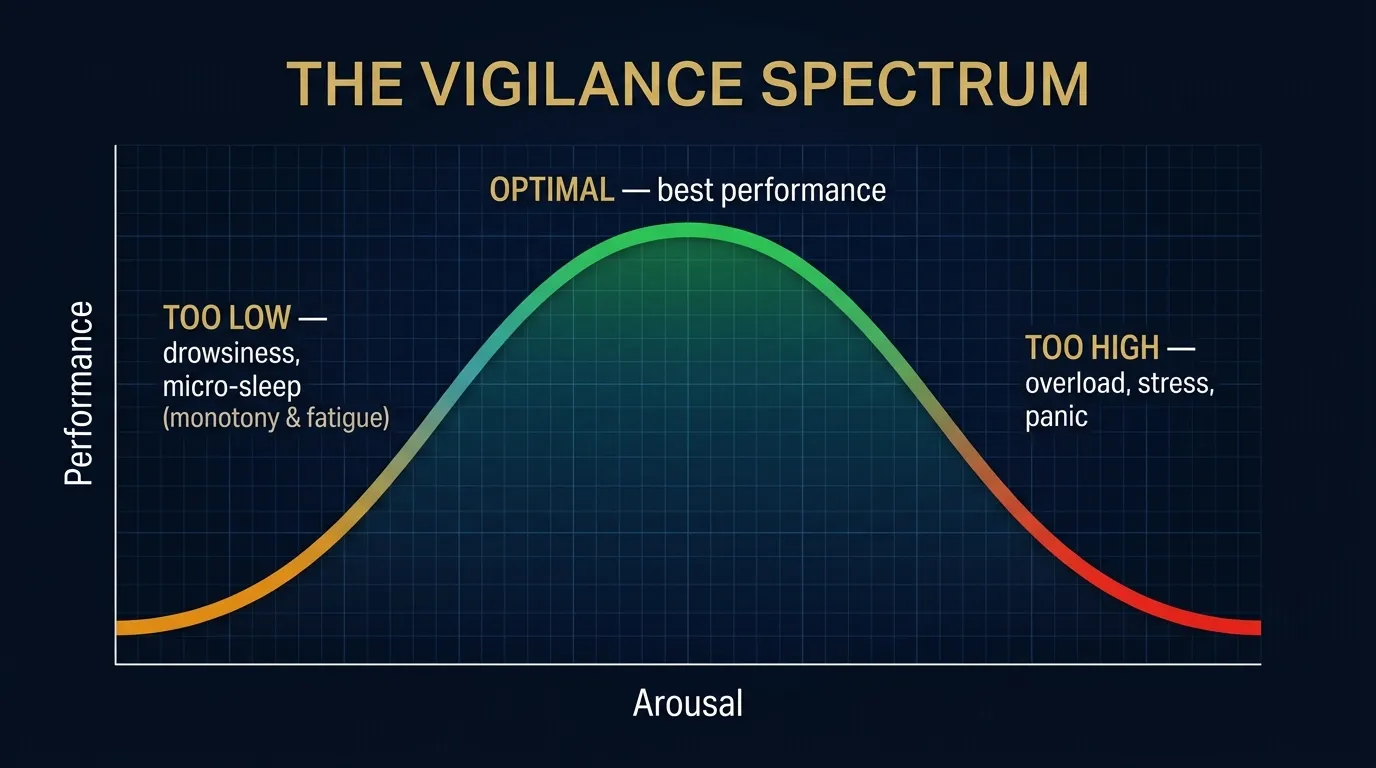
Mainly due to the monotony of the task, tiredness, the need for sleep and a lack of stimulation. It may occur at any moment of the flight. Decrease in sensory perception and sensation of muscular heaviness are indications of low vigilance.
A state of high fatigue is liable to cause phases of drowsiness and hypo-vigilance, which result in a reduction of performance and unconscious phases of micro-sleep.
SOP — Managing Hypo-VigilanceHealthy food and organising periods of rest during the flight can mitigate the effects of low vigilance.
8.2 Hyper Vigilance
In its most acute forms, an extremely agitated state of panic or near panic. Characterised by indiscriminate attention to all sorts of minor and major threat cues, as the person frantically searches for means of escaping the anticipated danger.
Hazard — Hyper Vigilance
Hyper vigilance is a state of panic that often results in regrettable decision-making.
8.3 Optimum Vigilance
Lies somewhere between hypo and hyper vigilance.
8.4 Complacency
A state of self-satisfaction with one's own performance coupled with an unawareness of danger, trouble or controversy.
Hazard — Complacency
Complacency is extremely dangerous in aviation. You get so used to things being done the same way that you become less vigilant to hazards in your surroundings. Automation may make pilots complacent due to low workload.
Figure 20.2 — The vigilance spectrum: too little arousal brings drowsiness and micro-sleep; too much brings overload — performance peaks in between.
9. Motor Programmes (Skills) — Anderson Model
What this section covers
What motor programmes are, the three phases of skill development per the Anderson model, and how skill enables resource management.
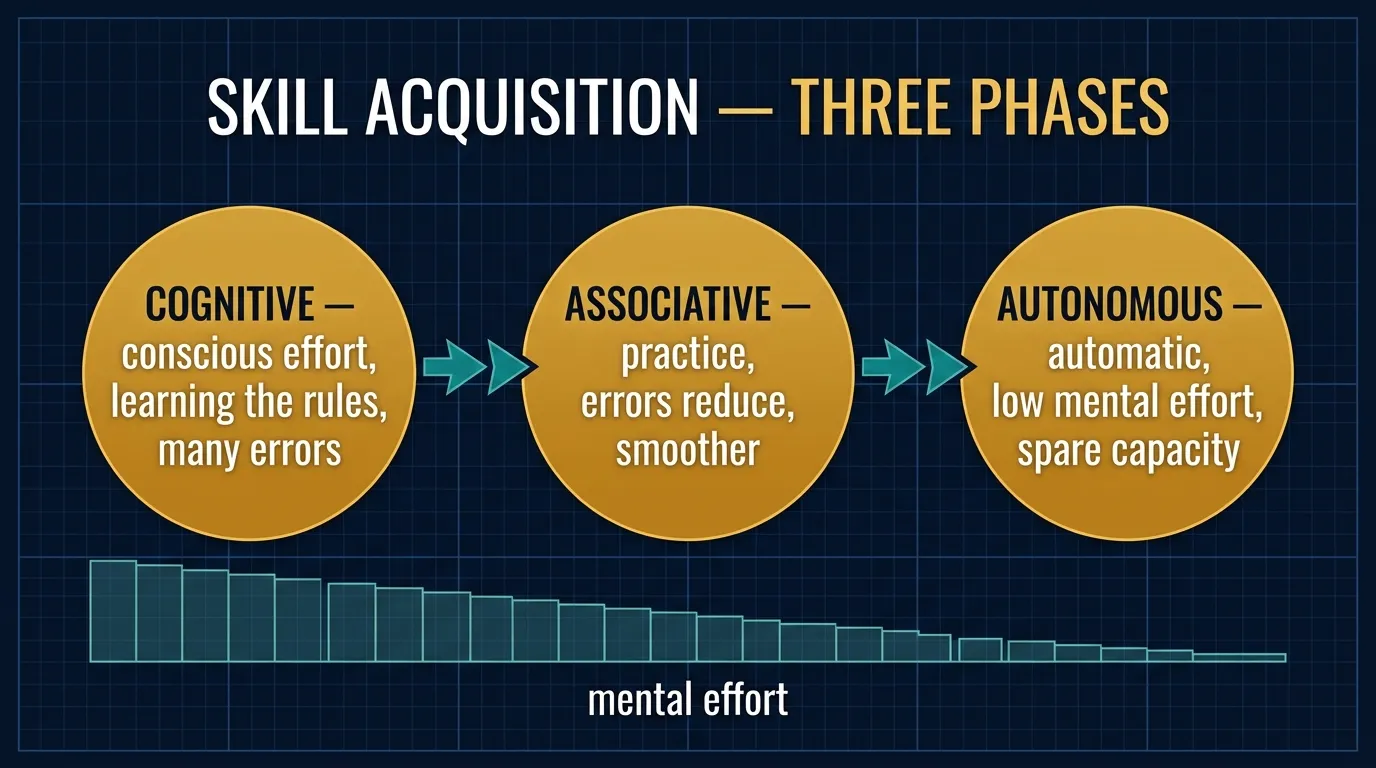
Motor Programmes, or "Skills", are behavioural sub-routines which are learnt by practice and/or repetition and are held within the Long-Term Memory. They can be carried out without conscious thought.
In the initial phase of flight training the pilot is competent enough to fly the aircraft at this stage but does neither have a great deal of confidence in his/her abilities nor in the whole system.
What Makes a Pilot "Skilled"
A pilot is skilled when he trains or practices regularly, knows how to manage himself/herself and knows how to keep resources in reserve for coping with the unexpected.
Figure 20.3 — Anderson's model of skill acquisition: cognitive (conscious effort) → associative (practice) → autonomous (automatic).
Exam Tip — "Flying a coordinated turn is …"Skill-based behaviour — not attention-based, not experience-based. It draws from procedural memory in the LTM.