Plate 4.0 — The control computer. Every decision, reflex and command in the cockpit begins here.
§ 7The Brain & the Nervous System
The brain is the master controller of your body — every input you receive in flight (visual, vestibular, proprioceptive, auditory) is processed here, and every output (control inputs, R/T calls, decisions) originates here. The nervous system is the wiring that connects the brain to every organ and muscle.
7.1 The Brain
DefinitionThe brain controls all bodily functions. It performs an incredible number of tasks, every one of which is potentially flight-critical.
What the brain does — exam list
It controls body temperature, blood pressure, heart rate and breathing.
It accepts information about the world around you from your various senses — seeing, hearing, smelling, tasting and touching.
It handles your physical movement when walking, talking, standing or sitting.
It lets you think, dream, reason and experience emotions.
The brain controls decision-making and speech. Through the brain we experience consciousness, vision, hearing, taste, smell, thought and memory.
Why this matters in the cockpit
Every one of these functions is oxygen-dependent. The brain consumes about 20 % of the body's oxygen despite being only ~2 % of body mass. Even mild hypoxia degrades judgement, decision-making and speech long before the pilot is consciously aware of it. (Detailed in §10 Hypoxia — Part 3.)
7.2 The Nervous System — Three Main Parts
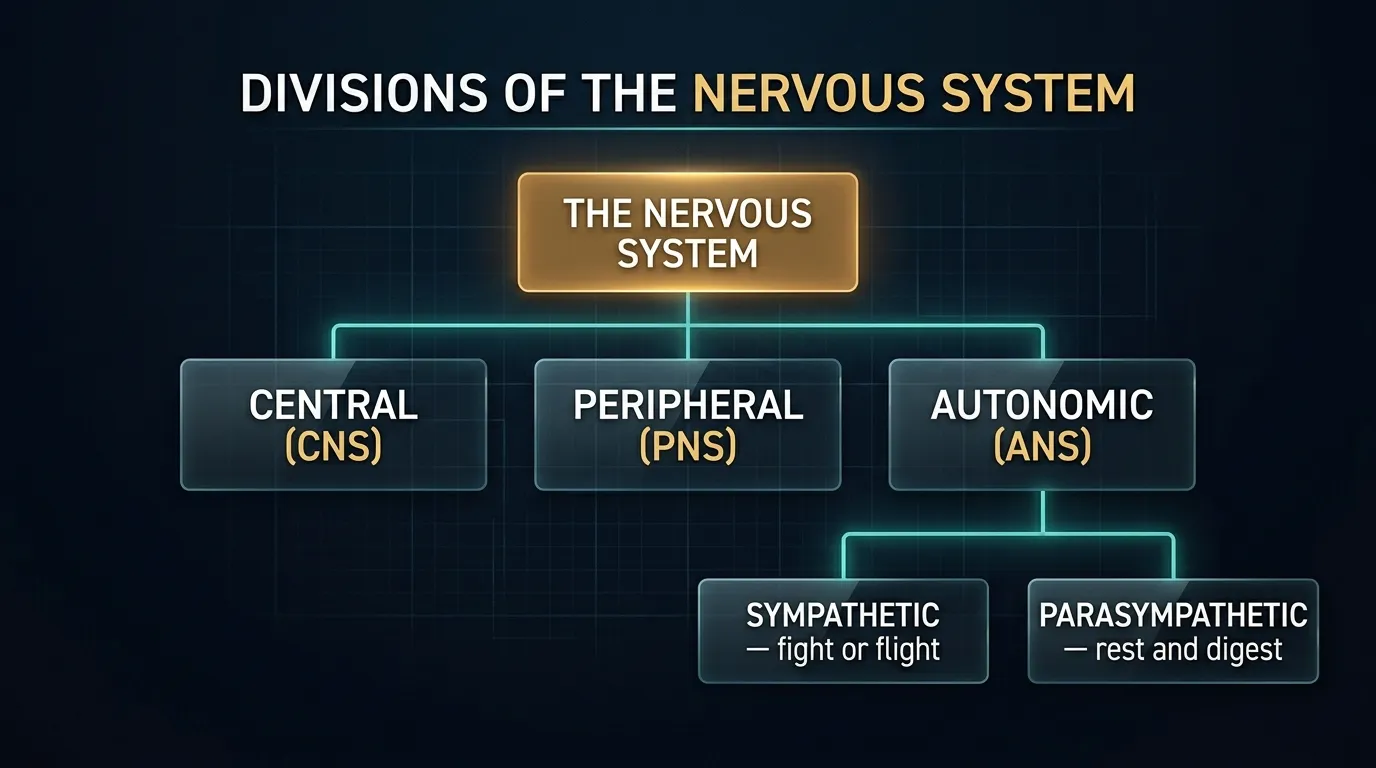
The Nervous System is divided into three main parts:
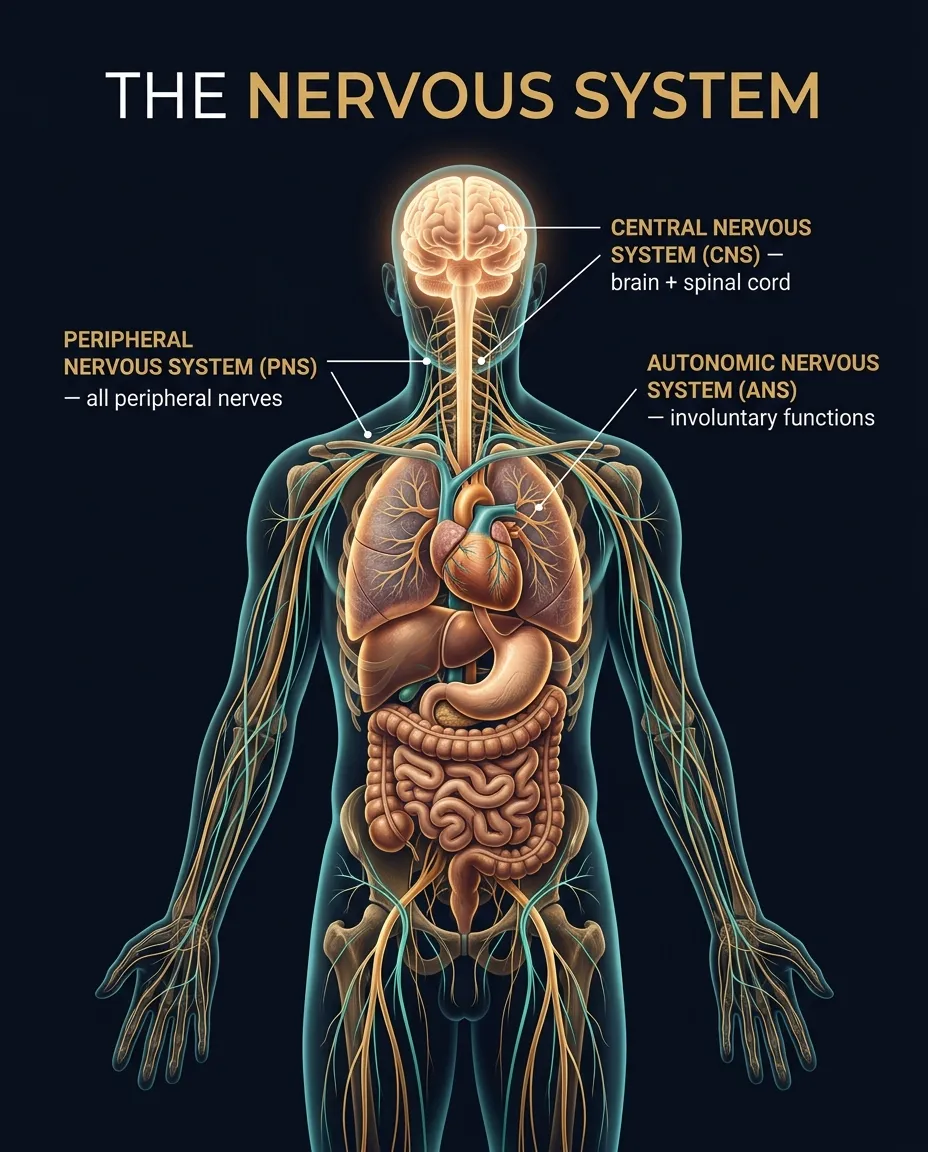
Figure 4.1 — The nervous system: the central (CNS), peripheral (PNS) and autonomic (ANS) divisions.
The Central Nervous System (CNS)
Definition
The central nervous system consists of the brain and the spinal cord. The brain, spinal cord and peripheral nerves make up a complex, integrated information-processing and control system known as Central Nervous System. In tandem, they regulate all the conscious and unconscious facets of your life.
The scientific study of the brain and nervous system is called neuroscience or neurobiology.
The brain functions to receive nerve impulses from the spinal cord and cranial nerves.
The spinal cord contains the nerves that carry messages between the brain and the body.
The Peripheral Nervous System (PNS)
Function
The peripheral nervous system includes all peripheral nerves. It connects the central nervous system to the organs and muscles of the body and regulates all purposeful and reflex actions. The peripheral nervous system controls organs and muscles like skin, eye, blood vessels, heart and stomach.
The Autonomic Nervous System (ANS)
Definition
The organs (the "viscera") of our body — such as the heart, stomach and intestines — are regulated by a part of the nervous system called the Autonomic Nervous System (ANS). The ANS is part of the peripheral nervous system, and it controls many organs and muscles within the body.
Key characteristic — it works without you knowingIn most situations, we are unaware of the workings of the ANS because it functions in an involuntary, reflexive manner. For example, we do not notice when blood vessels change size or when our heart beats faster.
The Autonomic Nervous System exercises its functions independently of the Central Nervous System to the extent that it controls parts of the body without having to think about it.
What the ANS controls — full DGCA list
Sensory
Eye
Cardiac
Heart
Respiratory
Breathing
Thermoregulation
Temperature
Vascular
Blood Pressure
Digestive
Stomach & Intestines
Excretory
Urinary Output & Bladder
Cooling
Sweating & Glands
Stress Response
Fight-or-Flight Reaction
Flight-relevance — the "Fight or Flight" reflex
The ANS controls the fight-or-flight response or reaction to stress. In a sudden emergency — engine failure, severe turbulence, near-miss — the ANS dumps adrenaline into your bloodstream automatically. Heart rate, breathing rate, BP and sweating all spike without your conscious permission. This is why a well-trained pilot's drilled checklist beats raw reaction: the conscious brain must override an autonomic surge.
Three divisions of the Nervous System — quick comparison