Human Performance & Limitations · Module A — The Ocean of Air
Altitude & Oxygen
Chapter 3 — The partial pressure of oxygen and the altitude penalty, the four physiological zones of the atmosphere, and the numbers every pilot must know cold.
Plate 3.0 — Higher is thinner. As the total pressure falls, so does the oxygen your blood can reach — the altitude penalty.
§ 4Partial Pressure of Oxygen — Effects of Increasing Altitude
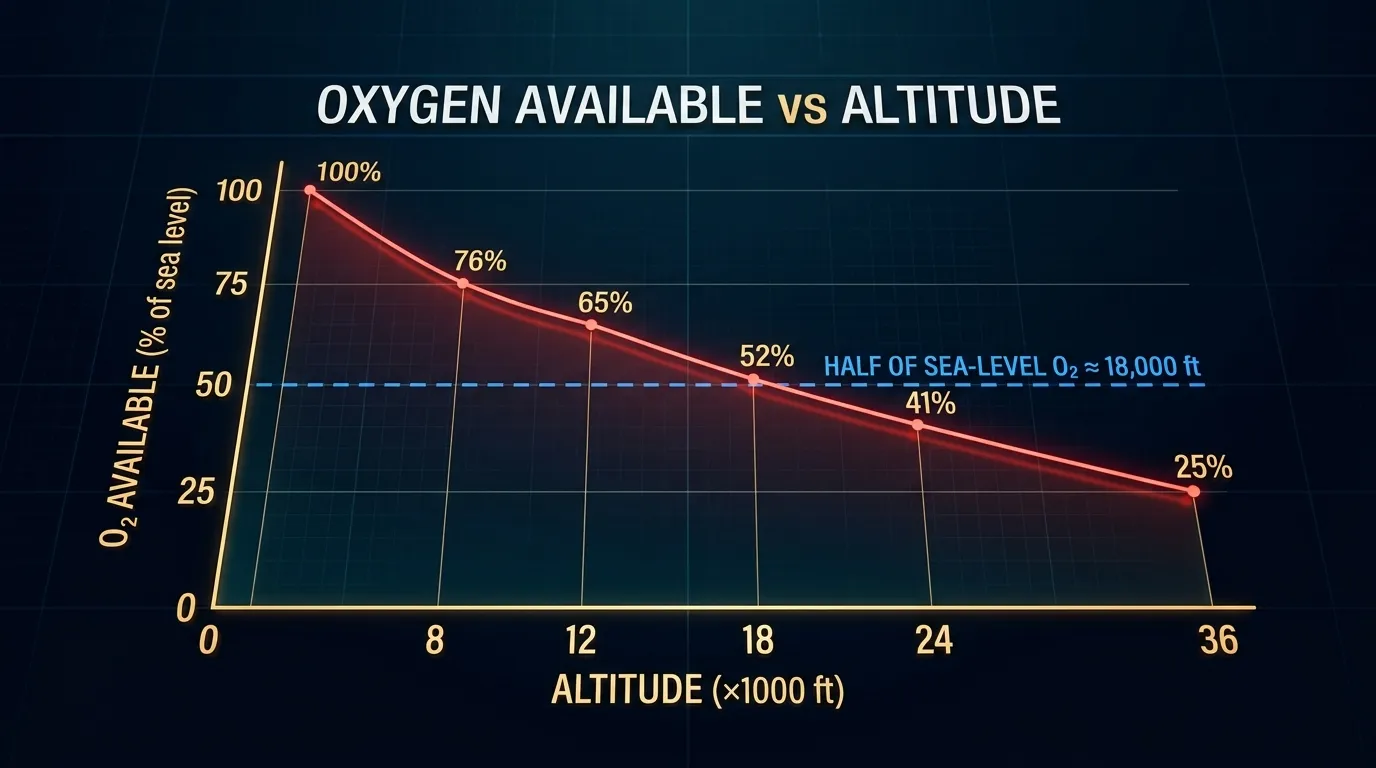
As you climb, the total barometric pressure drops, and with it the partial pressure of oxygen (pO₂). Because the diffusion of oxygen across the alveolar membrane depends on the pressure gradient, what matters to your blood is not the percentage of O₂ — it is the pO₂. Here are the standard values the DGCA expects you to know:
Standard barometric pressure & oxygen availability at altitude
Altitude
Standard Barometric Pressure
O₂ Available (% of Sea Level)
Pilot Significance
Sea Level (0000 ft)
101 kPa (760 mmHg)
100 %
Normal physiological baseline.
8,000 ft
77 kPa (574 mmHg)
76 %
Cabin pressure is maintained between 6,000 – 8,000 ft.
12,000 ft
66 kPa (496 mmHg)
65 %
Lower edge of the Physiological-Deficient Zone.
18,000 ft
53 kPa (395 mmHg)
52 % (≈ half)
Half the O₂ of sea level.
24,000 ft
41 kPa (311 mmHg)
41 %
Without supplemental O₂ — incapacitation imminent.
36,000 ft
25 kPa (187 mmHg)
25 % (one-fourth)
Only ¼ of sea-level oxygen.
Three deductions you must be able to state in the exam
The availability of oxygen and barometric pressure DECREASE with altitude.
The oxygen available is one-fourth at 36,000 ft and half at 18,000 ft of the oxygen available at sea level.
Atmospheric pressure drops faster at lower altitudes in comparison to the same altitude changes at higher altitudes (the pressure–altitude curve is exponential, not linear).
Figure 3.1 — The oxygen available falls non-linearly with altitude: half is gone by 18,000 ft, three-quarters by 36,000 ft.
§ 5The Physiological Zones of the Atmosphere
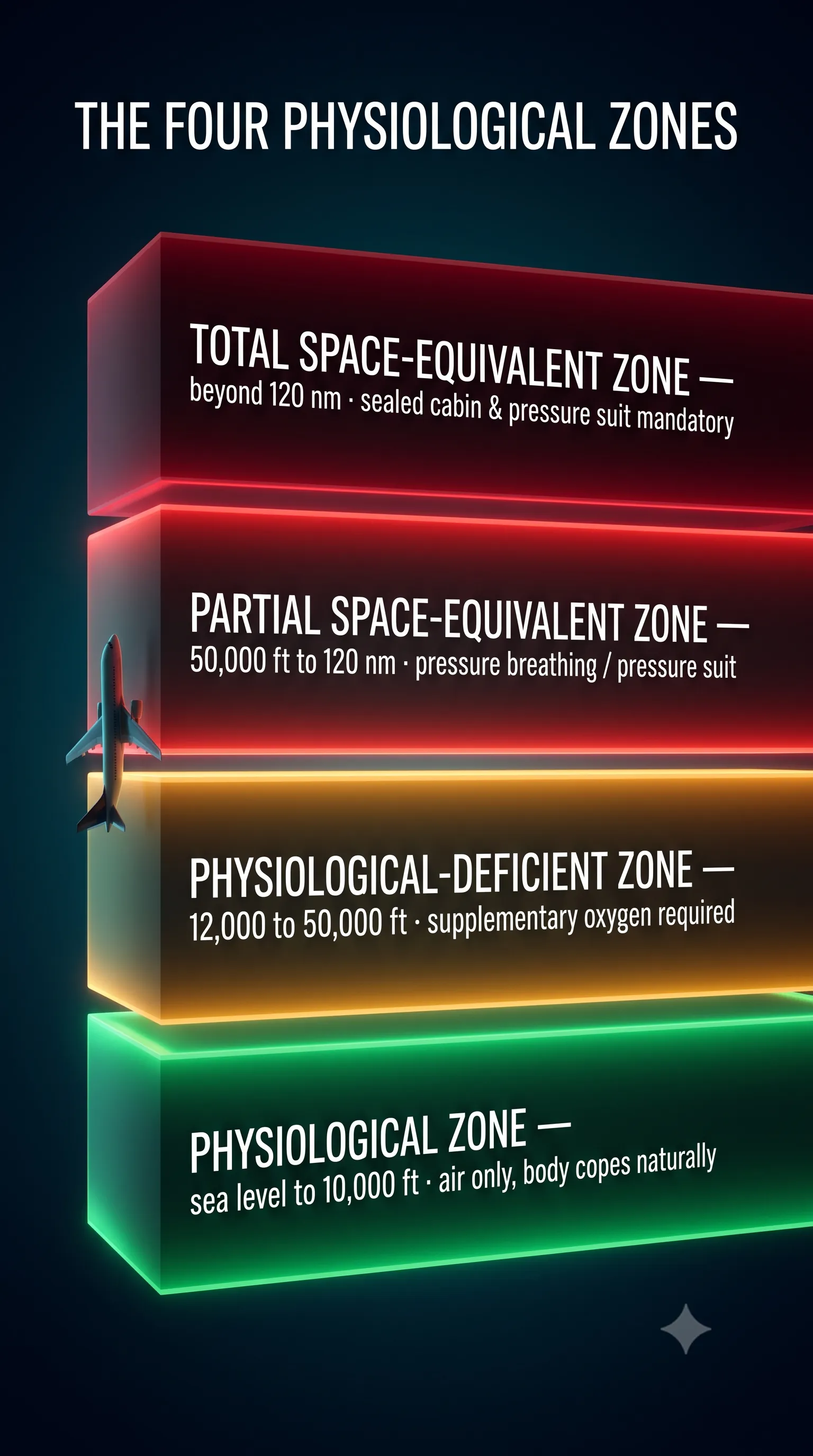
The atmosphere is divided — from the pilot's body's point of view — into four functional zones, each demanding a different protective strategy. You must know the boundaries and the SOP for each.
Figure 3.2 — The four physiological zones of the atmosphere and the protection each demands.
5.1 The Physiological Zone
SOP — Within this zone
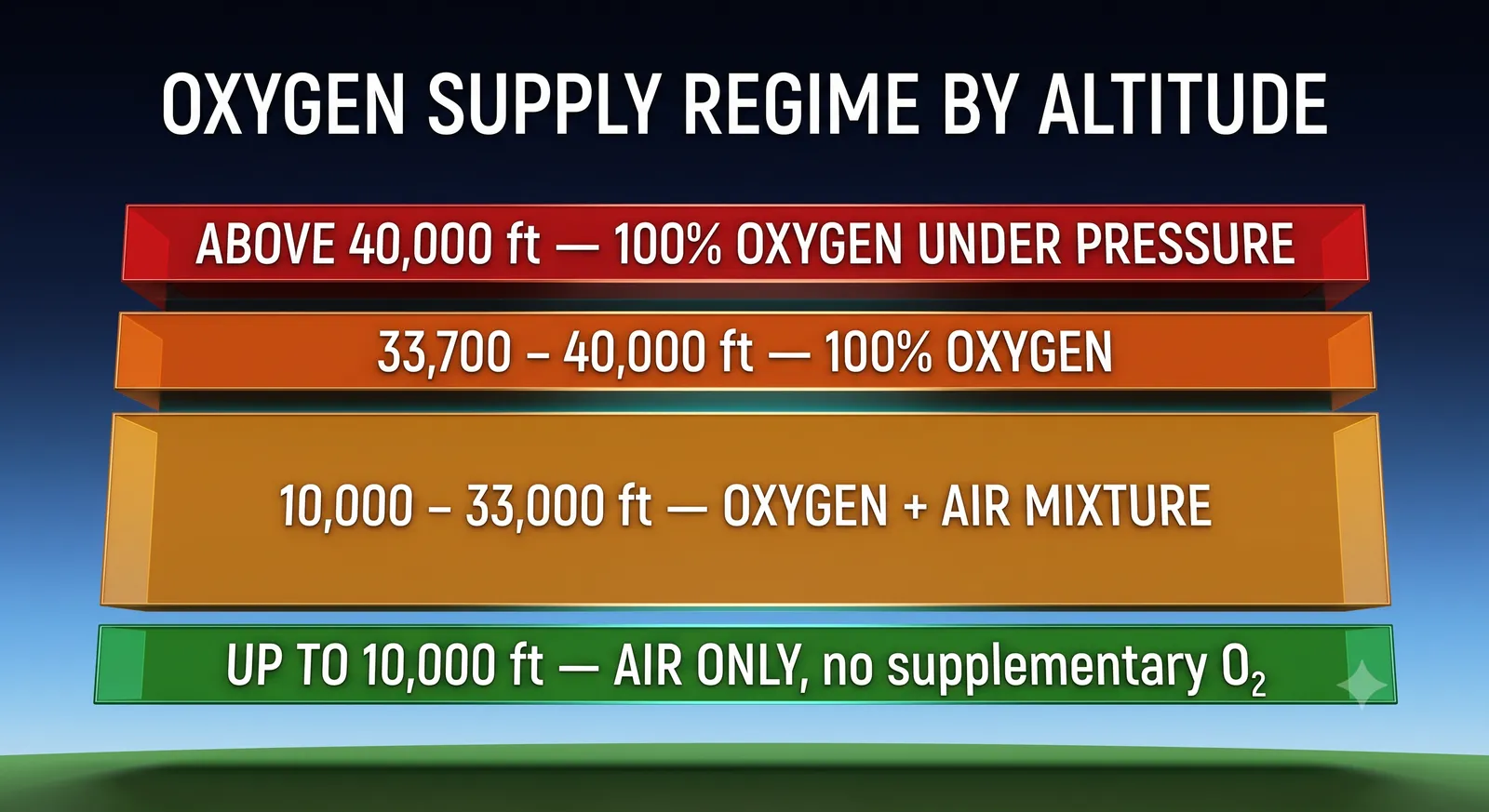
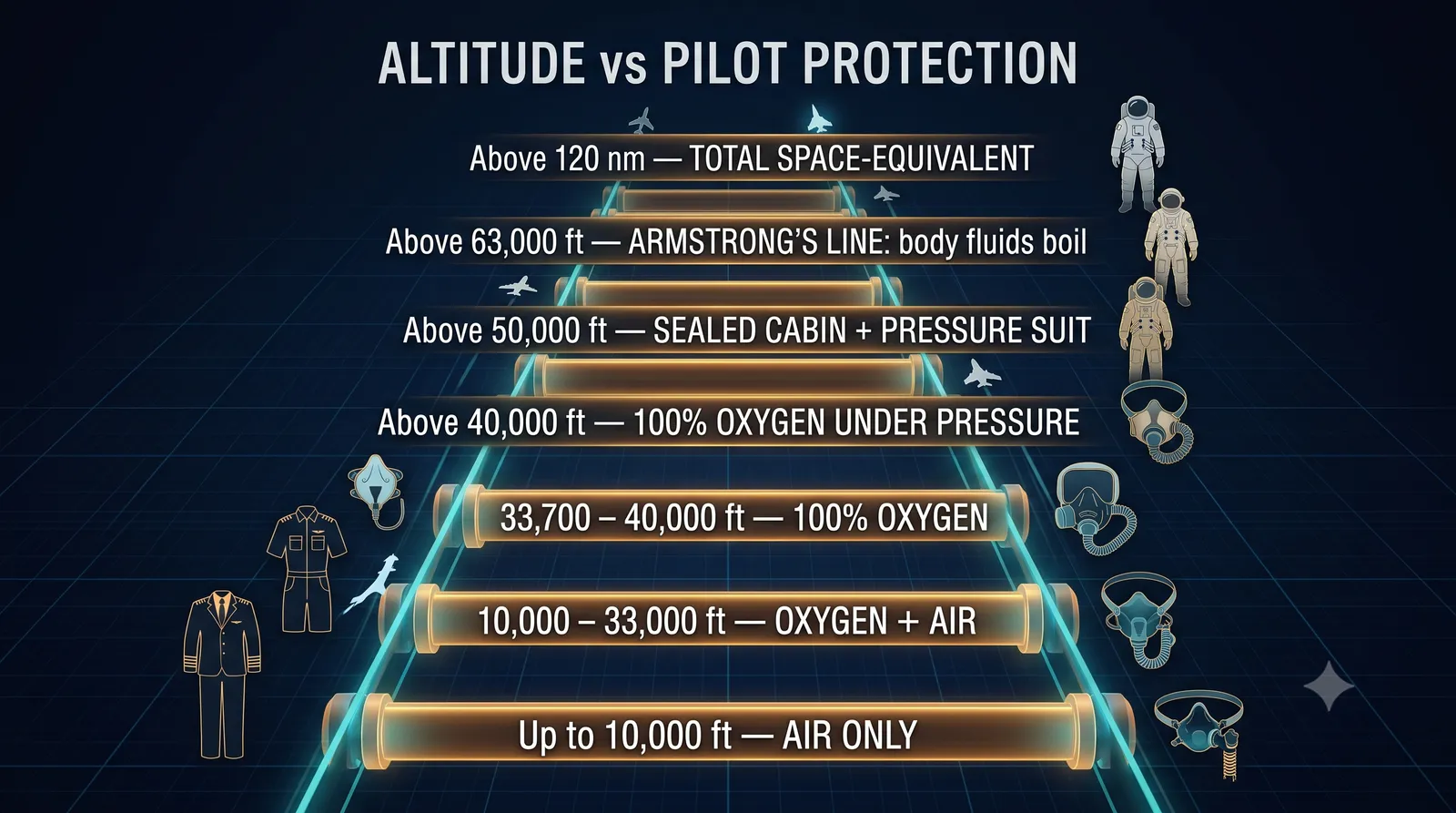
Normal healthy human beings used to living near sea level will need supplementary oxygen to function normally at altitude exceeding 10,000 to 12,000 ft. Pilots will normally begin breathing supplementary oxygen from 10,000 ft above sea level.
Figure 3.3 — The oxygen-supply regime by altitude: air only, oxygen+air, 100% oxygen, then oxygen under pressure.
5.2 The Physiological-Deficient Zone
Limits & symptoms — strict
Exists from 12,000 ft to 50,000 ft. The body is not used to this environment. The adverse effects include:
Middle ear and sinus blockage
Shortness of breath
Dizziness
Headache
Compensatory threshold
At 6,000 – 7,000 ft altitude the human organism starts with remarkable measures to compensate for the drop in pO₂ when climbing — this is the threshold for compensatory reactions. (Hyperventilation, raised heart rate, raised cardiac output, etc. — all later sections.)
A pilot climbing in a non-pressurised aircraft and WITHOUT using supplemental oxygen will pass the "critical threshold" at approximately 22,000 ft.
Breathing 100 % oxygen will lift the pilot's physiological safe altitude to approximately 38,000 ft.
5.3 The Partial Space-Equivalent Zone
Definition & extent
This zone extends from 50,000 ft to 120 nm (nautical miles). Even 100 % oxygen ceases to be enough at these heights — total pressure becomes the limiting factor.
5.4 The Total Space-Equivalent Zone
Definition
The Total Space-Equivalent Zone extends outwards from 120 nm.
Mandatory limits in the upper two zones
100 % oxygen does NOT protect from hypoxia — pressure-breathing required.
Sealed cabins and pressure suits are a MUST.
Blood and body fluids BOIL above 63,000 ft (Armstrong's Line — vapour pressure of body fluids equals ambient pressure).
Gravitational changes affect the body (micro-G adaptation, fluid shift, motion-sickness, etc.).