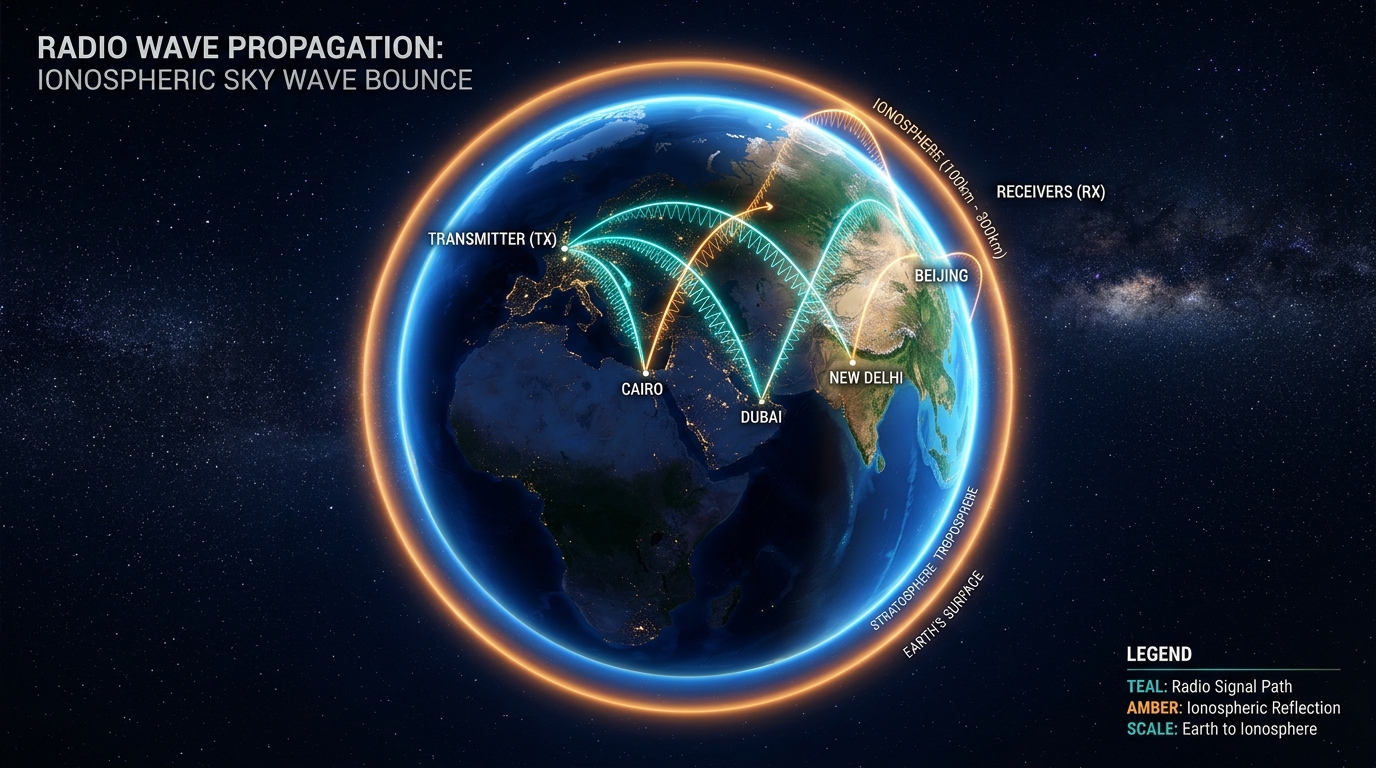
A transmitter radiates energy; a receiver picks it up — but how the wave gets from one to the other decides everything about the radio. Will it hug the curve of the Earth, bounce off a layer 300 km up, or shoot in a straight line and stop dead at the horizon? The answer depends almost entirely on frequency.
SYLLABUS MAP
Part II (ii) Propagation · day/night frequencies · skip distance · fading · ground shadow
Learning objectives — by the end of this chapter you will be able to…
Describe the three propagation paths — ground, sky and space wave — their mechanisms and bands.
Explain the structure of the ionosphere and its daily, seasonal and solar variation.
Define MUF, LUF and the optimum working frequency, and explain day/night frequency choice.
Explain skip distance and dead space, with the geometry.
Calculate line-of-sight range from the radio-horizon formula.
Explain attenuation, fading and ground shadow.
9.1 The three paths
9.2 The ground wave
9.3 The ionosphere
9.4 The sky wave: MUF, LUF & OWF
9.5 Day & night frequencies
9.6 Skip distance & dead space
9.7 The space wave & radio horizon
9.8 Attenuation, fading & ground shadow
The path a radio wave takes across the globe is dictated entirely by its frequency and the physical environment.
9.1 The three paths a radio wave takes
Propagation Paths
Path
How it travels
Band
Used by
Ground (surface) wave
Follows the curve of the Earth, hugging the surface
LF / MF
NDB; maritime
Sky wave
Refracted (bent back) by the ionosphere
HF
Long-range / oceanic HF voice
Space wave
Straight line (line-of-sight) to the radio horizon
VHF & above
ATC VHF voice, VOR, ILS
Mnemonic
Low hugs, High bounces, VHF shoots straight. LF/MF follow the ground; HF bounces off the ionosphere; VHF and up go line-of-sight.
9.2 The ground wave
FIRST PRINCIPLES — WHY LOW FREQUENCIES FOLLOW THE EARTH
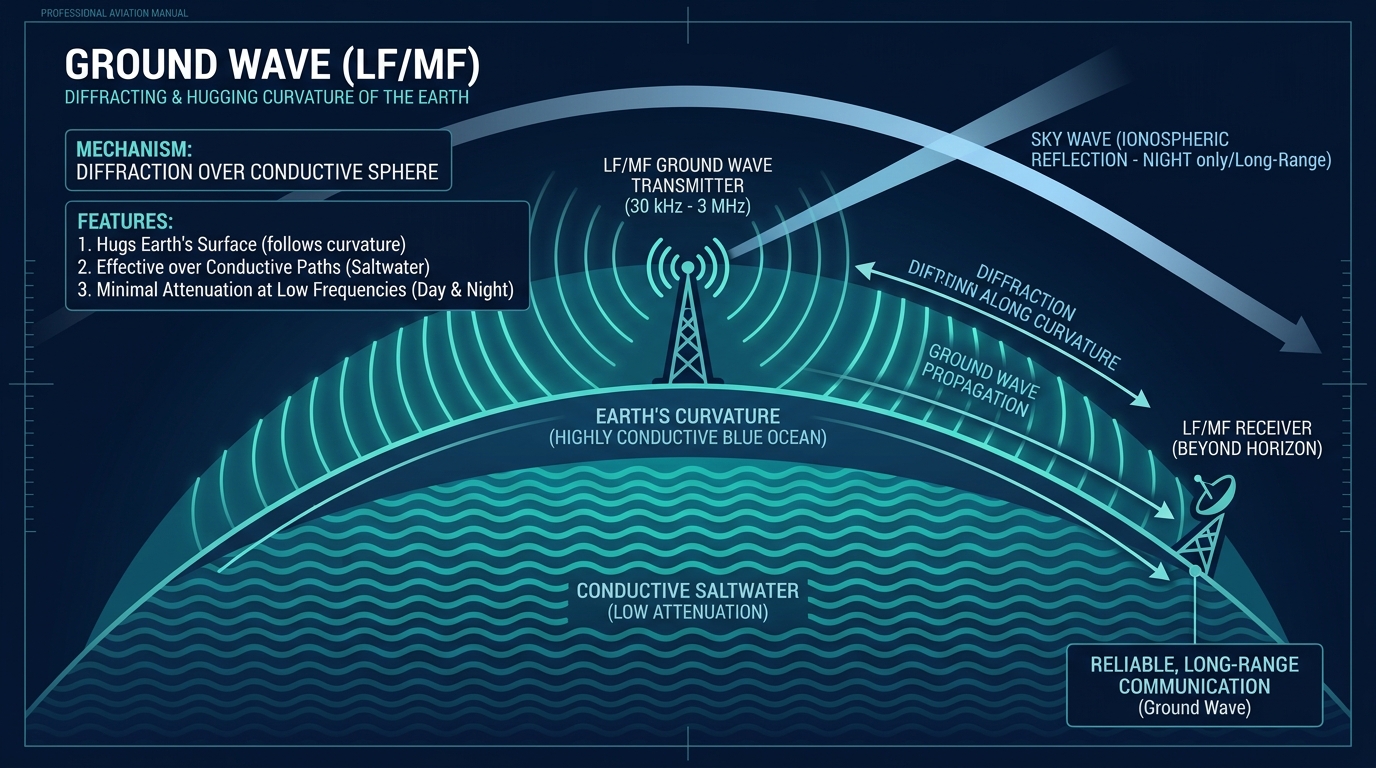
A vertically-polarized wave at low frequency induces currents in the conducting surface of the Earth; these slow the bottom of the wavefront, tilting it forward so it diffracts around the curve of the planet. The lower the frequency, the better it clings — and the farther it reaches.
What sets ground-wave range
Range grows with transmitter power, with lower frequency, and with the conductivity of the surface — so it is much greater over sea water (highly conductive) than over dry land or mountains. This is the path the NDB relies on, giving useful range beyond line-of-sight at low level.
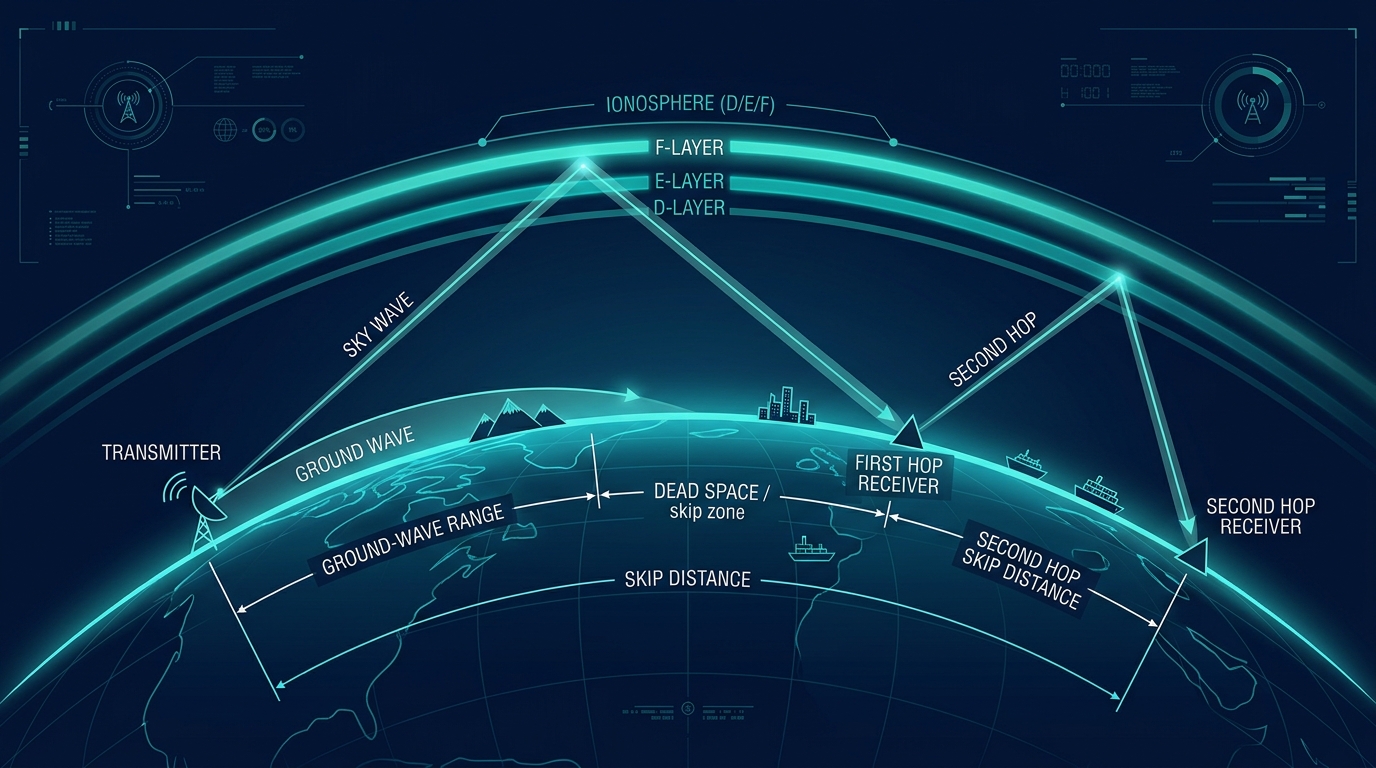
The ground wave diffracts around the curvature of the Earth, achieving greatest range over highly conductive sea water.
9.3 The ionosphere
IN PLAIN TERMS
High above the Earth, solar radiation strips electrons from thin air, creating electrically charged layers. These act like a mirror for HF radio, bending the wave back to Earth and giving HF its enormous range.
The layers
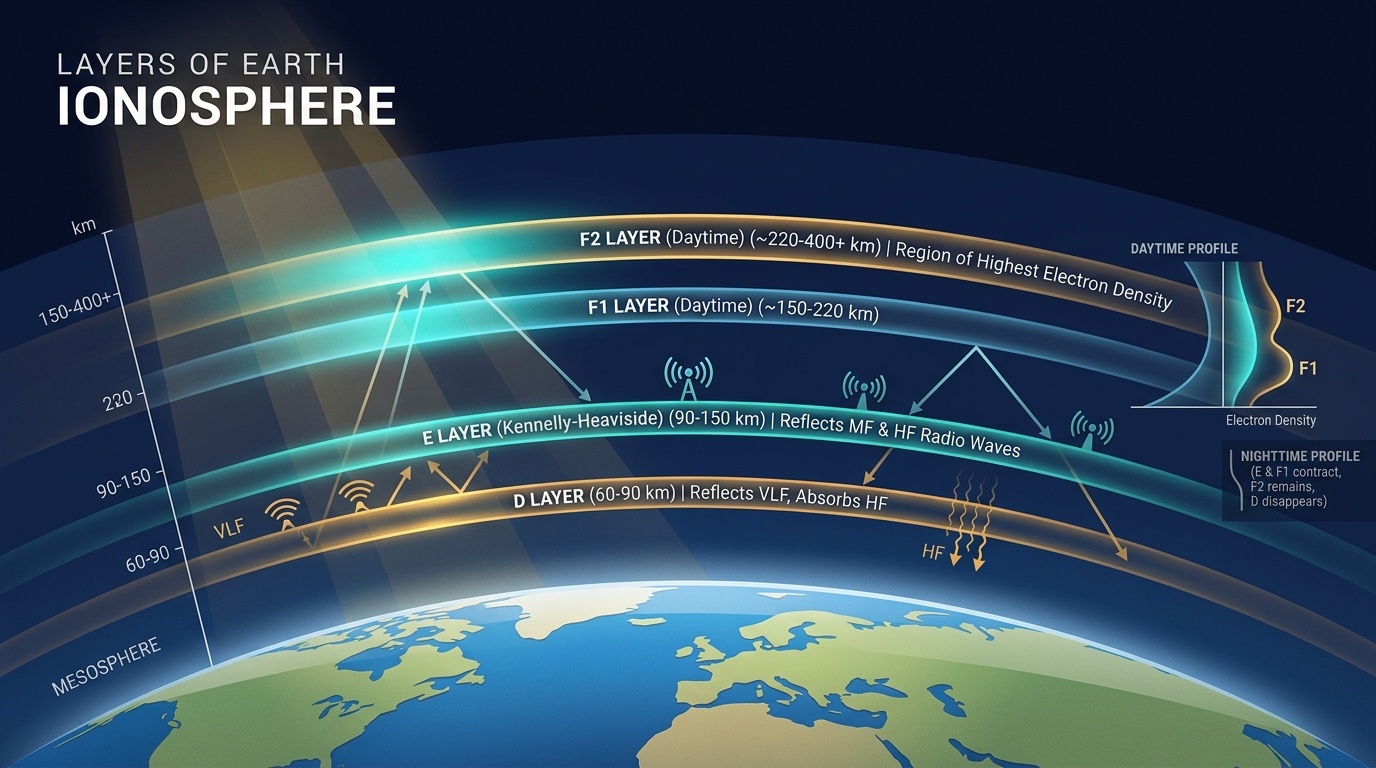
D layer (lowest, ≈60–90 km) — forms only by day and absorbs lower HF frequencies. E layer (≈90–150 km). F1 & F2 layers (highest, ≈150–400 km) — the main HF-refracting layers; at night F1 and F2 merge into a single, weaker F layer.
Variation — why HF is never constant
Ionisation depends on the Sun, so it varies diurnally (strong by day, weak by night), seasonally, and with the 11-year solar cycle (sunspots). The critical frequency is the highest frequency a layer will reflect at vertical incidence; above it the wave punches straight through.
The structure of the ionosphere: The D layer absorbs signals during the day, while the F layers act as a mirror for high-frequency (HF) sky waves.
9.4 The sky wave: MUF, LUF & OWF
Definitions
MUF — Maximum Usable Frequency: the highest frequency the ionosphere will still refract back to a given point. Above it, the wave escapes into space and is lost. LUF — Lowest Usable Frequency: the lowest frequency that still arrives usable; below it, D-layer absorption kills it. OWF — Optimum Working Frequency: typically about 85% of the MUF — set safely below the MUF so normal ionospheric variation doesn't push the working frequency above it. The usable window lies between LUF and MUF.
Angle of incidence & hops
A wave striking the ionosphere at a shallow (grazing) angle is refracted back over a long distance; a steep angle may punch through. By bouncing between the ionosphere and the ground, a sky wave can make several hops, reaching right around the world.
9.5 Day & night frequencies
FIRST PRINCIPLES — WHY HF TRACKS THE SUN
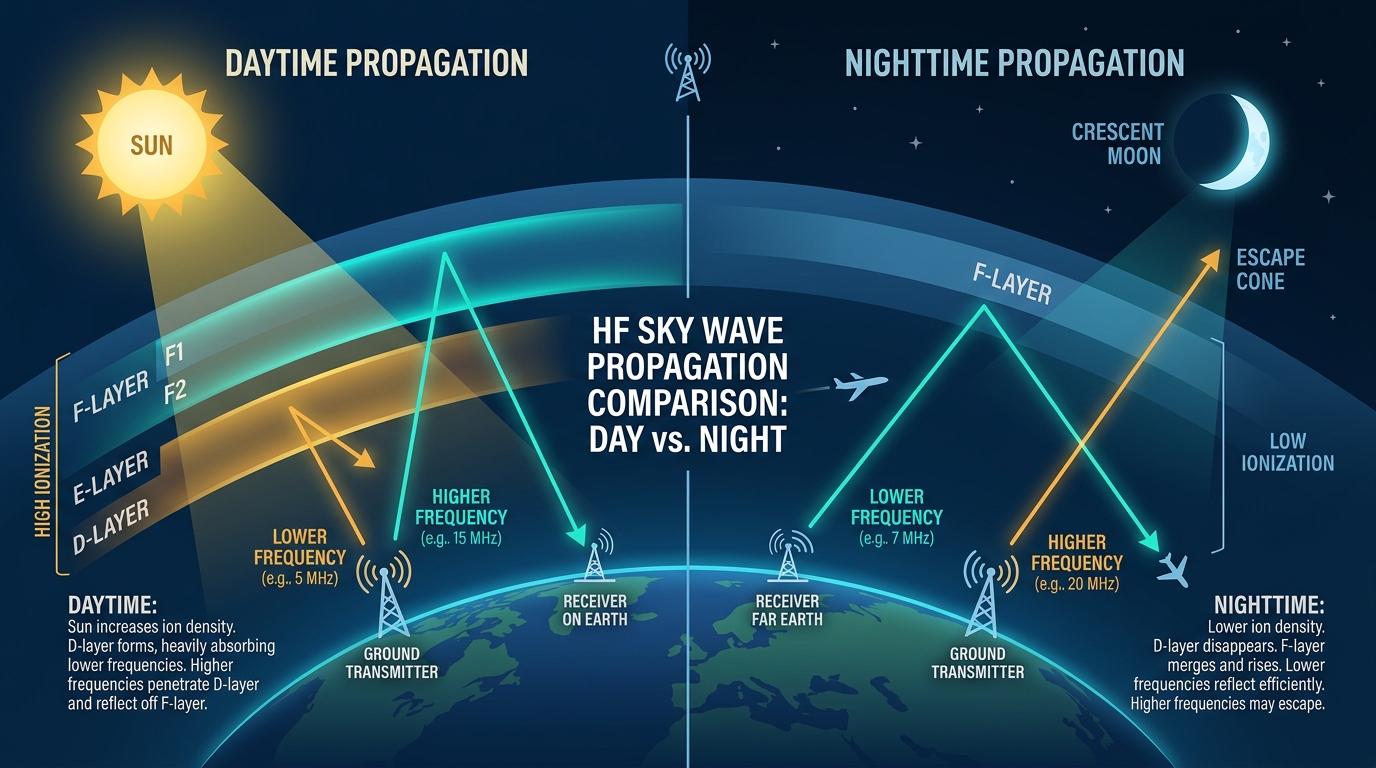
By day the D layer is present and absorbs lower frequencies, so you must use a higher HF frequency to get through. By night the D layer disappears and the ionosphere weakens, so a lower HF frequency works best.
The rule of thumb
Higher frequency by DAY, lower frequency by NIGHT for HF sky-wave communication. This is why long-haul crews change their HF frequency as they cross the day/night terminator.
Mnemonic
"Day = High, Night = Low." Sun up, frequency up.
By day, the absorbing D-layer forces crews to use higher frequencies. By night, the D-layer vanishes, allowing lower frequencies to reach the reflecting F-layer.
9.6 Skip distance & dead space
Definitions
Skip distance: the distance from the transmitter to the point where the first sky wave returns to Earth. Dead space (skip zone): the silent ring between the end of ground-wave coverage and the point where the first sky wave lands — a region where neither wave reaches and reception fails.
Exam trap
Skip distance increases as you raise the frequency (toward the MUF) and as the ionosphere weakens at night — which is why dead space changes through the day. Above the MUF there is no sky-wave return at all.
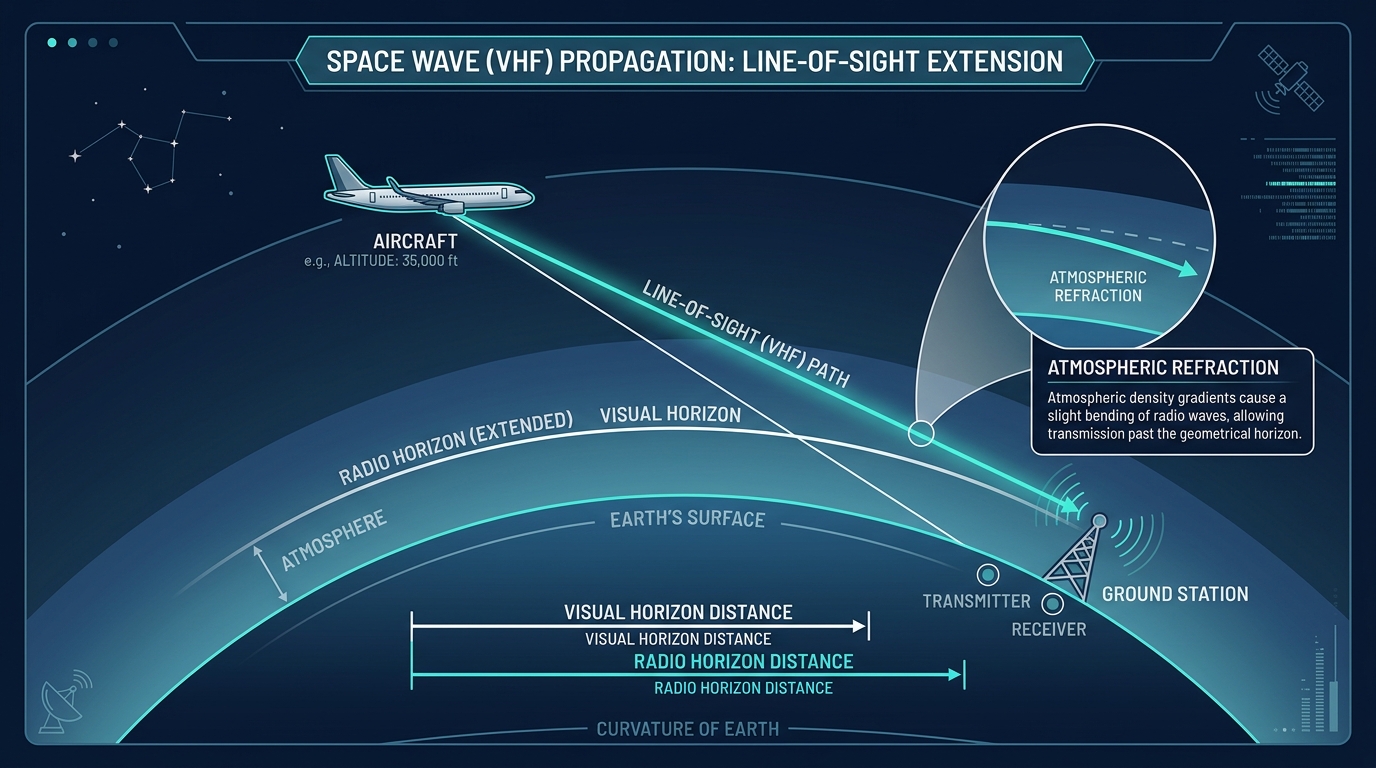
VHF and above travel in essentially straight lines (the space wave), so range is set by the radio horizon — and the higher you (or the station) are, the farther that horizon. This is why a VHF call that fails on the ground works once you climb.
d (NM) ≈ 1.23 × √h
h = height in feet · the radio horizon is slightly beyond the visual horizon (atmospheric refraction)
Worked example — line-of-sight range
At 10,000 ft: d ≈ 1.23 × √10,000 = 1.23 × 100 = 123 NM to the radio horizon.
If the ground station antenna is at 400 ft: its horizon ≈ 1.23 × √400 = 1.23 × 20 = ≈ 25 NM. The total path is the sum: 123 + 25 ≈ 148 NM.
Takeaway: more height, more range — the exact figure isn't usually required, but the principle and the formula are.
VHF and UHF waves travel in a straight line-of-sight. Atmospheric refraction bends them slightly, making the radio horizon ≈15% farther than the visual horizon. Deep dive — ducting & super-refraction
Occasionally a temperature inversion traps VHF/UHF in a "duct" near the surface, carrying it far beyond the normal horizon (super-refraction). The opposite, sub-refraction, shortens range. These are anomalies, not the rule — for the exam, treat VHF as reliable line-of-sight whose range grows with altitude.
9.8 Attenuation, fading & ground shadow
Three signal enemies
Attenuation — the natural weakening of a signal with distance and absorption. Fading — fluctuation in received strength, typically when two paths (ground + sky, or two sky paths) arrive together and interfere; common on HF at dusk. Ground shadow — loss of a line-of-sight (space) wave behind a hill, building or terrain that blocks it.
Cockpit reality
Low on approach behind high ground, your VHF can drop out — that's ground shadow; climb a little and the line-of-sight clears. On HF over the ocean at night you'll hear the signal swell and fade — that's sky-wave fading, eased by selecting a better frequency.
☆ Numbers to memorise
Essential Facts for Chapter 9
Fact
Value
Ground wave
LF/MF, follows Earth's curve, better over sea (NDB)
Sky wave
HF, refracted by ionosphere (long range, multi-hop)
Space wave
VHF+, line-of-sight to radio horizon
Ionosphere layers
D, E, F1, F2 (D absorbs by day; F1/F2 merge at night)
HF day/night
Higher freq by day, lower by night
MUF / LUF / OWF
Max usable / Lowest usable / ≈85% of MUF
Dead space
Gap between ground-wave range and first sky-wave return
Radio horizon
d (NM) ≈ 1.23 × √h(ft)
Question bank
Part A — MCQs (click an option to check)
1. An NDB relies mainly on which propagation path?
Ground (surface) wave
Sky wave
Space wave
Satellite
Answer: Ground (surface) wave. NDB (LF/MF) uses the ground wave that follows the Earth's curvature.
2. Ground-wave range is greatest over:
Dry desert
Sea water (high conductivity)
Mountains
Forest
Answer: Sea water (high conductivity). Higher surface conductivity (sea) gives much greater ground-wave range.
3. Long-range HF communication is achieved by:
Ground wave
Sky wave refracted by the ionosphere
Line-of-sight space wave
Direct wave only
Answer: Sky wave refracted by the ionosphere. HF sky waves refract off the ionosphere to travel thousands of miles.
4. Which ionospheric layer absorbs lower HF frequencies by day?
D layer
E layer
F1 layer
F2 layer
Answer: D layer. The D layer forms by day and absorbs lower frequencies; it disappears at night.
5. For HF, the best night-time frequency compared with daytime is generally:
Higher
Lower
The same
Zero
Answer: Lower. The D layer disappears at night, so a lower frequency works best — "day high, night low."
6. A frequency above the MUF will:
Be absorbed by the D layer
Pass through the ionosphere into space
Follow the ground
Always reflect
Answer: Pass through the ionosphere into space. Above the Maximum Usable Frequency the wave is no longer refracted back — it escapes to space.
7. The optimum working frequency (OWF) is typically about:
50% of the MUF
85% of the MUF
110% of the MUF
Equal to the LUF
Answer: 85% of the MUF. The OWF is set around 85% of the MUF so variation doesn't push it above the MUF.
8. The silent ring between ground-wave coverage and the first returning sky wave is the:
Skip distance
Dead space (skip zone)
Radio horizon
Fading zone
Answer: Dead space (skip zone). Dead space is the gap where neither ground nor sky wave is received.
9. Skip distance generally increases when:
Frequency is lowered
Frequency is raised toward the MUF / at night
Power is reduced
The antenna is shortened
Answer: Frequency is raised toward the MUF / at night. Higher frequency and a weaker (night) ionosphere lengthen the skip distance.
10. The line-of-sight range from 10,000 ft is approximately:
11. VHF reception is lost behind a hill on approach. This is:
Sky-wave fading
Skip distance
Ground shadow
Absorption by the D layer
Answer: Ground shadow. Terrain blocking the line-of-sight (space) wave creates a ground shadow.
12. Fading on an HF signal is usually caused by:
High transmitter power
Two paths interfering (e.g. ground + sky, or two sky paths)
A short antenna
Vertical polarization
Answer: Two paths interfering (e.g. ground + sky, or two sky paths). Fading is interference between signals arriving by different paths, common on HF.
13. The ionosphere's ionisation varies with:
Transmitter power only
Time of day, season and the 11-year solar cycle
Antenna length
Aircraft altitude
Answer: Time of day, season and the 11-year solar cycle. It is driven by the Sun, so it varies diurnally, seasonally and with the sunspot cycle.
14. A sky wave can reach right around the world by:
Following the ground
Multiple hops between the ionosphere and the ground
Travelling in a straight line
Using a satellite
Answer: Multiple hops between the ionosphere and the ground. Repeated refraction and ground reflection make multiple hops possible.
15. The radio horizon is, compared with the visual horizon:
Shorter
Slightly farther (atmospheric refraction)
Exactly the same
Half as far
Answer: Slightly farther (atmospheric refraction). Atmospheric refraction bends the wave slightly, extending the radio horizon a little beyond the visual one.
16. Which path does VHF ATC voice use?
Ground wave
Sky wave
Space wave (line-of-sight)
All three equally
Answer: Space wave (line-of-sight). VHF uses the space wave — line-of-sight, range growing with altitude.
Part B — Oral / viva (tap to reveal model answers)
Name the three propagation paths and the bands that use them.
Model Answer:
Ground (surface) wave — LF/MF, follows the Earth's curve; sky wave — HF, refracted by the ionosphere; space wave — VHF and above, line-of-sight.
Describe the ionosphere and how it varies.
Model Answer:
Layers of ionised air — D, E, F1, F2 — created by solar radiation. The D layer forms by day and absorbs lower HF; the F layers refract HF. Ionisation varies diurnally, seasonally and with the 11-year solar cycle.
Define MUF, LUF and OWF.
Model Answer:
MUF — the maximum usable frequency the ionosphere will refract back; above it the wave is lost. LUF — the lowest usable frequency; below it the signal is absorbed. OWF — the optimum working frequency, about 85% of the MUF.
Why does the choice of HF frequency change between day and night?
Model Answer:
By day the D layer absorbs lower frequencies, so a higher frequency is needed; by night the D layer disappears, so a lower frequency works best.
What is dead space, and how does it relate to skip distance?
Model Answer:
Dead space (skip zone) is the region between the limit of ground-wave reception and the point where the first sky wave returns (the skip distance) — where neither wave is received.
How is VHF line-of-sight range estimated, and what increases it?
Model Answer:
By the radio-horizon formula d ≈ 1.23 × √h, with h in feet; combine the heights of aircraft and station. Range increases with height — the higher you fly, the farther the horizon.
Part C — Numerical problems (tap for worked solutions)