Part I (vi) Licensing of radio apparatus · (vii) Minimum radio equipment per Annex 6 (ICAO & DGCA)
Learning objectives — by the end of this chapter you will be able to…
- Distinguish the operator's licence (RTR) from the aircraft radio station licence, and name the authority that issues each.
- Describe how radio apparatus is licensed in India (WPC, NFAP, SACFA) and why type approval matters.
- State the minimum communication, navigation and surveillance equipment Annex 6 requires, and how it scales with the operation.
- Explain the independence (no single-point-failure) requirement and apply it.
- Describe ELT and transponder carriage and the role of the Minimum Equipment List (MEL).
- Explain how India's CARs give Annex 6 domestic effect.
3.1 Why two licences, not one
3.2 The operator's licence (RTR)
3.3 Licensing the apparatus — WPC, NFAP, SACFA
3.4 Annex 6 — the minimum-equipment standard
3.5 Communication equipment required
3.6 Navigation & surveillance required
3.7 The independence rule
3.8 ELT & emergency equipment
3.9 The MEL — flying with an item u/s
3.10 How India applies Annex 6
3.1 Why two licences, not one
The radio-frequency spectrum is policed at two independent levels because two different things can go wrong. The person can be untrained — so the operator is licensed (the RTR). The equipment can be the wrong type, off-frequency, or interfering — so the apparatus is licensed too (the aircraft radio station licence). Remove either control and the system fails: a trained pilot on an unapproved, interfering transmitter is as dangerous as an approved radio in untrained hands. To make a single legal transmission, both authorisations must exist at the same time.
Operator's licence — RTR(A): authorises a person to operate aeronautical radio equipment and use the airwaves.
Aircraft Radio Station Licence / installation approval: authorises the radio apparatus installed in a particular aircraft to transmit on assigned frequencies. Issued by the national radio authority and carried/registered with the aircraft.
"What licences are needed to operate an aircraft radio?" — the complete answer is both: the operator's RTR and the aircraft radio station licence. Naming only one is the classic half-mark answer.
3.2 The operator's licence (RTR)
The RTR(A) is the certificate covered in Chapter 1 — the licence of the person at the microphone. It certifies that the operator knows the regulations, the radio theory, and the disciplined phraseology needed to use a shared, safety-critical frequency.
The aircraft may carry a fully approved, licensed radio installation, but it may only be operated by a person holding a valid radio operator's licence appropriate to the equipment — for civil aircraft radiotelephony, the RTR(A). Operation by an unlicensed person is an offence even if the equipment itself is fully licensed.
Confirm the exact wording linking operator licensing to operation of aircraft radio under the RTR (Restricted) Rules, 2025, and any categories of person permitted to operate under supervision/exemption.
3.3 Licensing the apparatus — WPC, NFAP, SACFA
A transmitter radiates energy into shared spectrum. If it is the wrong type, drifts off frequency, or radiates spurious emissions, it interferes with everyone else on the band — potentially blocking a distress call. So the State requires that each radio station be type-approved and licensed, and that its frequencies be assigned from the national plan so two stations don't clash.
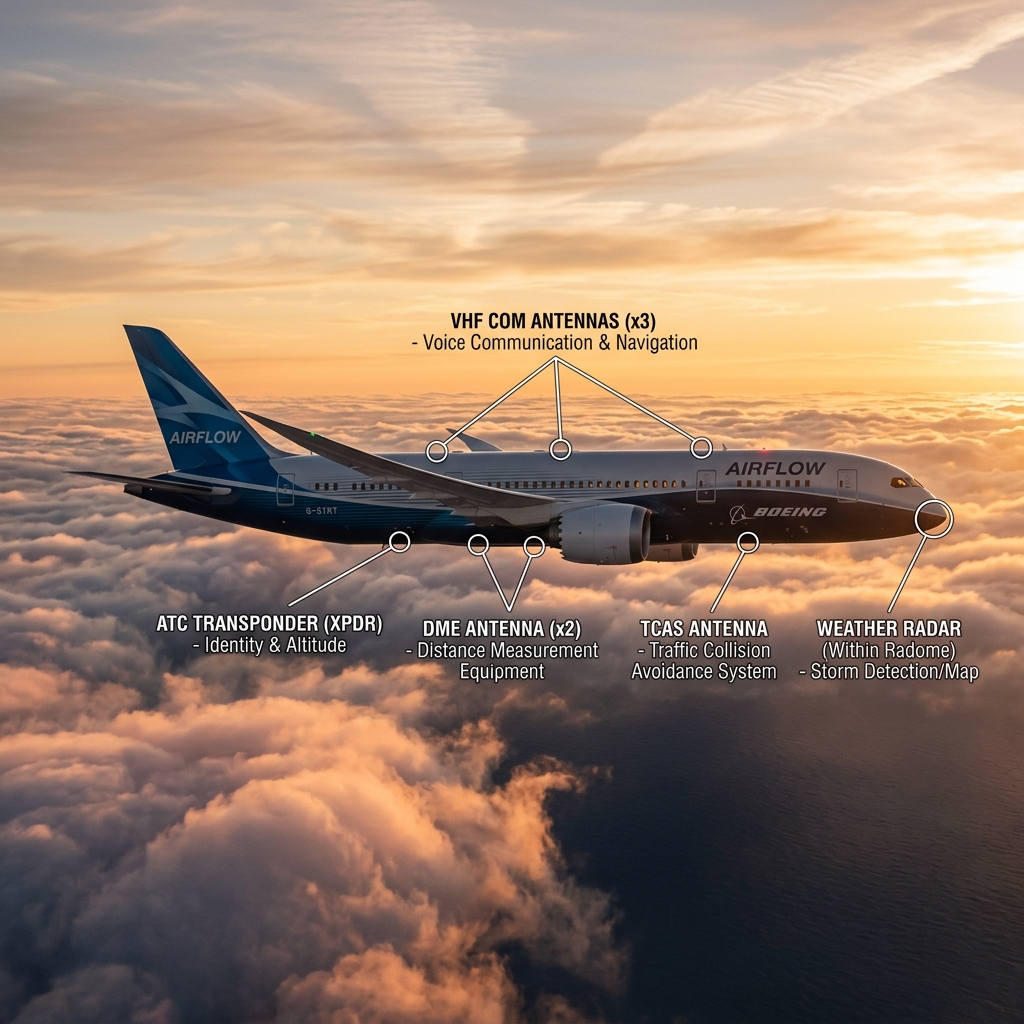
WPC (Wireless Planning & Coordination) Wing, Ministry of Communications — the national radio regulator: it licenses the use of radio spectrum and apparatus and assigns frequencies.
NFAP (National Frequency Allocation Plan) — India's table of which services may use which bands, derived from the ITU Radio Regulations.
SACFA (Standing Advisory Committee on Frequency Allocation) — clears siting of transmitters/masts.
The DGCA separately regulates the airworthiness and operational fitment of the equipment in the aircraft.
WPC licenses the box; DGCA approves the fitment; you (RTR) operate it. Spectrum & apparatus = Communications ministry; airworthiness & operation = Civil Aviation.
Confirm the exact current name and validity period of the aircraft radio station licence in India and whether the 2025 framework changed the issuing route. Insert the validity figure if examinable.
3.4 Annex 6 — the minimum-equipment standard
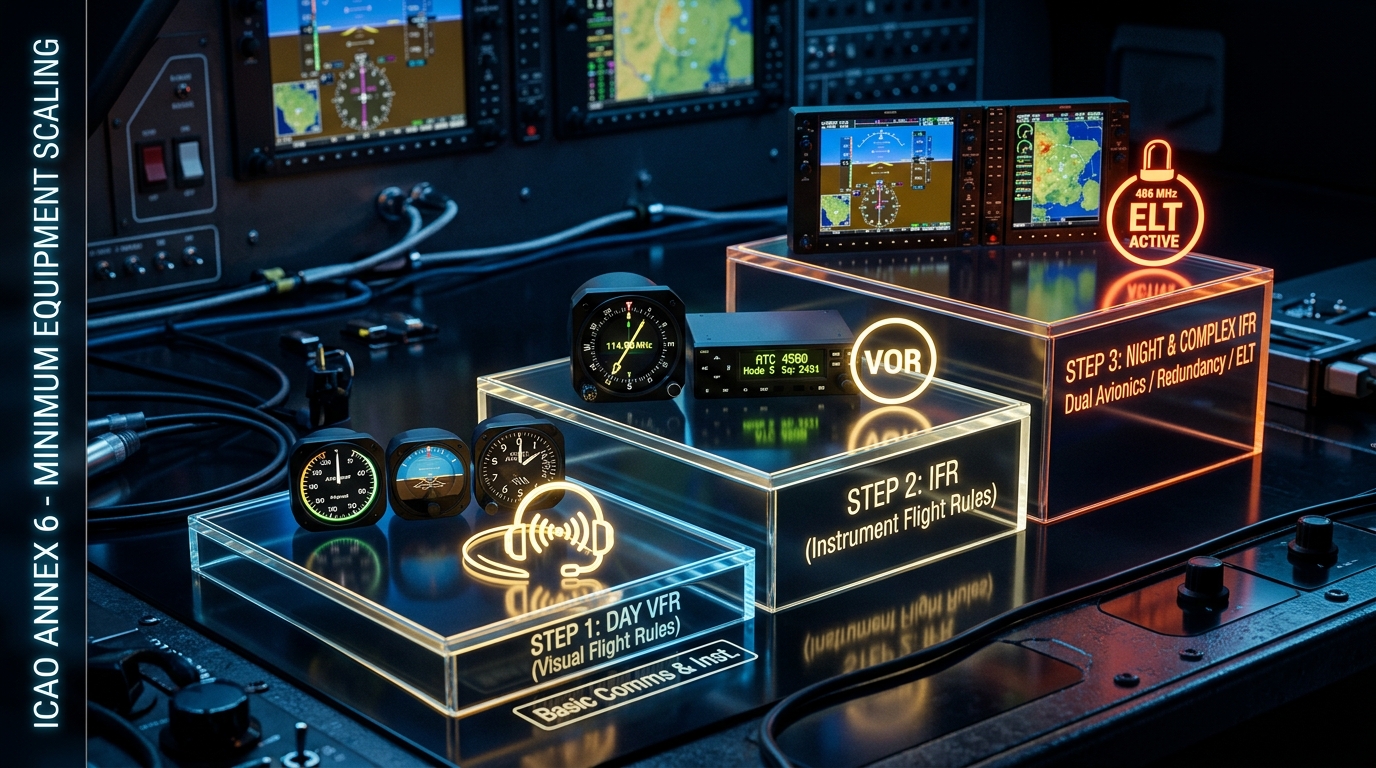
An aircraft may not set off carrying whatever radios the owner happens to fancy. ICAO Annex 6 (Operation of Aircraft) prescribes the minimum communication, navigation and surveillance equipment that must be carried — and the requirement scales with the kind of flying: more is required for IFR and night than for simple day-VFR.
Annex 6 — Operation of Aircraft. Part I covers international commercial air transport (aeroplanes); Part II international general aviation (aeroplanes); Part III helicopters. It prescribes, among much else, the minimum communication, navigation and surveillance equipment to be carried.
3.5 Communication equipment required
An aircraft shall carry radio communication equipment capable of:
• conducting two-way communication with the appropriate aeronautical stations on the frequencies required by the authority;
• receiving meteorological information at any time during flight;
• conducting two-way communication at any time with at least one aeronautical station and such other stations/frequencies as prescribed for the route.
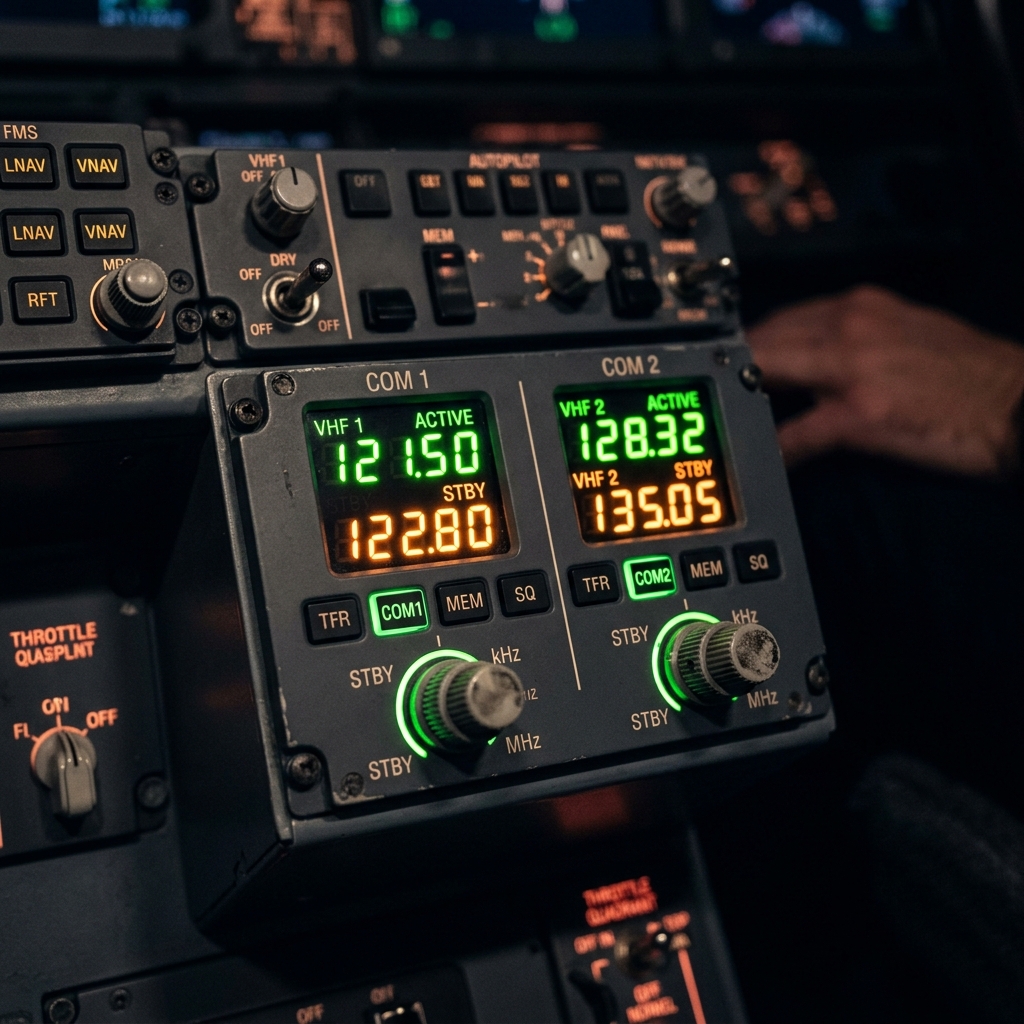
Notice the standard is written around capability and availability, not mere possession of a box. A receive-only set, or one that cannot reach a met broadcast en route, would not satisfy it. This is precisely why airliners carry multiple independent COM radios and can tune VOLMET/ATIS — the rule demands the capability to talk both ways and to get weather throughout the flight.
3.6 Navigation & surveillance required
The aircraft shall also carry navigation equipment sufficient to proceed in accordance with its flight plan and the requirements of air traffic services; and, where required for the airspace, a transponder (SSR/Mode S) and other surveillance equipment. For IFR or night operations the standard rises to redundant communication and navigation equipment appropriate to the route, and for precision approaches the relevant ILS/radio-altimeter fit.
"Sufficient to proceed per flight plan" is why an aircraft must hold the right navigation approval (e.g. RNP/PBN, Chapter 12) for the route it files. File an RNP route without the equipment and approval, and you are below the Annex 6 minimum for that flight.
3.7 The independence rule
Communication and navigation equipment shall be installed so that the failure of any single unit required for either communication or navigation purposes will not result in the failure of another unit required for the other purpose. In plain words: one failure must not take out both your talking and your navigating.
Two VHF radios and two navigation receivers share a single power bus and a single antenna coupler.
Does this meet the independence rule? No — the shared bus (or coupler) is a single point whose failure disables comms and nav together.
Compliant design: separate power sources/buses and separate antenna feeds, so any one failure leaves the other function working. This is why airliners split avionics across independent buses and generators.
3.8 ELT & emergency equipment
Annex 6 requires the carriage of an ELT (the number/type depending on the operation). It activates automatically on impact (or manually) and transmits on the 406 MHz satellite distress frequency (with a coded, registered identity) and 121.5 MHz for homing, to summon search and rescue. (Full detail in Chapter 22.)
Insert the exact Indian CAR figures: number/type of ELTs required by operation, mandatory transponder (Mode S / ADS-B) carriage threshold, and the precise minimum-equipment wording from the current DGCA CAR mirroring Annex 6.
3.9 The MEL — flying with an item unserviceable
If a required item is unserviceable, the aircraft is not automatically grounded. The Minimum Equipment List tells the crew whether, and under what conditions, the flight may still be made.
The MMEL (Master MEL) is produced by the manufacturer/State of design and lists items that may be inoperative for a type. The operator's MEL is at least as restrictive and approved for that operator. It specifies any limitations and "O" (operational) or "M" (maintenance) procedures required to dispatch with the item inoperative. The Annex 6 minimum-equipment principle is exactly what the MEL enforces: never depart below the legal minimum for the intended flight.
3.10 How India applies Annex 6
Annex 6 is the global standard; the DGCA writes the Indian version into its Civil Aviation Requirements, so the minimum-equipment rule you are tested on is the Indian CAR that mirrors Annex 6 — confirmed at every pre-flight by checking the required radios are fitted, serviceable, and (if not) permitted by the MEL.
🔍 Deep dive — type approval & spurious emissions
"Type approval" means a radio model has been tested to confirm it transmits only within its assigned channel, with controlled power and acceptably low spurious emissions (unwanted outputs on other frequencies). A non-type-approved or faulty transmitter can splatter energy across adjacent channels — the same effect as over-modulation in Chapter 10 — which is why both the equipment and its installation are licensed, not just bought and bolted in.
☆ Numbers to memorise
| Fact | Value |
|---|---|
| Licences needed | Operator's RTR(A) + Aircraft Radio Station Licence (apparatus) |
| Apparatus regulator (India) | WPC Wing, Ministry of Communications (NFAP, SACFA) |
| Fitment/airworthiness regulator | DGCA |
| Minimum-equipment standard | ICAO Annex 6 — Operation of Aircraft (Parts I/II/III) |
| Core radio capability | Two-way comms on required frequencies + receive met at any time |
| Navigation requirement | Sufficient to proceed per flight plan + ATS requirements (+ transponder) |
| Independence rule | Single failure must not disable both comms and navigation |
| Emergency beacon | ELT — 406 MHz (satellite) + 121.5 MHz (homing) |
| Dispatch with item u/s | Governed by the MEL (derived from the MMEL) |
Part A — MCQs (click an option to check)
Part B — Oral / viva (tap to reveal model answers)
60-SECOND REVISION CARD
- Two licences: RTR(A) (operator) + aircraft radio station licence (apparatus, via WPC).
- India: WPC = spectrum/apparatus (NFAP, SACFA); DGCA = airworthiness/fitment.
- Minimum-equipment standard = ICAO Annex 6; scales up for IFR/night.
- Core radio: two-way comms on required frequencies + receive met any time; nav per flight plan + transponder.
- Independence: one failure must not kill both comms and nav. ELT 406 + 121.5; dispatch u/s governed by the MEL.