CONSOLIDATED FROM MODULES A, B & C
Pair this chapter with the Chapter 24 Question Bank for your final exam preparation.
How to use this chapter
- Each table is a self-test: use the button below to blur the right-hand column, then tap/hover to reveal the value from the cue.
- The "Quick cards" at the end are the reference sheets to photograph and carry.
- Finish with the rapid-fire self-test, then move to the Chapter 24 question bank.
A · Regulations, bodies & documents
B · Licensing, Annexes & equipment
C · Q-codes, pressure & definitions
D · FIRs, frequencies & AIS
E · Meteorology & RVR
F · Electrical & wave relationships
G · Frequency bands & propagation
H · Modulation & equipment
I · Navigation aids & squawks
J · Phraseology, numbers & procedures
☆ Quick cards
? Rapid-fire self-test
A Regulations, bodies & documents
| Cue | Value |
|---|---|
| Chicago Convention | Signed 7 Dec 1944 (52 States); in force 4 Apr 1947; created ICAO; 96 Articles, 19 Annexes |
| Article 1 | Complete & exclusive sovereignty over national airspace |
| Article 38 | Notify ICAO of any differences from a Standard |
| ICAO | UN specialised agency · HQ Montreal · Assembly / Council(36) / ANC / Secretariat |
| ITU | UN agency · HQ Geneva · founded 1865 (oldest) · ITU-R/T/D · allocates spectrum (Radio Regs) |
| ITU Regions | Region 1 (Europe/Africa/ME), Region 2 (Americas), Region 3 (Asia-Pacific — India) |
| IATA | Airline trade association (not a regulator); 3-letter airport / 2-letter airline codes |
| Standard vs Recommended | Standard = necessary (comply or file difference); Recommended = desirable |
| India | DGCA (regulator/CARs) · AAI (ANS) · WPC (spectrum/NFAP) · BCAS (security) · AAIB (investigation) |
| Key ICAO docs | Annex 10 (telecom) · Doc 4444 PANS-ATM · Doc 8168 PANS-OPS · Doc 9432 RTF Manual |
B Licensing, the 19 Annexes & equipment
| Cue | Value |
|---|---|
| RTR(A) | Radio Telephone Operator (Restricted), Aeronautical — for the aeronautical mobile service |
| Two licences | Operator's RTR(A) + aircraft radio station licence (apparatus, via WPC) |
| Governing law | Bharatiya Vayuyan Adhiniyam 2024 · RTR (Restricted) Rules 2025 · CAR Sec 7, Series G, Part VI |
| Minimum equipment | ICAO Annex 6 (Operation of Aircraft); scales up for IFR/night |
| Independence rule | One failure must not disable both comms and navigation |
| Dispatch u/s | Governed by the MEL (from the MMEL) |
| # | Annex | # | Annex |
|---|---|---|---|
| 1 | Personnel Licensing | 11 | Air Traffic Services |
| 2 | Rules of the Air | 12 | Search and Rescue |
| 3 | Meteorological Service | 13 | Accident & Incident Investigation |
| 4 | Aeronautical Charts | 14 | Aerodromes |
| 5 | Units of Measurement | 15 | Aeronautical Information Services |
| 6 | Operation of Aircraft | 16 | Environmental Protection |
| 7 | Aircraft Nationality & Registration | 17 | Security |
| 8 | Airworthiness of Aircraft | 18 | Dangerous Goods |
| 9 | Facilitation | 19 | Safety Management |
| 10 ☆ | Aeronautical Telecommunications — 5 volumes (RTR uses Vol I & II) | ||
C Q-codes, pressure & vertical definitions
| Cue | Value |
|---|---|
| QNH | Set → altimeter reads ALTITUDE (AMSL); reads aerodrome elevation on the ground |
| QFE | Set → reads HEIGHT above aerodrome; zero on the runway |
| QNE | Standard 1013.2 hPa (29.92 inHg) → FLIGHT LEVEL |
| QFF | True MSL pressure (meteorological, not flown) |
| Pressure lapse | ≈ 1 hPa per 27 ft near sea level |
| Transition | Climb: set 1013 at transition ALTITUDE · Descend: set QNH at transition LEVEL |
| QDM / QDR | Magnetic heading TO / bearing FROM station (QDR = QDM ± 180°) |
| QUJ / QTE | True bearing TO / FROM the station |
| QSY / QGH | Change frequency / controlled descent (DF let-down) |
| Altitude/Height/Elevation/FL | From MSL / from a datum / of a surface point / referenced to 1013.2 hPa |
D FIRs, frequencies & AIS
| Cue | Value |
|---|---|
| Indian FIRs | Delhi, Mumbai, Kolkata, Chennai (+ Chennai Oceanic) |
| ICAO location codes | VIDP Delhi · VABB Mumbai · VECC Kolkata · VOMM Chennai (India = V, 4 letters) |
| Airspace classes | A (all controlled) → G (uncontrolled) |
| VHF ATC band | 118.0 – 136.975 MHz (AM, line-of-sight) |
| Emergency | 121.5 MHz (VHF) · 243.0 MHz (UHF mil) · 406 MHz (ELT) · 123.1 (SAR aux) |
| Maritime distress | 2182 kHz (MF) |
| IAIP | AIP (GEN/ENR/AD) · Amendment · Supplement · AIC · NOTAM |
| NOTAM types | NOTAMN (new) · NOTAMR (replace) · NOTAMC (cancel); SNOWTAM, ASHTAM |
| AIRAC | 28-day cycle |
| AFTN priorities | SS Distress · DD Urgency · FF Flight-safety · GG Met · KK Regularity |
E Meteorology & RVR
| Cue | Value |
|---|---|
| METAR / SPECI / TAF | Observed / special observed / forecast |
| METAR order | Station · Time(Z) · Wind · Vis · Weather · Cloud · Temp/Dew · QNH · Trend |
| Cloud oktas | FEW 1–2 · SCT 3–4 · BKN 5–7 · OVC 8 (heights in hundreds of ft) |
| TAF change groups | FM · BECMG · TEMPO · PROB30/40 |
| CAVOK | Vis ≥10 km · no cloud <5000 ft / no CB·TCU · no significant weather |
| SIGMET / AIRMET | Hazard to all aircraft / to low-level light aircraft |
| ATIS / VOLMET | One-aerodrome broadcast / en-route multi-aerodrome broadcast |
| RVR | Runway Visual Range (metres); points: touchdown · midpoint · stop-end |
| Wind reference | METAR = degrees TRUE; ATC surface wind = degrees MAGNETIC |
F Electrical & wave relationships
| Cue | Value |
|---|---|
| Units | Volt · Ampere · Ohm (Ω) · Watt · Farad · Henry |
| Ohm's Law | V = I × R |
| Power | P = V × I = I²R = V²/R |
| RMS (sine) | RMS = 0.707 × peak · peak = 1.414 × RMS |
| Aircraft power | 28 V DC · 115 V AC 400 Hz |
| Series / parallel | Series: R adds, same current · Parallel: R reduces, same voltage |
| Wave relationship | c = f × λ · c = 3 × 10&sup8; m/s · f = 1/T (higher f → shorter λ) |
G Frequency bands & propagation
| Band | Frequency | Propagation / use |
|---|---|---|
| LF/MF | 30 kHz – 3 MHz | Ground wave — NDB |
| HF | 3 – 30 MHz | Sky wave — oceanic voice (SSB) |
| VHF | 30 – 300 MHz | Space wave (line-of-sight) — ATC voice, VOR, ILS LOC |
| UHF | 300 MHz – 3 GHz | Line-of-sight — ILS GP, DME, SSR, GPS |
| Cue | Value |
|---|---|
| HF day/night | Higher frequency by DAY, lower by NIGHT (D layer absorbs by day) |
| MUF / LUF / OWF | Max usable / Lowest usable / Optimum ≈ 85% of MUF |
| Dead space | Gap between ground-wave range and first sky-wave return |
| Radio horizon | d (NM) ≈ 1.23 × √h(ft) |
| Channel spacing | 25 kHz and 8.33 kHz |
| Aviation VHF polarization | Vertical |
H Modulation & equipment
| Cue | Value |
|---|---|
| AM | Amplitude varied; bandwidth = 2 × highest audio; info in sidebands; ∼67% power in carrier |
| FM | Frequency varied; noise-resistant; capture effect (not used for VHF voice) |
| SSB | One sideband, carrier suppressed; efficient — HF voice |
| Aviation choice | VHF voice = AM (A3E) · HF voice = SSB (J3E) |
| Receiver | Superheterodyne (converts to a fixed IF) |
| Simplex | One frequency, one transmitter at a time (aviation VHF) |
| Squelch / AVC | Mutes background hiss / holds received audio level steady |
I Navigation aids & squawk codes
| Aid | Band | Gives |
|---|---|---|
| NDB / ADF | LF/MF 190–1750 kHz | Relative bearing (±5°) |
| VOR | VHF 108.0–117.975 MHz | Magnetic radial TO/FROM |
| ILS LOC / GP | VHF 108.10–111.95 / UHF 329–335 MHz | Azimuth / glidepath |
| Markers | 75 MHz | Distance to runway |
| DME | UHF 962–1213 MHz | Slant range |
| SSR | 1030 ↑ / 1090 ↓ MHz | Identity (A) + altitude (C) + Mode S |
| GPS | L1 1575.42 MHz | 4 satellites for a 3-D fix |
| Radio altimeter | 4200–4400 MHz | True height (AGL) |
| Squawk | Meaning |
|---|---|
| 7500 | Unlawful interference (hijack) |
| 7600 | Radio / communications failure |
| 7700 | General emergency |
| 7000 / 2000 | Conspicuity (VFR) / entering from a non-SSR area |
J Phraseology, numbers & procedures
| Cue | Value |
|---|---|
| Altered numerals | 3 = TREE · 5 = FIFE · 9 = NIN-er · decimal = DAY-SEE-MAL |
| Number rules | Digit-by-digit (call signs, headings, FL, squawk, freq) · hundreds/thousands (altitude, height, cloud, vis) |
| Time | UTC (Zulu); minutes only, or full hours+minutes if confusion |
| ROGER / WILCO | Received / will comply (ROGER ≠ yes; AFFIRM/NEGATIVE = yes/no) |
| Readability | 1 unreadable → 5 perfectly readable |
| Ground suffixes | Delivery · Ground · Tower · Approach · Departure · Director · Control · Information |
| Always read back | Runway/level/heading/speed clearances, QNH, squawk, frequency changes |
| Circuit legs | Upwind · crosswind · downwind · base · final |
| Distress / urgency | MAYDAY ×3 (grave danger) / PAN-PAN ×3 (safety, not immediate) |
| Silence | Impose: SEELONCE MAYDAY · End: DISTRESS TRAFFIC ENDED, SEELONCE FEENEE |
| Emergency descent | ATC "ATTENTION ALL AIRCRAFT … emergency descent in progress" |
| Comms failure | Squawk 7600 · continue per last clearance/flight plan · light signals |
| Wake categories | Super · Heavy (≥136t) · Medium (7–136t) · Light (≤7t) |
| VDF bearing classes | A ±2° · B ±5° · C ±10° · D worse |
| TCAS RA | Obey (vertical only), say "TCAS RA" then "clear of conflict" |
☆ Quick cards
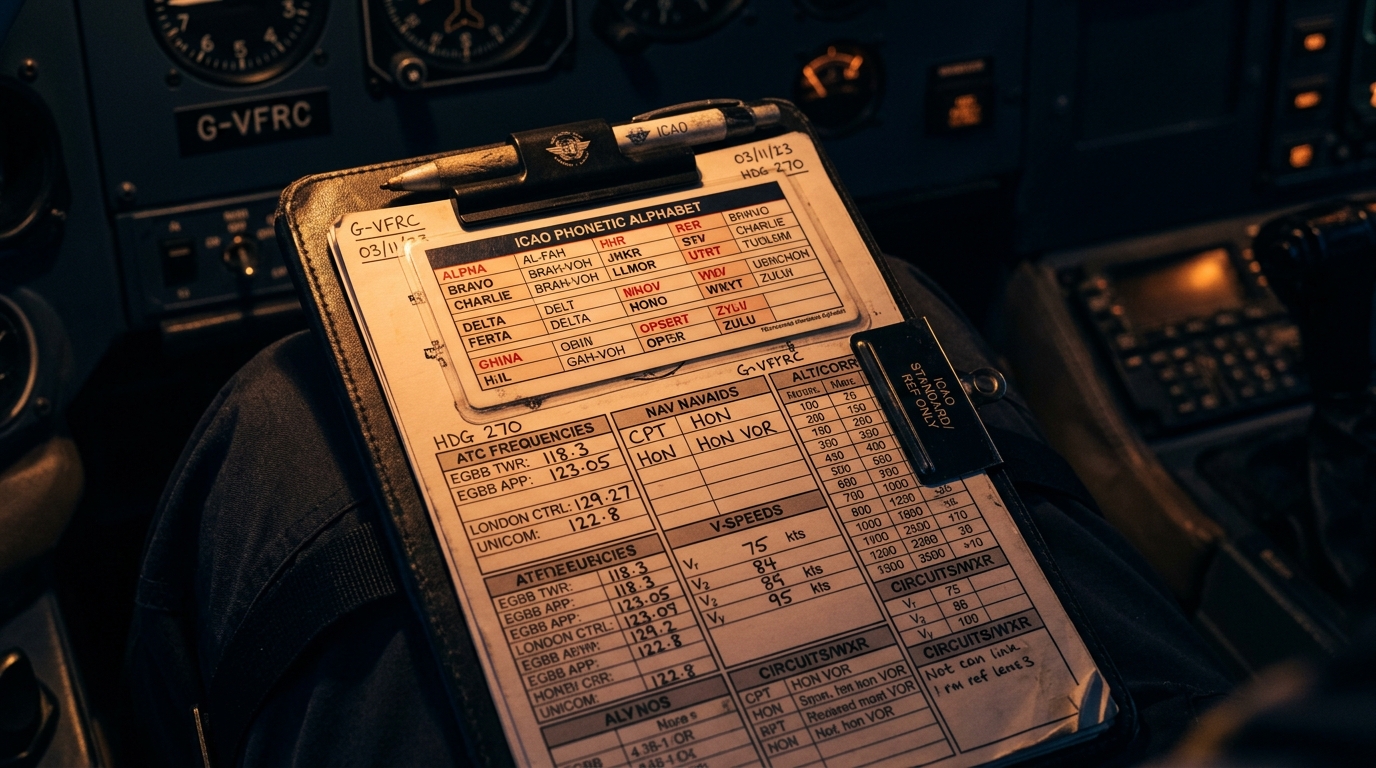
Phonetic alphabet
A Alfa
B Bravo
C Charlie
D Delta
E Echo
F Foxtrot
G Golf
H Hotel
I India
J Juliett
K Kilo
L Lima
M Mike
N November
O Oscar
P Papa
Q Quebec
R Romeo
S Sierra
T Tango
U Uniform
V Victor
W Whiskey
X X-ray
Y Yankee
Z Zulu
B Bravo
C Charlie
D Delta
E Echo
F Foxtrot
G Golf
H Hotel
I India
J Juliett
K Kilo
L Lima
M Mike
N November
O Oscar
P Papa
Q Quebec
R Romeo
S Sierra
T Tango
U Uniform
V Victor
W Whiskey
X X-ray
Y Yankee
Z Zulu
Numerals: 0 ZE-RO · 1 WUN · 2 TOO · 3 TREE · 4 FOW-er · 5 FIFE · 6 SIX · 7 SEV-en · 8 AIT · 9 NIN-er
Light signals (no radio)
| Signal | In flight | On the ground |
|---|---|---|
| Steady green | Cleared to land | Cleared for take-off |
| Steady red | Give way, continue circling | Stop |
| Green flashes | Return for landing | Cleared to taxi |
| Red flashes | Aerodrome unsafe — do not land | Taxi clear of landing area |
| White flashes | Land & proceed to apron | Return to starting point |
| Red pyrotechnic | Do not land for the time being (notwithstanding previous instructions) | |
Big mnemonics on one line
Bands: "Very Long Modems Help Various Useful Signals Excel" · Annex 10 = TEN=TELECOM · Law = Act→Rules→CAR · Squawks 75 alive / 76 no comms / 77 heaven · AFTN Some Dogs Find Good Kennels · QDM = Direction to Mother · HF Day high, Night low.
Rapid-fire self-test
Click an option to check — one from each table
1. The Chicago Convention created ICAO and was signed in:
Answer: 1944. Signed 7 Dec 1944; in force (ICAO created) 4 Apr 1947.
2. Annex 10 covers:
Answer: Aeronautical Telecommunications. Annex 10 — Aeronautical Telecommunications (TEN = TELECOM).
3. QNE is the standard setting:
Answer: 1013.2 hPa. 1013.2 hPa (29.92 inHg) → flight levels.
4. The international VHF emergency frequency is:
Answer: 121.5 MHz. 121.5 MHz (VHF guard); 243.0 UHF military.
5. The AIRAC cycle is:
Answer: 28 days. Common effective dates every 28 days.
6. Broken cloud (BKN) is:
Answer: 5–7 oktas. FEW 1–2, SCT 3–4, BKN 5–7, OVC 8.
7. c = f × λ, where c is:
Answer: 3 × 10&sup8; m/s. Speed of radio waves ≈ 3 × 10&sup8; m/s.
8. HF long-range voice uses:
Answer: SSB, sky wave. HF = SSB, sky wave; VHF = AM, line-of-sight.
9. An SSR transponder replies on:
Answer: 1090 MHz. Interrogate 1030, reply 1090 MHz.
10. The squawk for radio failure is:
Answer: 7600. 7600 radio failure; 7500 hijack; 7700 emergency.
11. "ROGER" means:
Answer: I have received all your last transmission. ROGER = received; WILCO = will comply; AFFIRM = yes.
12. The distress signal, spoken three times, is:
Answer: MAYDAY. MAYDAY ×3 = distress; PAN-PAN ×3 = urgency.
FINAL-WEEK ROUTINE
- Recite each master table by covering the value column — aim for zero misses.
- Carry the phonetic, light-signal and squawk quick cards; glance daily.
- Then hammer the Chapter 24 question bank (297 real questions) until 80%+ everywhere.
- Say the phraseology and the oral answers out loud — the practical decides the result.