CHAPTER 22 · REFERENCE DEPTH

Voice Weather Broadcasts

While data-link (D-ATIS/D-VOLMET) is now standard in modern cockpits, the exam focuses on the traditional voice broadcasts — VOLMET and ATIS — that continuously transmit met conditions on loop over VHF or HF. This chapter covers their structure, differences, and how they keep pilots updated without cluttering the control frequencies.

SYLLABUS MAP

Part III (x) VOLMET & ATIS broadcasts

Learning objectives — by the end of this chapter you will be able to…

22.1 ATIS — the local picture

22.2 VOLMET — the regional picture

22.3 The broadcast sequence

22.4 Using the information

☆ Numbers to memorise

? Question bank
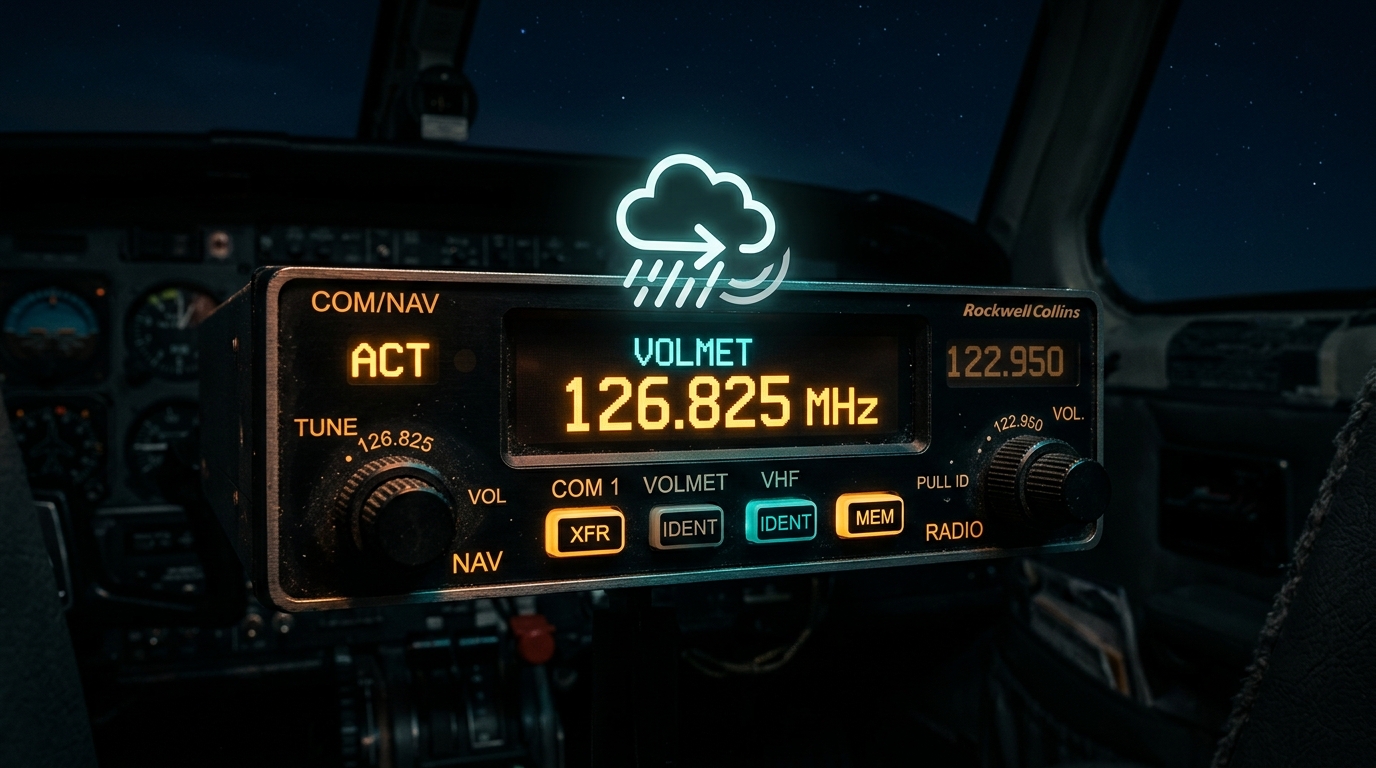
Aviation radio receiver tuned to a VOLMET frequency
Continuous voice broadcasts allow pilots to copy down weather and aerodrome information before contacting ATC, drastically reducing congestion on the main control frequencies.

22.1 ATIS — the local picture

Definition — Automatic Terminal Information Service

ATIS is the continuous broadcast of recorded non-control information in selected high-activity terminal areas. It contains both meteorological and operational information (runway in use, approach type, transition level) for a single aerodrome. It is updated when conditions change significantly, and each update is given an alphabetical designator (Alpha, Bravo, Charlie...).

Mnemonic — the purpose

The purpose of ATIS is to relieve frequency congestion. Because the pilot listens to the ATIS on a separate frequency before calling approach, the controller does not have to read the weather and runway details to every arriving aircraft.

22.2 VOLMET — the regional picture

Definition — VOLMET

VOLMET (meteorological information for aircraft in flight) is a continuous or scheduled voice broadcast of meteorological information for several aerodromes in a region. It contains only met information (METARs, TRENDs, and sometimes TAFs or SIGMETs) — no operational details like runway-in-use. It allows an aircraft in the cruise to check the weather at its destination and alternates well in advance.

Feature ATIS VOLMET
ScopeOne specific aerodrome (terminal area)Several aerodromes in a region
ContentsWeather AND operational info (runway, approaches, NOTAMs)ONLY weather (METAR, TREND, TAF, SIGMET)
UpdatesDesignated by a letter (Information Alpha)Usually updated every half hour (no letter)

22.3 The broadcast sequence

The standard order

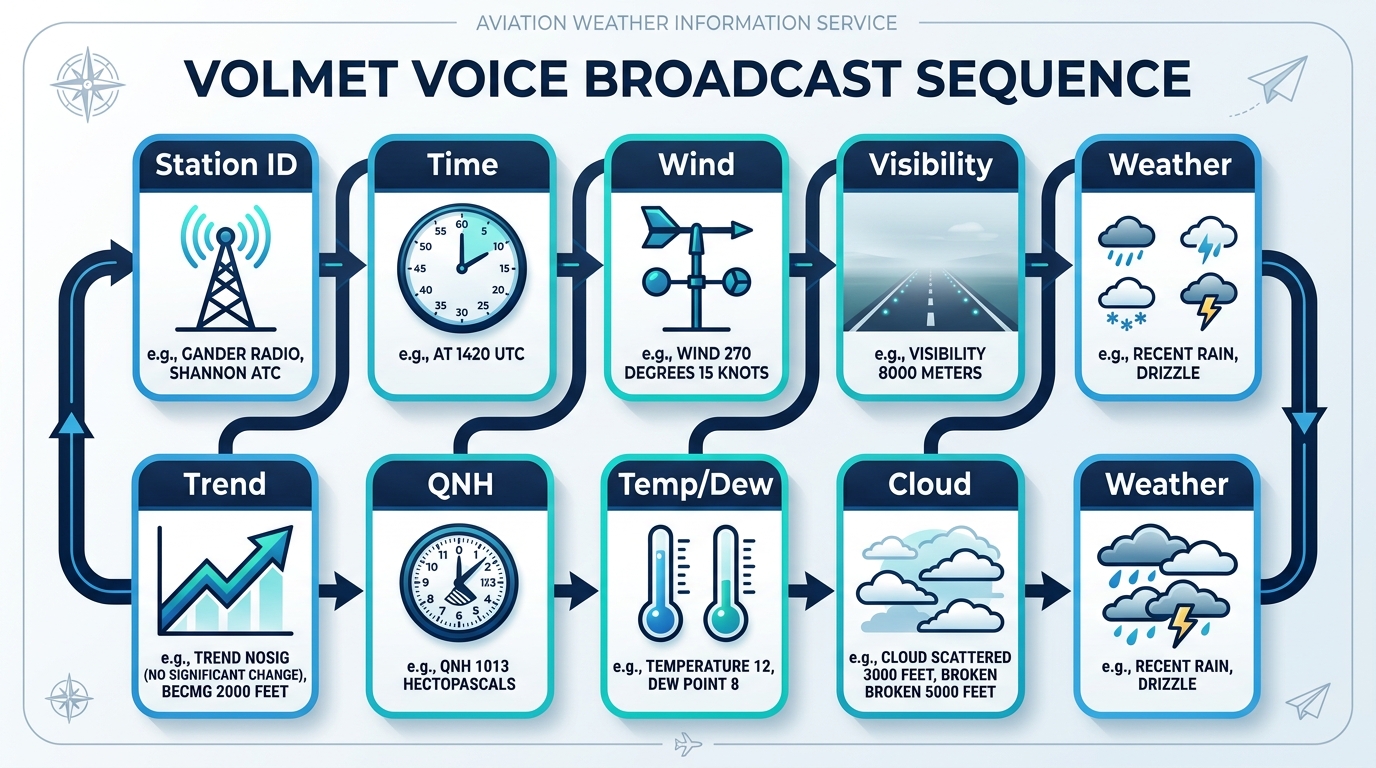
Both ATIS and VOLMET follow the standard meteorological sequence (the same order as a METAR): identification · time · surface wind · visibility/RVR · weather · cloud · temperature/dew point · QNH · trend.
Transcript — typical ATIS
ATIS Delhi International Airport, information Charlie, zero eight three zero zulu. Expect ILS approach runway two seven, runway two seven and two eight in use. Wind two four zero degrees, one zero knots. Visibility three thousand metres. Haze. Cloud few three thousand feet. Temperature three two, dew point two zero. QNH one zero zero nine. Acknowledge receipt of information Charlie on initial contact.
The VOLMET/ATIS Sequence
Figure 22.1 — The Sequence: The broadcast strictly follows the METAR order, allowing pilots to rapidly copy the data into standard forms on their kneeboards.

22.4 Using the information

Acknowledging ATIS

When making initial contact with Approach or Ground, the pilot states they have the ATIS by giving the letter and the QNH (to prove it is the correct current version). Example: "Delhi Approach, Ghostair ABC, descending flight level one five zero, information Charlie, QNH one zero zero nine." The controller then does not need to read the weather to them.

☆ Numbers to memorise

Essential Facts for Chapter 22
Fact Value
ATISAutomatic Terminal Information Service
ATIS coversOne aerodrome; met AND operational info (runways/approaches)
ATIS identifierAlphabetical letter (Alpha, Bravo, etc.)
VOLMET coversSeveral aerodromes; ONLY met info (no runways)
SequenceID · time · wind · vis · weather · cloud · temp/dew · QNH · trend
Pilot action (ATIS)State information letter and QNH on initial contact with ATC
Question bank

Part A — MCQs (click an option to check)

1. What does ATIS stand for?
  • Aviation Terminal Information System
  • Automatic Terminal Information Service
  • Aerodrome Traffic Information Service
  • Air Traffic Instruction Service
Answer: Automatic Terminal Information Service. ATIS is the Automatic Terminal Information Service.
2. An ATIS broadcast contains:
  • Only meteorological information for several aerodromes
  • Meteorological and operational information for a single aerodrome
  • Control clearances
  • Radar vectors
Answer: Meteorological and operational information for a single aerodrome. ATIS covers one aerodrome and includes operational data like runway-in-use.
3. The primary purpose of ATIS is to:
  • Provide radar separation
  • Relieve frequency congestion on the ATC channels
  • Clear aircraft to land
  • Broadcast distress messages
Answer: Relieve frequency congestion on the ATC channels. By putting routine info on a separate broadcast, the main frequency is kept clear.
4. Successive ATIS broadcasts are identified by:
  • A number
  • An alphabetical letter (e.g. Information Alpha)
  • The frequency
  • A squawk code
Answer: An alphabetical letter (e.g. Information Alpha). Each new ATIS update gets the next letter in the alphabet.
5. VOLMET contains:
  • Runway in use and approach types
  • Only meteorological information for several aerodromes in a region
  • Only information for a single aerodrome
  • Control clearances
Answer: Only meteorological information for several aerodromes in a region. VOLMET provides only weather, for multiple stations.
6. On initial contact with ATC, a pilot proves receipt of the ATIS by stating:
  • "Weather copied"
  • The information letter and the QNH
  • The surface wind
  • "Roger ATIS"
Answer: The information letter and the QNH. "Information Charlie, QNH 1009" confirms you have the latest and correct version.
7. The standard sequence of elements in an ATIS/VOLMET is:
  • Randomised to keep pilots alert
  • Wind, visibility, weather, cloud, temp/dew, QNH
  • QNH, wind, cloud, visibility, temp
  • Temp, wind, QNH, cloud, visibility
Answer: Wind, visibility, weather, cloud, temp/dew, QNH. It follows the standard METAR sequence.
8. If an aircraft hears the ATIS, does the controller need to read the weather to them?
  • Yes, always
  • No, not unless there is a significant change
  • Only the wind
  • Only the QNH
Answer: No, not unless there is a significant change. That is the whole point of ATIS — to save the controller passing it.

Part B — Oral / viva (tap to reveal model answers)

What is ATIS and what is its purpose?
Model Answer:
Automatic Terminal Information Service is the continuous broadcast of recorded meteorological and operational information for a single aerodrome. Its purpose is to relieve frequency congestion on the main ATC channels.
How does VOLMET differ from ATIS?
Model Answer:
VOLMET provides only meteorological information (no operational info like runway-in-use) and covers several aerodromes in a region, whereas ATIS covers a single aerodrome and includes operational data.
What is the standard sequence of weather elements in a broadcast?
Model Answer:
Surface wind, visibility (or RVR), present weather, cloud, temperature and dew point, QNH, and trend.
How should a pilot acknowledge receipt of the ATIS?
Model Answer:
On initial contact with ATC, the pilot states the ATIS information letter and the QNH — e.g. "Information Bravo, QNH 1012."

60-SECOND REVISION CARD