CHAPTER 21 · REFERENCE DEPTH

Meteorological & Aerodrome Information on RT

Chapter 6 taught you to read coded weather; this chapter is about the weather and aerodrome information passed by voice on the radio at the critical moments of approach and landing — above all the Runway Visual Range and the state of the runway surface, the numbers that decide whether an approach may continue at all.

SYLLABUS MAP

Part III (ix) Transmission of meteorological & other aerodrome information — RVR, runway surface conditions

Learning objectives — by the end of this chapter you will be able to…

21.1 RVR — what and why

21.2 Transmission of RVR

21.3 RVR vs met visibility

21.4 Runway surface conditions

21.5 Passing changes in wind, QNH & weather

☆ Numbers to memorise

? Question bank
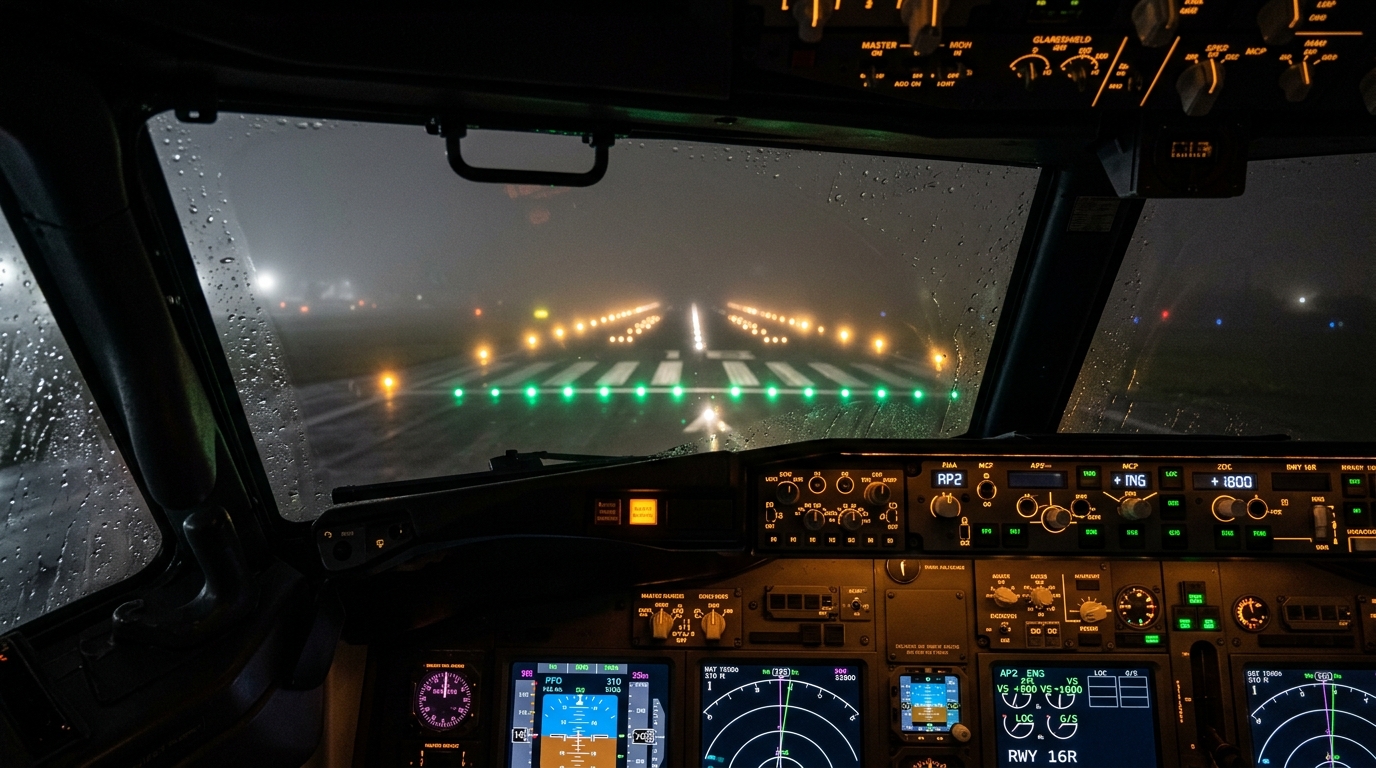
Foggy runway approach
When meteorological visibility drops, Runway Visual Range (RVR) becomes the governing factor for whether an aircraft is legally permitted to continue an approach.

21.1 RVR — what and why

Definition — Runway Visual Range

RVR is the distance over which the pilot of an aircraft on the centreline of a runway can see the runway surface markings, or the lights delineating the runway or identifying its centreline. It is measured close to the runway by transmissometers (or human observers) and is the governing visibility for low-visibility take-offs and approaches.

WHY RVR, NOT JUST "VISIBILITY"

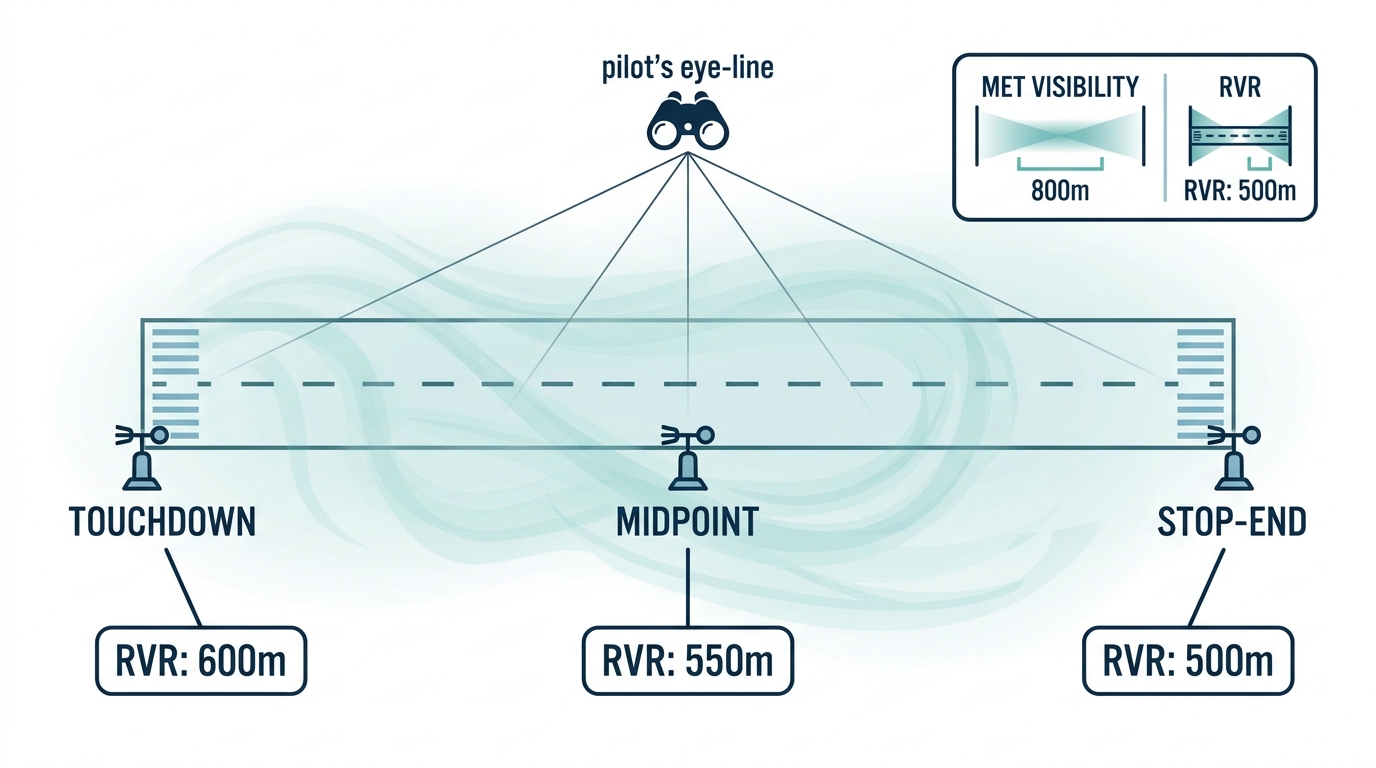
General met visibility is measured away from the runway and may not reflect what a pilot actually sees down the runway in fog or at night. RVR measures the operationally relevant distance at the runway itself, including the effect of the runway lighting — which is why approach minima are expressed in RVR.

21.2 Transmission of RVR

Touchdown, midpoint & stop-end

For a long runway, RVR is measured and passed at up to three points: the touchdown zone, the midpoint, and the stop-end. When passed, the values are given in that order and identified, e.g. "RVR runway two seven, touchdown six hundred metres, midpoint five fifty, stop-end five hundred". RVR is given in metres and read back.

Transcript — RVR passed on approach
ATC Ghostair Alfa Bravo Charlie, RVR runway two seven, touchdown six hundred metres, midpoint five hundred and fifty metres, stop-end five hundred metres.
A/C RVR runway two seven, six hundred, five fifty, five hundred metres, Ghostair Alfa Bravo Charlie.
Exam trap

RVR is passed when the visibility or RVR is at or below a stated value (the reporting threshold). It is in metres, not the digit-group altitude rule — but still spoken digit by digit. The touchdown RVR is normally the controlling value for the approach.

21.3 RVR vs met visibility

Meteorological visibility RVR
Where measuredGeneral aerodrome area / observerAlong the runway, near it
What it representsHorizontal visibility in generalDistance a pilot sees runway markings/lights
Includes lighting?NoYes (lights help RVR be greater than met vis at night)
Used forMETAR, general pictureApproach/take-off minima
Cockpit reality

On a foggy approach the controller's RVR call is the number you compare against your minimum. If the touchdown RVR is below your minimum, you do not continue below the decision point unless the required visual references are in sight — the RVR transmission is therefore safety-critical, not just informational.

21.4 Runway surface conditions

What is passed

When the runway is contaminated, ATC passes the surface condition and, where assessed, the braking action: the type of contaminant (water, slush, snow, ice), its depth/coverage, and the braking action reported as good · medium · poor (or measured values). "Runway two seven wet" / "standing water" / "braking action medium".

Transcript — runway condition
ATC VT-ABC, runway two seven is wet, water patches, braking action reported medium to poor.
A/C Runway two seven wet, braking action medium to poor, VT-ABC.
Author check before publishing

Confirm the current runway-condition reporting format and braking-action terminology in use in Indian airspace (the global reporting format / RWYCC if adopted), and any standard depths/coverage wording.

21.5 Passing changes in wind, QNH & weather

Updates by voice

Where ATIS is not current or conditions change, ATC passes the surface wind (degrees magnetic, knots) with the landing/take-off clearance, an updated QNH (read back), and any significant weather — thunderstorms, wind shear, heavy precipitation. A wind-shear or significant-weather warning is prefixed "caution" (e.g. "caution, wind shear reported on final"). Significant changes are passed as they occur.
Transcript — updated information on approach
ATC VT-ABC, wind now two four zero degrees one eight knots, gusting two eight, QNH one zero zero nine, caution wind shear reported on short final.
A/C Wind two four zero one eight gusting two eight, QNH one zero zero nine, copied wind shear caution, VT-ABC.
RVR along the runway - Touchdown, Midpoint, Stop-end
Figure 21.1 — RVR along the runway: Three transmissometers provide specific RVR values for the touchdown, midpoint, and stop-end segments of a long runway.

☆ Numbers to memorise

Essential Facts for Chapter 21
Fact Value
RVRDistance a pilot on the centreline sees runway markings/lights; in metres
Three RVR pointsTouchdown · midpoint · stop-end (touchdown usually controlling)
RVR vs met visRVR at the runway, includes lighting; used for minima
Surface conditionsWet / water / slush / snow / ice; braking action good/medium/poor
UpdatesWind (magnetic, knots), QNH (read back), significant weather "caution …"
Question bank

Part A — MCQs (click an option to check)

1. RVR is the distance over which a pilot on the centreline can see:
  • The control tower
  • The runway markings, or the lights delineating/identifying the runway
  • The horizon
  • Other aircraft
Answer: The runway markings, or the lights delineating/identifying the runway. RVR is the visible distance of the runway markings or lights from the centreline.
2. RVR is measured by:
  • The pilot's altimeter
  • Transmissometers near the runway (or observers)
  • Satellite
  • The transponder
Answer: Transmissometers near the runway (or observers). Transmissometers (or human observers) measure RVR close to the runway.
3. RVR is given in:
  • Nautical miles
  • Metres
  • Feet
  • Kilometres only
Answer: Metres. RVR is reported in metres.
4. The three points at which RVR may be passed are:
  • Start, middle, end of the taxiway
  • Touchdown, midpoint and stop-end
  • Apron, gate, runway
  • Departure, cruise, arrival
Answer: Touchdown, midpoint and stop-end. Touchdown, midpoint and stop-end RVR for a long runway.
5. The normally controlling RVR for an approach is the:
  • Stop-end value
  • Touchdown value
  • Midpoint value
  • Average of all three
Answer: Touchdown value. The touchdown RVR is normally the controlling value for the approach.
6. RVR differs from met visibility because RVR:
  • Is measured far from the runway
  • Is measured along the runway and includes the effect of runway lighting
  • Ignores lighting
  • Is only for take-off
Answer: Is measured along the runway and includes the effect of runway lighting. RVR is runway-specific and accounts for lighting; met visibility is general.
7. RVR is normally passed when the visibility/RVR is:
  • Above 10 km
  • At or below a stated reporting value
  • Always, regardless of value
  • Only at night
Answer: At or below a stated reporting value. RVR is reported when at or below the reporting threshold (low visibility).
8. "Braking action medium" describes the:
  • Wind
  • Runway surface friction condition
  • RVR value
  • QNH
Answer: Runway surface friction condition. Braking action (good/medium/poor) reports the runway surface condition.
9. A runway with standing water would be reported as:
  • CAVOK
  • A contaminated/wet surface condition
  • A wind shear
  • A NOTAM only
Answer: A contaminated/wet surface condition. Water/slush/snow/ice are surface conditions passed with braking action.
10. A wind-shear warning on final is prefixed:
  • "MAYDAY"
  • "Caution"
  • "SEELONCE"
  • "PAN-PAN"
Answer: "Caution". Hazard advisories such as wind shear are prefixed "caution".
11. An updated QNH passed on approach must be:
  • Ignored if you have ATIS
  • Read back
  • Not read back
  • Squawked
Answer: Read back. Altimeter settings are mandatory read-back items.
12. Surface wind passed with a landing clearance is in:
  • Degrees true, km/h
  • Degrees magnetic, knots
  • Degrees true, knots
  • Degrees magnetic, m/s
Answer: Degrees magnetic, knots. ATC passes surface wind in degrees magnetic and knots.
13. "RVR runway 27 touchdown 600 metres" should be read back as:
  • Not read back
  • Read back including the runway and value
  • Acknowledged with "roger" only
  • Squawked
Answer: Read back including the runway and value. RVR passed to an aircraft is read back to confirm correct receipt.
14. At night, RVR is often:
  • Lower than met visibility
  • Greater than met visibility, because the runway lights are visible further
  • The same as met visibility
  • Not measured
Answer: Greater than met visibility, because the runway lights are visible further. Runway lighting lets a pilot see the runway further than general met visibility suggests.

Part B — Oral / viva (tap to reveal model answers)

What is RVR, and how is it measured?
Model Answer:
The Runway Visual Range — the distance over which a pilot on the runway centreline can see the runway surface markings or the lights delineating or identifying the runway. It is measured close to the runway by transmissometers, or by observers.
How is RVR transmitted for a long runway?
Model Answer:
At up to three points — touchdown, midpoint and stop-end — given in that order in metres and identified, with the touchdown value normally controlling, and read back by the pilot.
How does RVR differ from meteorological visibility?
Model Answer:
RVR is measured along the runway itself and includes the effect of the runway lighting, so it can exceed met visibility at night; met visibility is a general value measured elsewhere. Approach minima are expressed in RVR.
What runway surface information is passed, and how is braking action reported?
Model Answer:
The type of contaminant — water, slush, snow or ice — its extent, and the braking action reported as good, medium or poor (or measured values), e.g. "runway wet, braking action medium".
How are significant changes in wind, pressure or weather passed?
Model Answer:
The surface wind (degrees magnetic and knots) and an updated QNH (read back) are passed, and any significant weather such as wind shear or thunderstorms is given prefixed "caution".

60-SECOND REVISION CARD