CHAPTER 20 · REFERENCE DEPTH · THE CHAPTER THAT MATTERS MOST
Distress, Urgency & Communications Failure
This is the chapter that matters most on the worst day of a pilot's career. When something goes badly wrong, phraseology becomes a lifeline: the right word, spoken the right number of times, on the right frequency, summons the whole machinery of air traffic control and search-and-rescue to your aid. Here you learn the exact difference between MAYDAY and PAN, how to format a distress message, the silence procedures, the emergency descent, and what to do when the radio itself fails.
SYLLABUS MAP
Part III (viii) Distress & urgency · imposition/termination of silence · urgency · emergency descent · communications failure
Learning objectives — by the end of this chapter you will be able to…
Distinguish distress (MAYDAY) from urgency (PAN-PAN) and their priorities.
Compose and transmit a complete distress message.
Apply the imposition and termination of silence (SEELONCE).
Carry out and broadcast an emergency descent.
Follow the communications-failure procedure, squawk 7600, and read light signals.
20.1 Distress vs urgency
20.2 The distress message
20.3 Acknowledgement & handling
20.4 Imposition & termination of silence
20.5 Urgency messages
20.6 Emergency descent
20.7 Communications failure
20.8 Light signals
☆ Numbers to memorise
? Question bank
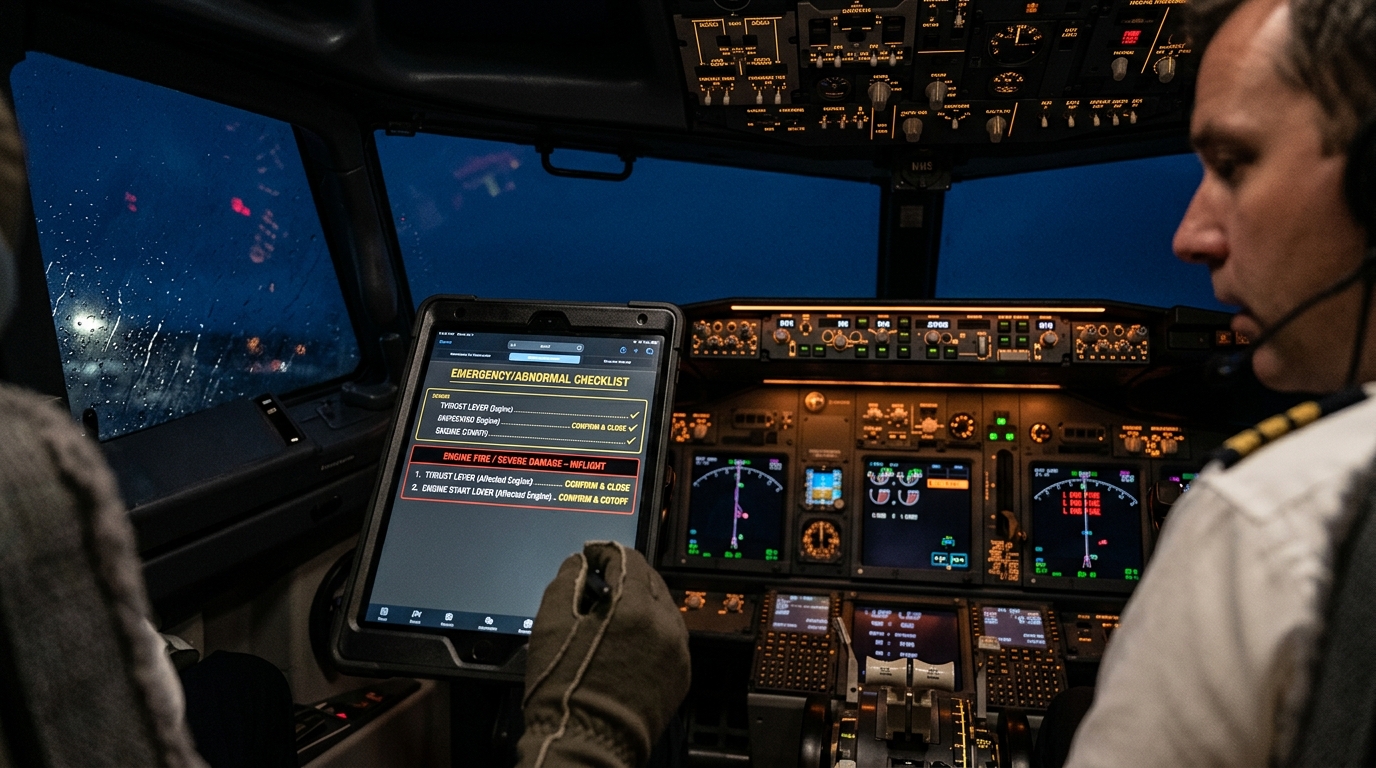
When an emergency occurs, precise standard phraseology cuts through the confusion and ensures ATC can immediately dispatch the necessary assistance.
20.1 Distress vs urgency
The two conditions
Distress — MAYDAY (spoken three times): a condition of being threatened by grave and imminent danger and requiring immediate assistance. It has absolute priority over all other transmissions.
Urgency — PAN-PAN (spoken three times): a condition concerning the safety of the aircraft or a person, but not requiring immediate assistance. It has priority over all communications except distress.
Mnemonic
MAYDAY = "M'aider" (help me) — life in danger, help now. PAN = "Panne" (breakdown) — a problem, but not life-threatening yet. Both are said three times. If in doubt, MAYDAY is never wrong.
Frequency & squawk
Make the call on the frequency in use (don't change away from the controller already helping you); if not in contact, use 121.5 MHz. Squawk 7700 (Chapter 12) so you light up on every radar.
20.2 The distress message
The format — as much as time allows
1. MAYDAY MAYDAY MAYDAY · 2. name of the station addressed (if time/known) · 3. aircraft call sign · 4. nature of the emergency · 5. intentions of the pilot-in-command · 6. position, level and heading · 7. any other useful information (e.g. persons on board, fuel). Speak slowly and clearly; you may not get a second chance.
Transcript — a distress message
A/C MAYDAY MAYDAY MAYDAY, Delhi Approach, Ghostair Alfa Bravo Charlie, engine failure, attempting forced landing, eight miles north of the field, two thousand feet, heading two seven zero, three persons on board.
ATC Ghostair Alfa Bravo Charlie, Delhi Approach, MAYDAY received, wind two seven zero degrees eight knots, runway two seven, you are number one, all other traffic standby.
Mnemonic — what to pass
"Mayday × 3, who, who I am, what's wrong, what I'll do, where I am, anything else." Or remember it as nature · intentions · position as the three things ATC most needs.
20.3 Acknowledgement & handling
How the message is handled
The station addressed (or the first to hear it) acknowledges the distress, takes charge, gives the aircraft priority, and may impose silence on other traffic. Any station hearing a distress call that is not acknowledged should relay it and assist. The aircraft in distress (or the controlling station) is the controlling station for the distress traffic.
20.4 Imposition & termination of silence
Imposing silence
To keep the frequency clear for the distress, silence is imposed: the controlling station (or the aircraft in distress) may say "STOP TRANSMITTING, MAYDAY"; the standard signal is SEELONCE MAYDAY (silence, mayday) imposed by the station in control, or SEELONCE DISTRESS by another station. All other stations stop transmitting until released.
Terminating silence
When the distress is over, the controlling station announces the end and lifts the silence: "DISTRESS TRAFFIC ENDED, SEELONCE FEENEE" (silence finished). Normal working then resumes on the frequency.
Mnemonic — the French roots
SEELONCE = silence; FEENEE = fini (finished). "SEELONCE MAYDAY" imposes it; "SEELONCE FEENEE" ends it.
20.5 Urgency messages
PAN-PAN format
The format mirrors the distress message but begins PAN-PAN PAN-PAN PAN-PAN: station addressed, call sign, the nature of the urgency, intentions, position/level, and other information. A medical emergency, a minor technical problem, or a low-fuel situation that is concerning but not yet critical are typical urgency calls.
Transcript — an urgency message
A/C PAN-PAN PAN-PAN PAN-PAN, Delhi Approach, VT-ABC, a passenger seriously ill, request priority landing and medical assistance, six miles south, three thousand feet.
ATC VT-ABC, Delhi Approach, roger your PAN, cleared direct, descend two thousand feet, medical services alerted.
20.6 Emergency descent
FIRST PRINCIPLES — GET DOWN FAST, AND WARN EVERYONE BELOW
An emergency descent — typically after a pressurisation failure — requires the aircraft to descend rapidly to a safe (breathable) level. The danger is to other traffic below, so the procedure is as much about warning them as about the descent itself. This is the topic your original notes left out entirely.
The phraseology
The crew declares it (often as a MAYDAY): "MAYDAY MAYDAY MAYDAY, Ghostair ABC, emergency descent". ATC immediately broadcasts to all other aircraft in the area: "ATTENTION ALL AIRCRAFT in the vicinity of [position], emergency descent in progress from flight level [X]", and clears traffic out of the way. The descending aircraft turns off the airway if able and may continue to a lower level until cleared.
Transcript — emergency descent
A/C MAYDAY MAYDAY MAYDAY, Mumbai Control, Ghostair Alfa Bravo Charlie, pressurisation failure, emergency descent, leaving flight level three five zero.
ATC ATTENTION ALL AIRCRAFT in the vicinity of SIERRA, emergency descent in progress from flight level three five zero, all aircraft below flight level one zero zero leave the airway to the right.
ATC Ghostair Alfa Bravo Charlie, descend to flight level one zero zero, QNH one zero one three, report level.
20.7 Communications failure
The actions
1. Squawk 7600 (radio failure).
2. Try the basics — frequency, volume, squelch, selector, PTT, alternate radio (Chapter 11).
3. Listen out — you may still be able to receive (a "transmitter failure"); follow instructions you hear and acknowledge by transponder/turns.
4. Transmit blind your intentions, prefixed "transmitting blind" (and "due to receiver failure" if you cannot hear).
5. Continue in accordance with the last acknowledged clearance / the flight plan, flying the cleared or expected levels and routing, and complete the flight, joining and landing using light signals if necessary.
Exam trap
Distinguish a complete failure (you can neither transmit nor receive) from a transmitter-only failure (you can still hear). If you can hear, comply with what you are told and acknowledge by transponder ident or turns — the controller can still help you (Chapter 19).
20.8 Light signals
WHEN THE RADIO IS GONE, THE TOWER USES A LAMP
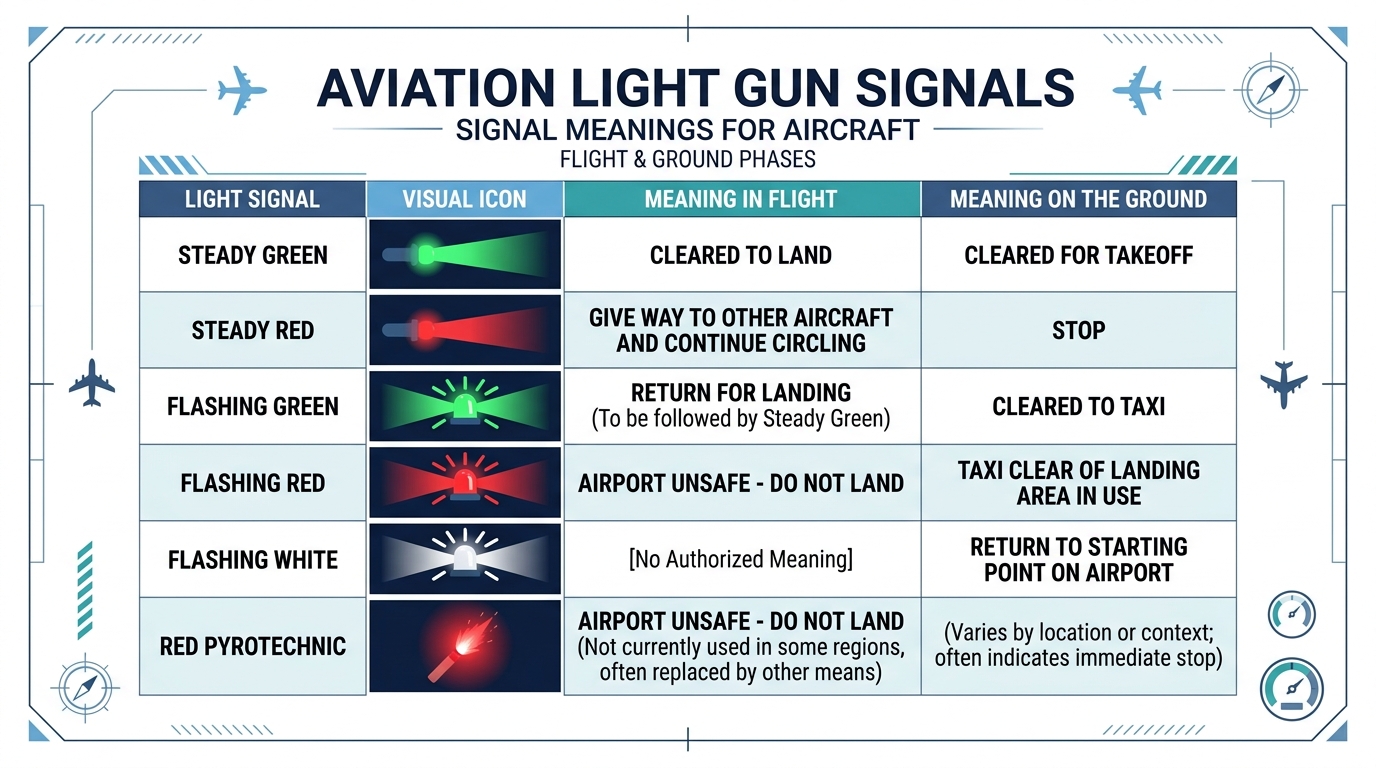
If you arrive with no radio, the tower directs you with a signal lamp. Know these cold — they are the last line of communication.
Figure 20.1 — Light Signals: When experiencing a total communications failure, the tower will use these visual signals to issue clearances.
Signal
Aircraft in flight
Aircraft on the ground
Steady green
Cleared to land
Cleared for take-off
Steady red
Give way to other aircraft and continue circling
Stop
Green flashes
Return for landing*
Cleared to taxi
Red flashes
Aerodrome unsafe — do not land
Taxi clear of the landing area in use
White flashes
Land at this aerodrome and proceed to apron*
Return to starting point on the aerodrome
Red pyrotechnic / flare
Notwithstanding any previous instructions, do not land for the time being
Mnemonic
Green = go / good; Red = stop / danger. Steady = the clearance; flashing = an instruction to position. *Clearances to land/taxi will follow.
Author check before publishing
Confirm the exact light-signal wording and any nuances against the current ICAO Annex 2 / DGCA CAR, and confirm the precise comms-failure routing/level rules (IFR vs VFR) in Indian airspace.
10. A passenger taken seriously ill, not yet life-threatening to the aircraft, is a:
Distress (MAYDAY)
Urgency (PAN-PAN)
Routine call
Radio failure
Answer: Urgency (PAN-PAN). A safety concern not requiring immediate assistance is an urgency (PAN-PAN); escalate to MAYDAY if it worsens.
11. An emergency descent is most often caused by:
Engine fire
Pressurisation failure
A blocked pitot
A radio failure
Answer: Pressurisation failure. Loss of pressurisation demands a rapid descent to a breathable level.
12. On an emergency descent, ATC broadcasts to other traffic:
"SEELONCE FEENEE"
"ATTENTION ALL AIRCRAFT … emergency descent in progress"
"Squawk 7600"
"Resume own navigation"
Answer: "ATTENTION ALL AIRCRAFT … emergency descent in progress". The all-stations broadcast warns and clears traffic below the descending aircraft.
13. On a complete communications failure, the pilot squawks:
7500
7600
7700
2000
Answer: 7600. 7600 indicates a radio/communications failure.
14. If you can still receive but not transmit, you should:
Land immediately anywhere
Comply with instructions heard and acknowledge by transponder/turns
Switch off the transponder
Ignore ATC
Answer: Comply with instructions heard and acknowledge by transponder/turns. A transmitter-only failure still lets you follow ATC and acknowledge by ident/turns.
15. A steady green light to an aircraft in flight means:
Stop
Cleared to land
Do not land
Return for landing
Answer: Cleared to land. Steady green in flight = cleared to land; on the ground = cleared for take-off.
16. Red flashes to an aircraft in flight mean:
Cleared to land
Aerodrome unsafe — do not land
Cleared to taxi
Give way
Answer: Aerodrome unsafe — do not land. Red flashes in flight warn that the aerodrome is unsafe — do not land.
17. Transmitting your intentions with no expectation of acknowledgement is prefixed:
"PAN-PAN"
"Transmitting blind"
"SEELONCE"
"Standby"
Answer: "Transmitting blind". "Transmitting blind" tells anyone listening you cannot receive a reply.
18. After a communications failure, an IFR aircraft should generally:
Descend immediately to the ground
Continue in accordance with the last clearance / flight plan and complete the flight
Orbit until fuel runs low
Squawk 7500
Answer: Continue in accordance with the last clearance / flight plan and complete the flight. Continue per the last acknowledged clearance and flight plan, using light signals to land.
Part B — Oral / viva (tap to reveal model answers)
What is the difference between distress and urgency?
Model Answer:
Distress (MAYDAY, said three times) is a condition of grave and imminent danger requiring immediate assistance, with absolute priority over all transmissions. Urgency (PAN-PAN, said three times) concerns the safety of the aircraft or a person but does not require immediate assistance, with priority over all except distress.
Give the format of a distress message.
Model Answer:
MAYDAY three times; the station addressed; the aircraft call sign; the nature of the emergency; the pilot's intentions; position, level and heading; and any other useful information such as persons on board.
How is radio silence imposed and lifted?
Model Answer:
It is imposed by the controlling station (or the aircraft in distress) with "STOP TRANSMITTING, MAYDAY" or "SEELONCE MAYDAY"; it is lifted when the distress ends with "DISTRESS TRAFFIC ENDED, SEELONCE FEENEE".
Describe the emergency-descent procedure on the radio.
Model Answer:
The crew declares it, usually as a MAYDAY with "emergency descent". ATC immediately broadcasts "ATTENTION ALL AIRCRAFT in the vicinity of [position], emergency descent in progress from flight level [X]" and clears other traffic out of the way, while clearing the descending aircraft to a safe level.
What are the steps on a communications failure?
Model Answer:
Squawk 7600; check the basics and try the alternate radio; listen out and comply with any instructions heard, acknowledging by transponder or turns; transmit your intentions blind; and continue in accordance with the last acknowledged clearance and the flight plan, landing using light signals if necessary.
What does a steady red and a steady green light mean to an aircraft in flight?
Model Answer:
Steady green — cleared to land; steady red — give way to other aircraft and continue circling.