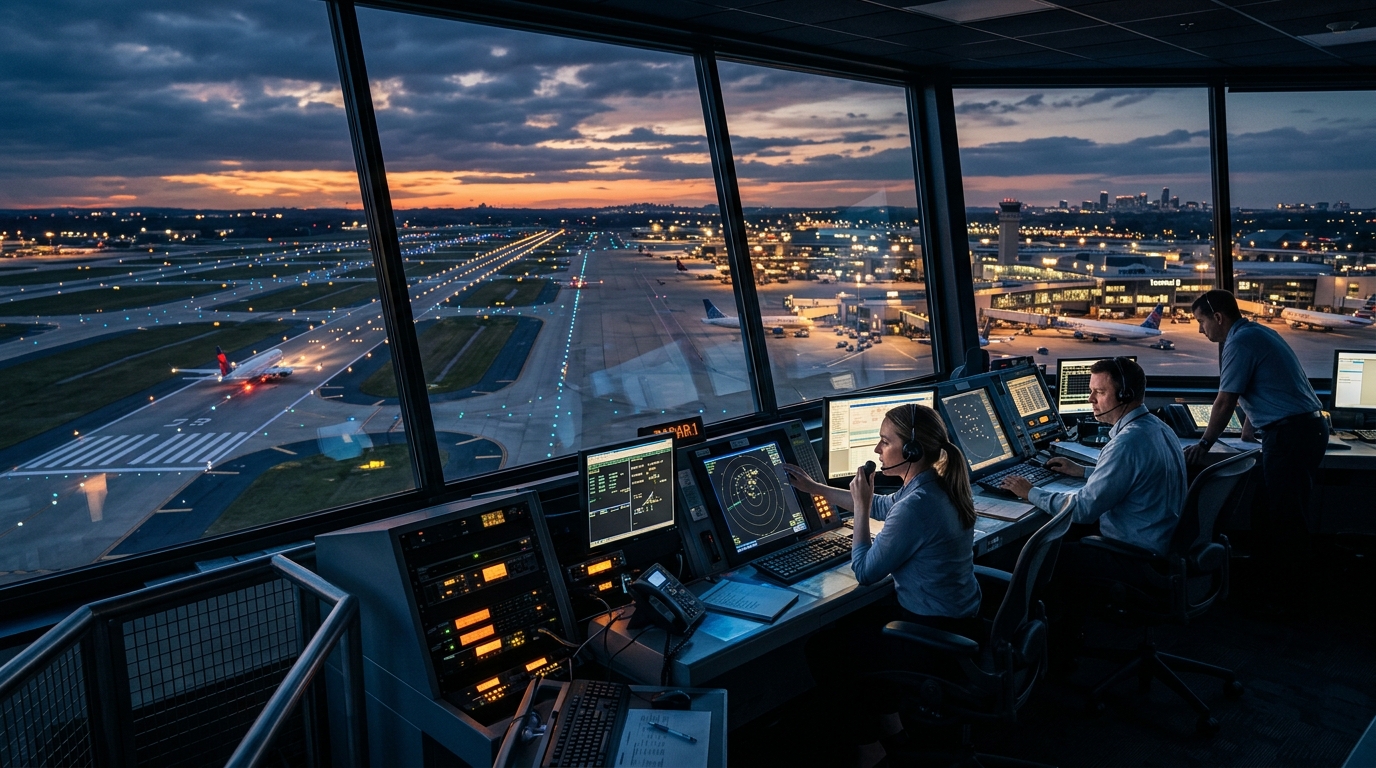
Part I (i) International Telecommunication Convention & Radio Regulations · International & national aviation bodies
By the end of this chapter you will be able to…
- Explain what the Chicago Convention is and what it created.
- Describe the roles of ICAO, the ITU and the DGCA — and how they differ.
- State what ICAO Annexes are and identify Annex 10 as the radiotelephony Annex.
- Distinguish a regulator (ICAO/DGCA) from a trade body (IATA).
- Trace the chain of authority from a global standard down to your microphone.
2.1 Why the world needed a shared rule-book
2.2 The Chicago Convention (1944)
2.3 ICAO — the global standard-setter
2.4 ITU — the keeper of the spectrum
2.5 India's regulators — DGCA, AAI & WPC
2.6 ICAO vs IATA — regulator or club?
2.7 How it all fits together
2.8 Exam-day specifics: answering "Who publishes?"
2.9 Case study: a flight from Delhi to Dubai
2.10 Question bank
2.1 Why the world needed a shared rule-book
An aircraft that takes off in Delhi and lands in Dubai crosses the airspace of several sovereign nations in a single flight. If each country invented its own radio frequencies, its own phraseology, its own units and its own licences, international flying would be impossible — or lethal. So the world agreed, decades ago, to a shared rule-book. The organisations in this chapter are the bodies that write that rule-book and the chain that connects a global standard to the words you speak on the radio.
No single country can command another. So aviation is governed by agreement: nations sign a treaty, a UN body turns that treaty into technical standards, and each country then writes those standards into its own national law and enforces them. Understanding this three-step chain — treaty → international standards → national law — is the key to the whole chapter.
2.2 The Chicago Convention (1944)
The Chicago Convention is the founding treaty of international civil aviation — the document that made worldwide flying possible by agreeing common principles between nations. It also created ICAO to look after those principles.
The Convention on International Civil Aviation, signed at Chicago on 7 December 1944 by 52 States. It established the principles and arrangements for safe and orderly international air transport — and created the International Civil Aviation Organization (ICAO). India was an original signatory.
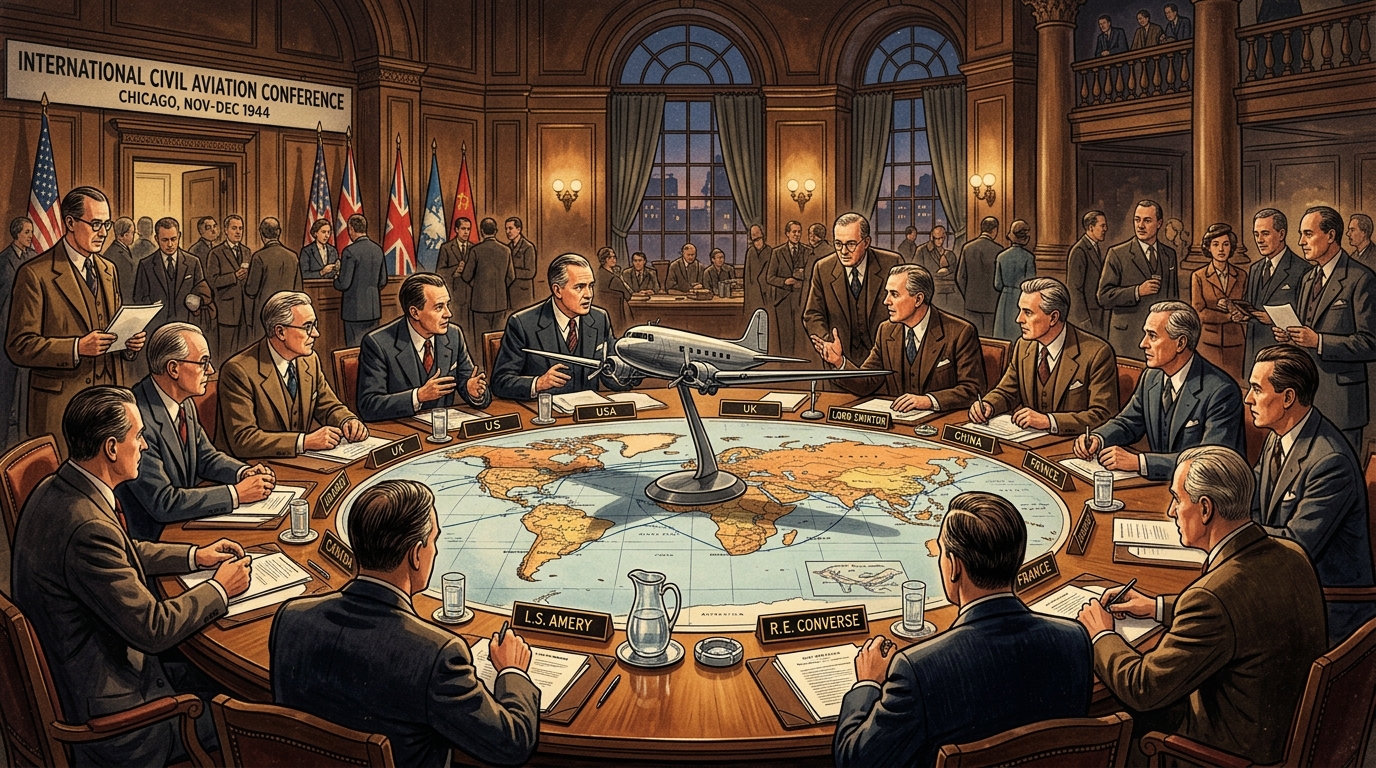
Memorise the date and the headline fact: Chicago, 7 December 1944, and "it created ICAO." Don't confuse the signing in 1944 with ICAO becoming operational later (1947, after the treaty entered into force).
🔍 Deep dive — the Freedoms of the Air
Alongside the Convention, nations negotiated the "freedoms of the air" — the commercial rights one country grants another's airlines, such as the right to overfly (1st freedom), to land for fuel/technical reasons (2nd), and to carry passengers between the home country and another (3rd/4th). You don't need every freedom by heart for RTR, but know that they exist and that they flow from the Chicago framework.
2.3 ICAO — the global standard-setter
ICAO is the United Nations agency for civil aviation. It writes the technical standards that let aircraft, crews and controllers from any country work together safely. Those standards live in documents called Annexes to the Chicago Convention.

The International Civil Aviation Organization — a specialised agency of the United Nations, headquartered in Montreal, Canada. It develops Standards and Recommended Practices (SARPs), published as 19 Annexes to the Convention.
A Standard is a specification whose uniform application is recognised as necessary for safety; States must comply or file a difference. A Recommended Practice is desirable but not mandatory.
The most-tested fact in this chapter: Annex 10 = Aeronautical Telecommunications, the home of radiotelephony. Learn the full list, but lock Annex 10.
| # | Annex — subject |
|---|---|
| 1 | Personnel Licensing |
| 2 | Rules of the Air |
| 3 | Meteorological Service for International Air Navigation |
| 4 | Aeronautical Charts |
| 5 | Units of Measurement |
| 6 | Operation of Aircraft |
| 7 | Aircraft Nationality and Registration Marks |
| 8 | Airworthiness of Aircraft |
| 9 | Facilitation |
| 10 ☆ | Aeronautical Telecommunications — the radiotelephony Annex |
| 11 | Air Traffic Services |
| 12 | Search and Rescue |
| 13 | Aircraft Accident and Incident Investigation |
| 14 | Aerodromes |
| 15 | Aeronautical Information Services |
| 16 | Environmental Protection |
| 17 | Security — Safeguarding against Acts of Unlawful Interference |
| 18 | The Safe Transport of Dangerous Goods by Air |
| 19 | Safety Management |
"TEN = TELECOM." Annex 10 is Aeronautical Telecommunications. The two RTR favourites: Annex 2 = Rules of the Air, Annex 10 = Telecom. (Remember the pair "2 & 10".)
Vol I — Radio Navigation Aids · Vol II — Communication Procedures · Vol III — Communication Systems · Vol IV — Surveillance Radar & ACAS · Vol V — Aeronautical Radio Frequency Spectrum Utilization. The RTR syllabus draws mainly on Volumes I & II.
2.4 ITU — the keeper of the spectrum
Radio waves are a shared natural resource. The ITU is the UN body that divides up the radio spectrum worldwide so that aviation, broadcasting, maritime, mobile phones and the military don't transmit on top of each other.
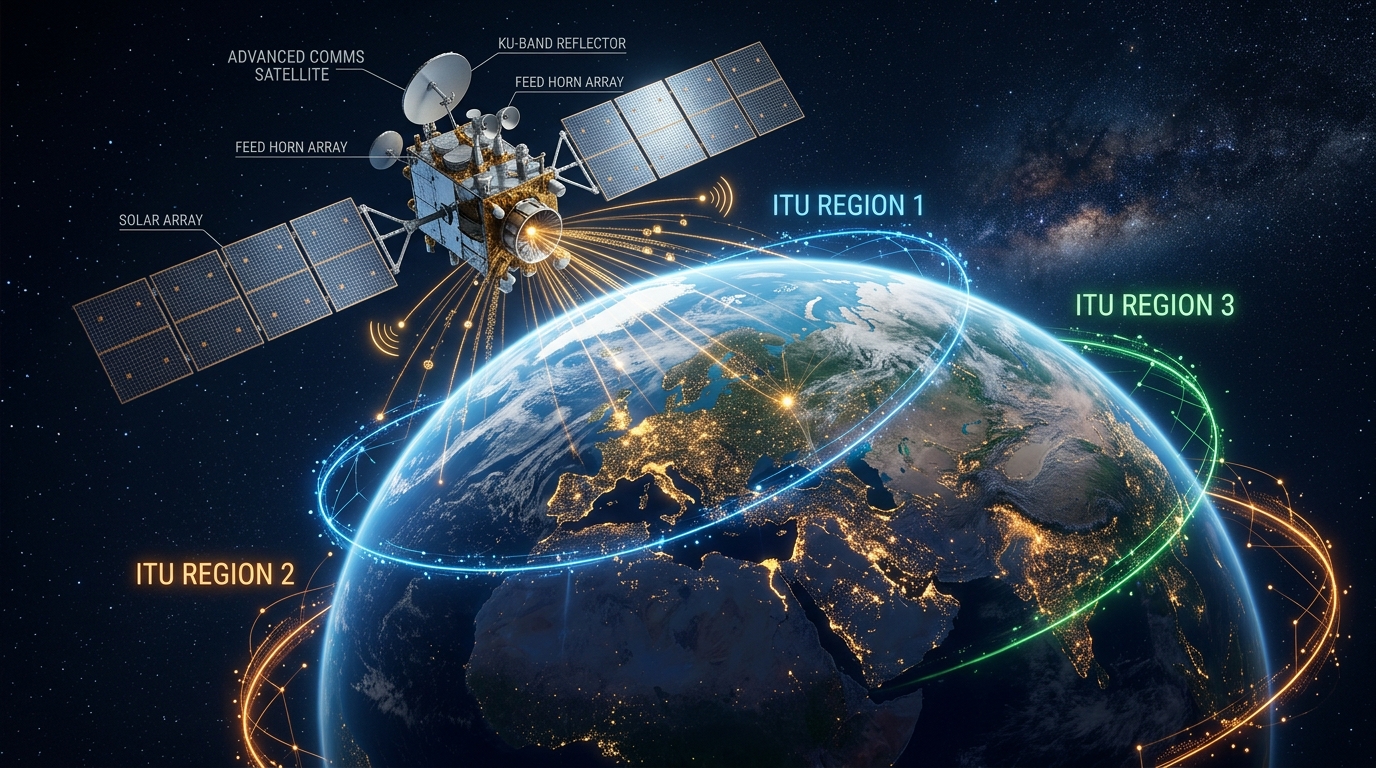
The International Telecommunication Union — the United Nations specialised agency for information and communication technologies, headquartered in Geneva. It allocates the global radio-frequency spectrum and satellite orbits and publishes the Radio Regulations. It is the oldest UN agency (origins in 1865).
Think of it as land and buildings. The ITU owns the land — it decides which frequency bands aviation may use at all. ICAO designs the building on that land — it decides exactly how aviation uses its allocated bands (which frequency is the emergency channel, how phraseology works, and so on). ITU allocates; ICAO applies.
"Which body allocates radio frequency spectrum?" → ITU, not ICAO. "Which body publishes aviation communication procedures?" → ICAO (Annex 10). Examiners deliberately swap these.
2.5 India's regulators — DGCA, AAI & WPC
ICAO's standards are not law in India until India adopts them. The bodies below are how India turns global standards into national rules, runs its airspace, and licenses radio operators.
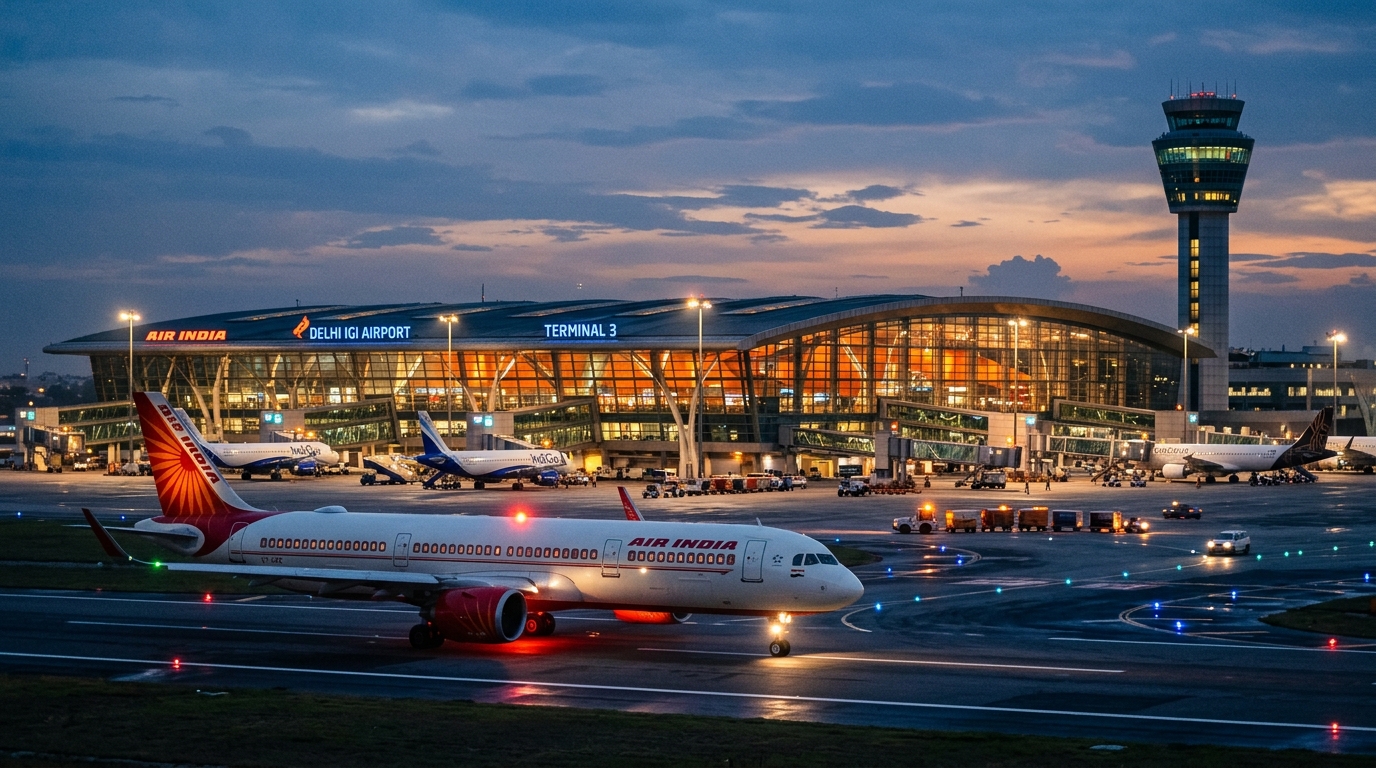
DGCA (Directorate General of Civil Aviation) — India's civil aviation regulator under the Ministry of Civil Aviation; it adopts ICAO standards into national rules and publishes the Civil Aviation Requirements (CARs), including the RTR syllabus.
AAI (Airports Authority of India) — manages airports and provides air navigation services (ATS and communications/navigation/surveillance) across Indian airspace.
WPC (Wireless Planning & Coordination Wing) — the national radio regulator under the Ministry of Communications; it licenses the use of radio spectrum and apparatus.
2.6 ICAO vs IATA — regulator or club?
These two are constantly confused because the acronyms look alike. ICAO is a regulator made of governments. IATA is a trade association made of airlines.
| Feature | ICAO | IATA |
|---|---|---|
| What it is | UN specialised agency (States) | Trade association (airlines) |
| Members | Sovereign States | Airlines |
| Role | Safety standards & SARPs (Annexes) | Commercial coordination, fares, industry practice |
| HQ | Montreal | Montreal / Geneva |
| Airport codes | 4-letter location indicator (e.g. VIDP) | 3-letter code (e.g. DEL) |
ICAO = countries, IATA = airlines. "C" in ICAO → Countries. And for codes: ICAO = 4 letters (VIDP), IATA = 3 letters (DEL).
2.7 How it all fits together
From a global resource down to your transmit button, authority flows in a clear chain — spectrum from the ITU, aviation standards from ICAO, national adoption and licensing by India's bodies, and finally the RTR licence that authorises you.
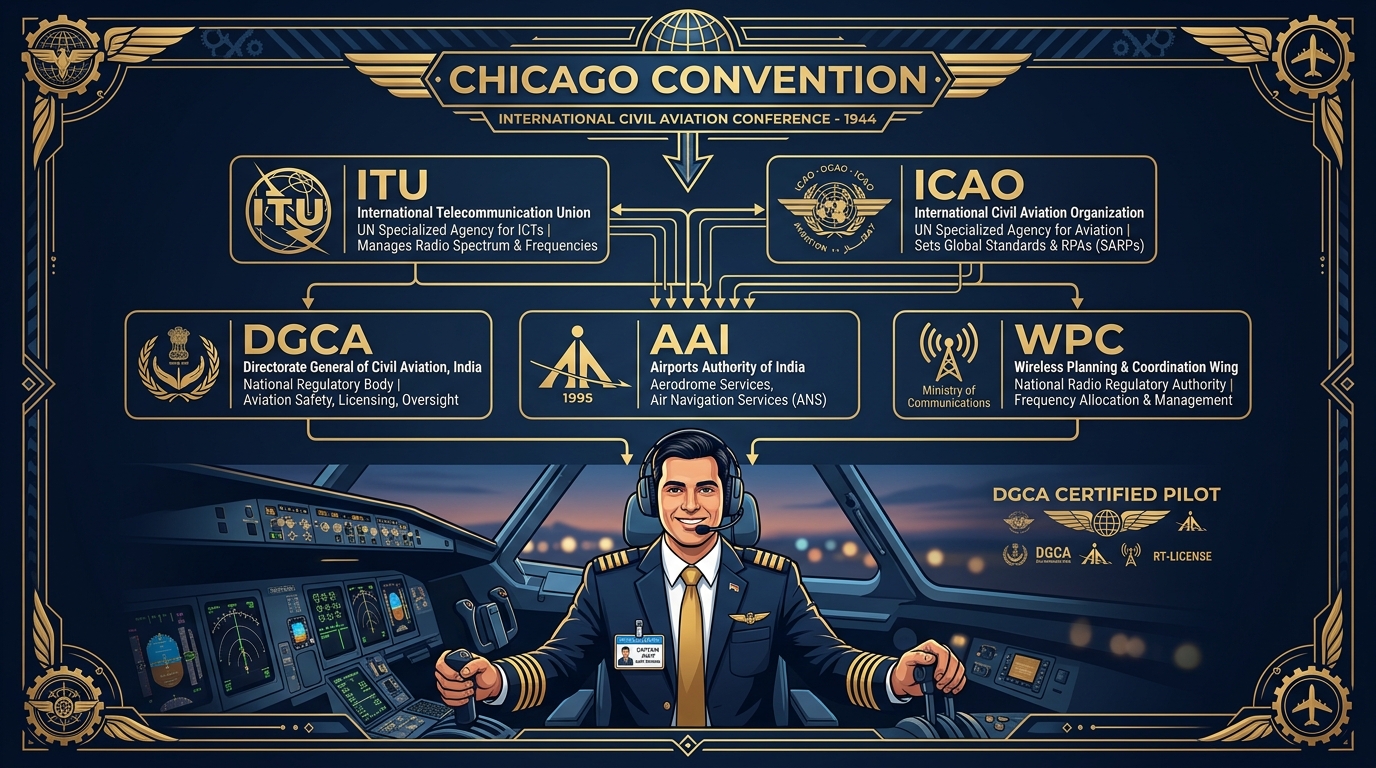
When you say "QNH 1013, runway two-seven" to a controller in any country, it works because of this chain: ITU reserved the band, ICAO standardised the phraseology and the Q-code in Annex 10, and India's DGCA wrote it into the rules you were tested on. You are the last link — and the only one the passengers can hear.
2.8 Exam-day specifics: answering "Who publishes?"
Examiners love to ask "Who publishes X?" A candidate who confuses a national document with an international one loses the mark. Here is the definitive list to lock down.
| Document / Publication | Published By |
|---|---|
| Radio Regulations (RR) | ITU (International Telecommunication Union) |
| Annex 10 (Aeronautical Telecommunications) | ICAO (International Civil Aviation Organization) |
| AIP (Aeronautical Information Publication) India | AAI (Airports Authority of India) |
| Civil Aviation Requirements (CARs) | DGCA (Directorate General of Civil Aviation) |
| RTR(A) Syllabus | DGCA (via CAR Section 7) |
Do not say the DGCA publishes the AIP. AAI publishes the AIP. The DGCA regulates.
2.9 Case study: a flight from Delhi to Dubai
Imagine you are departing Delhi for Dubai. How do the bodies in this chapter impact your flight?
1. WPC granted the licence for the VHF radio installed in your aircraft.
2. You hold an RTR(A) issued under rules made by the Indian Government, governed by a syllabus from the DGCA.
3. You request start-up from Delhi Delivery on 121.900 MHz — a frequency allocated globally to aviation by the ITU.
4. You are talking to an Air Traffic Controller employed by the AAI.
5. You cross into Pakistan airspace, then Iran, then UAE. The reason the controllers in all those countries speak English and use the same phraseology you do is because they all signed the Chicago Convention and adopted ICAO Annex 10.
☆ Numbers to memorise
| Fact | Value |
|---|---|
| Chicago Convention signed | 7 December 1944, Chicago — by 52 States; created ICAO |
| ICAO | UN agency · HQ Montreal · 19 Annexes (SARPs) |
| Annex 10 | Aeronautical Telecommunications (5 volumes; RTR uses Vol I & II) |
| Annex 2 / Annex 11 / Annex 15 | Rules of the Air / Air Traffic Services / Aeronautical Information Services |
| ITU | UN agency · HQ Geneva · allocates spectrum · Radio Regulations · oldest UN agency |
| DGCA | India's regulator · issues CARs (RTR syllabus = CAR Sec 7, Series G, Part VI) |
| ICAO vs IATA | ICAO = States/regulator (4-letter codes); IATA = airlines/trade (3-letter codes) |
Part A — MCQs (click an option to check)
Part B — Oral / viva (tap to reveal model answers)
30-SECOND REVISION CARD
- Chicago Convention, 7 Dec 1944 → created ICAO (HQ Montreal, 19 Annexes).
- Annex 10 = Telecom (5 vols; RTR uses I & II). Also know Annex 2, 11, 15.
- ITU (Geneva) allocates spectrum; ICAO applies it to aviation.
- DGCA adopts standards as CARs; AAI runs ATS; WPC licenses radio.
- ICAO = States/regulator (4-letter); IATA = airlines/trade (3-letter).
- AAI publishes the AIP.