Part III (vii) Area control — units, position/level info, joining/leaving/crossing airways, holding, ATS surveillance, ADS, oceanic control
Learning objectives — by the end of this chapter you will be able to…
- Describe area control units and the structure of a position report.
- Use level-information phraseology (maintain, climb/descend, cruise).
- Use joining, leaving and crossing-airway phraseology.
- Enter and fly an en-route hold, and understand the EAT/onward-clearance system.
- Explain ATS surveillance, ADS-C/ADS-B and CPDLC in area control.
- Describe oceanic control — the oceanic clearance, Mach-number technique and SELCAL.
18.1 Area control units
18.2 Position reporting
18.3 Level information
18.4 Joining, leaving & crossing airways
18.5 En-route holding
18.6 ATS surveillance & ADS
18.7 Oceanic control
☆ Numbers to memorise
? Question bank
18.1 Area control units
The Area Control Centre (ACC), with the call-sign suffix "Control", provides air traffic control to aircraft en route in the airways and upper airspace of an FIR/UIR. A large FIR is split into sectors, and as you fly across it you are transferred from sector to sector.
18.2 Position reporting
Where there is no radar, the aircraft reports its progress at compulsory reporting points. The order is: (1) position, (2) time, (3) level, (4) next point, (5) estimate for the next point — and the name of the point after that. ("ABC, PAPA at four two, flight level three five zero, ROMEO five five, next SIERRA.")
"Place, Time, Level, Next, Estimate (+ the one after)." Same order every time so the controller can write it straight onto the flight progress strip.
18.3 Level information
| Phrase | Meaning |
|---|---|
| "Maintain FL350" | Stay at that level |
| "Climb / descend to FL…" | Change to the new level |
| "Climb to reach FL… by [point]" | Be at the level by the point |
| "Cruise climb" | Climb gradually as weight reduces (oceanic) |
| "Report leaving / reaching FL…" | Tell ATC at the stated event |
| "Expedite climb/descent" | Climb/descend at best rate |
All level instructions are mandatory read-backs. "Climb FL350" and "maintain FL350" are different instructions — read back exactly what was said, and do not climb or descend on a "report" or "expect" alone.
18.4 Joining, leaving & crossing airways
Joining: an aircraft entering a controlled airway needs a clearance — "cleared to join airway [W] at [point], flight level …". Leaving: on leaving controlled airspace you are told "leaving controlled airspace, report …". Crossing: an aircraft crossing an airway is given a clearance to cross at a level/time keeping it separated from airway traffic.
18.5 En-route holding
When traffic ahead must be sequenced — for example a busy arrival airport — ATC may hold an aircraft in a racetrack pattern over a fix or beacon until it can be cleared onward.
"Hold at [fix], flight level …, expect onward clearance at [time]" or "expect approach time [time] (EAT)". The clearance specifies the fix, the level, and the time you may expect to be released (the Onward Clearance Time or, for an arrival, the Expected Approach Time, EAT). The aircraft reads it back and flies the published hold.
18.6 ATS surveillance & ADS
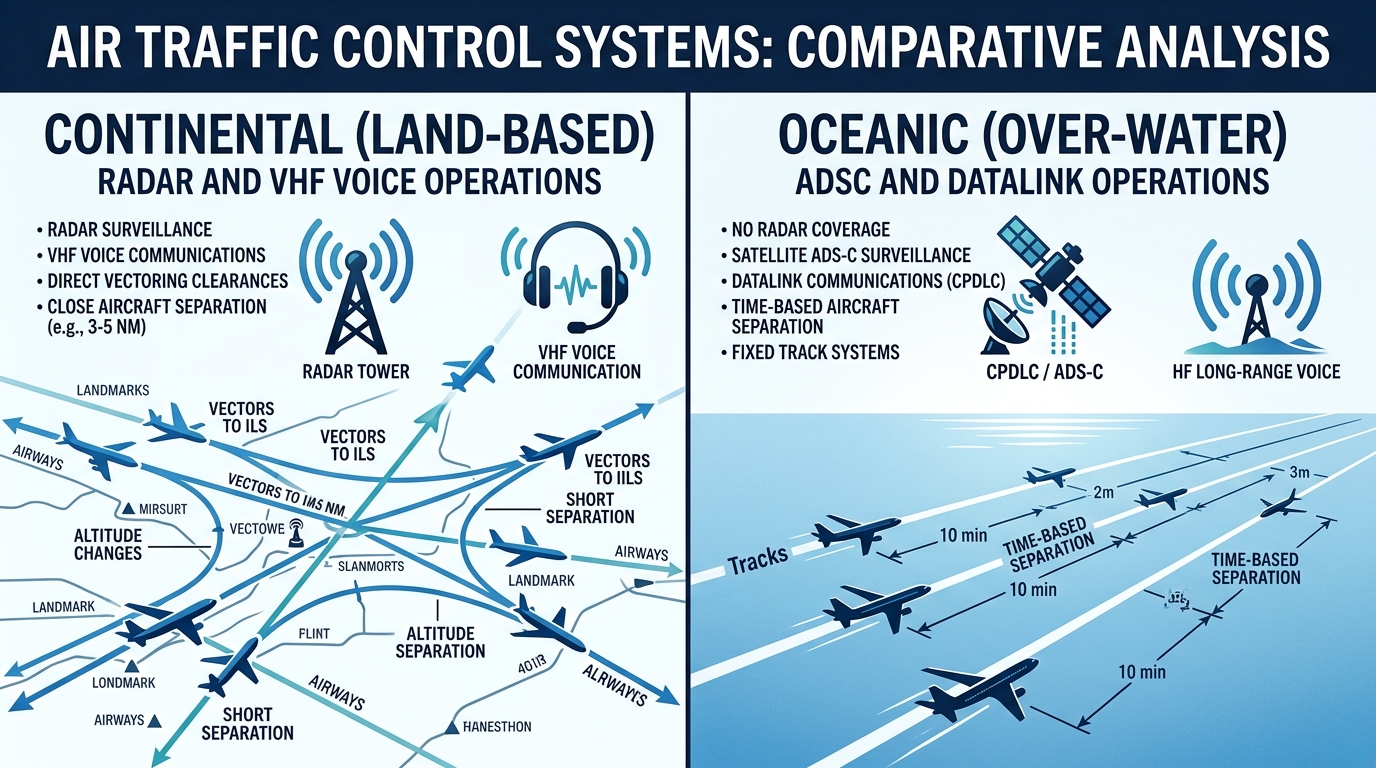
In well-served continental airspace, area control uses ATS surveillance — primary/secondary radar and increasingly ADS-B (Chapter 12) — to see aircraft directly, reducing the need for position reports and allowing radar separation and vectoring.
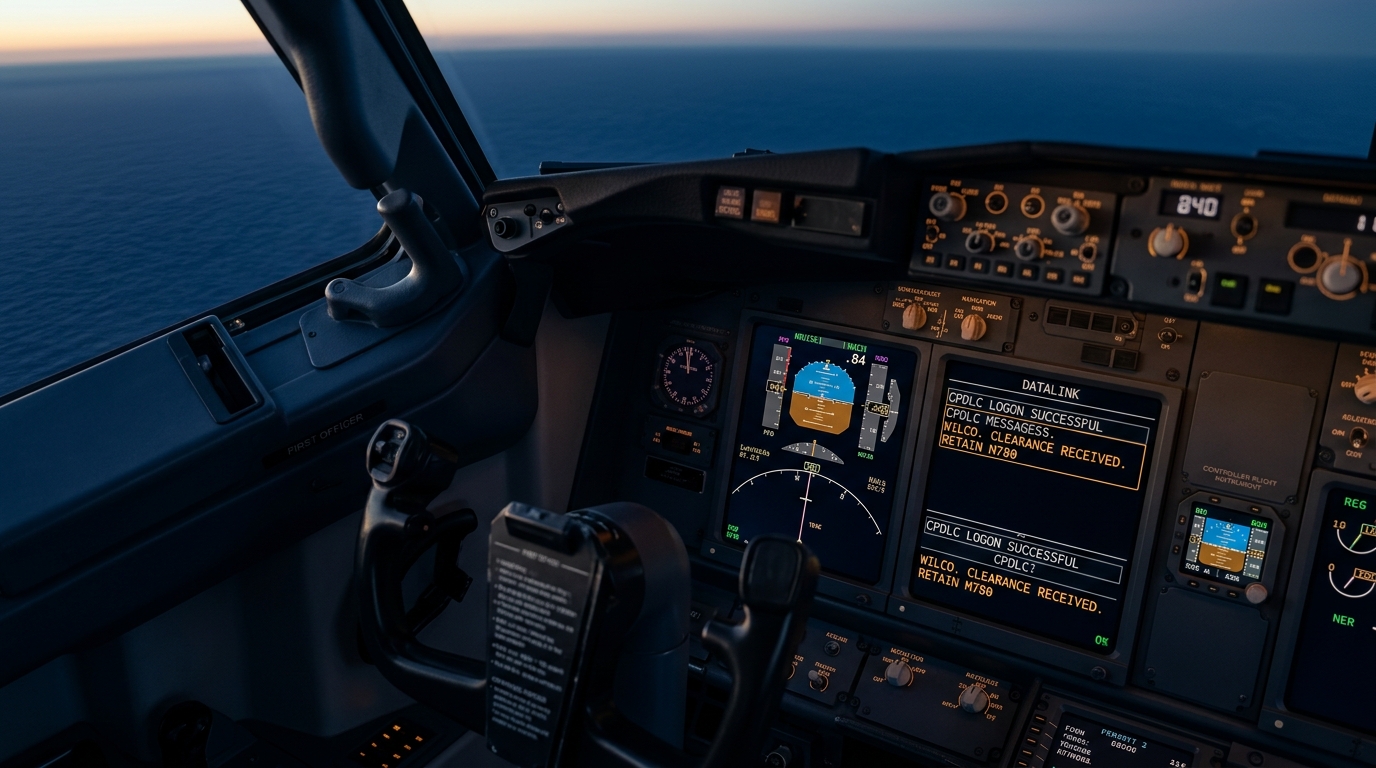
Where there is no radar, ADS-C (Automatic Dependent Surveillance — Contract) has the aircraft automatically send position reports over datalink at agreed intervals/events, and CPDLC (Controller–Pilot Data Link Communications) carries clearances and messages as text. Together they let an oceanic controller "see" and instruct aircraft without voice or radar.
18.7 Oceanic control
Over the ocean there is no VHF (line-of-sight) and traditionally no radar. So separation is procedural: aircraft are pre-cleared onto a track at a level and a Mach number, report their position by HF voice or CPDLC, and the controller keeps them apart by time and the Mach-number technique. This is why your original notes' "oceanic" was only a propagation footnote — the control procedure is here.
Before entering oceanic airspace the aircraft obtains an oceanic clearance: the track, the flight level, and the assigned Mach number. Aircraft on the same track at the same level fly the same Mach number so the time-spacing between them stays constant — the Mach-number technique. SELCAL (Chapter 22) lets the crew stop monitoring HF static until called.
☆ Numbers to memorise
| Fact | Value |
|---|---|
| Area Control Centre | Suffix "Control"; en-route control of the airways/upper airspace, by sector |
| Position report order | Position · time · level · next point · estimate (+ the one after) |
| Level instructions | Maintain / climb / descend — all mandatory read-backs |
| Airways | Join (clearance) · leave (report) · cross (level/time) |
| Holding | "Hold at [fix], FL…, expect approach time / onward clearance [time]" |
| ADS-C / CPDLC | Automatic datalink position reports / text clearances (oceanic-remote) |
| Oceanic | Procedural; oceanic clearance = track + level + Mach; HF/CPDLC; SELCAL |
Part A — MCQs (click an option to check)
Part B — Oral / viva (tap to reveal model answers)
60-SECOND REVISION CARD
- Area Control = "Control"; en-route, worked in sectors.
- Position report: position · time · level · next · estimate. Level instructions = mandatory read-back.
- Airways: join (clearance) · leave (report) · cross (level/time). Hold: fix + FL + EAT/onward time.
- Continental surveillance = radar/ADS-B; remote/oceanic = ADS-C + CPDLC.
- Oceanic = procedural: oceanic clearance (track, level, Mach), HF/CPDLC, Mach-number technique, SELCAL.