Approach control owns the busy transition between the runway and the en-route world — sequencing arrivals down to final, launching departures up to the airways, and, where there is no ILS, talking an aircraft all the way to the runway by radar. This chapter covers IFR and VFR arrivals and departures, vectors to final, and the surveillance and precision radar approaches your original notes were missing.
SYLLABUS MAP
Part III (vi) Approach control — IFR/VFR departures & arrivals, vectors to final, surveillance & precision radar approach
Learning objectives — by the end of this chapter you will be able to…
Describe approach control's role and where it sits between Tower and Area control.
Use IFR and VFR departure and arrival phraseology.
Be vectored to an ILS final and read back an approach clearance.
Fly a Surveillance Radar Approach (SRA) talkdown.
Fly a Precision Approach Radar (PAR) talkdown and apply its "do not acknowledge" rule.
17.1 What approach control does
17.2 IFR & VFR departures
17.3 IFR & VFR arrivals
17.4 Vectors to an ILS final
17.5 Surveillance Radar Approach (SRA)
17.6 Precision Approach Radar (PAR)
☆ Numbers to memorise
? Question bank
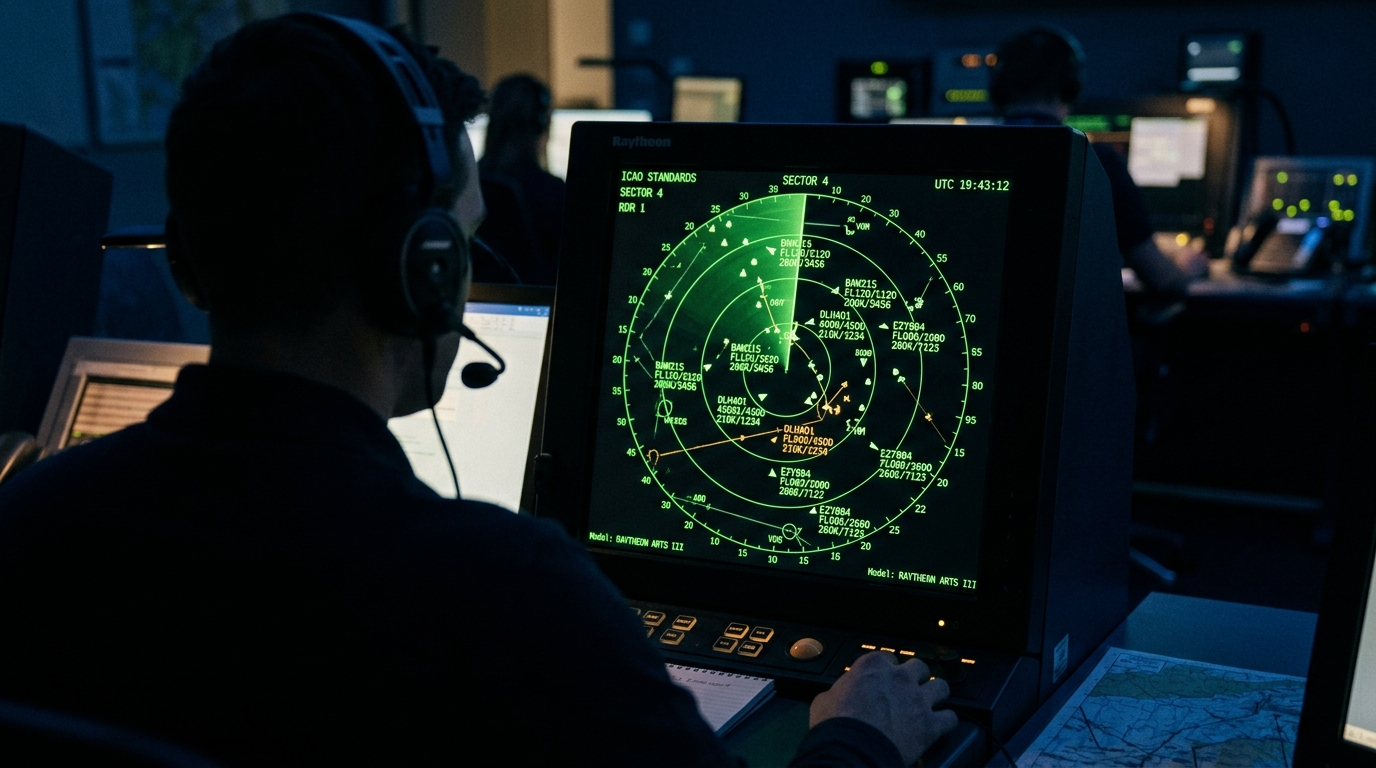
Approach control uses surveillance radar to vector and sequence aircraft in the terminal area, bridging the gap between the aerodrome and the en-route airways.
17.1 What approach control does
IN PLAIN TERMS
Approach control ("Approach", "Radar", "Director") handles aircraft in the terminal area — climbing departures handed up from Tower until they reach the airways, and descending arrivals handed down from Area control until they are established on final and passed to Tower. It usually has radar (a surveillance display), which is why it can vector aircraft and provide radar approaches.
17.2 IFR & VFR departures
Transcript — IFR departure handed to approach
A/C Delhi Approach, Ghostair Alfa Bravo Charlie, passing two thousand, PAPA two departure.
ATC Ghostair Alfa Bravo Charlie, identified, climb flight level one zero zero, when ready direct PAPA.
A/C Climb flight level one zero zero, when ready direct PAPA, Ghostair Alfa Bravo Charlie.
Transcript — VFR departure
A/C Delhi Approach, VT-ABC, leaving the zone to the north, VFR, two thousand feet.
ATC VT-ABC, roger, report leaving the zone, traffic is a helicopter two miles north.
17.3 IFR & VFR arrivals
Transcript — IFR arrival
A/C Delhi Approach, Ghostair Alfa Bravo Charlie, flight level one zero zero, inbound PAPA, information Delta.
ATC Ghostair Alfa Bravo Charlie, descend flight level six zero, expect ILS approach runway two seven.
A/C Descend flight level six zero, expect ILS runway two seven, Ghostair Alfa Bravo Charlie.
"Expect" vs a clearance
"Expect ILS approach runway two seven" is advance information so you can prepare — it is not the approach clearance. The clearance comes later: "cleared ILS approach runway two seven". VFR arrivals are given join instructions as in Chapter 15.
17.4 Vectors to an ILS final
WHY VECTORS
Radar lets the controller vector (assign headings to) arrivals so they intercept the ILS localizer at a sensible angle and spacing. The sequence is: turn onto a base heading, descend to the platform altitude, then a closing heading to intercept, then the approach clearance.
Transcript — vectors to ILS
ATC Ghostair Alfa Bravo Charlie, turn left heading two one zero, descend two thousand five hundred feet, QNH one zero one three.
A/C Left heading two one zero, descend two thousand five hundred feet, QNH one zero one three, Ghostair Alfa Bravo Charlie.
ATC Ghostair Alfa Bravo Charlie, closing the localizer from the left, report established. Turn left heading two five zero, cleared ILS approach runway two seven.
A/C Left heading two five zero, cleared ILS approach runway two seven, wilco, Ghostair Alfa Bravo Charlie.
A/C Ghostair Alfa Bravo Charlie, established ILS runway two seven.
ATC Ghostair Alfa Bravo Charlie, contact Tower one one eight decimal one.
17.5 Surveillance Radar Approach (SRA)
What an SRA is
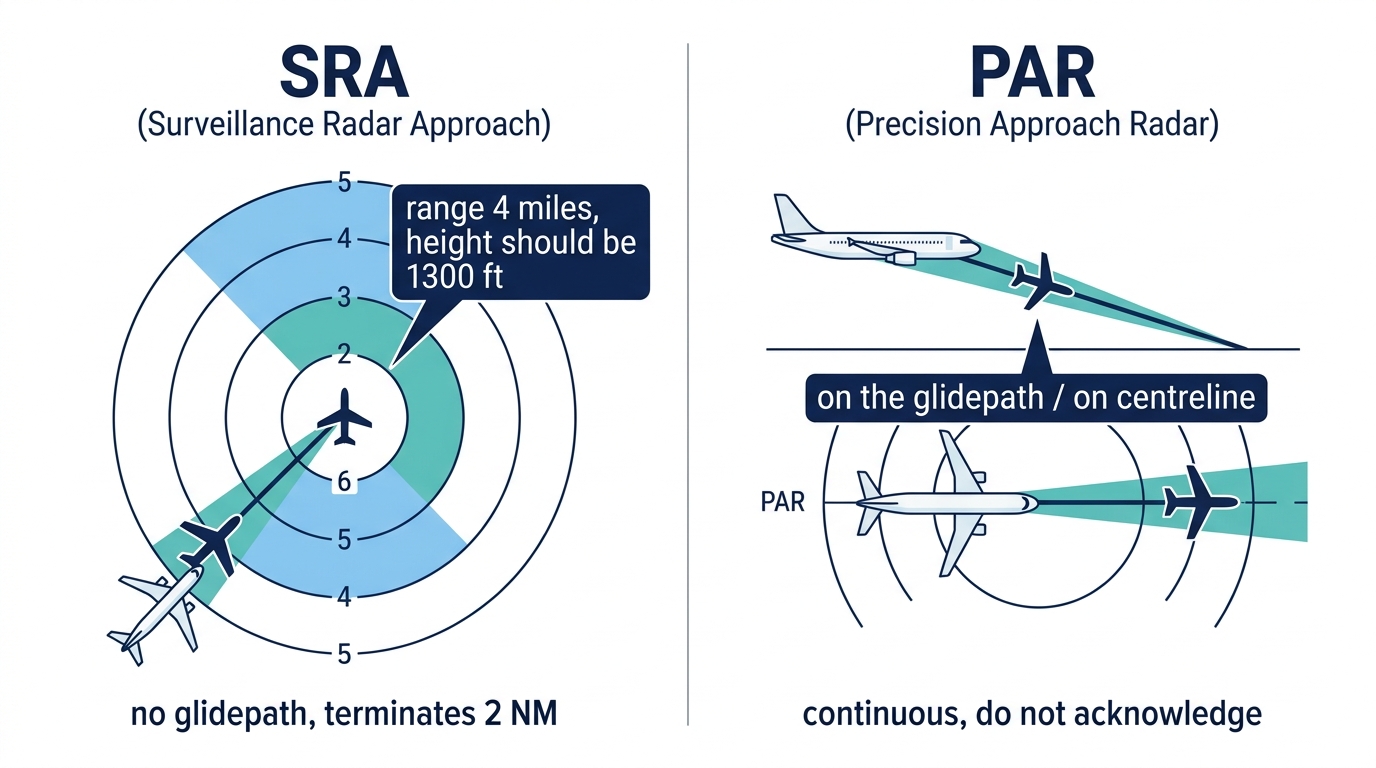
A Surveillance Radar Approach is a non-precision approach in which the controller uses the surveillance radar to give the pilot azimuth (heading) guidance and a series of ranges with advised heights, but no glidepath — the pilot maintains the correct descent by comparing the radar range with the advised height. It usually terminates at a fixed range (commonly 2 NM or ½ NM) from touchdown, from where the pilot continues visually.
Transcript — SRA talkdown
ATC VT-ABC, this will be a surveillance radar approach runway two seven, terminating at two miles. Check your minima. Turn left heading two seven zero, closing from the right.
ATC VT-ABC, range six miles, height should be one thousand nine hundred feet.
ATC VT-ABC, range four miles, height should be one thousand three hundred feet. On track.
ATC VT-ABC, range two miles, height should be six hundred and fifty feet, approach completed, contact Tower.
Exam trap
On an SRA the pilot is not normally asked to acknowledge each range/height call — the controller transmits a steady stream. The pilot flies the heading and checks the advised heights against the ranges. There is no electronic glidepath; the height/range advisory is the descent guide.
17.6 Precision Approach Radar (PAR)
What a PAR is
A Precision Approach Radar gives the pilot continuous azimuth AND elevation guidance — the controller watches the aircraft against both the centreline and a precise glidepath, and "talks it down" with a constant patter of corrections almost to touchdown. It is a true precision approach (used mainly by military and some civil fields).
The "do not acknowledge" rule
Because the talkdown is continuous and time-critical, the controller instructs the pilot "do not acknowledge further transmissions". The pilot then simply flies the corrections and does not reply, so the channel stays clear for the steady stream of guidance.
Transcript — PAR talkdown
ATC VT-ABC, this will be a precision approach runway two seven. Do not acknowledge further transmissions. Turn left heading two seven two.
ATC VT-ABC, approaching the glidepath … on the glidepath … on centreline.
ATC Slightly above the glidepath, coming down nicely … on the glidepath. On centreline.
ATC Going slightly left of centreline, turn right two degrees … on centreline. On the glidepath. Approaching decision height.
Mnemonic — SRA vs PAR
SRA = Steered + Range/height (no glidepath); PAR = Precise (centreline + glidepath), continuous, don't acknowledge. PAR gives both dimensions; SRA gives heading plus a height-check table.
Figure 17.1 — SRA vs PAR: what the controller can see and say. SRA provides headings and step-down altitudes, while PAR provides a continuous glidepath talkdown.
☆ Numbers to memorise
Essential Facts for Chapter 17
Fact
Value
Approach control
Terminal area between Tower and Area control; usually radar-equipped
"Expect" approach
Advance info, NOT the approach clearance
Vectors to ILS
Base heading → descend platform → closing heading → "cleared ILS approach"
SRA
Heading + range/height advisories, NO glidepath; terminates ~2 NM (or ½ NM)
PAR
Continuous azimuth + elevation talkdown; "do not acknowledge further transmissions"
Question bank
Part A — MCQs (click an option to check)
1. Approach control handles aircraft:
Only on the runway
In the terminal area between Tower and Area control
Only over the ocean
On the apron
Answer: In the terminal area between Tower and Area control. Approach sequences arrivals down to final and departures up to the airways.
2. "Expect ILS approach runway 27" is:
The approach clearance
Advance information, not a clearance
A landing clearance
A vector
Answer: Advance information, not a clearance. "Expect" prepares you; the clearance "cleared ILS approach" comes later.
3. To vector an aircraft, the controller assigns:
A squawk
Headings (and often levels)
A frequency
A call sign
Answer: Headings (and often levels). Vectoring is the assignment of headings using radar.
4. A Surveillance Radar Approach provides:
Azimuth and glidepath guidance
Heading guidance plus range/height advisories, no glidepath
No guidance at all
Only a squawk
Answer: Heading guidance plus range/height advisories, no glidepath. SRA gives heading and a series of ranges with advised heights; there is no glidepath.
5. An SRA normally terminates at:
The threshold
A fixed range, commonly 2 NM (or ½ NM)
10 NM
It never terminates
Answer: A fixed range, commonly 2 NM (or ½ NM). SRAs terminate at a set range, from where the pilot continues visually.
6. On an SRA, the pilot maintains the correct descent by:
Following an electronic glidepath
Comparing the radar range with the advised height
Using GPS only
Listening to the marker beacons
Answer: Comparing the radar range with the advised height. The advised height for each range is the descent guide; there is no glidepath signal.
7. A Precision Approach Radar provides:
Heading only
Continuous azimuth and elevation (centreline + glidepath) guidance
Range only
No talkdown
Answer: Continuous azimuth and elevation (centreline + glidepath) guidance. PAR gives both dimensions continuously — a true precision talkdown.
8. On a PAR, the controller instructs the pilot to:
Acknowledge every transmission
Not acknowledge further transmissions
Squawk ident
Change frequency each mile
Answer: Not acknowledge further transmissions. "Do not acknowledge further transmissions" keeps the channel clear for continuous guidance.
9. "Closing the localizer from the left, cleared ILS approach runway 27" tells the pilot to:
Continue past the localizer
Intercept the localizer and fly the ILS approach
Go around
Hold
Answer: Intercept the localizer and fly the ILS approach. It is the approach clearance once positioned to intercept the localizer.
10. A VFR arrival is given:
A radar talkdown
Join instructions (as for the circuit)
An oceanic clearance
A SELCAL check
Answer: Join instructions (as for the circuit). VFR arrivals receive join instructions, then are sequenced visually.
11. The platform/intercept altitude on vectors is given as a:
Flight level only
Descent to an altitude with QNH, read back
Squawk
Heading
Answer: Descent to an altitude with QNH, read back. Below the transition level the controller assigns an altitude on QNH, which is read back.
12. After establishing on the ILS, the aircraft is usually:
Told to hold
Transferred to Tower
Told to squawk standby
Given an oceanic clearance
Answer: Transferred to Tower. Approach hands the established aircraft to Tower for landing.
13. The key difference between SRA and PAR is that PAR also provides:
A squawk
Glidepath (elevation) guidance
A frequency change
Wind information
Answer: Glidepath (elevation) guidance. PAR adds continuous elevation/glidepath guidance that the SRA lacks.
14. On a PAR talkdown, "on the glidepath, on centreline" means the aircraft is:
Too high and left
Correctly positioned in both the vertical and the lateral plane
Below the glidepath
Off the radar
Answer: Correctly positioned in both the vertical and the lateral plane. It confirms correct position on both the glidepath and the runway centreline.
15. An IFR departure handed to Approach typically receives:
A landing clearance
A climb clearance and identification
A SELCAL check
Holding instructions only
Answer: A climb clearance and identification. Approach identifies the departure and issues climb instructions toward the airways.
16. The reason a controller can vector and provide radar approaches is:
It has no radar
Approach is usually radar-equipped (a surveillance display)
It uses HF only
It is on the apron
Answer: Approach is usually radar-equipped (a surveillance display). Radar at approach control enables vectoring and SRA/PAR.
Part B — Oral / viva (tap to reveal model answers)
What is approach control's role?
Model Answer:
To control aircraft in the terminal area — sequencing arrivals from Area control down to final and handing them to Tower, and taking departures from Tower and climbing them up to the airways — usually with radar, allowing vectoring and radar approaches.
What is the difference between "expect" an approach and being "cleared" for it?
Model Answer:
"Expect ILS approach runway 27" is advance information to help the crew prepare; the clearance to fly the approach is "cleared ILS approach runway 27", given when positioned to intercept.
Describe a Surveillance Radar Approach.
Model Answer:
A non-precision approach where the controller gives heading guidance and a series of ranges each with an advised height, but no glidepath. The pilot keeps the correct descent by comparing range with advised height, and the approach terminates at a fixed range (commonly 2 NM) from where the pilot continues visually.
Describe a Precision Approach Radar and its key procedural rule.
Model Answer:
A precision approach in which the controller gives continuous azimuth and elevation guidance — centreline and glidepath — talking the aircraft down almost to touchdown. The pilot is told "do not acknowledge further transmissions" so the channel stays clear for the continuous guidance.
What is the difference between SRA and PAR?
Model Answer:
SRA provides heading plus range/height advisories with no glidepath; PAR additionally provides continuous glidepath (elevation) guidance, making it a true precision approach.
60-SECOND REVISION CARD
Approach = terminal area, between Tower and Area; radar-equipped → vectoring & radar approaches.
Vectors to ILS: base heading → descend to platform (QNH) → closing heading → cleared ILS approach → Tower.
"Expect" ≠ clearance. VFR arrivals get join instructions.
SRA: heading + range/height, no glidepath, terminates ~2 NM.
PAR: continuous centreline + glidepath, "do not acknowledge further transmissions".