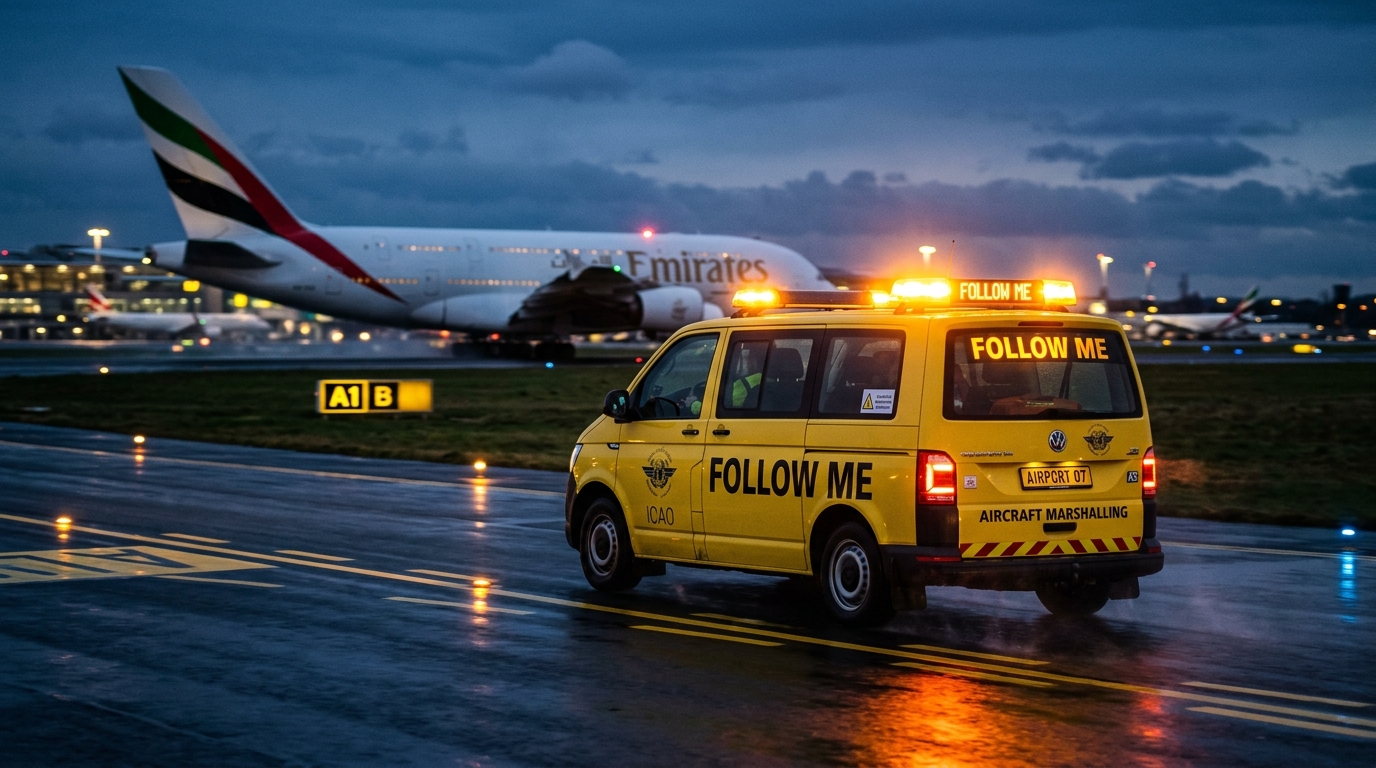
Aircraft are not the only traffic on the manoeuvring area. Fire trucks, "Follow-Me" cars, sweepers, tugs and inspection vehicles all move among the runways and taxiways — and a vehicle in the wrong place is one of the most dangerous causes of a runway incursion. This short but vital chapter covers the phraseology that keeps vehicles safely separated from aircraft.
SYLLABUS MAP
Part III (v) Aerodrome control — vehicles: movement instructions, crossing runways, vehicles towing aircraft
Learning objectives — by the end of this chapter you will be able to…
Explain why vehicles on the manoeuvring area need ATC clearance and phraseology.
Use vehicle call signs and basic movement instructions.
Apply the strict phraseology for crossing and holding short of runways.
Handle a vehicle towing an aircraft.
Use "report vacated" and conditional instructions correctly.
16.1 Why vehicles talk to the tower
16.2 Vehicle call signs & movement
16.3 Crossing & holding short of runways
16.4 Vehicles towing aircraft
16.5 Conditional instructions & "report vacated"
Vehicles on the manoeuvring area are subject to the same strict ATC control and read-back requirements as aircraft to prevent deadly incursions.
16.1 Why vehicles talk to the tower
FIRST PRINCIPLES — ONE CONTROLLER, ALL THE TRAFFIC
The manoeuvring area is a single shared space. Aircraft land and take off at high speed and cannot stop quickly; a vehicle that strays onto an active runway, or onto a taxiway in front of a taxiing aircraft, is a runway/taxiway incursion — a leading cause of serious accidents. So every vehicle on the manoeuvring area is controlled by the aerodrome controller, on the same frequency, using disciplined phraseology, exactly like an aircraft.
Who needs clearance
Any vehicle operating on the manoeuvring area (runways and taxiways) needs ATC clearance for its movements; vehicles confined to the apron are normally handled by apron management. The rule of thumb: if a vehicle could conflict with an aircraft taking off, landing or taxiing, the tower controls it.
16.2 Vehicle call signs & movement instructions
Call signs
Vehicles use a call sign that identifies their function and a number — e.g. "Car 5", "Fire 1", "Sweeper 2", "Follow-Me". The controller addresses them just as an aircraft, and they read back instructions.
Transcript — vehicle movement
VEH Delhi Tower, Car 5, request to proceed along taxiway Bravo to the threshold of runway two seven.
ATC Car 5, proceed along taxiway Bravo, hold short of runway two seven.
VEH Proceed Bravo, hold short of runway two seven, Car 5.
Common vehicle phrases
"Proceed [route]" — move along the stated path. "Hold position" — stop. "Hold short of [runway/point]" — stop at the marking, do not pass it. "Give way to [aircraft/vehicle]". "Vacate [runway/taxiway]". "Report [position/vacated]".
16.3 Crossing & holding short of runways
THE CRITICAL CASE
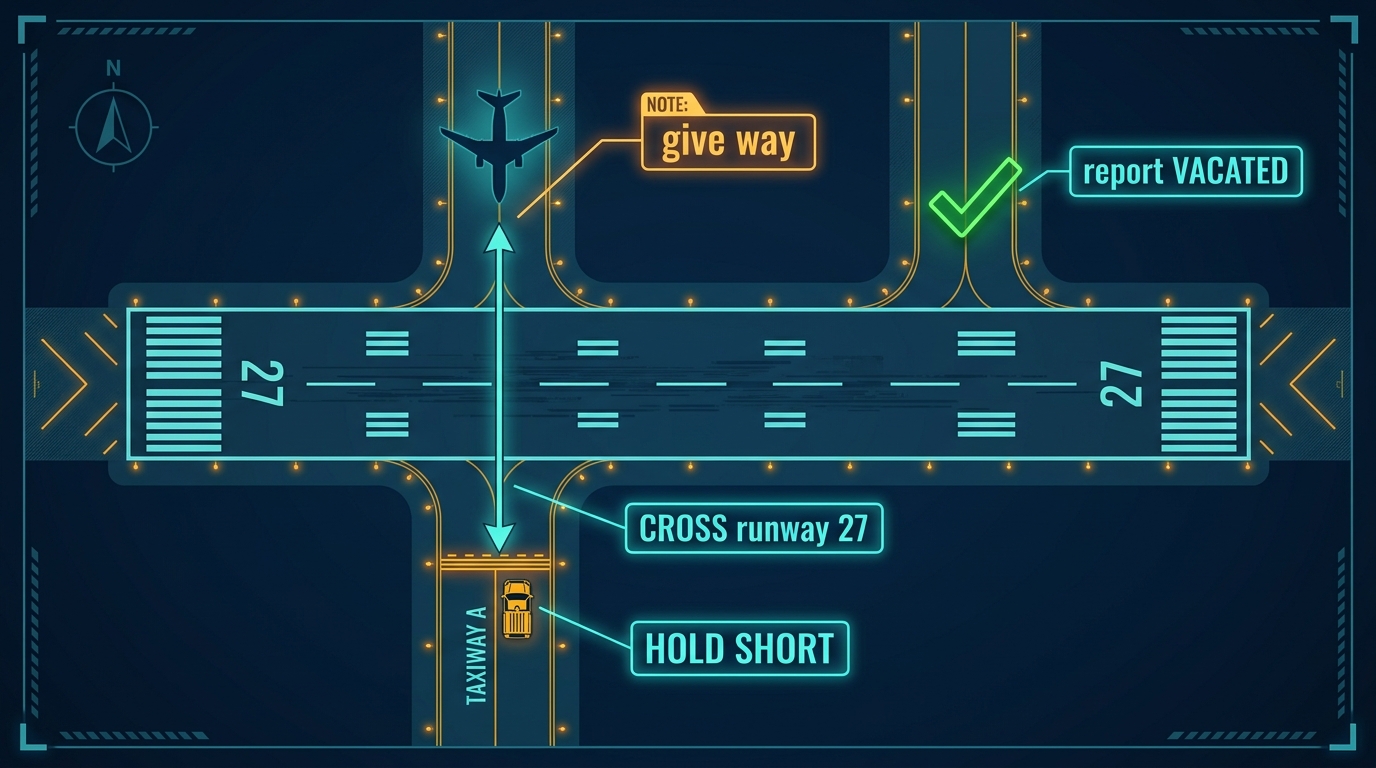
A vehicle crossing a runway is the highest-risk vehicle movement, so the phraseology is strict and explicit. A vehicle never crosses or enters a runway without a specific clearance, and reports when clear so the controller knows the runway is released.
Transcript — crossing a runway
VEH Delhi Tower, Car 5, holding short of runway two seven, request to cross.
ATC Car 5, cross runway two seven, report vacated.
VEH Cross runway two seven, will report vacated, Car 5.
VEH Car 5, runway two seven vacated.
ATC Car 5, roger.
Exam trap
"Hold short of runway 27" is an instruction to stop and wait — it is not a clearance to cross. Crossing requires the explicit "cross runway 27", read back in full, and the crossing is not complete until "vacated" is reported.
16.4 Vehicles towing aircraft
The tug & aircraft as one unit
When a vehicle (a tug) tows an aircraft, the combination is treated as a single moving unit on the manoeuvring area and is given taxi/movement instructions by the tower. The controller must know it is a tow (it may move slowly and turn within a large radius), and the tow is cleared along a route and to hold short or cross runways exactly like any other movement.
Transcript — towing an aircraft
VEH Delhi Ground, Tug 3, towing the Airbus from stand two one to the maintenance area, request tow.
ATC Tug 3, tow approved to the maintenance area via taxiway Bravo, hold short of runway two seven.
VEH Tow to maintenance via Bravo, hold short of runway two seven, Tug 3.
16.5 Conditional instructions & "report vacated"
Sequencing vehicles with aircraft
The controller often sequences a vehicle around aircraft movements: "give way to the landing aircraft, then cross", or "after the departing Airbus, cross runway 27". As with aircraft, a conditional instruction names the traffic, is read back including the condition, and is acted on only when that traffic has passed. Always report when the runway/taxiway is vacated.
Real-world relevance
Many of the world's worst runway accidents began with confusion over who was cleared onto the runway. Tight, explicit vehicle phraseology — hold short, cross, report vacated — exists precisely to make a vehicle on an active runway impossible to overlook.
Figure 16.1 — A visual representation of the critical phraseology sequence required for a vehicle to safely cross an active runway.
☆ Numbers to memorise
Essential Facts for Chapter 16
Fact
Value
Who controls vehicles
Aerodrome controller (Tower/Ground) on the manoeuvring area
Vehicle call signs
Function + number (Car 5, Fire 1, Sweeper 2, Follow-Me, Tug 3)
Hold short
Stop at the marking — NOT a clearance to cross
Crossing a runway
Explicit "cross runway XX", read back, then "report vacated"
Towing aircraft
Tug + aircraft = one unit; given taxi/movement instructions
Conditional
"Give way to … then cross" / "after the … cross" — act only when condition met
Question bank
Part A — MCQs (click an option to check)
1. Vehicles on the manoeuvring area are controlled by:
No one
The aerodrome controller (Tower/Ground)
Area control
The airline operations centre
Answer: The aerodrome controller (Tower/Ground). All vehicles on the manoeuvring area come under the aerodrome controller.
2. A vehicle in the wrong place on a runway is called a:
Go-around
Runway incursion
Conditional clearance
Transfer
Answer: Runway incursion. An unauthorised presence on the runway is a runway incursion — a major hazard.
3. A typical vehicle call sign is:
"Ghostair 5"
"Car 5" (function + number)
"VT-CAR5"
"Tower 5"
Answer: "Car 5" (function + number). Vehicles use a function name and number, e.g. Car 5, Fire 1.
4. "Hold short of runway 27" instructs the vehicle to:
Cross the runway
Stop at the marking and not enter the runway
Proceed onto the runway and wait
Vacate the taxiway
Answer: Stop at the marking and not enter the runway. Hold short = stop at the holding point; it is not a clearance to cross.
5. To cross a runway a vehicle needs:
No clearance if it is quick
An explicit "cross runway XX" clearance, read back
Only apron approval
A go-around
Answer: An explicit "cross runway XX" clearance, read back. Crossing requires a specific clearance, read back in full.
6. After crossing, the vehicle should:
Say nothing
Report "runway vacated"
Request take-off
Change frequency
Answer: Report "runway vacated". Reporting "vacated" tells the controller the runway is clear again.
7. A vehicle towing an aircraft is:
Not controlled by ATC
Treated as a single moving unit and given taxi/movement instructions
Always given priority over aircraft
Handled only by the airline
Answer: Treated as a single moving unit and given taxi/movement instructions. The tug-and-aircraft combination is one unit under ATC movement instructions.
8. "Give way to the landing aircraft, then cross" means the vehicle should:
Cross immediately
Wait until the landing aircraft has passed, then cross
Hold short permanently
Vacate the area
Answer: Wait until the landing aircraft has passed, then cross. A conditional instruction is acted on only when the stated condition is satisfied.
9. Vehicles confined to the apron are normally handled by:
Area control
Apron management
The Director
No one
Answer: Apron management. Apron-only vehicles are usually managed by apron control, not the tower.
10. A "Follow-Me" vehicle is used to:
Tow disabled aircraft only
Guide an aircraft along a taxi route
Inspect the runway surface
Fight fires
Answer: Guide an aircraft along a taxi route. A Follow-Me car leads an aircraft along its taxi route to the stand or runway.
11. The phraseology for vehicles is:
Casual and informal
Standard and disciplined, like aircraft, with read-backs
Spoken only by the controller
Optional
Answer: Standard and disciplined, like aircraft, with read-backs. Vehicles use standard phraseology and read back instructions just like aircraft.
12. The most safety-critical vehicle movement is:
Driving on the apron
Crossing an active runway
Parking at a stand
Refuelling
Answer: Crossing an active runway. Crossing an active runway carries the highest incursion risk, hence the strict phraseology.
Part B — Oral / viva (tap to reveal model answers)
Why must vehicles on the manoeuvring area use ATC and standard phraseology?
Model Answer:
Because the manoeuvring area is shared with fast-moving aircraft that cannot stop quickly; a vehicle in the wrong place is a runway or taxiway incursion. The aerodrome controller therefore controls every vehicle on the same frequency, with disciplined read-back phraseology, exactly like an aircraft.
What is the difference between "hold short of runway 27" and "cross runway 27"?
Model Answer:
"Hold short" instructs the vehicle to stop at the holding marking and not enter the runway; "cross runway 27" is an explicit clearance to cross, which must be read back, and the crossing is not complete until the vehicle reports "vacated".
How is a vehicle towing an aircraft handled?
Model Answer:
The tug and aircraft are treated as a single moving unit and given taxi/movement instructions by the tower, including a route and any hold-short or crossing clearances, just like any other movement.
How does a controller sequence a vehicle around aircraft?
Model Answer:
With conditional instructions such as "give way to the landing aircraft, then cross" or "after the departing Airbus, cross runway 27" — the vehicle reads back the condition and acts only when the stated traffic has passed, then reports vacated.
60-SECOND REVISION CARD
All vehicles on the manoeuvring area are controlled by the aerodrome controller, with read-back phraseology.
Call signs = function + number (Car 5, Fire 1, Tug 3, Follow-Me). Apron vehicles → apron management.
Hold short = stop (not cross). Crossing needs explicit "cross runway XX", read back, then "report vacated".
A tug + aircraft is one unit, given taxi/movement instructions.
Conditional: "give way … then cross" — act only when the condition is met. Crossing an active runway is the highest-risk vehicle movement.