This is the chapter the practical examiner listens for. Standard phraseology is a script — the same words, in the same order, for every phase of flight — so that a controller in Delhi and a pilot from anywhere understand each other instantly. Here we walk a flight from clearance and start, through taxi, take-off, the circuit, final approach and landing, the go-around, and vacating.
SYLLABUS MAP
Part III (iii) Aerodrome control — aircraft: departure info, start, push-back, taxi, take-off, circuit, final & landing, go-around, after landing
Learning objectives — by the end of this chapter you will be able to…
Describe the aerodrome controller's responsibilities and the manoeuvring area.
Use the correct phraseology for clearance delivery, start-up and push-back.
Use taxi phraseology, including holding points, "give way" and conditional clearances.
Use line-up and take-off phraseology and the circuit reporting points.
Use final-approach, landing and go-around phraseology.
Use after-landing and vacating phraseology.
15.1 The aerodrome controller
15.2 Clearance & departure information
15.3 Start-up & push-back
15.4 Taxi
15.5 Line-up & take-off
15.6 The traffic circuit
15.7 Final approach & landing
15.8 Go-around
15.9 After landing & vacating
From engine start to the final runway vacation, strict adherence to standard phraseology is the foundation of aerodrome safety.
15.1 The aerodrome controller
IN PLAIN TERMS
Aerodrome control (Tower) is responsible for traffic on the runways and in the aerodrome traffic circuit, and for vehicles and aircraft on the manoeuvring area.
The manoeuvring area is the runways and taxiways used for take-off, landing and taxiing — but not the aprons. The movement area is the manoeuvring area plus the aprons.
Two definitions to keep straight
Manoeuvring area = runways + taxiways (for take-off, landing, taxiing); excludes aprons. Movement area = manoeuvring area + aprons.
Ground/Tower control the manoeuvring area; the apron may be managed separately ("Apron").
15.2 Clearance & departure information
WHY A CLEARANCE IS READ BACK IN FULL
An IFR departure clearance is a contract: it states where you are cleared, by what route, to what level, and the squawk. Because an error here propagates into controlled airspace, the whole clearance is a mandatory read-back.
Transcript — IFR clearance (Delivery)
A/C Delhi Delivery, Ghostair Alfa Bravo Charlie, stand two one, request IFR clearance to Mumbai, information Charlie.
ATC Ghostair Alfa Bravo Charlie, cleared to Mumbai via PAPA two departure, climb flight level one zero zero, squawk four three two one.
A/C Cleared to Mumbai via PAPA two departure, climb flight level one zero zero, squawk four three two one, Ghostair Alfa Bravo Charlie.
Before taxi the pilot needs the runway in use, surface wind, QNH and any essential information — usually obtained from ATIS (Chapter 6) and confirmed on first contact ("…information Charlie"). The controller passes anything ATIS does not cover.
15.3 Start-up & push-back
Transcript — start & push
A/C Delhi Ground, Ghostair Alfa Bravo Charlie, stand two one, request start-up.
"Start-up approved" permits engine start, not movement. Push-back is a separate clearance, and the controller may give the direction to face. Never push or taxi on a start-up clearance alone.
ATC Ghostair Alfa Bravo Charlie, taxi to holding point Alfa One runway two seven via taxiway Bravo, QNH one zero one three.
A/C Taxi to holding point Alfa One runway two seven via Bravo, QNH one zero one three, Ghostair Alfa Bravo Charlie.
Key taxi phrases
"Hold position" — stop where you are. "Give way to [traffic]" — let the named traffic pass. "Follow [traffic]". "Hold short of runway 27" / "holding point Alfa One" — stop at the marked point and do not enter the runway. A clearance to taxi does not include clearance to enter or cross a runway.
Exam trap — runway entry
Taxiing to a holding point is not permission to enter the runway. Entering, crossing or backtracking a runway each needs its own explicit clearance — and each is a mandatory read-back.
15.5 Line-up & take-off
Transcript — line-up & departure
A/C Delhi Tower, Ghostair Alfa Bravo Charlie, holding point Alfa One, ready for departure.
ATC Ghostair Alfa Bravo Charlie, line up runway two seven and wait.
A/C Line up runway two seven and wait, Ghostair Alfa Bravo Charlie.
ATC Ghostair Alfa Bravo Charlie, wind two seven zero degrees eight knots, runway two seven, cleared for take-off.
A/C Runway two seven, cleared for take-off, Ghostair Alfa Bravo Charlie.
Take-off phraseology — exact words
The word "take-off" is used only when issuing or cancelling a take-off clearance — at all other times say "departure". "Cleared for take-off" / read back "cleared for take-off". To cancel: "hold position, cancel take-off, I say again cancel take-off". An "immediate take-off" may be issued if traffic requires.
Worked example — conditional line-up
ATC: "Ghostair Alfa Bravo Charlie, behind the landing Airbus, line up runway two seven behind."
Correct read-back: "Behind the landing Airbus, line up runway two seven behind, Ghostair Alfa Bravo Charlie." The word "behind" is said twice — at the start and end — so the condition cannot be missed. Do not move until the Airbus has passed.
15.6 The aerodrome traffic circuit
IN PLAIN TERMS
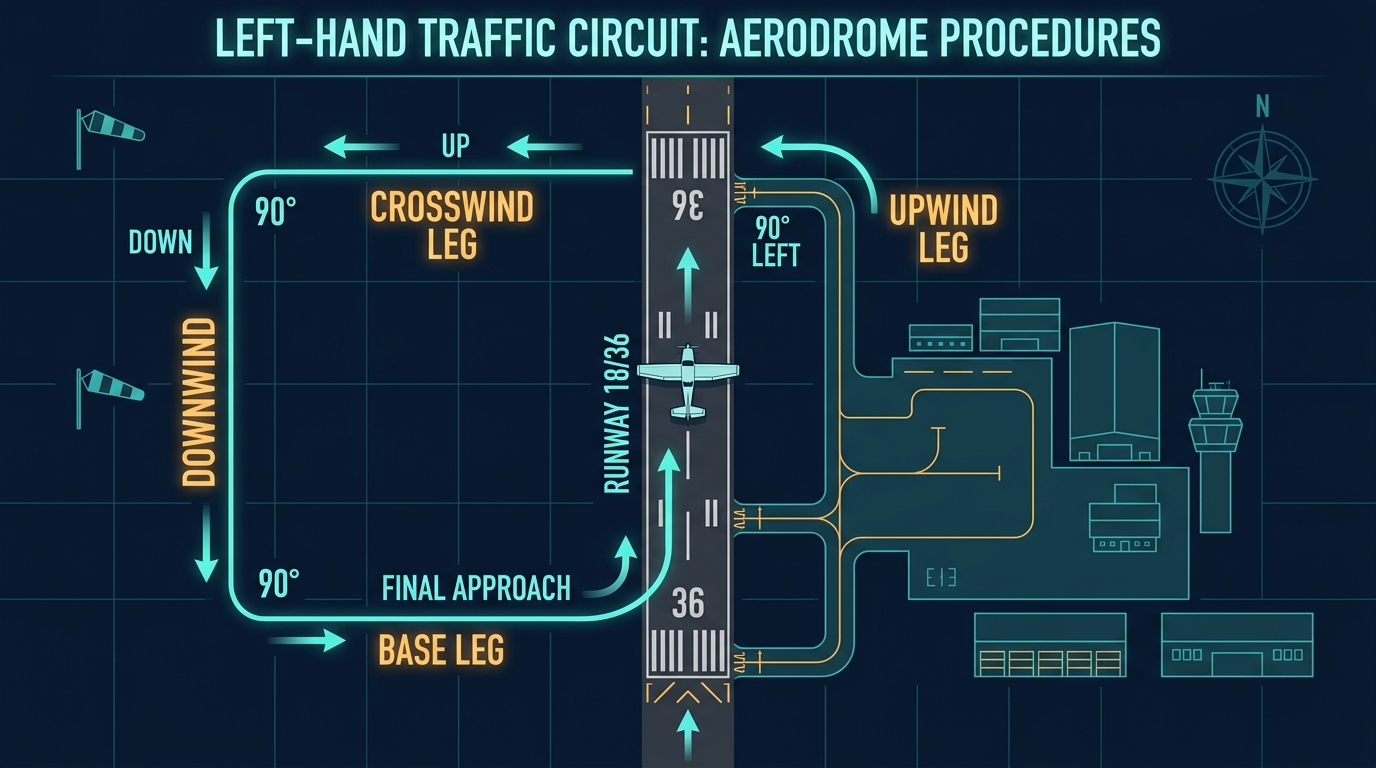
The circuit is the standard rectangular pattern flown around a runway. Its legs — upwind/crosswind, downwind, base, final — are the reporting points the tower uses to sequence visual traffic.
The visual traffic circuit provides a predictable, standardized pattern for VFR aircraft to maneuver and sequence for landing.
Circuit Legs
Leg
Where
Upwind / climb-out
Straight ahead after take-off
Crosswind
Turn (usually 90°) across the upwind end
Downwind
Parallel to the runway, opposite direction to landing
Base
Turn toward final, descending
Final
Lined up with the runway for landing
Transcript — joining & circuit reports
A/C Delhi Tower, VT-ABC, five miles north, for landing, information Charlie.
ATC VT-ABC, join left-hand downwind runway two seven, QNH one zero one three, report downwind.
A/C Join left-hand downwind runway two seven, QNH one zero one three, wilco, VT-ABC.
A/C VT-ABC, downwind.
ATC VT-ABC, number two, follow the Cessna on base, report final.
15.7 Final approach & landing
Transcript — final & landing
A/C VT-ABC, final.
ATC VT-ABC, wind two seven zero degrees one zero knots, runway two seven, cleared to land.
A/C Runway two seven, cleared to land, VT-ABC.
Landing variations
"Continue approach" — keep approaching; landing clearance not yet given. "Land after the departing/landing [traffic]" — a conditional landing clearance behind preceding traffic. "Cleared to land" is the full clearance and a mandatory read-back.
15.8 Go-around
The go-around / missed approach
If the approach must be discontinued, the instruction is "go around" (said clearly, often twice). The pilot applies power, climbs, and flies the missed-approach procedure or the tower's instructions. A pilot may also initiate a go-around without being told — reporting "going around".
Transcript — go-around
ATC VT-ABC, go around, I say again, go around, vehicle on the runway.
A/C Going around, VT-ABC.
ATC VT-ABC, climb straight ahead to two thousand feet, report downwind.
15.9 After landing & vacating
Transcript — vacating
ATC VT-ABC, vacate next left, contact Ground one two one decimal nine.
A/C Vacate next left, Ground one two one decimal nine, VT-ABC.
A/C Delhi Ground, VT-ABC, runway vacated, request taxi to apron.
ATC VT-ABC, taxi to stand two one via taxiway Bravo.
Exam trap — "runway vacated"
You are not clear of the runway until the whole aircraft is past the holding point. Report "runway vacated" only when fully clear — this releases the runway for the next aircraft, so accuracy matters.
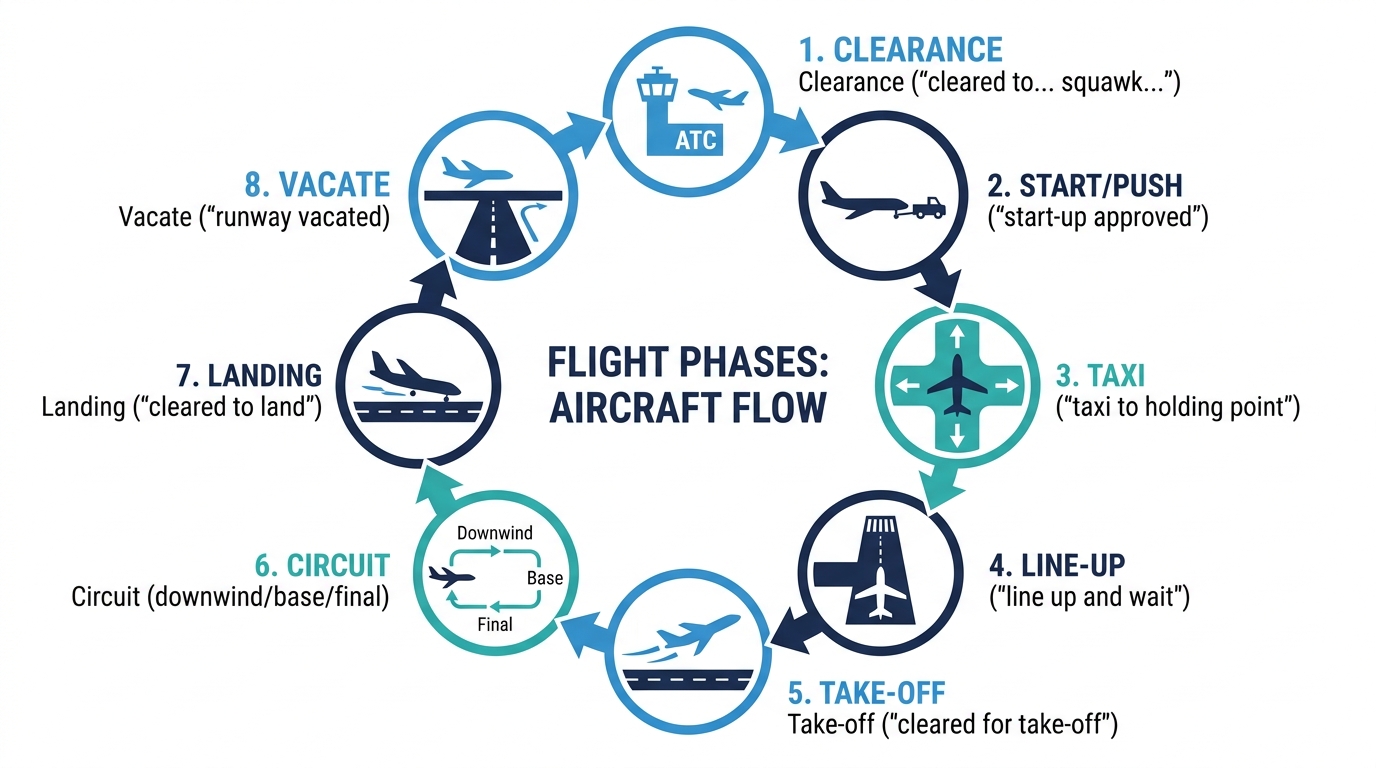
Figure 15.1 — A flight in phraseology: the critical communication nodes from clearance to vacating the runway.
☆ Numbers to memorise
Essential Facts for Chapter 15
Fact
Value
Manoeuvring vs movement area
Manoeuvring = runways+taxiways; Movement = + aprons
"Take-off"
Used only to issue/cancel a take-off clearance; else "departure"
Start vs push
"Start-up approved" ≠ movement; push-back is a separate clearance
Runway entry
Taxi to a holding point ≠ clearance to enter/cross/backtrack
Conditional clearance
Condition stated first & last ("behind … behind")
Circuit legs
Upwind · crosswind · downwind · base · final
Landing phrases
Continue approach / cleared to land / land after
Go-around
"Go around" (often twice); pilot may initiate "going around"
Question bank
Part A — MCQs (click an option to check)
1. The manoeuvring area consists of:
Aprons only
Runways and taxiways (excluding aprons)
Runways, taxiways and aprons
The terminal building
Answer: Runways and taxiways (excluding aprons). Manoeuvring area = runways + taxiways; adding aprons makes it the movement area.
2. An IFR departure clearance must be:
Acknowledged with "roger"
Read back in full
Read back only if requested
Not read back
Answer: Read back in full. Route clearances are mandatory read-back items.
3. "Start-up approved" permits:
Push-back and taxi
Engine start only
Take-off
Crossing the runway
Answer: Engine start only. It allows engine start; push-back and taxi are separate clearances.
4. The word "take-off" is used:
Throughout the taxi
Only when issuing or cancelling a take-off clearance
For any departure intention
Only by the pilot
Answer: Only when issuing or cancelling a take-off clearance. Otherwise "departure" is used, to reserve "take-off" for the clearance itself.
5. Taxiing to a holding point gives you:
Clearance to line up
Clearance to cross the runway
No clearance to enter the runway — stop at the holding point
Clearance for take-off
Answer: No clearance to enter the runway. A taxi clearance to a holding point does not authorise entering the runway.
6. "Give way to the Cessna" means:
Follow the Cessna
Let the Cessna pass before you continue
Overtake the Cessna
Stop permanently
Answer: Let the Cessna pass before you continue. Give way = yield to the named traffic, then continue.
7. "Line up runway 27 and wait" means:
Take off immediately
Enter the runway, line up, and hold for take-off clearance
Hold short of the runway
Vacate the runway
Answer: Enter the runway, line up, and hold for take-off clearance. You line up on the runway but do not take off until cleared.
8. A conditional clearance such as "behind the landing Airbus, line up behind" requires:
Immediate line-up
Waiting until the named Airbus has passed, reading the condition back
A go-around
Contacting Ground
Answer: Waiting until the named Airbus has passed, reading the condition back. You act only after the stated condition is satisfied, and read it back including "behind".
9. The downwind leg of the circuit is:
Straight ahead after take-off
Parallel to the runway, opposite to the landing direction
Lined up for landing
The turn onto final
Answer: Parallel to the runway, opposite to the landing direction. Downwind runs parallel to the runway in the opposite direction; base then turns toward final.
10. "Continue approach" means:
You are cleared to land
Keep approaching; landing clearance not yet given
Go around
Vacate the runway
Answer: Keep approaching; landing clearance not yet given. It is not a landing clearance; expect the landing clearance shortly.
11. "Cleared to land" is:
Not read back
A mandatory read-back item
Read back only at night
Optional
Answer: A mandatory read-back item. Landing clearances are mandatory read-back items.
12. The instruction to discontinue an approach is:
"Orbit"
"Go around"
"Hold position"
"Continue"
Answer: "Go around". "Go around" (often said twice) commands the missed approach.
13. A pilot who initiates a missed approach reports:
"Roger"
"Going around"
"Cancel landing"
"Vacating"
Answer: "Going around". The pilot announces "going around" when initiating it.
14. You should report "runway vacated" when:
The nose passes the holding point
The whole aircraft is clear past the holding point
You begin to slow
You are on final
Answer: The whole aircraft is clear past the holding point. Only when fully clear of the runway, releasing it for the next aircraft.
15. To cancel a take-off clearance, ATC says:
"Continue"
"Hold position, cancel take-off, I say again cancel take-off"
"Line up and wait"
"Go around"
Answer: "Hold position, cancel take-off, I say again cancel take-off". The cancellation uses "cancel take-off", repeated for emphasis.
16. Surface wind passed with a take-off/landing clearance is in:
Degrees true
Degrees magnetic
Knots only
Metres per second
Answer: Degrees magnetic. ATC passes surface wind in degrees magnetic (the runway is also magnetic).
Part B — Oral / viva (tap to reveal model answers)
Define the manoeuvring area and the movement area.
Model Answer:
The manoeuvring area is the part of an aerodrome used for take-off, landing and taxiing — the runways and taxiways, excluding aprons. The movement area is the manoeuvring area plus the aprons.
What does an IFR departure clearance contain, and how is it acknowledged?
Model Answer:
The clearance limit (destination), the route/departure, the cleared level, and the squawk. It is read back in full because it is a route clearance.
When is the word "take-off" used?
Model Answer:
Only when issuing or cancelling a take-off clearance; at all other times the word "departure" is used.
What must you do on a conditional clearance, e.g. "behind the landing aircraft, line up behind"?
Model Answer:
Identify the stated traffic, read the clearance back including the condition (the word "behind" said first and last), and only act once that traffic has passed.
Name the legs of the aerodrome traffic circuit.
Model Answer:
Upwind/climb-out, crosswind, downwind, base and final.
What is the difference between "continue approach" and "cleared to land"?
Model Answer:
"Continue approach" means keep approaching but you are not yet cleared to land; "cleared to land" is the full landing clearance and a mandatory read-back.
60-SECOND REVISION CARD
Manoeuvring = runways+taxiways; movement = + aprons. Clearance read back in full.
Start ≠ push ≠ taxi (separate clearances). Taxi to holding point ≠ enter runway.
"Take-off" only for the clearance; line up and wait → cleared for take-off. Conditional = "behind … behind".
Circuit: upwind·crosswind·downwind·base·final. Continue approach / cleared to land / land after.
Go around (twice); report going around; report runway vacated only when fully clear.