On a busy frequency a dozen aircraft may be listening at once, so every transmission must say who is calling and who is being called — unambiguously, every time. Call signs are that addressing system, and the rules around them are exact: which suffix names which controller, how an airline flight becomes a call sign, when you may shorten one, and what you must always read back.
SYLLABUS MAP
Part III (i) Call signs · aeronautical & aircraft call signs · establishment, continuation & transfer · read-back · test procedures
Learning objectives — by the end of this chapter you will be able to…
Identify aeronautical (ground) station call signs by their suffix.
Form the three types of aircraft call sign and apply the abbreviation rules correctly.
Make a correct initial call and continue communication.
Handle a transfer of communication.
State the items that must always be read back.
Carry out a radio-check (test) procedure.
14.1 Why call signs
14.2 Ground-station call signs
14.3 The three aircraft call-sign types
14.4 Abbreviation rules
14.5 Establishing communication
14.6 Transfer of communication
14.7 Mandatory read-back items
14.8 Test (radio-check) procedure
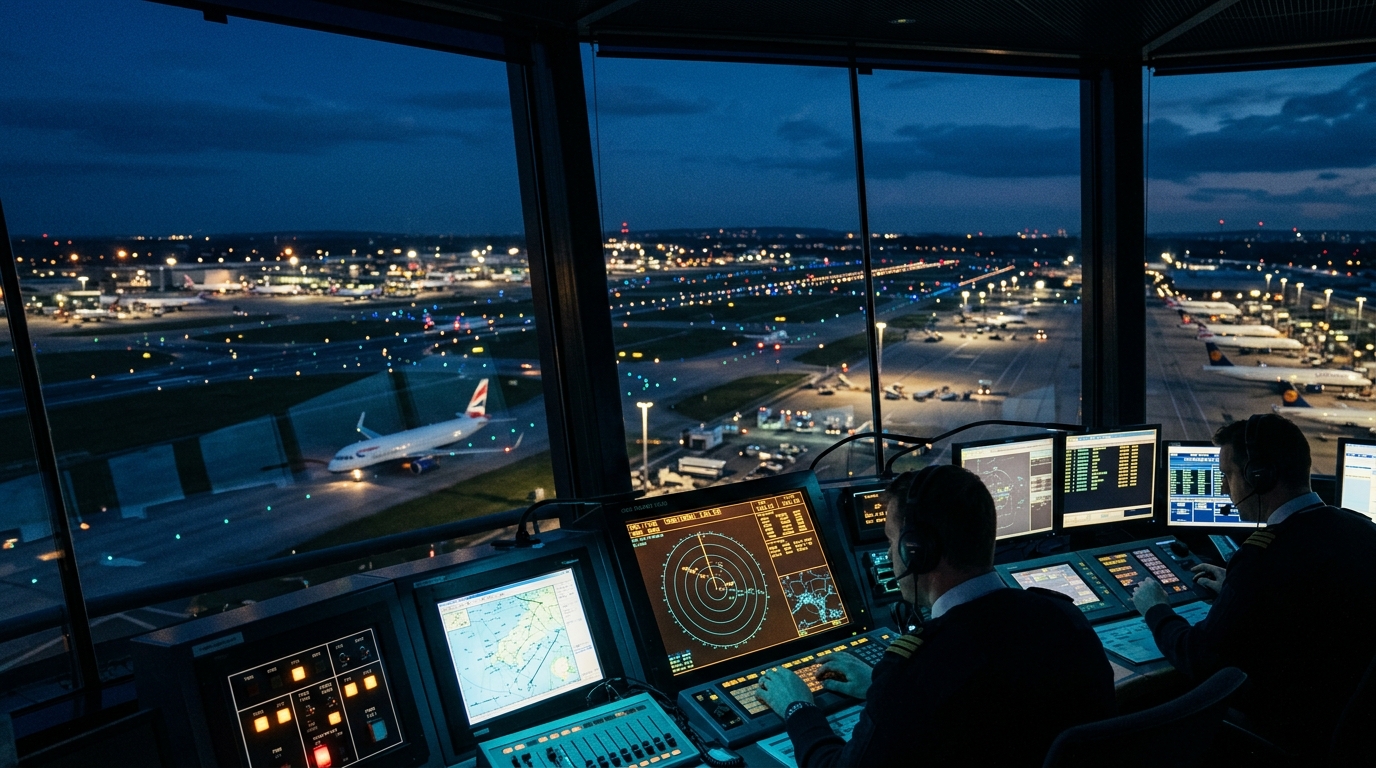
The ATC tower is the hub of the airport's communication. Ground station suffixes like TOWER, GROUND, and DELIVERY explicitly define who you are talking to.
14.1 Why call signs
FIRST PRINCIPLES — ADDRESSING ON A PARTY LINE
VHF is a shared, simplex "party line": everyone hears everything. A call sign is the address that tells one specific station "this is for you" and tells everyone else "this is not for me". Every transmission therefore names who is being called and who is calling, so there can never be doubt about who must act.
14.2 Ground-station call signs — the suffix names the service
IN PLAIN TERMS
A ground station's call sign is the place name + a suffix, and the suffix tells you which service you have reached.
Ground Station Suffixes
Suffix
Service
Suffix
Service
DELIVERY
Clearance delivery
CONTROL
Area control centre
GROUND
Surface movement control
RADAR
Radar (general)
TOWER
Aerodrome control
DIRECTOR
Approach radar (final director)
APPROACH
Approach control
PRECISION
Precision approach radar (PAR)
DEPARTURE
Departure control
INFORMATION
Flight Information Service (FIS)
APRON
Apron management
RADIO
Aeronautical station (HF/communications)
Mnemonic — the ground flow
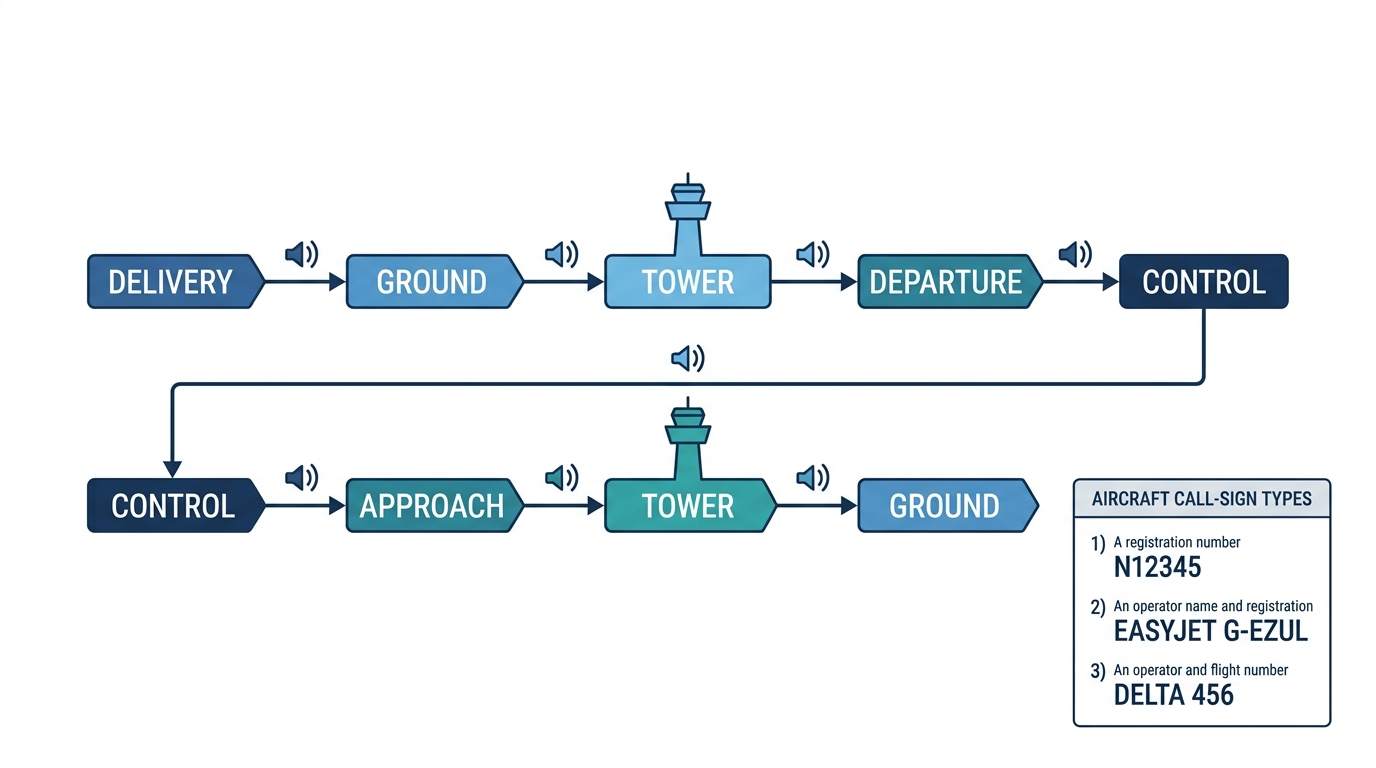
A departing flight typically walks through Delivery → Ground → Tower → Departure/Radar → Control; an arrival comes back Control → Approach/Director → Tower → Ground. Learn the suffixes in that running order.
Figure 14.1 — Who you talk to — the ground-station flow.
14.3 The three aircraft call-sign types
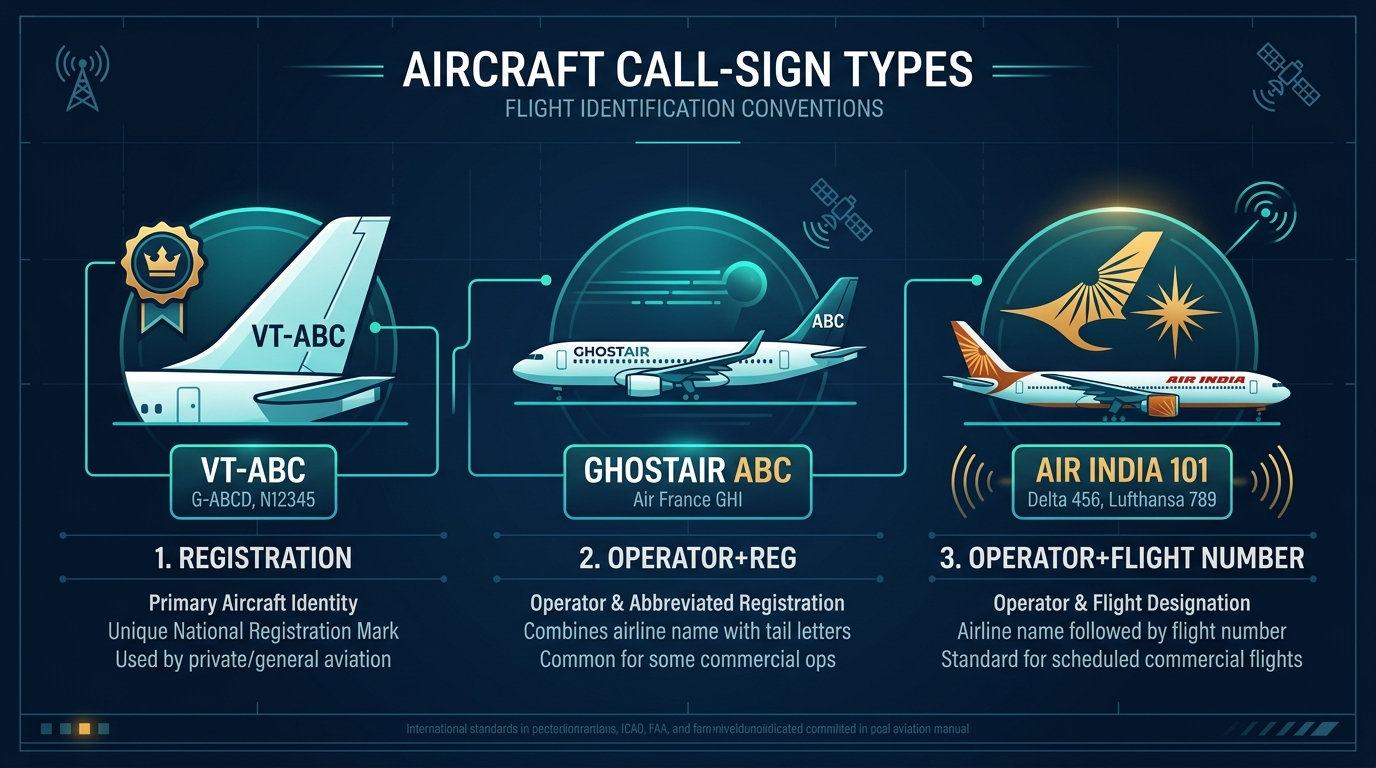
Type 1 — registration / type
The aircraft's registration spelled phonetically: VT-ABC → "Victor Tango Alfa Bravo Charlie". A general-aviation aircraft may prefix the manufacturer/type for the first call: "Cessna Victor Tango Alfa Bravo Charlie".
Type 2 — operator + last characters of registration
The telephony designator of the operator followed by the last characters of the registration: e.g. operator "GHOSTAIR" + registration ...ABC → "Ghostair Alfa Bravo Charlie".
Type 3 — operator + flight number
The operator's telephony designator followed by the flight identification (number/letters): "Air India one zero one" for AIC101. This is the airline call sign you hear most. The flight number is spoken digit by digit.
The three types of aircraft call signs ensure there is a clear, standard way to address both small general aviation aircraft and large commercial airliners.
Exam trap
The telephony designator is not the IATA two-letter code; "AI" is written but spoken as the telephony name "Air India". And the flight number is read digit by digit — "one zero one", not "one hundred and one".
14.4 Abbreviation rules
When and how a call sign may be shortened
1. An aircraft call sign may be abbreviated only after the ground station has first abbreviated it — never on the pilot's initiative, and not at all if there is any risk of confusion with another similar call sign on frequency.
2. Type 1 (registration) abbreviates to the first character and at least the last two: "VT-ABC" → "Victor Tango … Bravo Charlie" or "V…BC".
3. Type 2/3 (operator + flight number) is not abbreviated — the flight number is kept in full.
Transcript — full then abbreviated
A/C Delhi Ground, Victor Tango Alfa Bravo Charlie, request taxi.
ATC Victor Tango Alfa Bravo Charlie, taxi to holding point Alfa One. (ground initiates full)
A/C Taxi holding point Alfa One, Victor Tango Bravo Charlie. (now abbreviated)
14.5 Establishing communication
The initial call
An initial call names (1) who you are calling, then (2) who you are, then keeps the first message brief. On a first contact you may state a short request; for a longer message, wait to be invited ("pass your message").
Transcript — establishing communication
A/C Delhi Approach, Ghostair Alfa Bravo Charlie.
ATC Ghostair Alfa Bravo Charlie, Delhi Approach, pass your message.
A/C Ghostair Alfa Bravo Charlie, Cessna 172, 15 miles north, FL080, inbound for landing, information Charlie.
ATC Ghostair Alfa Bravo Charlie, roger, descend FL060, QNH one zero one three.
A/C Descend FL060, QNH one zero one three, Ghostair Alfa Bravo Charlie.
Cockpit reality — listen before you call
Before that first call, listen out for a few seconds: you may learn the runway in use, the QNH and how busy the controller is, and you avoid transmitting over someone mid-clearance.
14.6 Transfer of communication
Being handed on
As you pass between sectors, ATC transfers you to the next frequency: "contact [station] on [frequency]". You read back the frequency, change over, and make a fresh initial call on the new frequency. "Monitor" means tune and listen out without calling immediately.
Transcript — transfer
ATC Ghostair Alfa Bravo Charlie, contact Delhi Tower one one eight decimal one.
A/C Delhi Tower one one eight decimal one, Ghostair Alfa Bravo Charlie.
A/C Delhi Tower, Ghostair Alfa Bravo Charlie, FL060 inbound. (new call on new frequency)
14.7 Mandatory read-back items
WHY READ-BACK EXISTS
A read-back closes the loop: the controller hears you repeat the instruction and can catch a mishearing before it becomes an incident. Certain safety-critical items must always be read back in full.
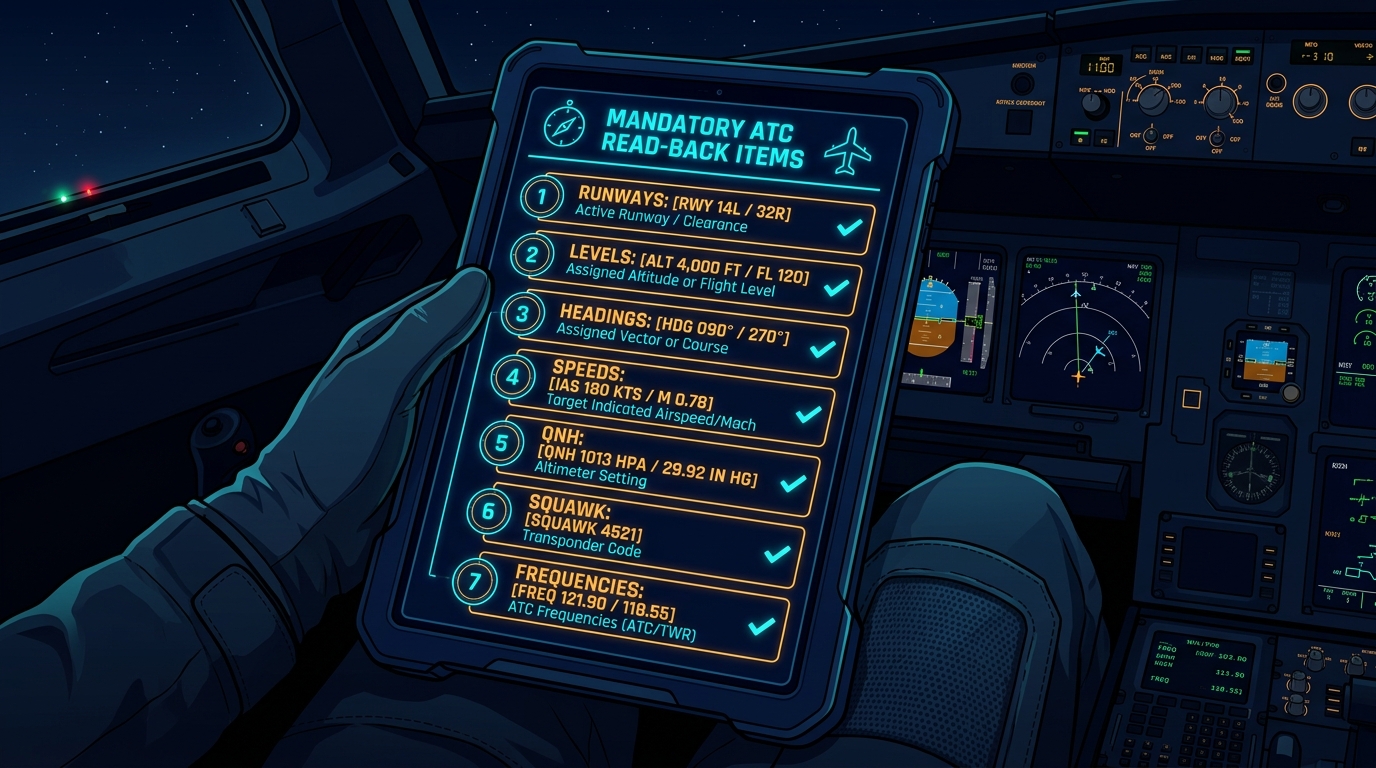
Always read back
ATC route clearances
clearances to enter, land on, take off from, backtrack, cross or hold short of any runway
runway in use
level instructions
heading and speed instructions
altimeter (QNH/QFE) settings
SSR (squawk) codes
frequency changes
VDF information and transition levels.
Mnemonic
"Runways, Levels, Headings, Speeds, QNH, Squawk, Frequencies" — if it's one of these, read it back in full. End the read-back with your call sign.
A pilot's mental checklist for read-backs ensures no safety-critical instruction is ever glossed over.
14.8 Test (radio-check) procedure
Transcript — radio check
A/C Delhi Tower, VT-ABC, radio check on one one eight decimal one.
ATC VT-ABC, Delhi Tower, readability five.
A/C VT-ABC, readability five also, thank you.
Reporting readability
State the readability on the 1–5 scale (1 unreadable … 5 perfectly readable). If readability is poor, the receiving station may say "readability three, you are broken/distorted", prompting a frequency or equipment check.
☆ Numbers to memorise
Essential Facts for Chapter 14
Fact
Value
Ground suffixes
Delivery · Ground · Tower · Approach · Departure · Director · Radar · Control · Information
Only after ATC abbreviates; Type 1 → first + last two; never abbreviate the flight number
Initial call
Who you call → who you are → brief message / request
Transfer
"Contact [station] [freq]" → read back freq → new call
Always read back
Runways, levels, headings, speeds, QNH, squawk, frequency changes
Radio check
Readability 1–5
Question bank
Part A — MCQs (click an option to check)
1. The ground-station suffix "GROUND" denotes:
Area control
Surface movement control
Approach control
Flight information
Answer: Surface movement control. GROUND = surface movement control (taxi); TOWER = aerodrome control.
2. "DIRECTOR" is associated with:
Apron management
Approach radar (final vectoring)
Clearance delivery
Area control
Answer: Approach radar (final vectoring). Director provides final approach radar vectoring.
3. The suffix for Flight Information Service is:
CONTROL
RADAR
INFORMATION
TOWER
Answer: INFORMATION. INFORMATION denotes the Flight Information Service.
4. An airline flight AIC101 is spoken as:
"A-I-C one hundred one"
"Air India one zero one"
"AI one zero one"
"Air India one hundred and one"
Answer: "Air India one zero one". Telephony designator + flight number digit by digit: "Air India one zero one".
5. An aircraft call sign may be abbreviated:
Whenever the pilot wishes
Only after the ground station has first abbreviated it
Never
Only on initial contact
Answer: Only after the ground station has first abbreviated it. The pilot may abbreviate only once ATC has done so, and not if confusion is possible.
6. Type 1 call sign VT-ABC abbreviates to:
"VT-A"
First character and at least the last two — e.g. "Victor … Bravo Charlie"
"ABC"
It cannot be abbreviated
Answer: First character and at least the last two. Registration call signs shorten to the first plus at least the last two characters.
7. An airline (operator + flight number) call sign is abbreviated by:
Dropping the operator name
Shortening the flight number
It is not abbreviated — the flight number is kept in full
Using the IATA code
Answer: It is not abbreviated. Operator + flight-number call signs are not abbreviated.
8. An initial call should give, in order:
Your request, then your call sign
Who you are calling, then who you are
The frequency, then your message
Your altitude, then your heading
Answer: Who you are calling, then who you are. Name the station being called first, then your own call sign.
9. "Pass your message" means:
Change frequency
Go ahead with your message / request
Standby
Read back
Answer: Go ahead with your message / request. It invites the aircraft to transmit its full message.
10. On a transfer of communication, ATC says:
"Squawk ident"
"Contact [station] on [frequency]"
"Report ready"
"Cleared to land"
Answer: "Contact [station] on [frequency]". A transfer instructs you to contact the next unit on a stated frequency.
11. "Monitor [frequency]" means:
Call immediately
Tune and listen out, without calling immediately
Squawk the code
Change runway
Answer: Tune and listen out, without calling immediately. MONITOR = listen out on the frequency without an immediate call.
12. Which of the following must always be read back?
Traffic information
A runway clearance (enter/land/take off/cross/hold short)
A weather report
A position report
Answer: A runway clearance. Runway clearances are mandatory read-back items.
13. A squawk code is:
Not read back
A mandatory read-back item
Only read back at night
Read back as a whole number
Answer: A mandatory read-back item. SSR codes must be read back, digit by digit.
14. A read-back should normally end with:
"Over and out"
Your call sign
"Roger"
The frequency
Answer: Your call sign. Finish the read-back with your own call sign for positive identification.
15. A radio check reply of "readability three" means the signal is:
Perfectly readable
Readable but with difficulty
Unreadable
Readable
Answer: Readable but with difficulty. 3 = readable but with difficulty (1 unreadable, 5 perfectly readable).
16. The telephony designator spoken for an airline is:
The IATA two-letter code
The assigned telephony name (e.g. "Air India")
The aircraft registration
The flight number only
Answer: The assigned telephony name. The spoken designator is the telephony name, not the written two-letter code.
Part B — Oral / viva (tap to reveal model answers)
What does the suffix of a ground station's call sign tell you? Give examples.
Model Answer:
It identifies the service: Delivery (clearance), Ground (surface movement), Tower (aerodrome control), Approach, Departure, Director (final radar), Control (area), Information (FIS).
Describe the three types of aircraft call sign.
Model Answer:
Type 1 — the registration spelled phonetically (optionally with the type); Type 2 — the operator's telephony designator plus the last characters of the registration; Type 3 — the operator's telephony designator plus the flight number, spoken digit by digit.
When may an aircraft abbreviate its call sign, and how?
Model Answer:
Only after the ground station has first abbreviated it, and not if confusion with another call sign is possible. A registration call sign shortens to the first character and at least the last two; operator-plus-flight-number call signs are not abbreviated.
What information does an initial call contain?
Model Answer:
Who you are calling, then who you are, then a brief message or request; for a longer message you wait for "pass your message".
List the items that must always be read back.
Model Answer:
ATC route clearances; runway clearances (enter/land/take off/backtrack/cross/hold short); the runway in use; level, heading and speed instructions; altimeter settings; SSR codes; and frequency changes.
How do you carry out a radio check?
Model Answer:
Call the station with "radio check on [frequency]"; the station replies with your readability on the 1–5 scale, and you acknowledge with your own readability assessment.