Part I (vi) Licensing of radio apparatus · examination framework · key definitions (ICAO Annex 10)
Learning objectives — by the end of this chapter you will be able to…
- Define the RTR(A) licence, the privileges it grants, and the aeronautical mobile service it authorises you to operate in.
- Define aeronautical station, aircraft station and radiotelephony precisely, as the examiner expects.
- Describe the structure of the examination — the written/oral theory paper and the practical transmission test — and how each is scored.
- State the validity, attempts, exemptions and renewal rules (figures to be entered from the current CAR).
- Explain the layered legal framework — Act, Rules, CAR, ICAO Annex 10, ITU Radio Regulations — and how they interlock.
- Use the study system in this book and follow a structured study plan.
1.1 What the RTR(A) is — privileges & the service
1.2 The key definitions you must own
1.3 How the examination is built & scored
1.4 Validity, attempts, exemptions & renewal
1.5 The legal framework
1.6 Eligibility & the application process
1.7 What the examiner is really testing
1.8 How to use this book — the study system
1.9 A structured study plan
1.10 Exam-day strategy & common failure causes
1.1 What the RTR(A) is — privileges & the service
RTR(A) stands for Radio Telephone Operator (Restricted) — Aeronautical. It is the certificate that legally permits a person to operate an aircraft radio station and communicate by radiotelephony with air traffic services. The aircraft owns the radio; the RTR is what authorises you, the human, to press the transmit button on a live frequency and speak. Without it, a pilot may not exercise the radio privileges of a flight crew licence.
Radio spectrum is a shared, finite, safety-critical resource governed by international treaty. One untrained operator who blocks a distress call, transmits on the wrong frequency, or causes a runway incursion through a misunderstood clearance endangers everyone on that frequency. The State therefore requires every operator to demonstrate a defined minimum standard of regulatory knowledge, radio theory and disciplined phraseology before being licensed. The word "Restricted" signals that the privilege is confined to the aeronautical mobile service — you are licensed as an aircraft radio operator, not as a radio engineer or a general (e.g. maritime) operator.
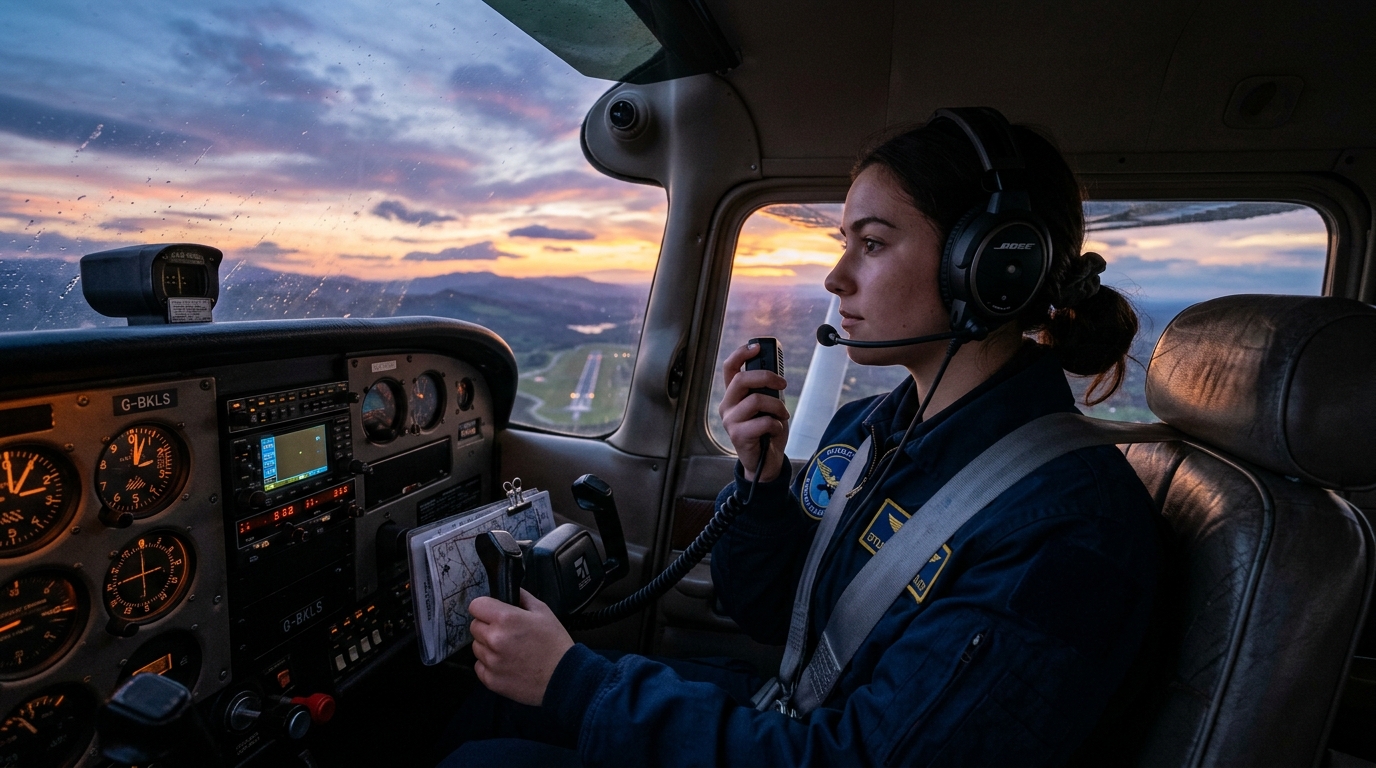
Privileges: to operate radiotelephone equipment in the aeronautical mobile service — transmitting and receiving voice communications with aeronautical (ground) stations and other aircraft, including handling distress, urgency and safety traffic.
Limitations: restricted to the aeronautical mobile service (not maritime/general); the holder operates equipment but is not certified to install or maintain it; operation is subject to the aircraft radio station being separately licensed (Chapter 3).
1.2 The key definitions you must own
The examiner frequently opens with a definition — "What is the aeronautical mobile service?" — because precise language is the foundation of safe radio work. Learn these word-for-word; they recur throughout the book.
Aeronautical Mobile Service (AMS): a mobile radiocommunication service between aircraft stations and aeronautical stations, or between aircraft stations, in which survival-craft and emergency position-indicating beacon stations may also participate.
Aeronautical Station: a land station in the aeronautical mobile service (e.g. an ATC or ground station). In certain cases it may be on board a ship or platform.
Aircraft Station: a mobile station in the aeronautical mobile service, located on board an aircraft (other than a survival-craft station).
Radiotelephony: a form of radiocommunication intended primarily for the exchange of information in the form of speech.
The AMS is sub-divided: AMS(R) — "Route" is reserved for communications relating to safety and regularity of flight along national or international civil air routes; AMS(OR) — "Off-Route" covers communications outside those routes. As an RTR(A) operator you work primarily in AMS(R).
Land station = Aeronautical; Aircraft station = Airborne. "Aeronautical is on the earth." Both live inside the Aeronautical Mobile Service because the aircraft end moves.
1.3 How the examination is built & scored
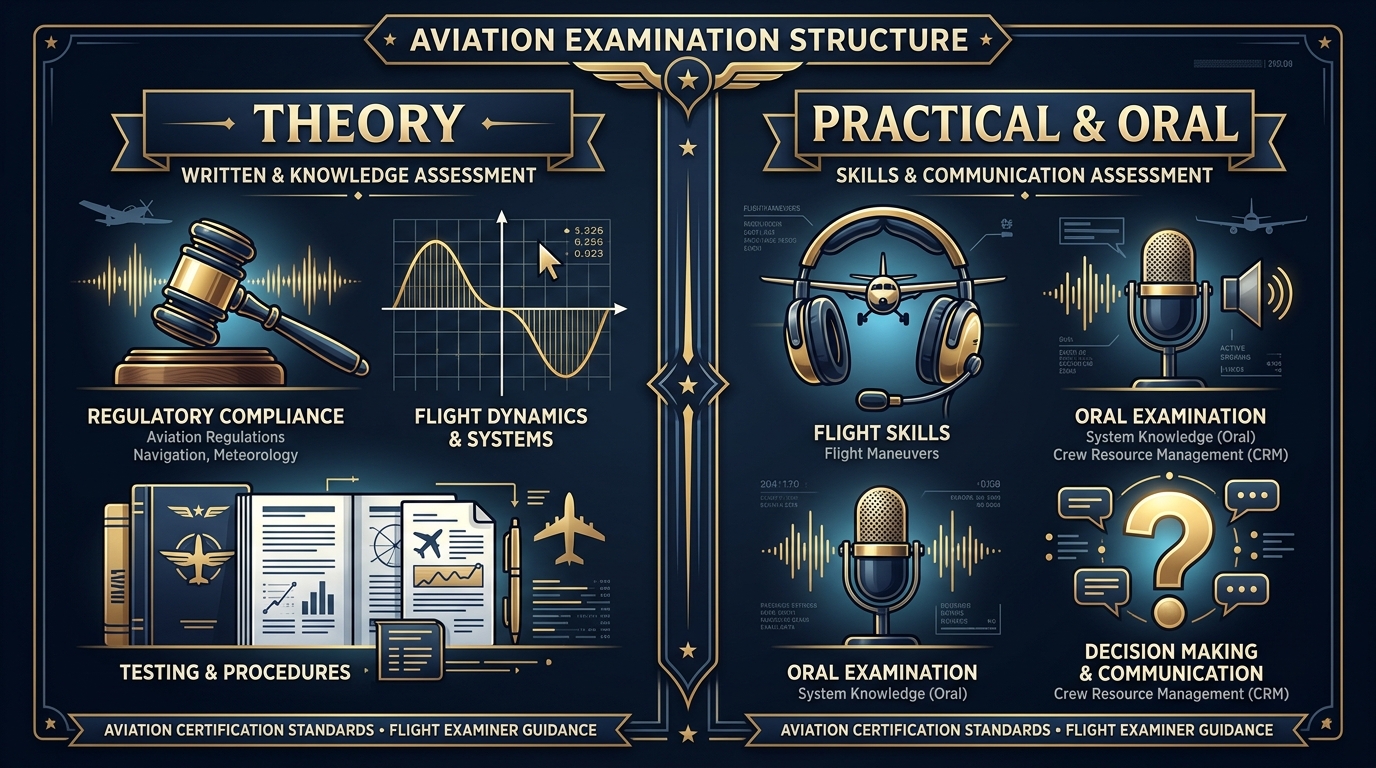
The RTR(A) is tested in two complementary halves. A theory examination (written and/or oral) checks your knowledge of regulations, radio principles and procedure. A practical test checks that you can actually operate — read a passage aloud, transmit and receive messages in correct phraseology, and answer the examiner's spoken questions on the spot.
1.4 Validity, attempts, exemptions & renewal
The theory paper — what it covers
The theory follows the CAR Section 7 syllabus and breaks into three knowledge blocks: (I) Aeronautical Telecommunication & Regulations; (II) Radio Principles & Practice; and (III) Radiotelephony procedures & phraseology. Questions are typically objective/short-answer; some centres also conduct an oral on the same material.
The practical & oral test — what it covers
Reading a printed passage clearly at a controlled pace; transmitting and receiving a set of messages using correct phonetic alphabet, numbers, phraseology and read-back; demonstrating distress/urgency handling; and answering spoken questions. This tests fluency under pressure, not just recall.
Reported section weighting on the theory paper is approximately:
Regulations & Procedure ≈ 30%, Radio Principles & Practice ≈ 40%, Radiotelephony ≈ 20%+. Exact total marks, the pass mark, and time allowed must be quoted from the current CAR — enter them below and in the table at 1.4.
Candidates over-invest in theory and under-prepare the oral/practical. Examiners fail more people on the spoken test, where nerves wreck phraseology and readability. Budget at least half your preparation for live transmission practice (Module C of this book).
Passing is governed by exact rules on how long a part-pass lasts, how many attempts you get, who is exempt, and how the licence is kept current. These are direct viva favourites and they govern your own paperwork — know the numbers cold.
| Item | Rule (enter exact figure from current CAR / Rules 2025) |
|---|---|
| Validity of a part-pass | A cleared part is valid for a fixed window within which the remaining part must be passed — insert exact period. |
| Number of attempts / re-sit interval | Insert permitted attempts and minimum gap between attempts. |
| Pass mark (each part) | Insert minimum percentage. |
| Minimum age | Insert minimum age to hold the licence. |
| Exemptions | Insert categories exempt from part of the exam (e.g. holders of certain higher RTF qualifications or flight crew licences). |
| Validity & renewal of the licence | Insert the licence validity period and any renewal/currency requirement. |
1.5 The legal framework
Authority over your radio licence flows downward through nested layers. The Act is the top-level national statute; the Rules are the detailed mechanics made under it; the CAR is the regulator's operating requirement that turns the rules into a syllabus and procedure. Above the national layer sit two international foundations: ICAO Annex 10 (the technical standards for aeronautical telecommunications) and the ITU Radio Regulations (the global allocation of spectrum). India's national law gives domestic legal force to these international standards.
| Layer | Instrument | What it does |
|---|---|---|
| International (spectrum) | ITU Radio Regulations | Allocates the radio-frequency bands aviation may use |
| International (aviation) | ICAO Annex 10 | Standards & Recommended Practices for aeronautical telecommunications |
| National Act | Bharatiya Vayuyan Adhiniyam, 2024 | India's principal civil aviation statute |
| National Rules | RTR (Restricted) Rules, 2025 | Create & govern the RTR licence and examination |
| Requirement | CAR Section 7, Series G, Part VI | The examinable syllabus & procedure |
Remember "A Real Carrier": Act (Vayuyan Adhiniyam) → Rules (RTR Restricted 2025) → CAR (Section 7). Broad to specific, top to bottom — just like a transmitter narrowing a big idea down to one exact frequency.
🔍 Deep dive — why a new Act and Rules appeared in 2024–25
India modernised its aviation statute, replacing the long-standing Aircraft Act, 1934 framework with the Bharatiya Vayuyan Adhiniyam, 2024, and refreshed the subordinate rules — including RTR licensing — in 2025. For the exam the practical takeaway is simple: cite the current Act and Rules by name. Quoting a repealed Act marks a candidate as out of date, and is exactly why second-hand notes are risky — the legal citations age fast even when the radio physics does not.
1.6 Eligibility & the application process
1. Meet the eligibility (minimum age; any prescribed nationality/identity requirements).
2. Apply to the examining authority with the required form, fee, photographs and identity/age proof.
3. Sit the theory examination (and oral where conducted).
4. Sit the practical & oral transmission test.
5. On passing both within the validity window, the licence is issued.
6. Maintain currency/renewal as required.
1.7 What the examiner is really testing
Behind every question sits one of five competencies. Frame your study around them, not just around topics:
| Competency | What it looks like in the exam | Where in this book |
|---|---|---|
| Regulatory knowledge | Bodies, licences, NOTAM/AIP, definitions | Module A (Ch 1–6) |
| Radio theory | Electrical, bands, propagation, modulation, equipment, nav aids | Module B (Ch 7–12) |
| Phraseology fluency | Phonetics, numbers, call signs, ATC scripts | Module C (Ch 13–22) |
| Readability & delivery | Clear, paced, correct pronunciation on the practical | Module C + practice |
| Emergency handling | Distress/urgency, comms failure, the right word at the right time | Ch 20 |

1.8 How to use this book — the study system
Every chapter is built the same way, so once you learn the pattern here you move fast everywhere. Watch for these coloured boxes — each has a job:
The exact wording to recite. Blue = "say it like this."
Hard figures — frequencies, distances, percentages. Teal = "memorise this."
A step-by-step sequence done in order. Green = "do it in this order."
A problem solved end-to-end. Indigo = "follow the working."
A common mistake or examiner favourite. Orange = "don't fall for this."
A memory hook for sticky facts. Purple = "remember it this way."
How the rule plays out in flight. Pink = "why it matters in the air."
Inside the text you'll also meet the three-pass method on each concept — In plain terms, then Why it works, then the exact figure or rule. Collapsible 🔍 Deep dives are optional enrichment. Every chapter ends with a question bank (MCQs + viva, and numerical problems where relevant) and a revision card.

1.9 A structured study plan
Treat theory and practical in parallel — never leave the practical to the last week.
| Week | Theory focus | Practical drill (in parallel) |
|---|---|---|
| 1 | Ch 1–2 — exam, bodies, framework | Phonetic alphabet & numbers daily |
| 2 | Ch 3–4 — licensing, Q-codes | Time, standard words, radio checks |
| 3 | Ch 5–6 — FIR/AIS/NOTAM, met codes | Decode METAR/TAF aloud; ATIS read-back |
| 4 | Ch 7–8 — electrical, frequency bands | Call signs & initial contact |
| 5 | Ch 9–10 — propagation, modulation | Taxi/clearance phraseology |
| 6 | Ch 11–12 — equipment, nav aids | Departure/circuit/approach scripts |
| 7 | Ch 13–18 — phraseology & control | Full message exchanges; distress drills |
| 8 | Ch 19–24 — revision & mock papers | Mock practical & oral under timed pressure |
On your first solo radio call your mouth goes dry and your mind blanks. The pilots who stay calm are the ones who drilled the pattern until it was automatic. The quizzes and revision cards exist for that — not merely to pass the exam, but so the right words come out when the frequency is busy and the pressure is real.
1.10 Exam-day strategy & common failure causes
Aim for 8/10 on every chapter's self-test before moving on; re-drill the "Numbers to Memorise" tables until automatic; and speak the phraseology out loud daily — silent reading does not build the spoken fluency the practical demands.
Theory: read every question fully before answering; do the ones you know first; never leave objective questions blank; watch the units. Practical: listen, then press, pause, speak, release; control your pace; use full standard phraseology and read back correctly; if you fumble, say "correction" and continue calmly.
1. Neglecting the practical/oral.
2. Guessing exact regulatory figures (validity, pass mark, frequencies).
3. Confusing look-alike facts (ICAO vs IATA, QNH vs QFE, 121.5 vs 243.0).
4. Poor readability — too fast, mumbled, wrong pronunciation.
5. Freezing on distress phraseology.
Every one is fixed by drilling, not cramming.
☆ Numbers to memorise
| Fact | Value |
|---|---|
| Licence | RTR(A) — Radio Telephone Operator (Restricted), Aeronautical |
| Service authorised | Aeronautical Mobile Service — primarily AMS(R) |
| Aeronautical station | A land station in the AMS |
| Aircraft station | A mobile station in the AMS aboard an aircraft |
| Governing Act / Rules | Bharatiya Vayuyan Adhiniyam 2024 / RTR (Restricted) Rules 2025 |
| Syllabus source | CAR Section 7, Series G, Part VI |
| International foundations | ICAO Annex 10 (telecom standards) · ITU Radio Regulations (spectrum) |
| Pass mark / validity / attempts | Author to insert from current CAR |
Part A — MCQs (click an option to check)
Part B — Oral / viva (tap to reveal model answers)
60-SECOND REVISION CARD
- RTR(A) = operator's licence for the aircraft radio, restricted to the Aeronautical Mobile Service (mainly AMS(R)).
- Aeronautical station = land; Aircraft station = airborne; Radiotelephony = communication by speech.
- Exam = theory (regs / radio principles / RTF) + practical & oral; pass both. The oral fails most people.
- Law stack: Act 2024 → Rules 2025 → CAR Sec 7; foundations ICAO Annex 10 + ITU Radio Regs.
- Insert & memorise the exact pass mark, validity, attempts, age from the current CAR.