Human Performance & Limitations · Module C — The Thin AirHypoxia
Chapter 6 — The single most-tested block in the paper, and a killer that gives no warning: the four types of hypoxia, its insidious stages, and the altitude thresholds every pilot must know.
Plate 6.0 — The silent killer. By the time hypoxia is felt, judgment is already gone — which is why it is recognised, not sensed.
§ 10HYPOXIA
Technical definition — "cerebral hypoxia"
The term cerebral hypoxia technically refers to lack of oxygen supply to the cerebral hemispheres (the outer portion of the brain). However, it is more typically used to refer to a lack of oxygen supply to the entire brain.
10.1 Why Hypoxia Matters to a Pilot
Two ways the body can be starved of oxygen
The body's organs and tissues may be deprived of the oxygen they need because of illness or disease.
But the pilot must know that oxygen deprivation or hypoxia can be caused by breathing air at low pressures at high altitude.
This second category — altitude-induced hypoxia — is the aviator's main concern, and the form most commonly tested in DGCA exams.
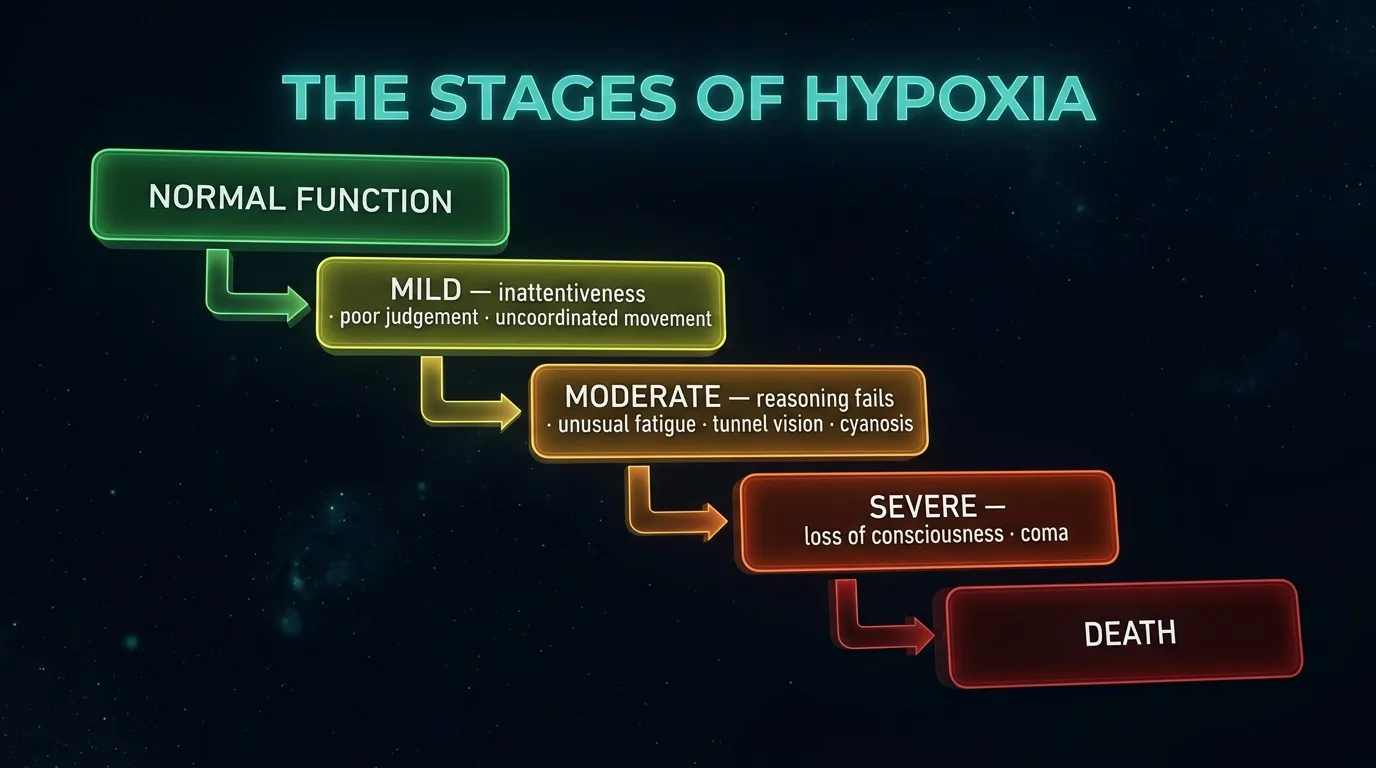
Effect on the pilot — direct quote, memoriseHypoxia will cause a pilot's intellectual and sensory judgment to become impaired. In mild cases, hypoxia causes only:
Inattentiveness,
Poor judgment, and
Uncoordinated movement.
10.2 Stages & Clinical Course — from "tipsy" to lethal
Severe cases — the cascade to deathSevere cases result in a state of complete unawareness and unresponsiveness (coma) — brain-stem reflexes, including response to light and the breathing reflex, stop. Only blood pressure and heart function are maintained. If this persists, brain death is inevitable.
If the lack of oxygen to the brain is limited to a very brief period of time, coma may be reversible with varying levels of return to function, depending on the extent of injury. Sometimes seizures may occur, which may be continuous with no stop between them — a condition called STATUS EPILEPTICUS.
Serious oxygen deprivation can kill a pilot within minutes.
Figure 6.2 — The clinical course of hypoxia, from normal function through mild and moderate to coma and death.
Onset characteristic — note the word "insidious"
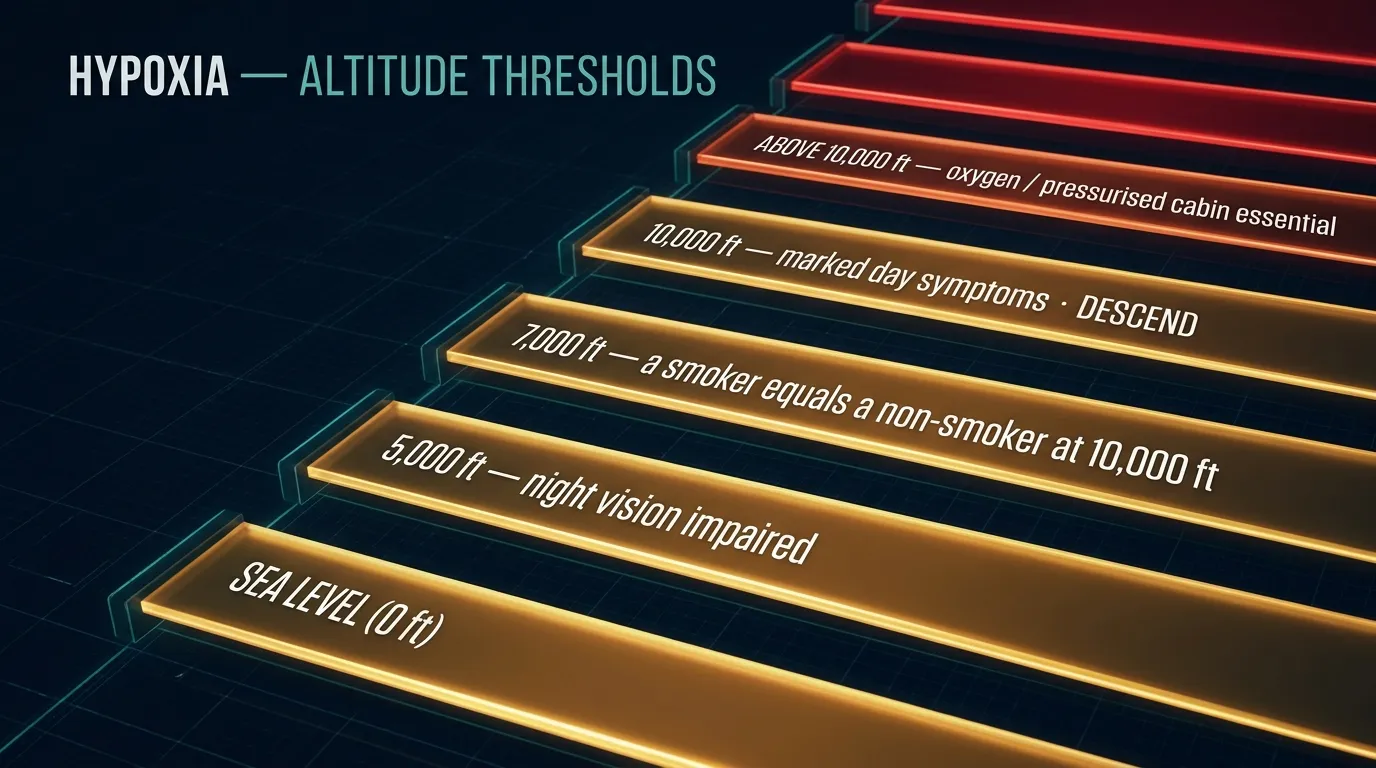
The symptoms are slow but progressive, insidious in onset, and are most marked at altitudes starting above 10,000 ft (3,500 m). Night vision, however, can be impaired starting at altitudes 5,000 ft.
"Insidious" means it sneaks up on you. You will not realise you are hypoxic — that is the entire problem. Your buddy in the right seat may notice it before you do.
Why "euphoria" is the most dangerous early symptom
The onset of hypoxia may be accompanied by a feeling of well-being, known as EUPHORIA. The pilot feels good — even great — and is therefore the last person in the cockpit who will suspect anything is wrong. This is why CRM and crew cross-checks are critical above 10,000 ft.
10.3 The FOUR Types of Hypoxia
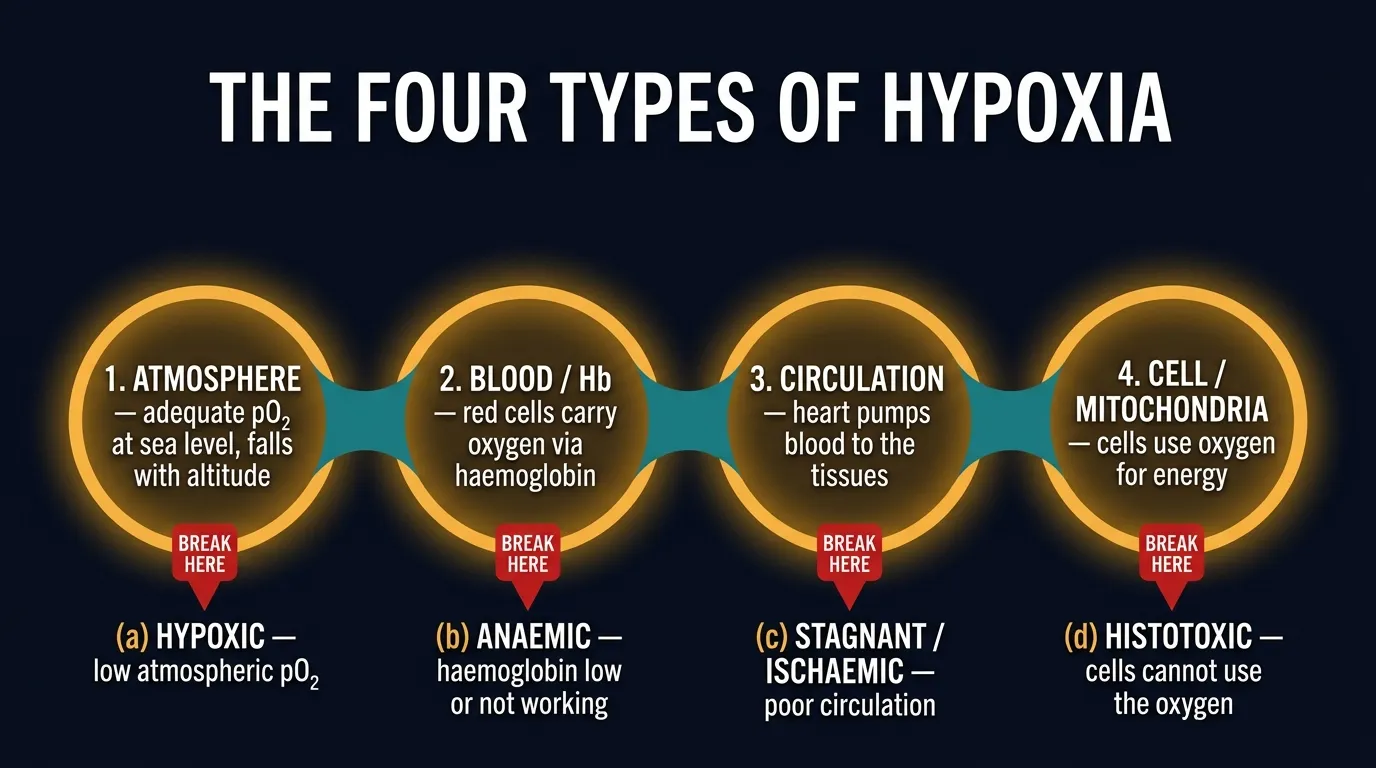
Classification — opening line of every DGCA hypoxia questionHYPOXIA IS CLASSIFIED INTO FOUR DIFFERENT TYPES:
TYPE (a)
Hypoxic Hypoxia
Cause: low oxygen levels in the bloodstream.
The pilot's type: in pilots, this most often occurs with exposure to altitude — hypobaric hypoxia. At low altitudes the partial pressure of oxygen is adequate to maintain brain function at peak efficiency. Atmospheric pressure and the partial pressure of oxygen both decline at higher altitudes.
TYPE (b)
Anemic Hypoxia
Cause: blood cannot carry enough oxygen even though atmospheric oxygen may be plentiful. Oxygen in blood is carried by haemoglobin, which is found in red blood cells. When the RBC count decreases, or the haemoglobin does not function properly, less oxygen can be carried by the blood.
Occurs in: heavy bleeding · some cancers · sickle-cell anemia · carbon monoxide poisoning, to name a few. Symptoms: breathlessness, fatigue, chest pain — and they worsen at higher altitudes, as the effects of hypoxia and anemia are additive.
TYPE (c)
Ischemic / Stagnant Hypoxia
"Ischemia" = inadequate supply of blood. Ischemic hypoxia occurs when there is inadequate blood flow to body tissues.
Occurs in:
Constriction of blood vessels (e.g. fingers and toes exposed to cold).
Low blood pressure / low cardiac output such as fainting.
Exposure to high sustained accelerations like excessive G-forces (stagnant hypoxia).
Oxygen therapy is not very helpful in this form. The best remedy is to correct the underlying cause.
TYPE (d)
Histotoxic Hypoxia
Cause: the inability of the cells of the body to use the oxygen available. The oxygen is there in the blood, in the tissues — but the cells can't metabolise it.
Rare in pilots, but can occur with:
Cyanide poisoning,
Chemical poisoning,
Intoxication with certain drugs.
Can also be caused by HIGH BLOOD ALCOHOL LEVELS. (Direct link to §14 in Part 4.)
The DGCA syllabus consolidates Hypoxia management into one master tabulation of all causes, all symptoms, and the immediate actions if hypoxia is suspected. This is reproduced verbatim below.
A tobacco smoker is likely to experience the effects of hypoxia at a lower altitude than a non-smoker
The symptoms are slow but progressive, insidious in onset, and are most marked at altitudes starting above 10,000 ft (3,500 m). Night vision can be impaired starting at altitudes 5,000 ft.
Its onset may be accompanied by a feeling of well-being, known as EUPHORIA.
Even minor hypoxia impairs night vision and slows reaction time.
More serious hypoxia interferes with reasoning, gives rise to unusual fatigue and, finally, results in loss of consciousness / death.
Impaired Judgment
Headache
Tingling in hands & feet
Hyperventilation (yes, hypoxia can trigger hyperventilation)
Muscular Impairment
Memory Impairment
Sensory Loss
Tunnel Vision
Cyanosis (a bluing of the body extremities)
Formication (a feeling of ants under the skin)
Provide Oxygen.
Descend below 10,000 feet or Minimum Safe Altitude if it is higher than 10,000 ft.
Memorise — the IMMEDIATE-ACTION drill (a 2-step reflex)
PROVIDE OXYGEN — don the mask, 100 % flow, regulator to "EMERGENCY" if available.
DESCEND BELOW 10,000 ft (or below MSA — Minimum Safe Altitude — if MSA is higher than 10,000 ft).
This is the standard DGCA-examined answer. Do not over-elaborate in the exam — write these two steps in this order.
10.5 Altitude Thresholds & Night Vision
Night vision impairment from
5,000 ft
Day symptoms marked from
10,000 ft (3,500 m)
Action threshold — descend below
10,000 ft
Smoker effective altitude (recap)
≈ 7,000 ft
DGCA reasoning the examiner is testing
The reason the action threshold is 10,000 ft and not, say, 14,000 ft is because symptoms are most marked at altitudes starting above 10,000 ft (3,500 m). The reason supplemental O₂ is required at night above 5,000 ft in many jurisdictions is because night vision is impaired starting at 5,000 ft — the rod cells in the retina are extraordinarily sensitive to even mild hypoxia. (Vision pathophysiology is dealt with in a later part of this chapter.)