Human Performance & Limitations · Module E — The SensesThe Ear & Balance
Chapter 13 — The organ that both hears and keeps you upright: the three sections of the ear, the Eustachian tube and barotrauma, noise and hearing loss, and the vestibular balance system that illusions will later fool.
Plate 13.0 — Two instruments in one: the ear both hears the world and tells the brain which way is up.
§ 37THE EAR — Two Functions, Three Sections
DGCA-quoted — the two functions of the earThe ear performs two quite separate functions:
To receive vibrations or sound waves in the air which it transmits to the brain.
To act as a balance organ and acceleration director.
Why this distinction is critical
Most students think of the ear as the "hearing organ" only. The second function — balance — is arguably more important for pilots, because spatial disorientation kills pilots, hearing loss usually doesn't. The vestibular apparatus inside the inner ear (covered in §42–43) is what tells you which way is up — when it lies to you, you crash.
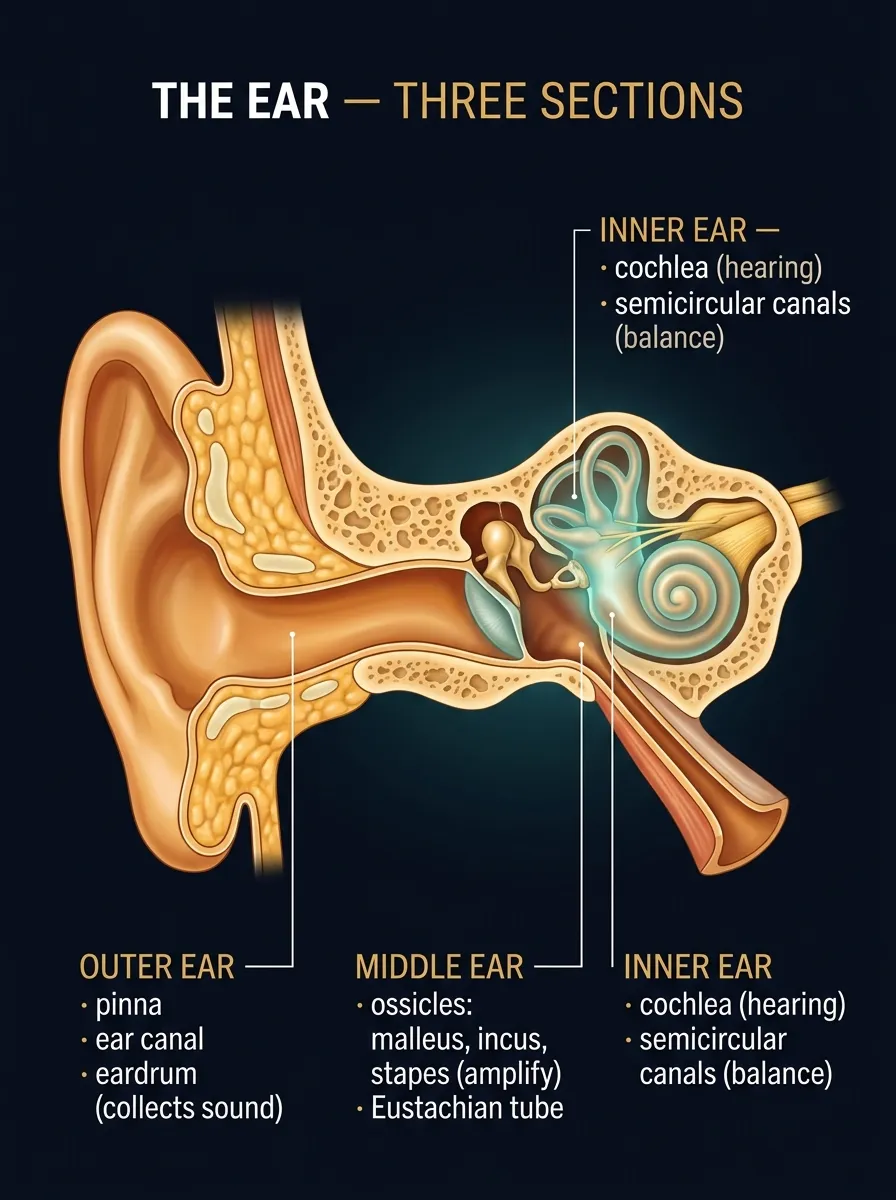
Figure 13.1 — The ear's three sections: outer (collects sound), middle (ossicles amplify), inner (cochlea hears, semicircular canals sense balance).
§ 38The Middle and Inner Ear · The Eustachian Tube
DGCA-quotedThe Tympanum and the Ossicles transmit sound waves to the inner ear.
The Tympanum is the eardrum. The Ossicles are the three smallest bones in the body — Malleus, Incus, Stapes (Hammer, Anvil, Stirrup). They form a tiny amplifying lever system that converts air pressure waves at the eardrum into mechanical motion at the oval window of the cochlea.
38.1 The Eustachian Tube — pressure equalisation
DGCA-quoted
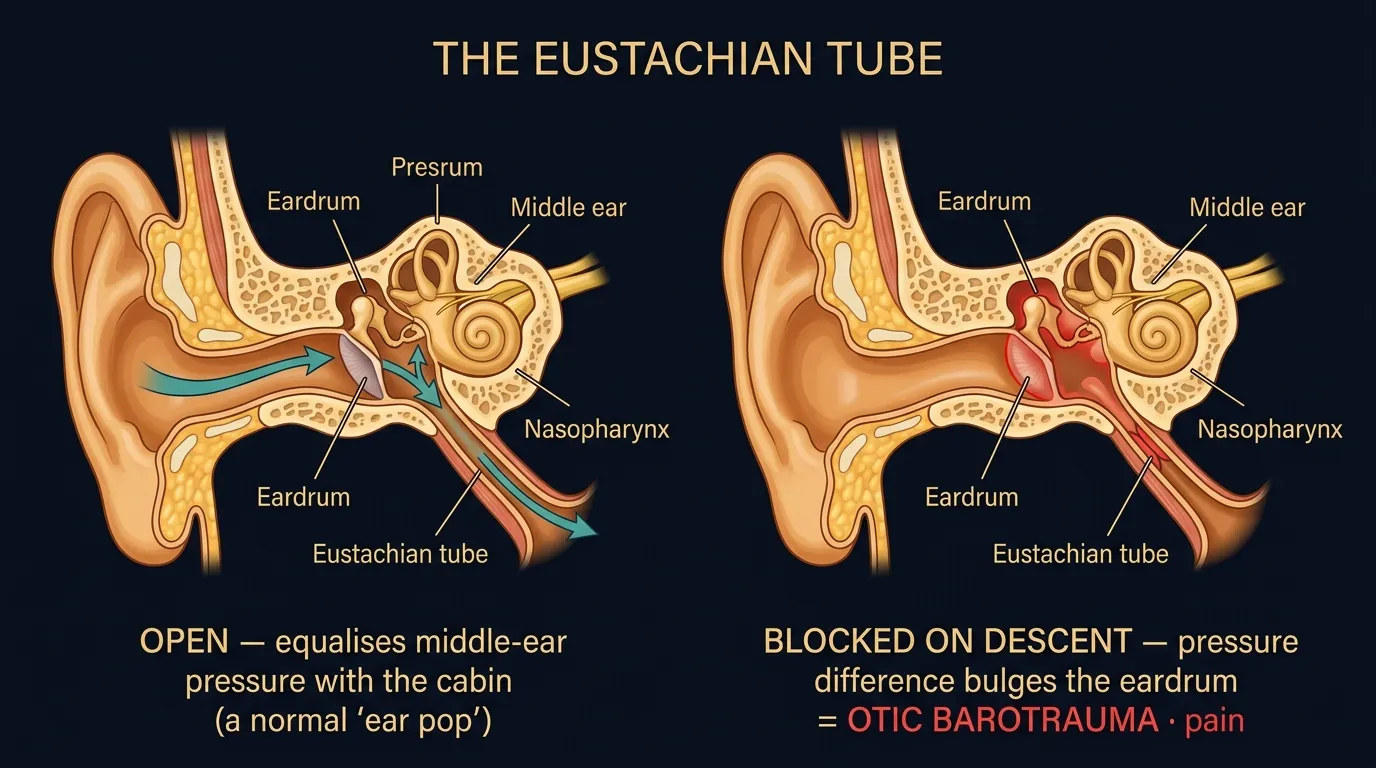
The Eustachian tube allows pressure in the middle ear to equalize across the ear drum with outside or ambient pressure when climbing or descending.
DGCA-quoted — the no-fly ruleNo one should fly if their Eustachian tube is blocked, and they cannot "clear" their ears.
38.2 Effects of Altitude Change — Clearing the Ears
DGCA-quoted — descent is the dangerous phaseIt is during DESCENT when difficulty in clearing the ears is most likely to be experienced.
Why descent — the one-way-valve effect
On climb, ambient pressure falls; the higher-pressure middle-ear air pushes outward through the Eustachian tube — this happens easily and automatically. On descent, ambient pressure rises; the now-relatively-lower-pressure middle-ear air must draw in through the Eustachian tube against gravity and tissue swelling. The tube tends to act like a one-way flap valve. If congested (cold, flu, sinusitis), it fails to open and the eardrum is pushed inward by external pressure — Otis Barotrauma.
38.3 Otis Barotrauma
DGCA-quoted definitionOtis Barotrauma — Stretching of the ear drum caused by the expansion and contraction of gases trapped in the inner ear by a blocked Eustachian tube.
DGCA-quoted clearing techniques + "step descent"
If you experience problems with pressure equalization during descent:
Swallow deliberately with the nostrils pinched closed,
Yawn,
or BLOW DOWN THE NOSE, again with the nostrils pinched closed. (This is the Valsalva manoeuvre.)
If the problem is not resolved, the rate of descent should be decreased or stopped at intervals to allow more time for pressure to equalize. This is also known as STEP DESCENT.
Pilot may resort to even CLIMB if pressure persists. Re-climbing reduces external pressure and helps un-block the tube.
Remember, never fly if your Eustachian tube becomes swollen or blocked and you cannot clear your ears.
Figure 13.2 — The Eustachian tube equalises middle-ear pressure with the cabin; a blocked tube on descent causes otic barotrauma.
§ 39Audible Range of the Human Ear
DGCA-quoted — sound has three main qualities
Pitch — which depends on the frequency of the vibration.
Loudness or Intensity — which depends on the amplitude of the vibrations.
Quality — which can be either harmonious or just plain noisy.
DGCA-quoted — frequency range
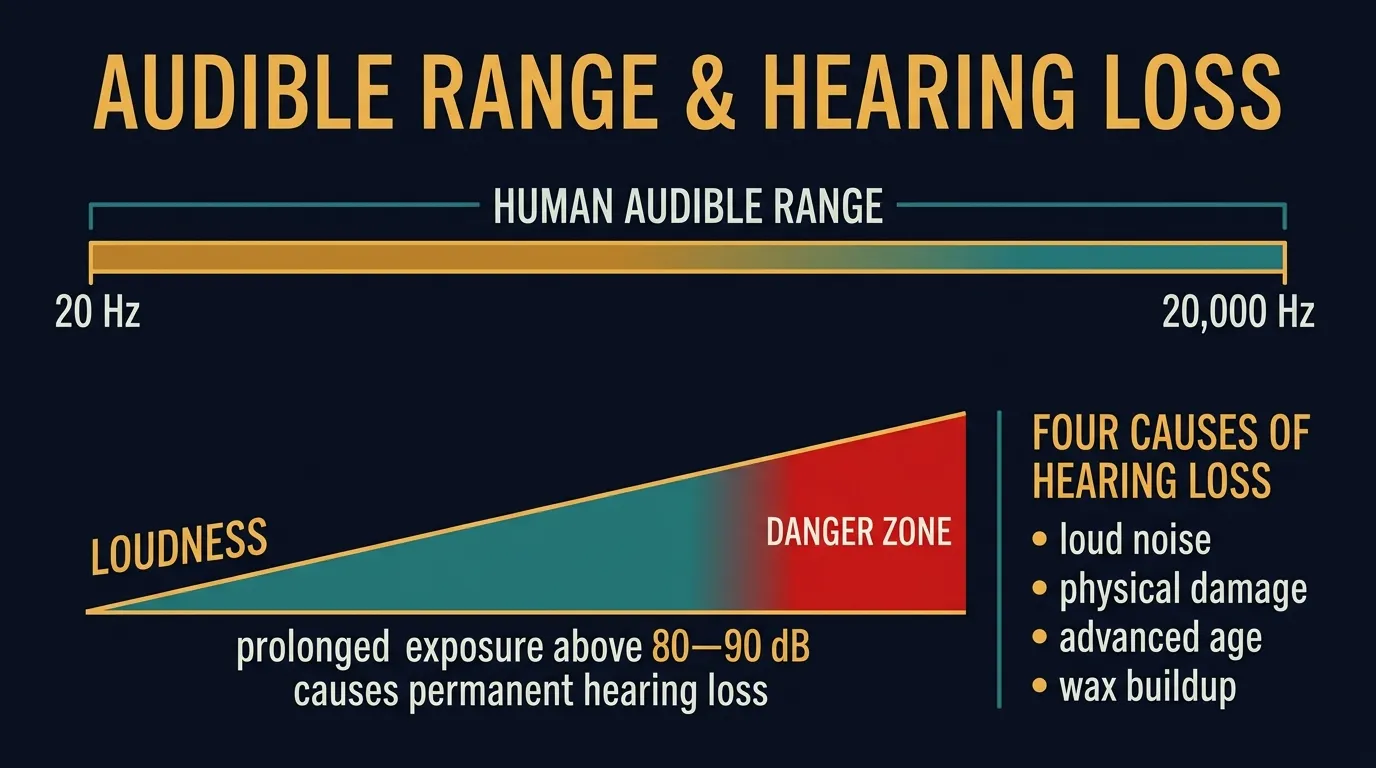
The range of pitch or frequency of sounds that a fit young person can hear lies between 16 and 20,000 Hertz, or cycles per second. Detectable sound range also depends on loudness.
Figure 13.4 — The audible range (20 Hz–20,000 Hz) and the noise thresholds: prolonged exposure above 80–90 dB causes permanent hearing loss.
DGCA-quoted — four causes of hearing impairmentHearing impairment can arise because of:
Exposure to loud noise.
Physical damage to the hearing mechanism.
Advanced age.
A buildup of wax.
40.1 Conductive Deafness
DGCA-quotedConductive Deafness — is caused by damage to the ossicles or the ear drum.
40.2 Noise-Induced Hearing Loss — the 80 / 90 dB thresholds
DGCA-quoted — exact dB thresholdsNoise Induced Hearing Loss:
> 80 dB — task performance may be impaired.
> 90 dB — measurable impairment of task performance.
DGCA-quoted — the counterintuitive "arousal" effectHowever, it has been shown that in some situations performance of VIGILANCE tasks can actually be BETTER in high noise levels than in low noise levels. This is because noise increases AROUSAL and can move the individual into the optimum performance area.
Any prolonged exposure to noise in excess of 90 dB can end up in noise-induced hearing loss. This can damage the very sensitive membrane in the cochlea.
40.3 Presbycusis — Hearing loss with age
DGCA-quotedPresbycusis — is the name given to the deterioration of hearing with advanced age. HIGH TONES are cut off FIRST.
Audible range young
16 – 20,000 Hz
Performance impaired above
80 dB
Measurable impairment above
90 dB
Conductive deafness — site
Ossicles / eardrum
Age-related hearing loss term
Presbycusis
Presbycusis — first to go
High tones
Noise damage site
Cochlear membrane
"Optimum" zone of noise-arousal
~ 70 – 80 dB (implied)
§ 41Protection of Hearing
DGCA-quotedNoise induced hearing loss can be avoided or reduced to a minimum by wearing suitable EAR PROTECTORS.
Always protect your ears if you know you are going to be exposed to excessive noise. In the cockpit, use the best quality HEADSET you can afford in order to reduce background noise.
Practical cockpit application
Active Noise Reduction (ANR) headsets — provide both passive (foam seal) and active (anti-phase electronic cancellation) noise attenuation. Reduce cockpit noise by 15–25 dB.
Maintenance crews on ramp — must use over-the-ear muffs near running engines (105–130 dB at engine intakes).
Earplugs alone — useful for passengers; usually inadequate for sustained cockpit duty.
Cumulative exposure — even short bursts of 130+ dB (gunfire, jet blast) can cause permanent damage. Each pilot's hearing is a non-renewable career asset.
§ 42The Ear and Balance · Orientation
DGCA-quoted definition"Orientation" refers to a human being's ability to maintain equilibrium and to interpret the body's position in space. The ear also provides us with our sense of balance.
DGCA-quoted — VISION is primaryThe primary and most reliable sense of spatial orientation is EYESIGHT.
The balance sensors situated in the ear provide us with a SECONDARY system.
Why this hierarchy matters
This is the single most important fact in spatial-disorientation training. The eyes are primary; the ear's balance organ is secondary. When the two disagree — as happens in IMC (Instrument Meteorological Conditions) where the eyes lose external reference — the pilot must trust the instruments (which calibrate to true vertical), not the inner ear (which lies). This is the foundational principle of IFR (Instrument Flight Rules).
§ 43THE BALANCE MECHANISM
43.1 Proprioception
DGCA-quoted definitionProprioception: is the awareness of the body in space. It is the use of joint position sense and joint motion sense to respond to stresses placed upon the body by alteration of posture and movement.
43.2 The Vestibular Apparatus — Otoliths & Semi-Circular Canals
DGCA-quoted — memorise the components & functions
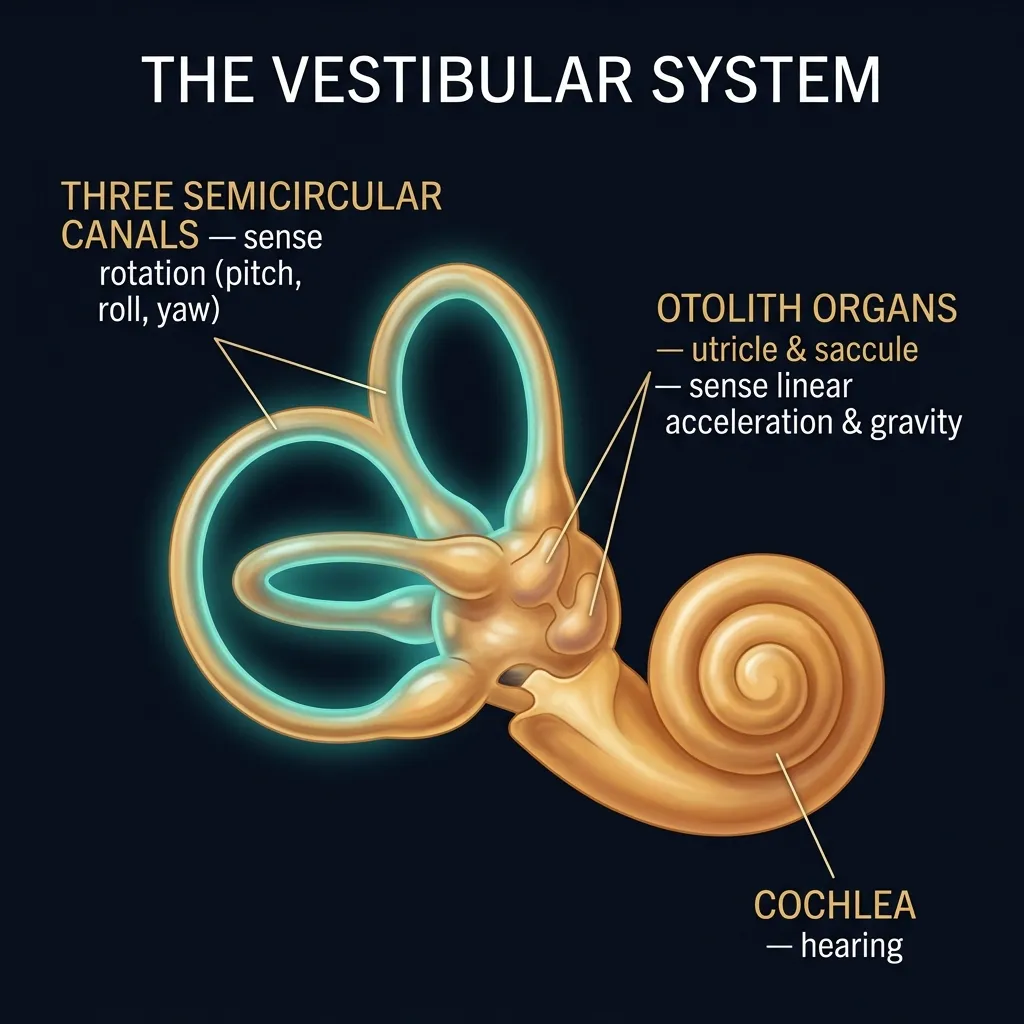
The Vestibular apparatus (Otoliths + Semi-circular canals) helps maintain spatial orientation.
The Otoliths detect LINEAR ACCELERATION.
The Semi-Circular Canals detect ANGULAR ACCELERATION.
OTOLITHS — linear acceleration
The otoliths are tiny calcium-carbonate crystals embedded in a gelatinous membrane sitting on top of hair cells in the utricle and saccule.
Sense linear acceleration: forward/back (takeoff, braking), up/down (turbulence, climb/dive)
Also sense gravity at rest (which way is "down")
Can be tricked by sustained acceleration → "somatogravic illusion" (Part 9)
SEMI-CIRCULAR CANALS — angular acceleration
Three fluid-filled loops at right angles to each other (one per axis: roll, pitch, yaw). Each ends in an ampulla containing a cupula with hair cells.
Sense angular acceleration: turning, pitching, rolling
Only respond to change in rotation, not steady rotation
Can be tricked by sustained turns → "the leans" / spiral dive illusion (Part 9)
43.3 The Three Orientation Factors — DGCA's "Big Three"
DGCA-quoted — the three factorsHuman beings maintain spatial orientation using a combination of three factors:
The sense of vision.
The Vestibular Apparatus.
The Somatosensory system ("seat of the pants" feeling) / G-Force.
Figure 13.3 — The balance mechanism: the three semicircular canals and otolith organs sense rotation and acceleration.
43.4 How Angular Acceleration is Sensed — DGCA-quoted
The fluid-flow mechanism
Both the Otoliths Organs and the Semi-Circular Canals send signals to our brain by means of impulses arising from the body being subjected to accelerations.
Fluid flow occurs when the body is subject to angular acceleration.
The flow takes place in the OPPOSITE direction to the acceleration, moving sensory hairs which send signals to the brain that the body is in motion.
The crucial failure mode — DGCA-quotedThere is NO FLUID FLOW when the body is at rest or if linear or turning movement is taking place at a STEADY SPEED. In these situations, the vestibular apparatus alone CANNOT DETECT MOTION.
Only the eyes and instruments tell a pilot that he is in a steady turn.
Why this is the foundation of "the leans"
In a steady-rate turn, the canal fluid catches up with the canal walls and stops flowing. The sensory hairs return to centre — the brain thinks "no turn is taking place". If the pilot then rolls out, the fluid now flows (in the opposite sense to the roll-out) → the brain interprets this as a turn in the opposite direction. The pilot, feeling that "wing-low" sensation, tends to re-roll back into the original turn = graveyard spiral. The cure: trust the attitude indicator, not the inner ear. (Detailed Part 9 — illusions.)